Cranberries & Yogurt

This is, admittedly, a rather odd title for a post, but in few minutes, you’ll see why.

Sugar is in everything, and so I decided I would try to make some cranberry sauce that has a good flavor, but is not filled with a cup of granulated white sugar.  I came across a number of recipes.  Some used stevia, the flavor of which I don’t like.  Others recommend aspartame or other synthetic sweeteners – all of these are horrid.  Sucralose is also suggested.  The fact is, I really don’t like the flavors of artificial or substitute sweeteners.  So, what is left?  A bit of research found some recipes using sweet cherries and cranberries, or adding apple sauce.  Orange flavoring via orange juice and zest.  Pineapple juice.  And honey, which is an easily digestible sweetener, and if not too strong, is okay with me!

So . . . I made up my own recipe for non-sugared cranberry sauce!

Cranberry Sauce Without Granulated Sugar

12 oz. cranberries
1 bosc pair, peeled and chopped
1/2 c. water
1/2 c. unsweetened apple sauce
zest and juice of 1 orange (I used a large navel orange)
2-4 T. honey

Simmer all the above together, and after cranberries have slowed their popping, pour in the juice of one orange, and its zest. Cook another 10 minutes on a low temperature. Sauce will be tart with a strong orange flavor. You may want to use less zest, or none, and just the juice. This is not a very cranberry sauce, but you do not want a sauce so sour your lips pucker!  Add some honey if you want (I added about 3 T – still tart, but not puckery – and I do like sour!).

Okay, now the yogurt part. Years ago I used to make my own yogurt. What? Yes, you can, and you can make it without an expensive yogurt maker. If you have a gas oven with a pilot light, there you go – home for your yogurt until done. My current stove is gas on top, electric inside, so I use an ice chest filled with a few bottles of boiling water to keep the yogurt warm, and I check on it periodically to make sure it is still warm. I let my yogurt set for 24 hours. Once done, you do need to cool it down so it won’t continue to ferment – too much is not a good thing.

There are two types of cultures for yogurt. Some are thermophilic, needing heat, and others are mesophilic, meaning room temperature is the best environment. I like Bulgarian yogurt, made with lactobacillus bulgaricus, and lactobacillus acidophilus. These days, with the increased knowledge about probiotics and prebiotics for gut health, it turns out that the acidophilus bifidus is not considered to be a “good” one for adults. Apparently breast fed babies gut flora is primarily acidophilus bifidus, but if it continues to flourish in the gut biome past weaning, it could set the individual up for digestive issues, such as celiac and other similar diseases. Here is a link to some interesting information about acidophilus bifidus.

So, I have some yogurt in my fridge.  It has bifidus in it.  A search for bifidus-free yogurt in the store to use as a starter yielded only one yogurt that does not have bifidus in it!  It is Siggi’s Sheep Yogurt, expensive, but bifidus free.  I bought some to use as a starter (it also tastes good!).  I also purchased a starter from Amazon for $8.00 which states it “contains live active bacteria like ”Lactobacillus delbrueckii subsp. Bulgaricus” and ”Streptococcus thermophilus” – there ya go!

My Yogurt Recipe

1 qt. whole milk
1/4 c. Siggi’s

Bring milk to simmer – hot to the touch. Watch on stove to be sure it does not burn, so stir it! Reduce to about 75 F. Take 1/2 c. cooled milk and whisk into the starter. Pour into 1 qt. container (or smaller containers, such as 2 pint jars, etc.). Place in ice chest filled with a few bottles of boiling water. Set aside to ferment for 24 hours.

Now you understand “Cranberries & Yogurt”!

Back to Work – Let the Stress Begin!

I had all of last week off – 10 days total – and in that time period we celebrated two Thanksgiving, did a whole lot of baking and cooking, saw friends and family.  In between, I managed to sketch and / or watercolor everyday.  In that time period, I had a lot of fun and found myself feeling really glad to be painting again.  Of course, some stuff was pure rubbish, but others produced a sense of satisfaction.  Even better, I could begin to see progress.  The connection between mind and hand and color and paper is beginning to return.

But now – can I keep this up?  Certainly not at the pace I was doing it.  But I have made a decision:  I will use my photos as the basis for sketches and paintings, and try to turn out two a week minimum, perhaps three.  When will I do it?  In the mornings, while I drink my coffee, and instead of looking at the depressing global situation, I’ll look at lines and colors instead.  Seems like a good deal, if you ask me!


Between Thanksgivings

Yesterday, here in the U.S., was Thanksgiving.  We celebrated it with a few members of our family out of town.  Tomorrow, members are coming here for the big family gathering, from east and south and west.  So, Wednesday we made pies, and today we set up the tabbouleh, tzatziki, zhuk, and marinating chicken for tomorrow’s feast.  Lots of chopping and such, along with a fun grocery trip to a market that sells all sorts of foods not seen in the ordinary middle class market . . . this one caters to Middle Eastern, Indian, Asian, and Mexican tastes, so there is a lot of fun and strange food to be had.  On top of it all, it’s so reasonably priced!  If you enjoy cooking, nothing like an exciting market and a family which loves good food.

So, did I spend my entire day prepping?  No, I didn’t.  I did some napping, had some coffee, edited some photos, and then had an epiphany:  I can use my photos for subject matter, whether sketching, ink-and-color, or pure watercolor.  I went through a few photos from our summer on the road throughout the Southwest and Western U.S., to places like Mesa Verde, Ft. Laramie, Yellowstone, and Teton National Forest.  Lots of wonderful things to see.  Now, a lot of wonderful things to recall with a drawing . . .

Photo from Fort Laramie in Wyoming:

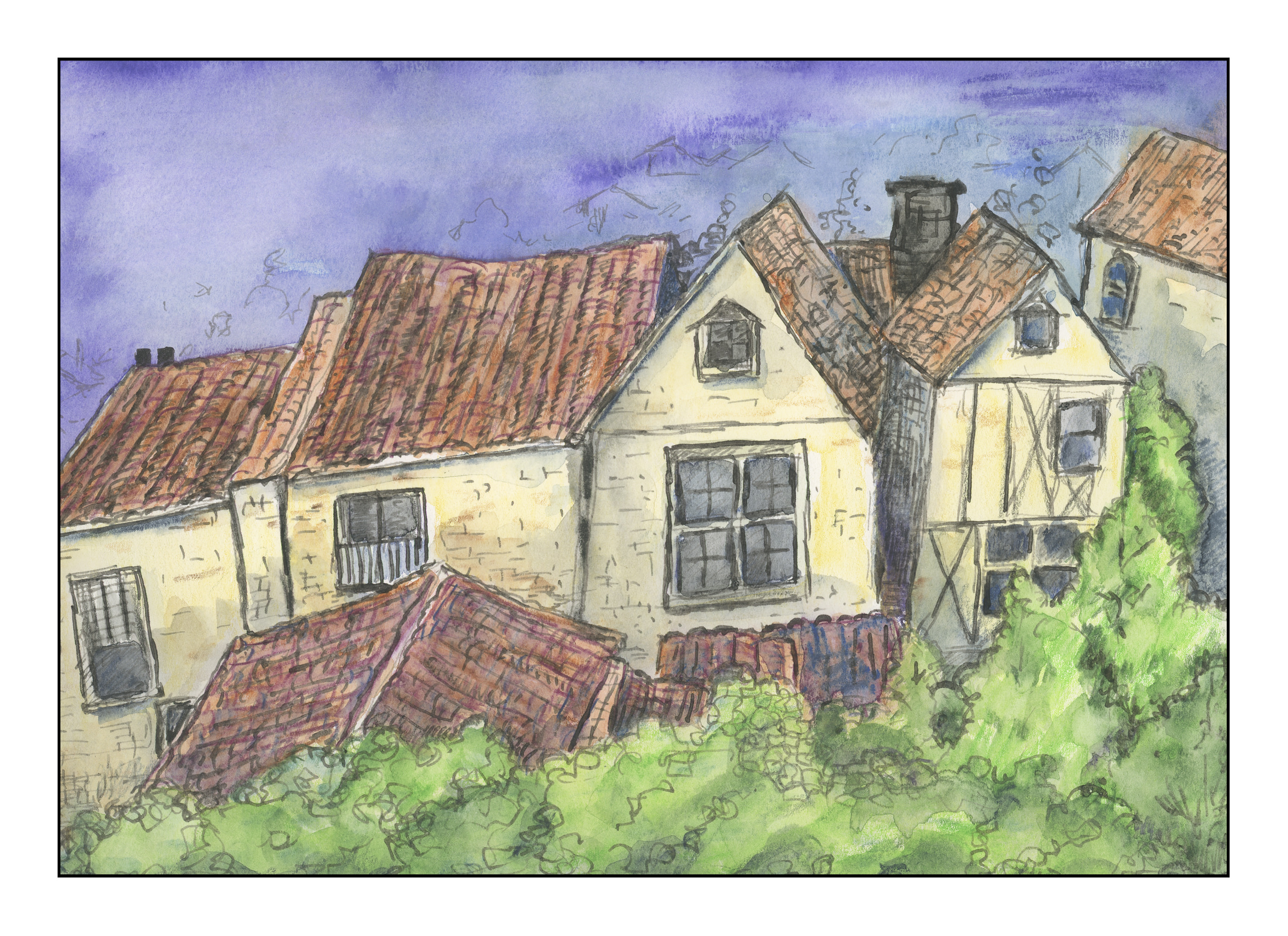
A quick ink-and-color sketch of the same:

They don’t really look like each other, but what the heck.  I liked the roof and chimneys against the blue of the sky.

Round Things: Highlights & Shadows

Painting light and dark – contrast – values – is a hard one for me in watercolor.  I want to do it wet-in-wet, but maybe layering will work better.  I just don’t know.  So, when in doubt, look to YouTube!

Here is one video I found that I think does a very good job on both highlights and shadow, discussing reflected light and so on.

Another video which is also good, with a look at only the shadows on a spherical object, discusses the use of analogous colors to create the shadow on the surface opposite the light source.  This video can be seen below.

Because I was having problems with making grapes believable (see here), I decided to research highlights, shadows, and round things.  These two videos proved very helpful.  Rather than describing them in detail, they are definitely worthwhile watching.  The top one addresses shape and shadows on the object, as well as the cast shadow.  The lower one uses analogous colors to deepen the shadow on the sphere itself, which keeps the color of the sphere rich, rather than neutralized by a complementary color or an added grey, such as Payne’s or Davy’s.

That said, I spent a bit of time on these old spheres today and yesterday.  Here are some of the results of my practice.

The image above is based on the exercises in the first video.  The ones with the red and blue spheres are the most believable, I think.  The spheres and shadows are essentially wet-in-wet, with the final thin lines of darkest shadow done with a finely pointed brush on a dried image.

Here is another round of studies, trying slightly different techniques, such as wetting the paper first, then applying color.  The techniques followed were the same as in the first video, with greater success.

Here, the spheres were made as in the first video, but then I went in to darken the shadows using analogous colors.  The blue spheres were done in ultramarine blue, and the deeper shadows were a glaze of indanthrene blue.  Below the 4 spheres is a bunch of spheres, sort of like grapes.  The spheres were done with quinacridone rose and ultramarine blue, with analogous layers in the shadows to include carbazole violet and then Payne’s grey (see note on lower right of image).  The shadows were done wet, and linked to the grapes to bleed color in.  I deliberately left areas of white, even if they didn’t make sense, just to create areas of white between grape and grape, and grape and shadow.

Finally, the above image.  I have a bunch of oranges I want to paint, so I thought it was now time to incorporate all my lessons into one little orange.  The one on the left is the example, with, I think, the best orange colors.  These were hansa yellow, pyrrol orange, and organic vermillion – all three are colors new to my palette.  The ink is carbon ink from Sailor on the left, and just a fountain pen with regular black ink on the right, just if you are curious.

My orange is my favorite of all the exercises as it pleases me the most.  The grapes are OK, but they are glazed, which I am not too excited about.  It could be that I am just not adept at glazing.  Anyway, there we have it:  Thanksgiving morning exercises.


With Lines, Without Lines

Yosemite: Reflections at Mirror Lake

If you have been following this blog of late, you will know that I have been putzing around with watercolor on a more serious level than in a long time. (Really, more serious than ever before.) In the process, I have struggled with control of the medium, like all who begin with watercolors. Lines help when a painting fails, and sometimes lines add to a painting if that is part of its intended style.

Having done sumi-e for many years, I love lines and their expressiveness. I also like colors, and that is where self-control needs to show up the most. Think of Hawaiian shirts or 40s palm frond prints and you get the idea about my ideas of color – louder and more is the best!

This painting of Mirror Lake was very satisfying as I felt the use of sumi ink and colors worked well.

Grapes of Wrath (3)

The painting is inspired by a number of paintings I found when I googled “pears grapes watercolor” and chose images. There were a lot out there, and so I painted a number of grapes-and-pear paintings yesterday.

This is the one that pleases me the most. I like its painterly elements and the colors of both the grapes and the pears. It is the most controlled and thought-through of the series. I did not draw any pencil lines prior to painting it, but painted it freehand, recalling brushwork in sumi-e.   It’s easy to fall prey to haste in watercolor, to achieve a “painterly” look, but it really requires forethought, just as sumi-e does.

I did four paintings altogether in this series, which you can find under “My Other Lives” above.