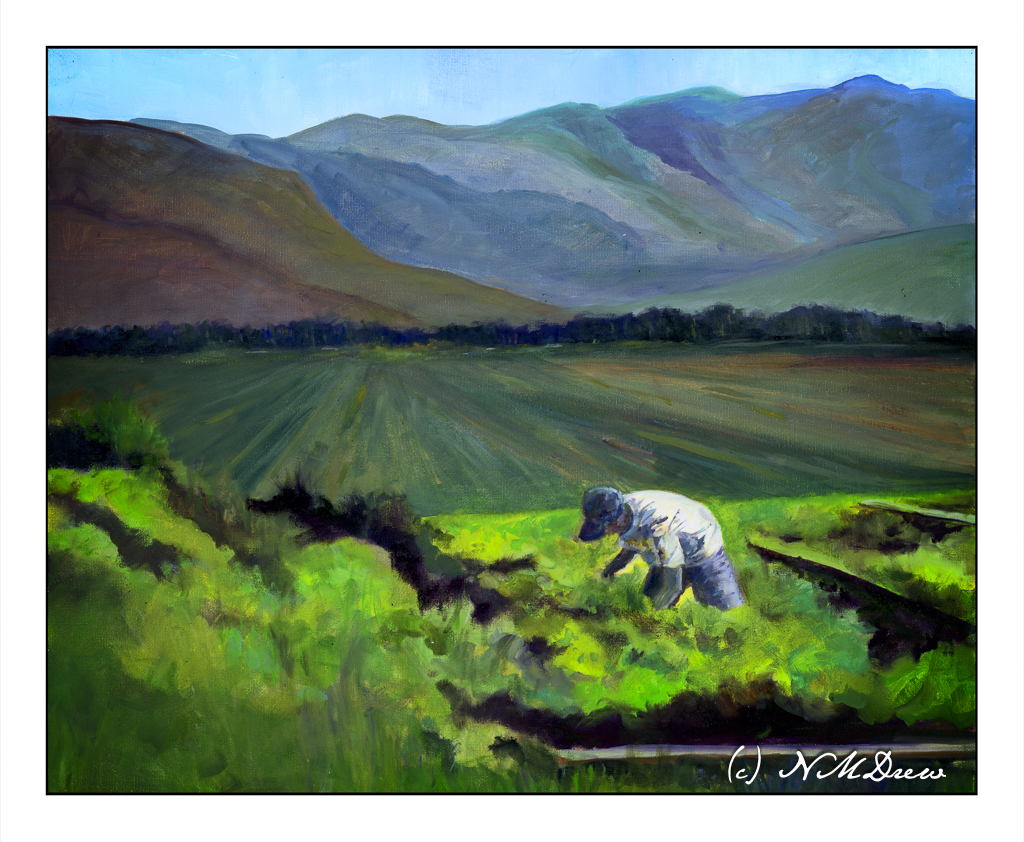
This painting was laid in on the last day of my Tuesday afternoon class which ended in July. It’s been sitting around while life moved into different areas. I finally found the time last week to finish it up. Final touch ups took place a few minutes here and there after that. Now, it is in a frame and ready to be put on display.
A summer or two ago a friend and I went to her family’s little farm plot out on the Oxnard Plain. I don’t know if this was her husband or just a worker I saw, but I thought it was such a wonderful photo it deserved becoming a painting. It shows the beautiful flat farmland found in western Ventura County, CA, and the coastal mountains which border it. I spent my teens in a then-small town nearby and always loved driving through the farm / ranch country on narrow roads surrounded by a variety of crops. I still do, too.
Today I have to head over to Simi Valley, where the fire I wrote about yesterday is still burning. Because I have to go there to get a crown fitted, I just checked out the situation online.
It’s called the Sandy Fire, and while still uncontained, a number of back fires have been lit to help do so. The fire is moving south of Simi, into the hilly country of the mountains on the southern edge of the city itself. There are homes here, but because of the nature of the place, it is difficult to build as well as remote. Unfortunately, though, some structures have been lost. Damage to wildlife is not to be dismissed, either, as the hills are home to many critters.
2017 Thomas Fire taken from the Reagan Library
Above is a photo I took years ago. The fire spread from the mountains to about 20+ miles west to the sea. My in-laws were evacuated from Ventura in the middle of the night. No one thought the fire so far away could spread as fast and fiercely as it did, and in so short of time.
The wind is what is often the most devastating element involved in the fires of Southern California. We get what we call variously “sundowners” and “east winds” and “Santa Ana winds” and “Santanas” – sundowners because as the evening sets in, the cool air from the ocean draws the heated air from inland. East winds because the land is east, the ocean is west. And there are a lot of other reasons for these winds of which I know nothing!
At times, these winds can be over 50 mph. Yesterday’s winds in my area were only 15 mph, but enough to make me uneasy. I always have my nose sniffing out smoke and my ears pricked for sirens. The rugged terrain means chasing fires is very difficult to impossible on foot. Helicopters with fire retardant and water help, but when the wind blows embers ahead of the fire, from mountain top to the next across an arroyo or canyon, the chase is on. It is this element – the embers – which can lead to large and devastating fires and damage.
Ironically, much of California and the west are environments which depend on cycles of fire. Native Americans often used fire to control the fertility of the landscape, and only recently has the Forestry Service begun to use their knowledge. Plants flourish in the burnt land, and many depend on fires for propagation of the next generation of plants. Human settlement disrupts this cycle. Thus, years of dried debris and overgrowth provide fuel. Wet winters giving way to dry summers do this as well.
Today, the winds are down from yesterday. Usually, a light steady prevails in my area, but even that can have its effects. I’ve lived in California most of my life, but I never get used to fires as a normal part of life. I loved the wind until I came fear its effects. Today the Sandy Fire is likely to be contained, but there are fires elsewhere that need attending, and more to come. Fortunately, family and friends offer us places to stay should we need to evacuate, as we have offered them.
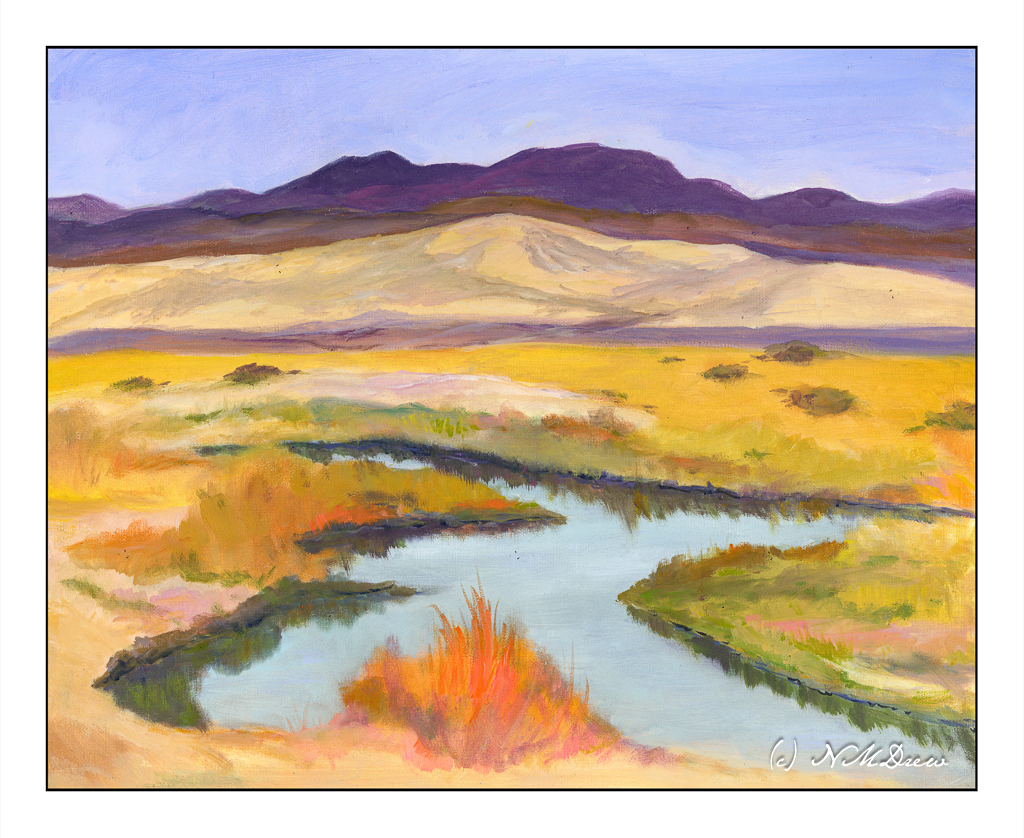
I’ve been too focused on too many things rather intensely and it makes me unsociable and not interested in the small and seemingly unimportant stuff that makes up daily living. One of these focal points has been painting. I have been working on this oil painting off and on for several weeks, and think it is finally done to my liking.
Tecopa Hot Springs is located in the Mojave Desert in Inyo County, California. It is not a very populated area. The hot springs are odorless, mineral springs considered to have healing properties. In my area the hot springs are quite sulfurous and smell like rotten eggs, so odorless is nice! The view from the springs is spectacular, taking in the land and the mountains beyond. This is a bit of the grandeur that is California.
I took a bit of a colorist approach to this painting, a bit of imagination and improvisation as well. Realism is for photography, so here I could play around while working to capture a sense of the place. I like semi-abstract or colorist paintings which keep the subject recognizable.
The southeastern corner of California is primarily desert. The land varies. There are hot springs, mountains, little rainfall, sparse vegetation. Days can be hot, nights can be cold. Within it are contained major parks and areas, which include Mojave National Preserve, Joshua Tree National Park, Death Valley and the Anza Borrego Desert State Park. Farming here is supported by irrigation from the Colorado River, but as times go by, the Colorado is not able to support farming as it once did. Despite its rather hostile environment – at least to people in some ways – this part of California is stunning. Its austere beauty is something perhaps not appreciated initially, but with time and observation, it becomes a magical landscape. There are towns, too, where you can stay to visit and learn a bit about the desert and its land and people.
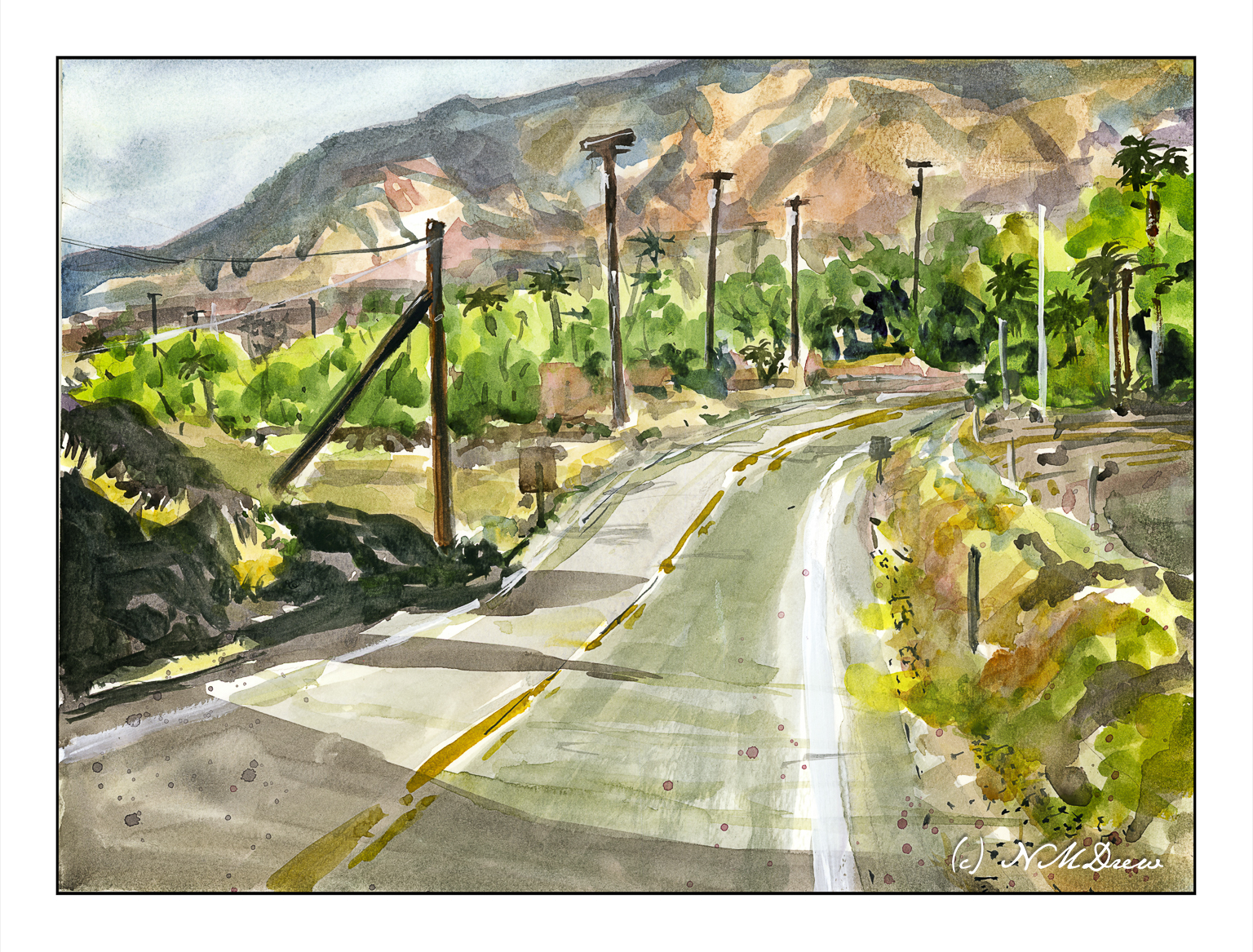
This afternoon was a sort of what-do-I-want-to-do day. I really didn’t know. The winds are up right now, and anything done outdoors would require hanging onto everything. So, an indoor watercolor rather than an outdoor oil painting was my choice. And as far as any planning – well, let’s just say I did this on the proverbial wing and a prayer.
Overall, I blocked in the major color areas, using lighter colors. First came the sky, then the mountains of blue and orange brown. The road was limned in, along with the greens of the vegetation. Once dried, details were added. I used the hair dryer a lot! Finally, white gouache here and there, splatters of reddish and bluish paint, and here we are.
I am quite surprised that it turned out as well as it did – at least in my opinion!
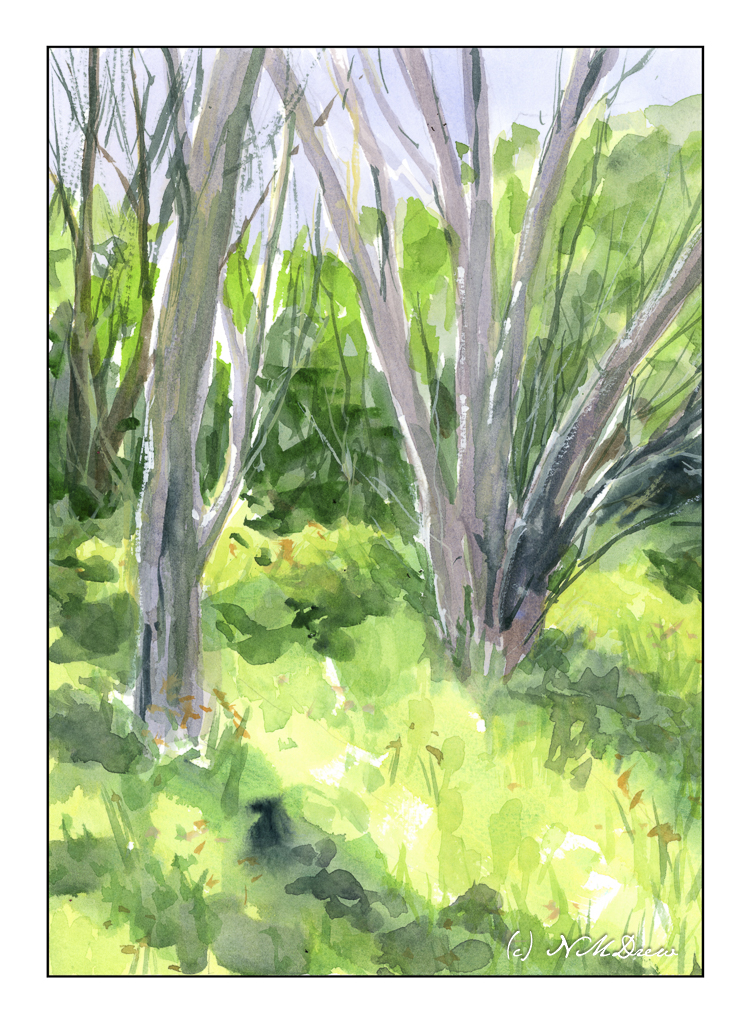
There are some days where chaos is the daily menu and you just have to flow with it. I had an appointment in the morning so I could go to my painting class in the afternoon. Well, that appointment turned into a hurry-up-and-wait-for-a-phone-call situation. Solution? Watercolor!
This painting is loosely based on a photograph I took while out at the settling ponds in Ventura. In California, “Spring” happens after any rainstorm. The brown grasses green, trees bud, flowers bloom. It’s the nature of the beast. We had rain yesterday and have another big storm coming in next week. In the days before my visit to the settling ponds, we had a lot of rain, and the result is this lovely little bit of trees and grass. Hard to believe this is within walking distance to the beach!
I did a bit of post in LR on the photo, but it does catch the sense of Spring, I think.