Tecopa Hot Springs

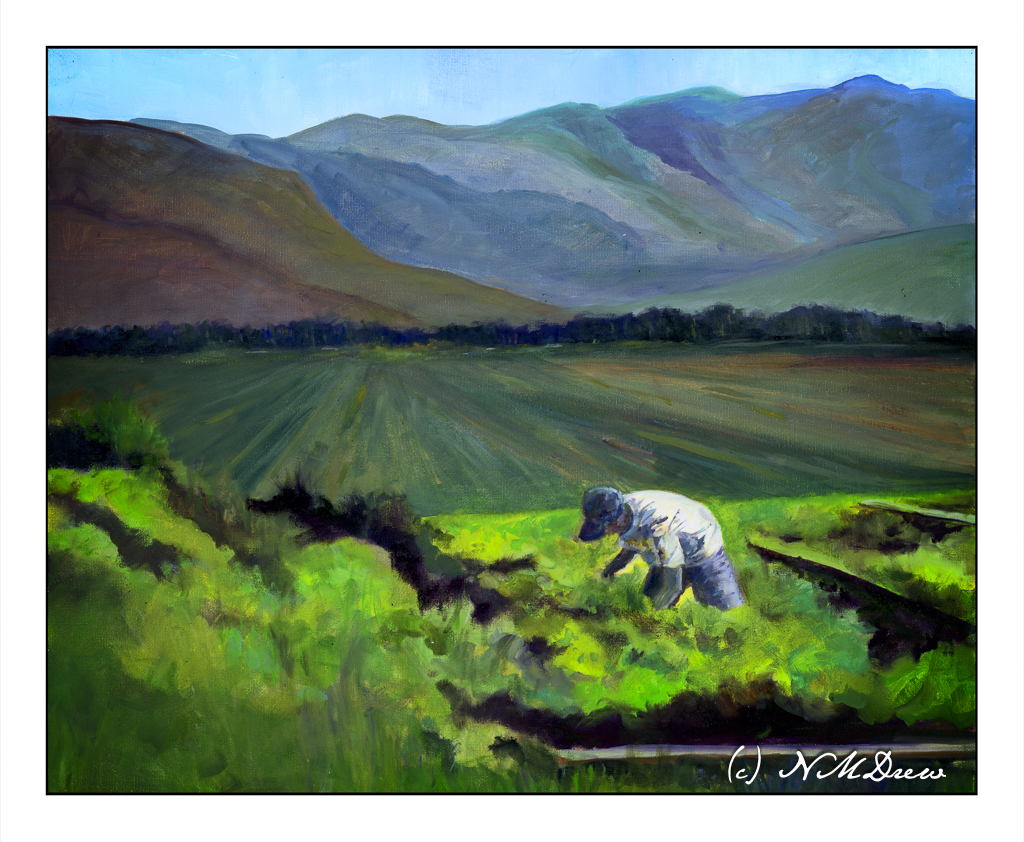
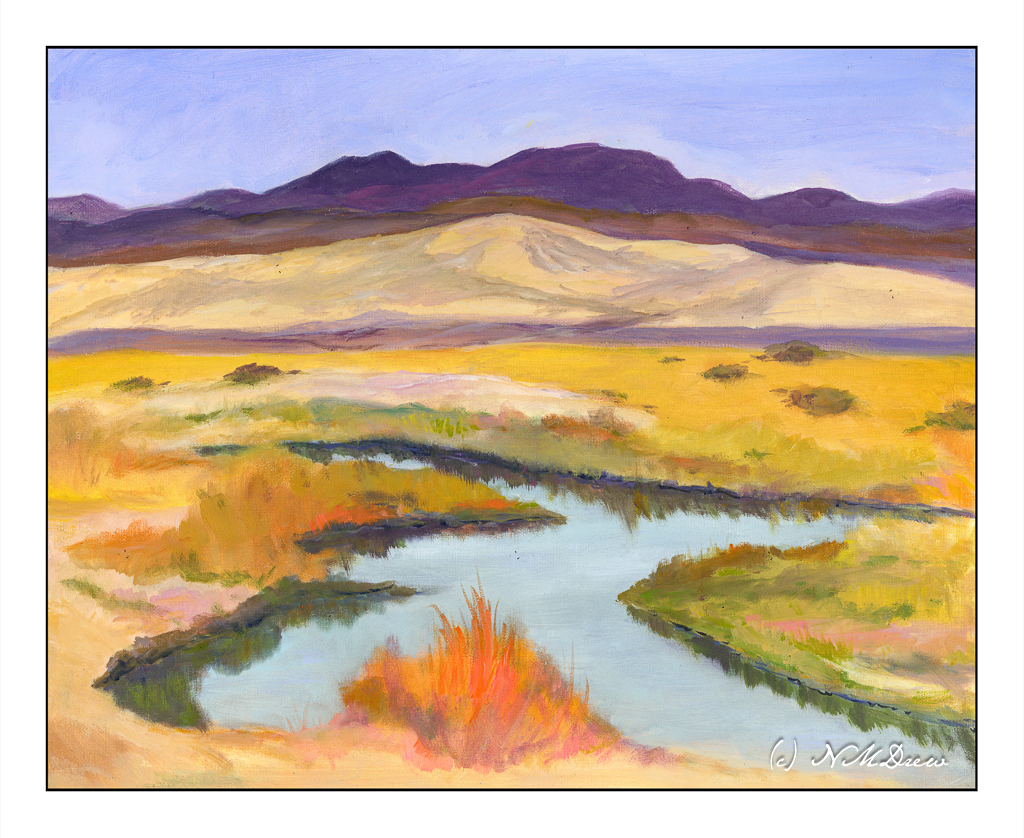
I’ve been too focused on too many things rather intensely and it makes me unsociable and not interested in the small and seemingly unimportant stuff that makes up daily living. One of these focal points has been painting. I have been working on this oil painting off and on for several weeks, and think it is finally done to my liking.

Tecopa Hot Springs is located in the Mojave Desert in Inyo County, California. It is not a very populated area. The hot springs are odorless, mineral springs considered to have healing properties. In my area the hot springs are quite sulfurous and smell like rotten eggs, so odorless is nice! The view from the springs is spectacular, taking in the land and the mountains beyond. This is a bit of the grandeur that is California.

I took a bit of a colorist approach to this painting, a bit of imagination and improvisation as well. Realism is for photography, so here I could play around while working to capture a sense of the place. I like semi-abstract or colorist paintings which keep the subject recognizable.

Oil on canvas panel, 16×20.

Body Parts, I

These past few weeks have just flown by! I spent a number of days up in Monterey. I’ve been learning Mah Jongg (American style), playing cards, running around, taking my painting classes, and just enjoying life. I also ignore the news as much as possible.

I decided to get more serious about portraits, have done a few which I am still working on, as well as decided to go into the body parts business. It’s one thing to get all the bits and pieces to work together well in the face, but I have decided to do some studies of the eyes, nose, and mouths of different people – from photos – just to have a focus on the details of each body part.

Or, I guess, face part.

I also decided to use a new-to-me product, Arches “Huile” paper – 140# cotton rag paper treated to take direct painting of oil paints without the need to gesso its surface. The texture of the paper is not like canvas, but it is tactile in its own way, and I rather enjoyed it.

To begin . . . I decided to save the hardest part for last and begin with what I thought would be fairly straightforward. First, lips and a few teeth, then the nose, and finally the eyes.

This study is from a photo of a kid just getting his adult teeth. Snaggle-toothed and chapped lips, so it was a pretty realistic photo. As this was my first painting on the Arches “Huile” I dipped my toe – well, my brush – in a bit gingerly, getting a sense of paint on paper. My brush was really small, a flat synthetic.

This is the nose of the same child, done separately on a different part of the paper. My brushwork became a bit more loose and I played a bit more with mixing colors not just on the palette, but on the paper as well for blending.

Finally, the eyes of an adult woman. I wanted something with a bit of drama, such as catch lights and strong eyebrows and lashes against a pale skin. Doing the eyes was a a bit of a slog, but in the end it seems to have worked out. Eyes have a lot of details whereas the lips and the nose had were more about color and shadow rather than itsy bitsy parts.

When I began the painting, I toned the paper for all studies with a thin layer of burnt umber, washed onto the paper with soy solvent. Once that was dried, I began each part separately by sketching it in with a small, flat brush and darker burnt umber. Once that was in place, I worked at pre-mixing the colors I anticipated I might use to match both value and color of the part I was painting. This is not my usual routine, so it was also a challenge.

After I did the mouth, I did the nose, followed by the eyes. Each time I used the same steps of outlining each part with the darker burnt umber. As many of my colors were already mixed on the palette, I added some new ones and modified the existing ones. This was rather fun and I did a bit of guessing about modifying colors, but it worked out pretty well.

My palette was restricted to titanium white, cadmium lemon, yellow ochre, cadmium red light, alizarin crimson, magenta, cerulean blue, ultramarine blue, burnt umber, and ivory black. The Arches “Huile” paper is rather nice, a bit pricey, but has a nice tooth. Other oil / acrylic papers I have used have smoother textures. Both are pleasant under the brush.

My goal is to learn to finally paint portraits with oils. It means practice and observation. I plan on continuing with this current palette and have set aside the above colors in a designated, dedicated “portrait baggy” to keep all the colors easily accessible.

Rainy Night, Snowy Night

Pixabay is a wonderful source for photos for painting subjects. Resources like this allow you – the artist or whoever – to explore worlds new to you. I, for one, doubt I shall ever visit a city with yellow trams unless I travel far from my current stomping grounds. This painting is derived from one such photo.

In the afternoon of one of my classes, I had about 20 minutes left to paint. The one I was working on was done to the point I could not go any further. It still needs to be finished while I try to figure out how to do the people in it.

I laid in an essential outline and some basic colors in those remaining 20 minutes and set it aside for the next class period, which is about 2.5 hours in length. I also decided to do it alla prima – finish it all at once. And, I did. Over the past few days I worked on some refinements, but very little.

The only thing I think I want to do a bit differently is the headlamp on the tram – make the white brighter and colder. To achieve this, I probably will use a cold blue mixed with titanium white.

Pretty pleased with this one!

Oil on 11×14 canvas panel.

Rio Chama

The Rio Chama is a branch of the Rio Grande River in New Mexico. It flows through the Chama River Canyon Wilderness and is managed by the Bureau of Land Management (BLM). Country like this is public land, subject to the rules and regulations to help preserve it, but also vulnerable to the whims and politics of the times. It is host to a variety of wild life and the beauty of the American Southwest.

Oil, 11×14, cotton canvas panel.