Landscape in Ink & Color

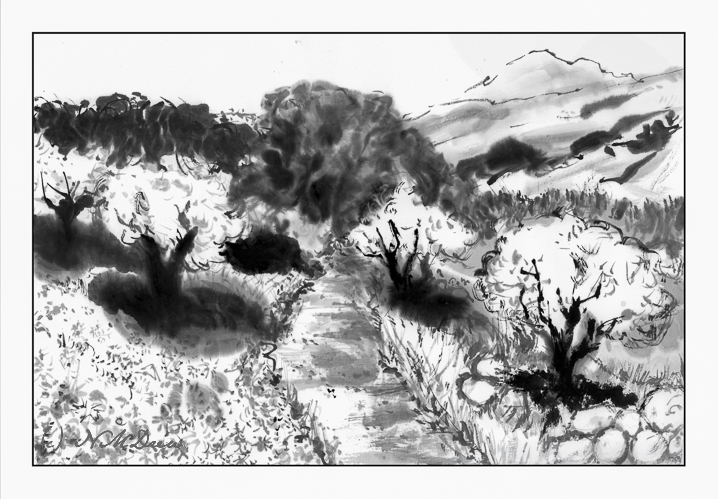
Traditional landscape painting in ink does not focus on realism. Instead, it works to capture the spirit of a place. Brush strokes are key as painting in black, white, and shades of grey can be challenging. Once the brush touches the paper, you leave a mark you cannot remove. So – think! Landscapes can be complex and it is very easy to make a mess. Even thinking in terms of masses of shade and shape is hard, because how do you convey the texture of a flowery field in ink without color?

The absorbent qualities of the xuen paper really make me work. It holds onto water and ink a long time before it dries. I found this out as I painted – the black kept spreading outward from my brush tip, and if I hadn’t pressed the water out of my brush before picking up more, the black became grey and the water was on the paper and in the paper forever! It seemed to spread forever. Even using a hair dryer didn’t seem to speed up the drying process. The challenge of ink painting is forethought.

Not a great landscape. Will color make it any better or interesting?

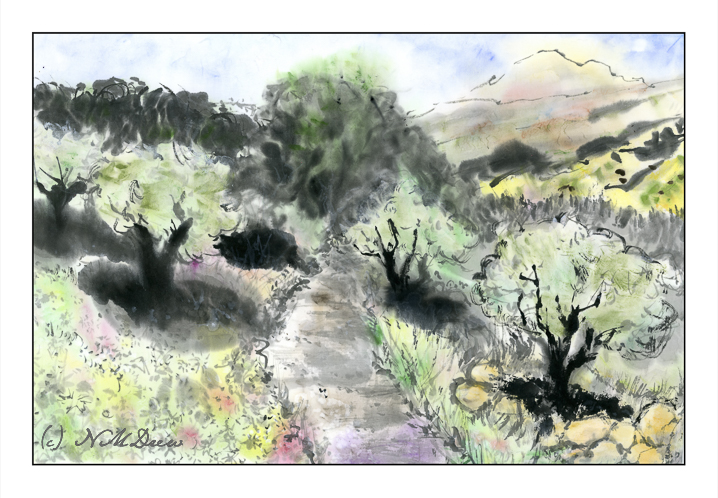
Kuretake makes traditional Japanese Gansai paints, of which I have a few colors! I decided to use these a day after the original landscape had been painted. Most of the painting I re-wet in sections to see how the colors would blur into one another. Some areas, like the rocks in the lower right hand side, I did on dry paper with a fairly dry brush but diluted paint. The Gansai colors vary in intensity, so the diluted paint seemed to be a good starting point. The bright yellow is a mistake – too intense although diluted. At this point I used a bit of scrap paper to test colors before painting.

Most of the colors were applied wet-on-wet. In the end, this painting makes me think of hand-colored photographs from the early 1900s.

Yasutomo Liquid Sumi Ink, “Jade Plate” double xuen paper.

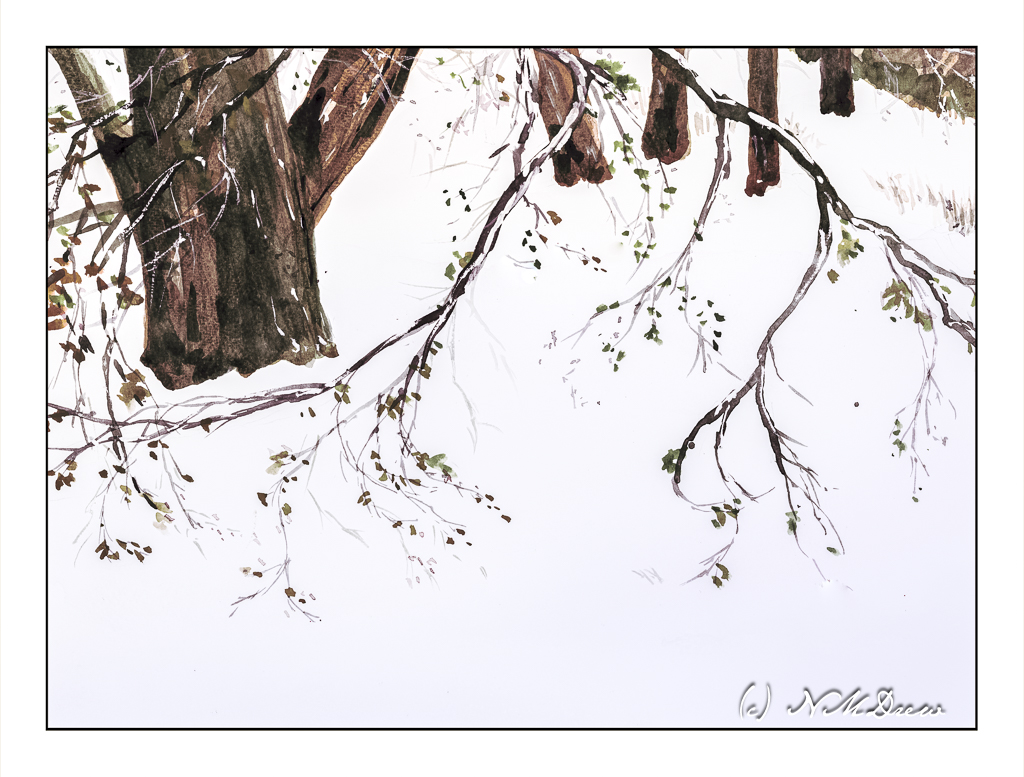
Trees in Snow

This was an exceedingly hard painting to scan simply because of the very soft usage of blue in the foreground snow. While this scan does not represent the painting very well, the overall image is good enough unless I decided to really play with my scanner’s software. I am not so sure I want to do that.

There are a few “points” to this painting. Using a very limited palette was one point – colors here are ultramarine blue, burnt umber, burnt sienna. There is a touch of a few other colors here but nothing of any significance.

Another point is to keep as much of the paper as white as possible. I managed to do this, but the scan does not do justice to the pale blue of the foreground snow; to compensate for this I used a very light blue graduated filter overlay in my post production software.

And the final point was to work in layers – light to dark – for the trees. Yes, I used titanium white artist’s gouache for the snow on the branches.

St. Cuthberts Mill, Bockingford archival watercolor paper, 12×16, CP 140#.

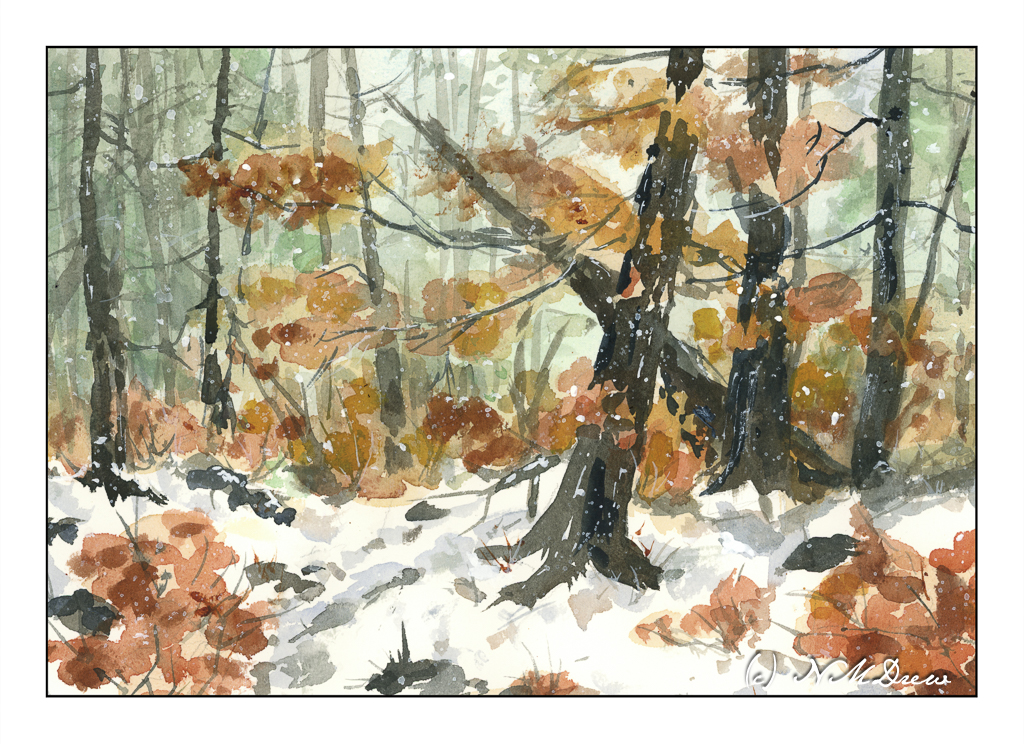
Snowfall

Christmas Day! Nothing like a snowfall and the cold and the quiet of the woods for remembering the magic of the season. New and old traditions overlap, memories and hopes for the future all seem to be rolled into the end of the year and depth of winter. The stillness of the winter woods gives pause to our crazy lives. Holidays of any sort at this time of the year make us look backward as well as forward.

Here I worked from very light to dark. The colors I used for the greenish-blue sky were cobalt teal, a bit of ultramarine, and a touch of Hooker’s green, neutralized by a bit of alizarin. The leaves and autumnal foliage were various siennas and orange with a touch of Indian yellow. Trunks, from light to dark, were essentially ultramarine with burnt sienna and raw umber with a bit of Payne’s grey. Snow shadows were ultramarine and Payne’s grey. Finally, I watered down some titanium white gouache and tapped my brush across my forefinger to look like falling snow after applying a few lines and dots in white here and there.

This is another watercolor which pleases me. Perhaps I should stick to Arches Rough paper instead of my usual cold press . . . ?

Have a wonderful Christmas Day – or whatever it is you celebrate!

Watercolor, Arches Rough 140# paper, 10×14.

Shades of Grey?

Recently it has brought to my attention that my watercolors have very intense colors with strong contrast – too strong colors and clashing contrast. It is an interesting thought. Often I feel my colors are a bit over the top, but after working hard to get rid of mud and blandness, I worked to have more pure colors. Now that I can do this, perhaps it is time to scale back a bit. This means, the way I see it, is to create more middle tone values in general throughout a painting, and then have areas of light and dark.

So, let’s begin. On Pixabay I downloaded an image which was not too complicated but, in color, provided a pleasant array of colors and a few areas of bright and dark while the overall tone was middle values

As you can see, the shadow in the left middle ground is strong, as is the tree on the right, as well as bits of the buildings and trees. I converted this to grey scale to see how well it held up to my perceptions in color to actual black and white.

My suspicions were confirmed! My eyes did not deceive me! And, if you are interested, I simply desaturated the photograph by reducing the vibrancy and saturation in Lightroom Classic.

From here, on to my watercolor. I chose a limited but coherent palette of about 6-7 colors – yellow, green, red, blue, browns. Which ones I chose, I don’t recall, but I worked to create secondary and tertiary colors while I painted. My painting is meant to replicate values in the painting as well as make it recognizable without painstaking details. Below is my color rendition.

My painting looks a bit more dynamic than the photograph, I think, but it is interesting to see how it looks in black and white – again done in LR by reducing vibrancy and saturation.

Overall, most of this painting is in middle values of grey with some areas of bright and dark. So, I did achieve what I set out to do. I plan to work on this a bit to see if I like my paintings better – and, I expect I probably will. Working with color is challenging as colors distract so easily from value!!

Thoughts?

Watercolors, Hahnemuhle CP paper, 9×12.

Transition

Even though seasonal changes in SoCal are subtle, elsewhere in the state, further north or at higher elevations, shifts in color and temperature are more apparent. The tilt of the earth changes the light, winter pushes trees to change colors and lose their leaves. Temperatures drop. While today is about 73F, two weeks ago it was in the 50s (no snow, yay!) and nights are chilly. So, let’s celebrate the shift of summer to fall, and now fall to winter.

For me, this is a rather complex painting. Rocks and sandy shore, trees and brush, water, sky and reflections in the creek. Remembering the “rule” – simple big shapes, moderate shapes, details last, I worked by creating the most noticeable areas – or certainly the ones I felt could be the most challenging. This meant the creek in particular – keeping the water marked out. As well as that, the shoreline in the foreground coupled with bits of sandy shore on the right. After that, the rocks on the left and foliage of trees. I was all over the place working larger to smaller, light or dark, and then on to light or dark details.

Overall, I think this painting worked out. Analyzing its complexity and then breaking it into its larger components and areas of color helped. It is still not quite what I would have liked to produce, but much of it did succeed.

Watercolor, Hahnemuhle paper, about 10×12.