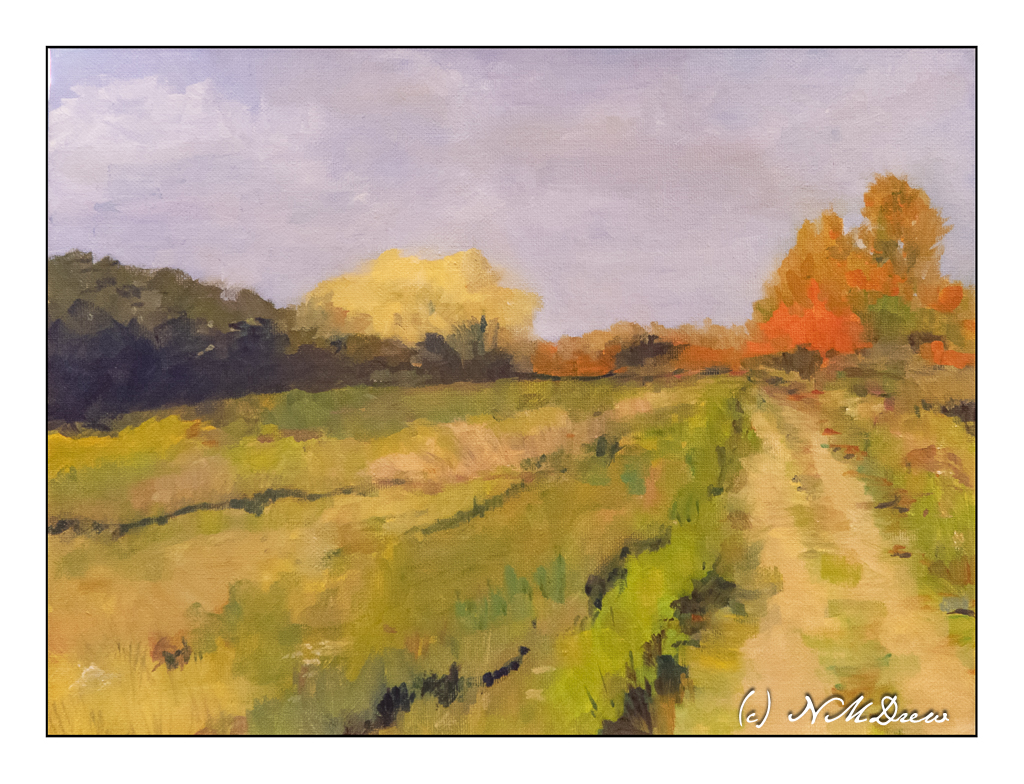
I had been working on my geese (see “Honk, Honk, Honk”) for weeks on end. The last few sessions in my painting class found me bringing it in, setting it up on the whiteboard ledge, looking at it, and then dabbing a bit here or there. I expect I will dab a little bit more, but I will be submitting it the first annual student art show at the adult school campus in August.
Spending a lot of time on a painting means a lot of focused work. Breaking that focus seems important for me. Play and don’t get precious. In painting class this means slap on some paint and get going. With this painting, I did. And I finished it in two hours, all within the allotted class time. I rather like it and totally enjoyed the play time.
A lot has been happening here, and time just slips away. Additionally, my painting journey has been mostly oil painting, and that takes time. I have been pleased with my progress there. Along with my usual painting class, I have been taking a gouache class, and I have been having so much fun. Our instructor worked for decades in animation at Disney and Warner Brothers, so her background is very different than mine. As a result, it’s a lot of technique gleaned from her 40+ years of experience and exploration into gouache being used differently from my own more painterly approach.
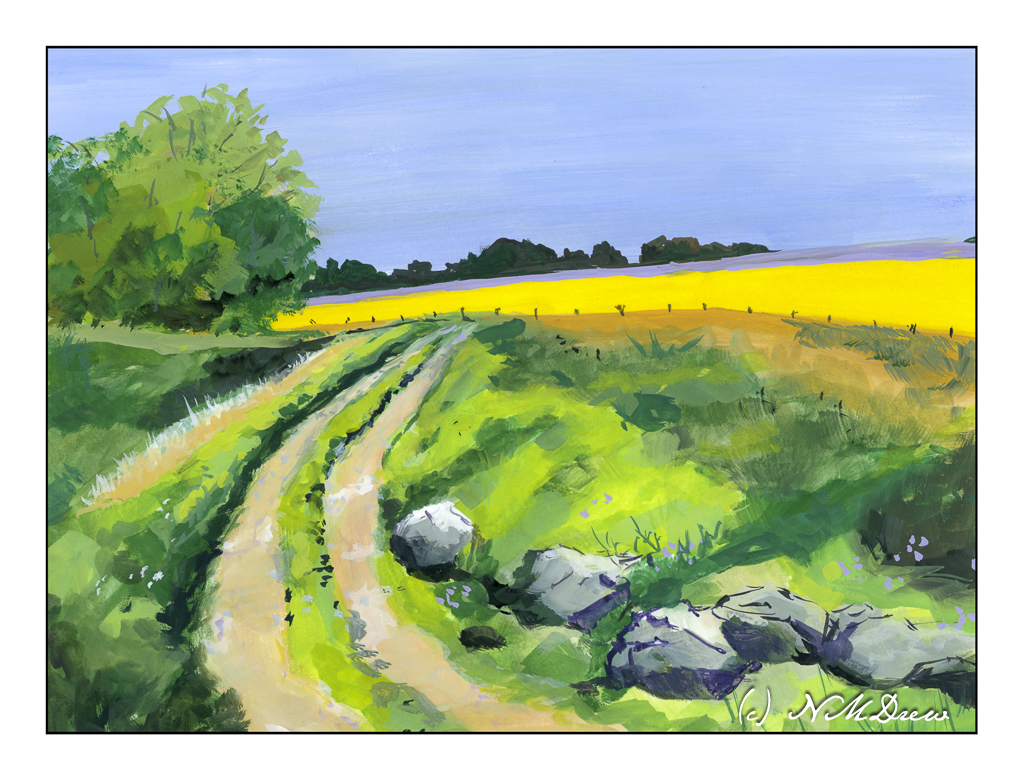
While this painting is more in my usual style, the lessons I have been learning each week are apparent here to me. Maybe not you, but me! The class has made me see and visualize gouache painting differently as well as how to apply it. I could get into the details here, but it’s something I am not in the mood to try to explain. Let it suffice to say I had a delightful time painting this little scene of a track leading to a rape seed field – the bright yellow – and a lavender field beyond. I thought some boulders would be a fun thing to try, and I think they worked out rather well.
Artists gouache, Arches HP 140# paper, approximately 9 x 12 inches.
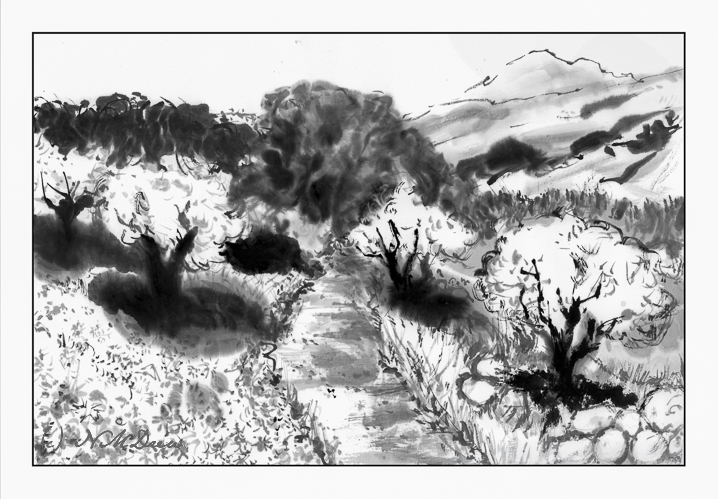
Traditional landscape painting in ink does not focus on realism. Instead, it works to capture the spirit of a place. Brush strokes are key as painting in black, white, and shades of grey can be challenging. Once the brush touches the paper, you leave a mark you cannot remove. So – think! Landscapes can be complex and it is very easy to make a mess. Even thinking in terms of masses of shade and shape is hard, because how do you convey the texture of a flowery field in ink without color?
The absorbent qualities of the xuen paper really make me work. It holds onto water and ink a long time before it dries. I found this out as I painted – the black kept spreading outward from my brush tip, and if I hadn’t pressed the water out of my brush before picking up more, the black became grey and the water was on the paper and in the paper forever! It seemed to spread forever. Even using a hair dryer didn’t seem to speed up the drying process. The challenge of ink painting is forethought.
Not a great landscape. Will color make it any better or interesting?
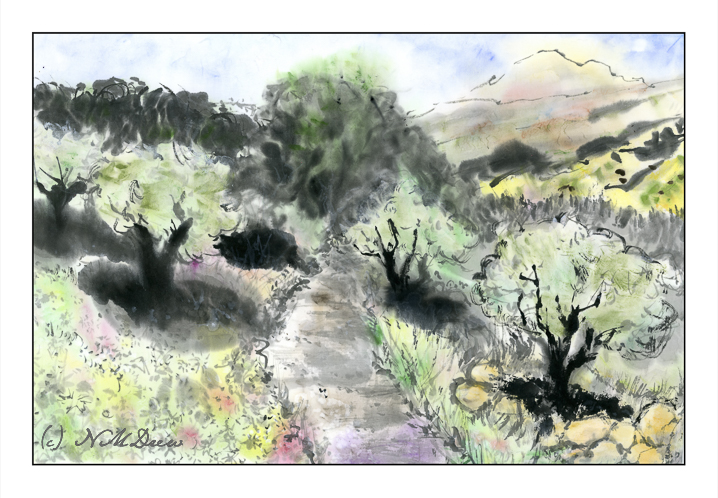
Kuretake makes traditional Japanese Gansai paints, of which I have a few colors! I decided to use these a day after the original landscape had been painted. Most of the painting I re-wet in sections to see how the colors would blur into one another. Some areas, like the rocks in the lower right hand side, I did on dry paper with a fairly dry brush but diluted paint. The Gansai colors vary in intensity, so the diluted paint seemed to be a good starting point. The bright yellow is a mistake – too intense although diluted. At this point I used a bit of scrap paper to test colors before painting.
Most of the colors were applied wet-on-wet. In the end, this painting makes me think of hand-colored photographs from the early 1900s.
Sometimes things just catch my eye or interest and, as someone who paints, makes me want to practice doing them – not just with a sketch, but with a painting. Some people practice but my practice wants a result. Not perhaps the best way to learn, but my little Puritan heart always wants my time to be productive and the productive part falls into a “finished” painting. Maybe a bit sinful for a Puritan, but . . .
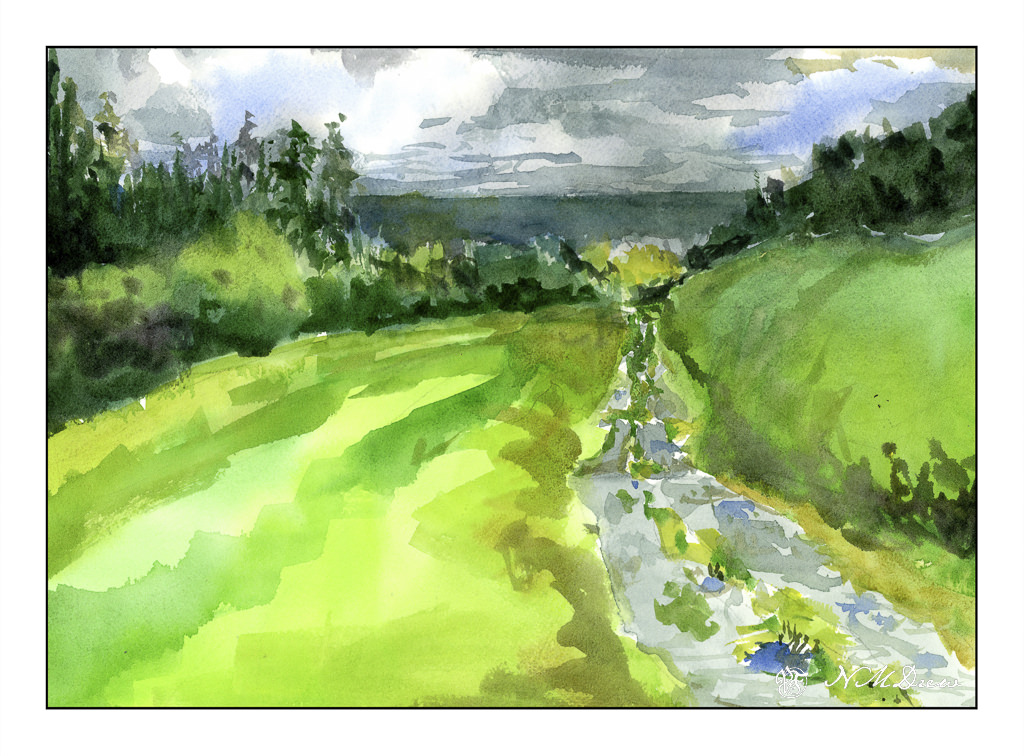
So, roads and tracks. Straight lines through a woods, a track over uneven back country here. Also, a suggestion of a water puddle or two reflecting a bit of the stormy sky above. Wet, green, verdant land. Sea or mountains in the distance. I want to walk that road.
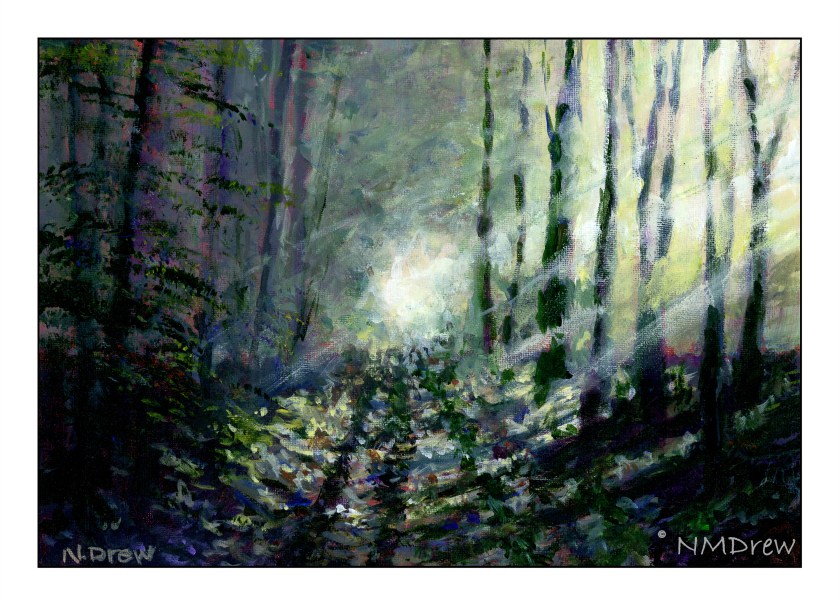
Today is my fifth painting with acrylics. I felt confident enough to choose a more complex subject, using (of course) another YouTube video. I am learning a lot by following videos, especially ones that suggest brushes and colors, as well as explain techniques.
This painting is done on Fredrix canvas pad paper, 11×14. The canvas, though already gessoed, was gessoed by me. I like that step and feel it is a good way to begin a painting, much like grinding ink prior to doing sumi-e. There is a meditative element to it.
Murray Stewart, whose video I followed, painted his underlying canvas with burnt sienna. I used red ochre and found that the color is just yummy! I live where red soil is known, so it was like seeing an old friend. That said, from there I pretty much followed through the video. About half way, Stewart mentions that the basic work was done, and details were what were needed to finish the painting. I agreed, but watched through to the end.
I have been using titanium white for mixing colors, but decided to use zinc white, as I do with gouache. For gouache, and mixing colors, it is great, but the titanium is a much better choice for mixing colors in acrylics. I am not quite sure where I will use zinc white in acrylics, but I am sure I can do some research.
This video presented me with a lot of material I enjoyed learning: making sun beams, using a fan brush for foliage, dark against light and light and against light effects. More, too, simply by doing. While painting, I found that dipping my brush in water prior to picking up paint made for better painting. The brush wasn’t sopping, and the water in the brush gave enough moisture to allow pure pigment to be spread around. I also found that this helped with glazes.
So, here is Stewart’s video – he did a good job, and he is pretty darn funny, too!