Practice

Over the next several weeks I am enrolled in a couple of oil painting classes. Acrylic paints really do frustrate me in a lot of ways, and please me in others, but it is time to work with oil paints on a more serious level. Let’s see where it goes.

To get ready for these classes, I pulled out some of my supplies. Of course, the oil paints come out – I have a smaller selection of colors than any other medium! I also have canvases in panel and mounted format. However, I did need to stock up on linseed oil, solvent, and other such stuff. And then paint.

Canvas mounted on panels is actually, I think, the easiest way to go. Canvas pads flop around and easily bend. Mounted canvas on stretcher bars takes up a lot of space but can provide a gratifying surface to paint on if properly and tightly mounted and prepared. For now I am using canvas panels which, while not super high quality, are relatively inexpensive and easy enough to prepare, if at all, prior to painting. 
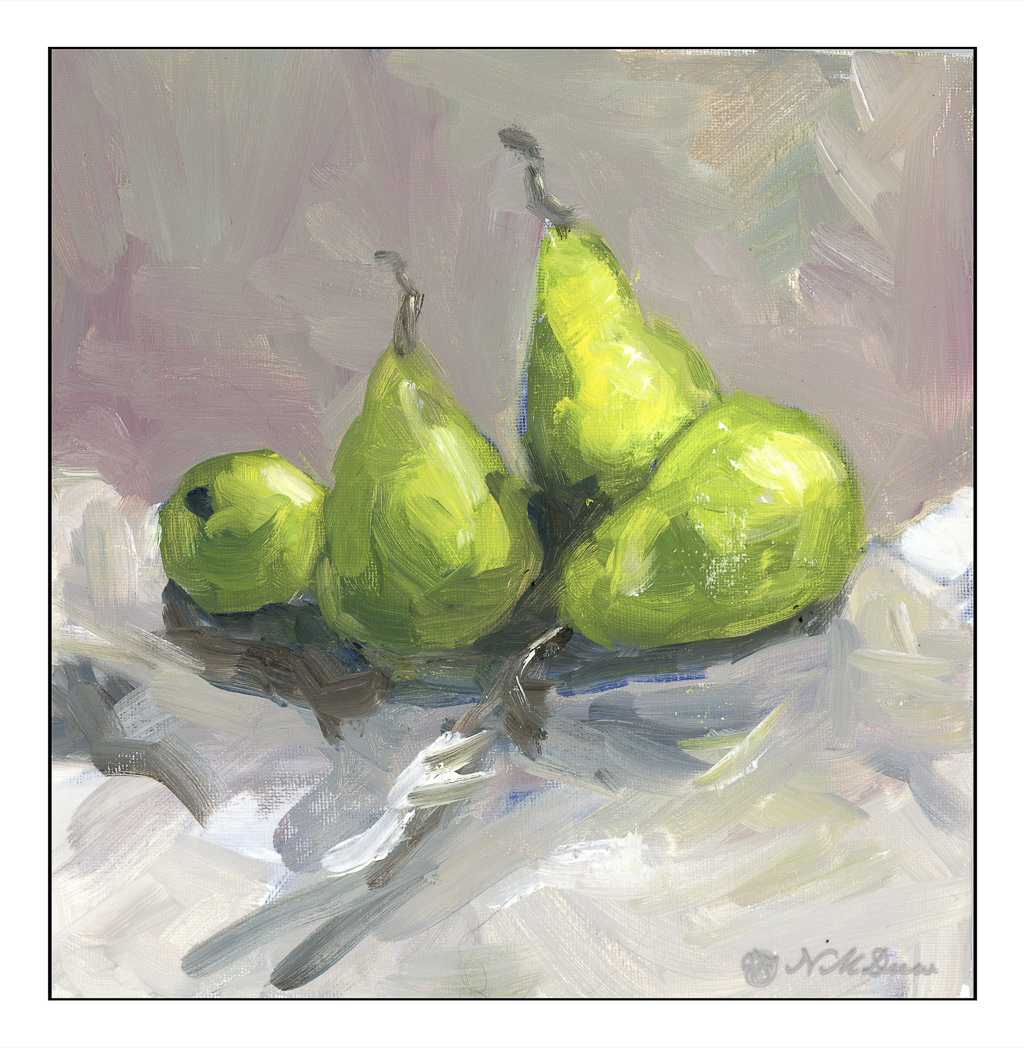
I love pears! Painting them is far less tasty than eating them, but they are by far one of my favorite winter fruits. Here, some d’Anjous, all cuddled together. My focus here was brushwork and getting a sense of the unctuous quality of oil paints. Some people use the paints straight out of the tube, but I like mine to slide around a bit. It really makes for fun blending. The colors, too, were rather limited here for the purpose of seeing how they can interact. 
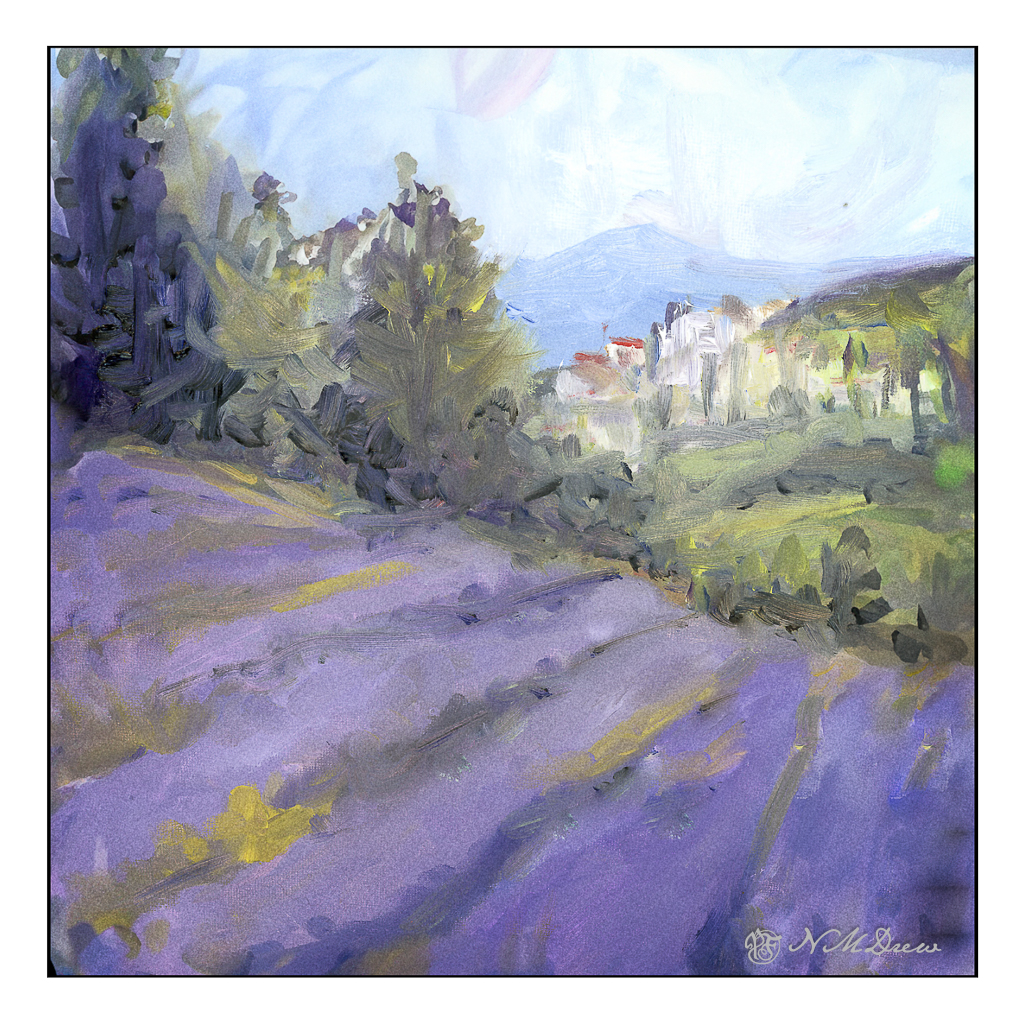
Here, more lavender fields. Why so many? It is because lavender and purple are honestly rather nasty colors to create from the standard mixes. I find that I like to have “convenience colors” on hand – namely, a good violet such as carbazole or dioxazine. Mixed with other colors and / or white, I get lavenders and such that appeal to me. I initially tried to just use variants of red, blue, and white for the lavenders, but gave up with frustration. Not worth the sweat! Maybe later I will master a good orchid lavender, but for now . . .

As with the pears, playing with the things you can add to the oil paints to thin them out. I used Gamsol and Soy-Thin, both low odor solvents. I didn’t use any linseed oil in either painting – that will come later – as will other things, such as drying agents like alkyds. 

The pears and the lavender field were painting on pre-gessoed 10×10 cotton canvas panels measuring 10×10 inches square.
Sweet Lavender

More gouache! Such a lovely, forgiving medium. Mistake? Dry, re-wet, blend some more, paint over. Can you really ask for more? The only problem with artist’s gouache is that it stays water soluble when you are done with the painting, but there are ways to seal it and make it waterproof. I think I will try that out on some gouache painting failures – like my snow scene of yesterday.

After getting lost in a drift on that snowy road of yesterday, off in my Learjet for warmer climes and roads easier to navigate. May as well time travel a bit, too, and move from winter to late summer.

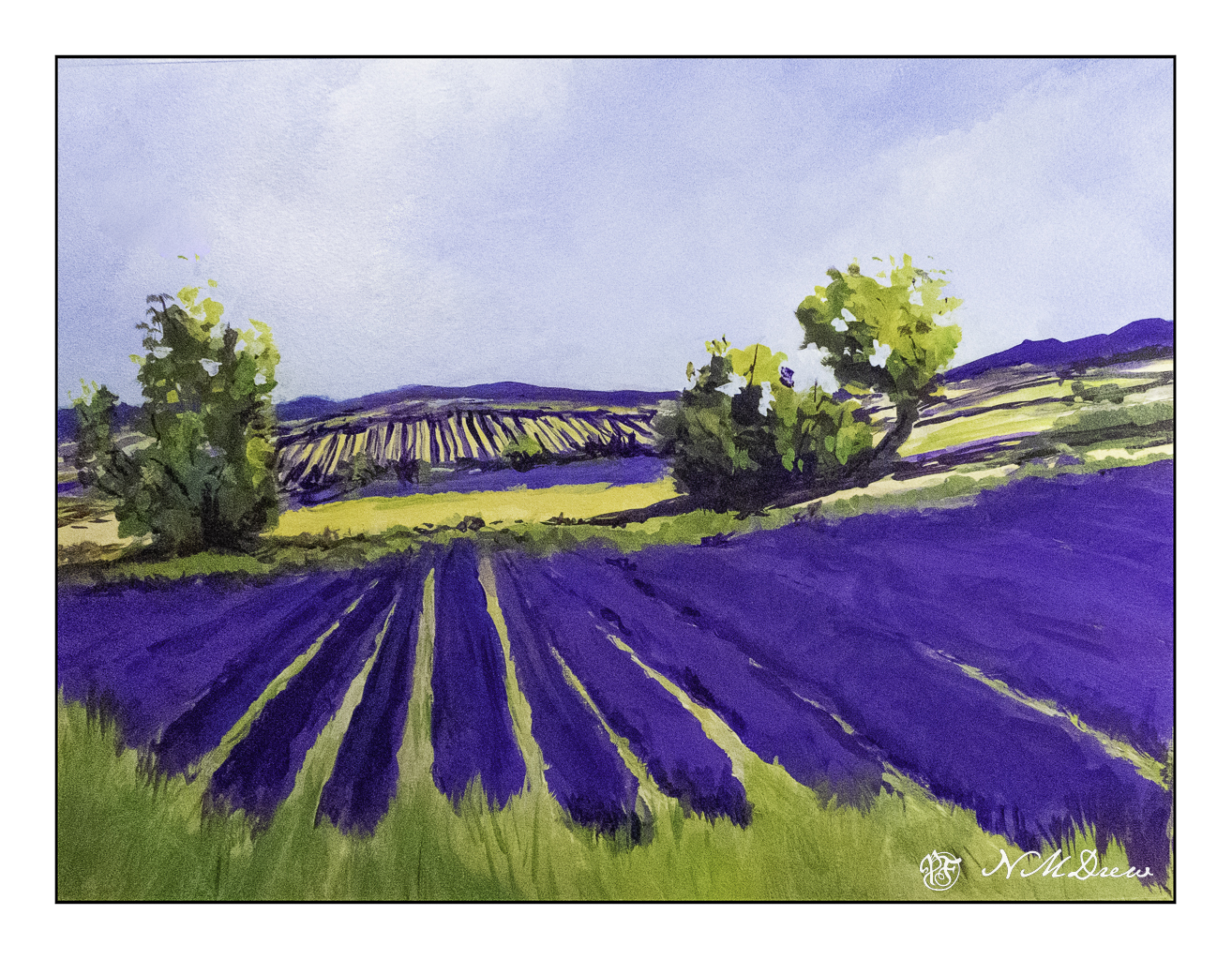
Back to lavender fields! The ones I have been doing in acrylic are a bit gaudy, but so is lavender. Some lavender is light, some is so dark it rivals the deep blues of lobelia. I tried to strike a bit of a more subdued approach to a large amount of lavender, and I think it works pretty well.

Artist’s gouache on bristol paper; about 8×10.

Color Planes

As I mentioned a few days ago, I am experimenting with swaths of color. Not simple planes of one color, but variations of color within that plane is the goal. A number of artists do this beautifully, and the graphic quality is elegant to my way of thinking, with the simplification being the subject and the goal and the voice of the artist. As I am a dabber, this is a big challenge for me.

To begin this, I decided to try my hand at exploring a painting by Wolf Kahn. The one I copied is called Ground Fog, and it is a simple study of grey, white, yellow, green, and variations of each within each area of color. Below is my attempt.

This was a challenge to try as he painted this in oil and I am using Golden fluid acrylics. Blending the colors was hard and required a lot of thought and movement rather rapidly since acrylics dry quickly, and the fluid acrylics even more so than heavy bodied acrylics. I got frustrated, let me tell you! Despite that, I did learn a bit about color – not quite sure what, perhaps just that subtlety is hard to achieve.

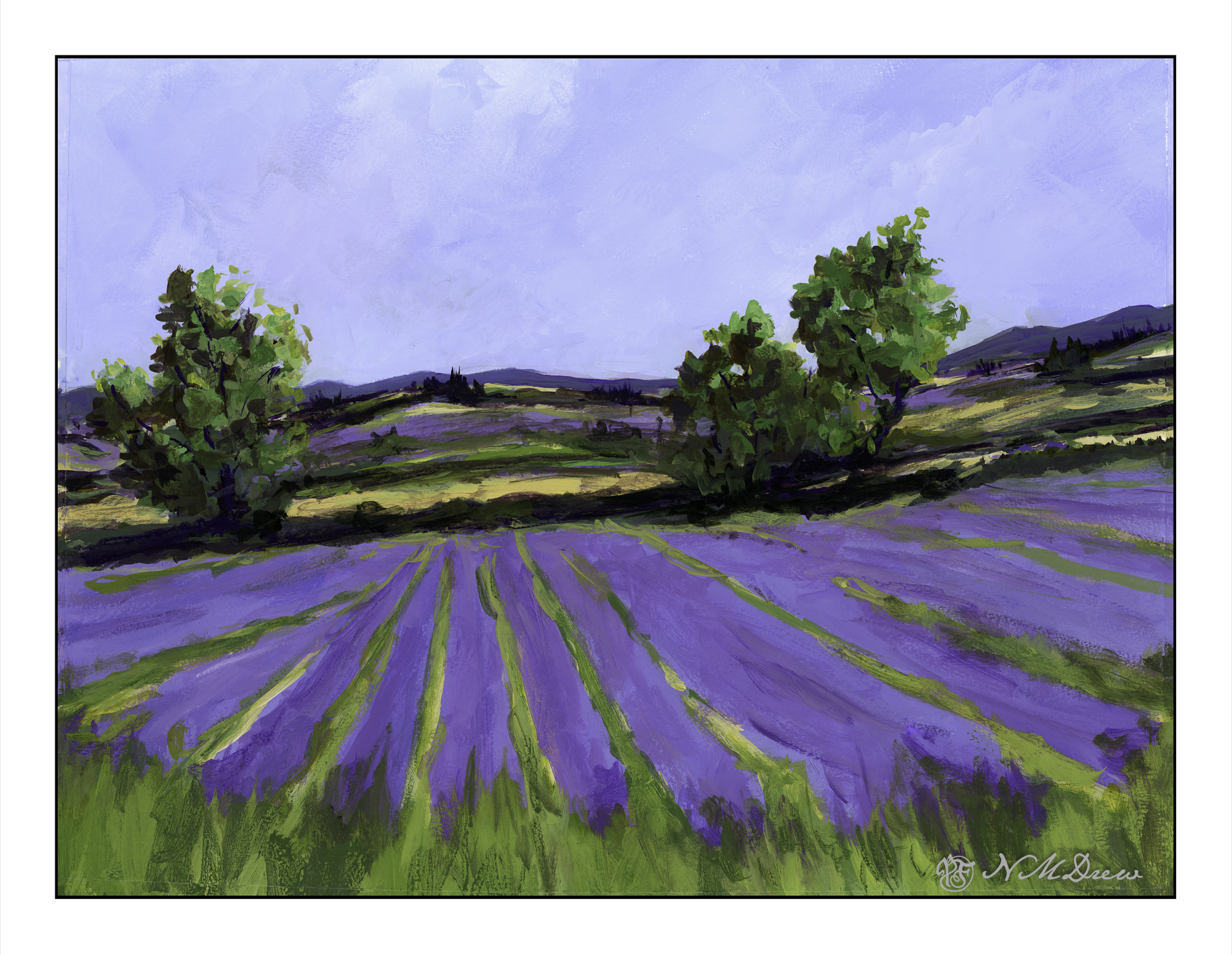
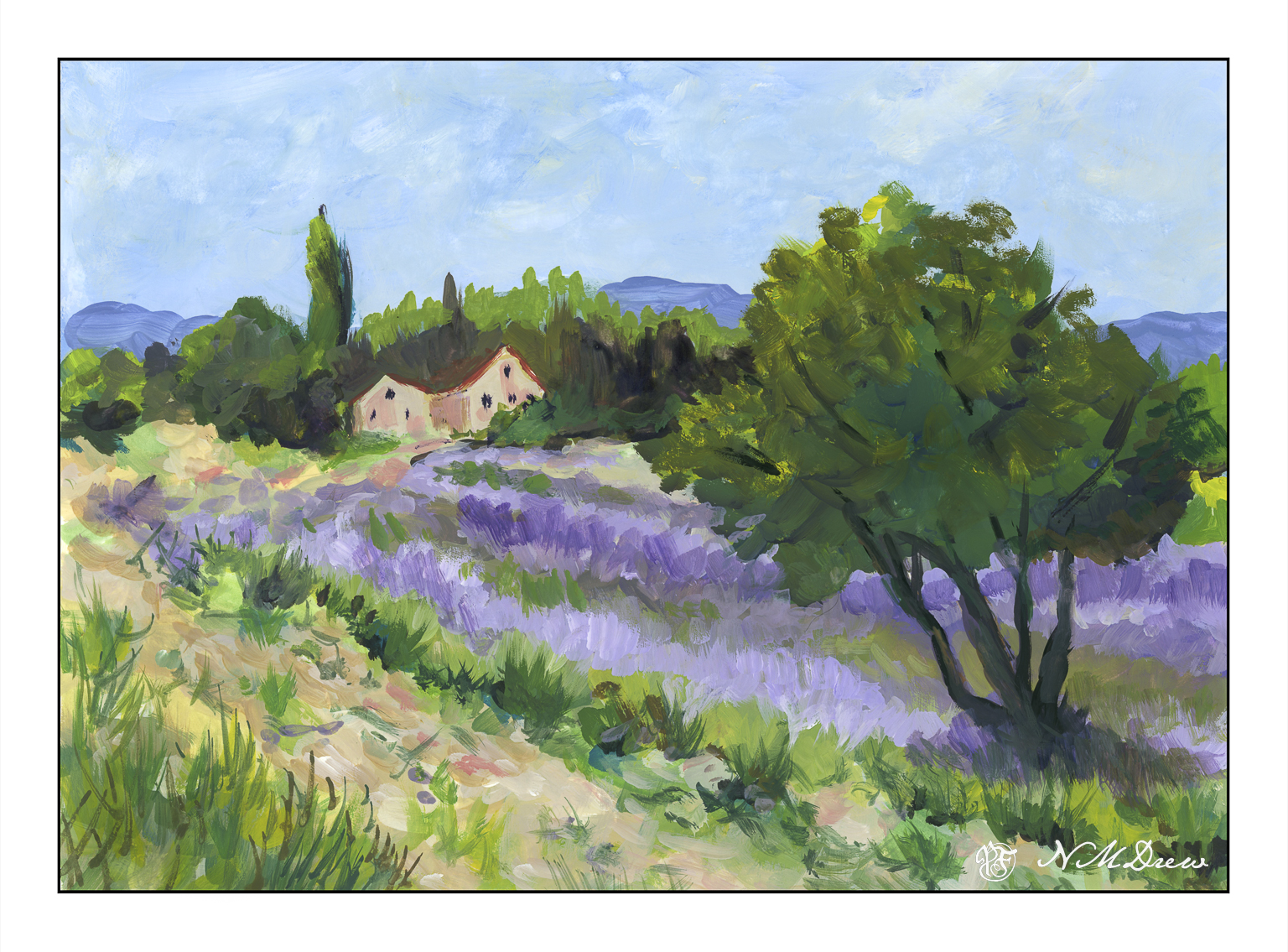
From there, once more a foray into fields of lavender and other crops, such as perhaps alfafa or wheat – no idea! I just know I see tawny colors and greens when I look at photos of lavender country.

While not especially low key or subtle, I was pretty pleased with the planes of color with the variations therein. The green and lavender are not too heinous when juxtaposed. I like the mountains and sky in the distance, as well as the trees. Sometimes nature is not subtle, and while bright, I think I did a decent job of catching a sunny day in a Mediterranean clime.

The lavender field with the green foreground was done with both large and smaller brushes. This one was done, for the most part, with a rather scraggly 2.5 inch bristle brush with a lot of scrubbing. In particular, you can see this in the sky. I applied varying layers of blue and white, painting up and down to use the brushwork to express the clouds in the sky. The same with the lavender field below. I used a smaller brush for the dried field area with trees, but worked to keep the brush strokes and colors to convey light and depth. I think it worked fairly well.

The study I did on Kahn’s painting gave me ideas on how to create the color planes, but of course I am not Wolf Kahn, and therefore have my own whatever method in creating such things. Acrylics, too, have qualities which oils do not, and blend differently. I am still learning them, and while I get annoyed and frustrated, each painting helps me gain skill and learn the language of the paints. These are invaluable lessons in technique and composition and methods.

Lavender #3 – Final (For Now?)

For the last 2 or so weeks it has been appointments and appointments and ordering this or that and consolidating little things and I am so sick of it I could scream!! My lavender painting has been sitting on my easel, I see it every day, and at last I have found time to work on the painting. Finally. Oh, finally! Something fun to do.

I wanted to accomplish a few things with this painting. One was simpler, more blended brushwork throughout. I wanted to grey out the distant colors a bit for a sense of atmospheric perspective. The trees, too, need to be cleaned up a bit. I think the pale field before the second level of lavender could indent a bit more on both sides of the left hand tree. I won’t say this is a masterpiece, but it has a bit more a painterly quality in it, has a decent sense of depth, colors aren’t too overwhelming.

This is painted in Golden Fluid Acrylics. A Sta-Wet palette doesn’t keep the paints wet as they are so fluid – the heavy body acrylics work well with the Sta-Wet because they are thicker. This means working a bit differently and I have found I like them best when they are a bit dryer – great for dry brush. Too much water in the paint – or in the brush – and they can drip down on completed paintwork, or form a rather interesting craquelure.

I have been putzing on this painting for quite some time, so here is a series showing its evolution – earliest paint

15×20, Langston watercolor paper, Golden Fluid Acrylics.

Lavender Field #2

Today just got away from me!! Where it went is up for the imagination. I had plans to paint – but time to focus on another larger painting in acrylic was not there. Instead, I thought it would be a good time for me to get reacquainted with my sketch book, and what better way than ink and color? My lavender field from yesterday seemed to be the perfect subject.

So, back to the sketch book. Micron pens for a simple outline. Then color and I used water brushes, but sprayed a bit of water into the foreground and into the sky to get better effects – ones that water brushes and no cup of water cannot achieve. I did some painting, then I inked more detail in, did some more painting, paused to let things dry, and so on. Nothing exciting, but it was a definitely pleasant way to spend an hour or so on the patio in very pleasant weather.

Fun!