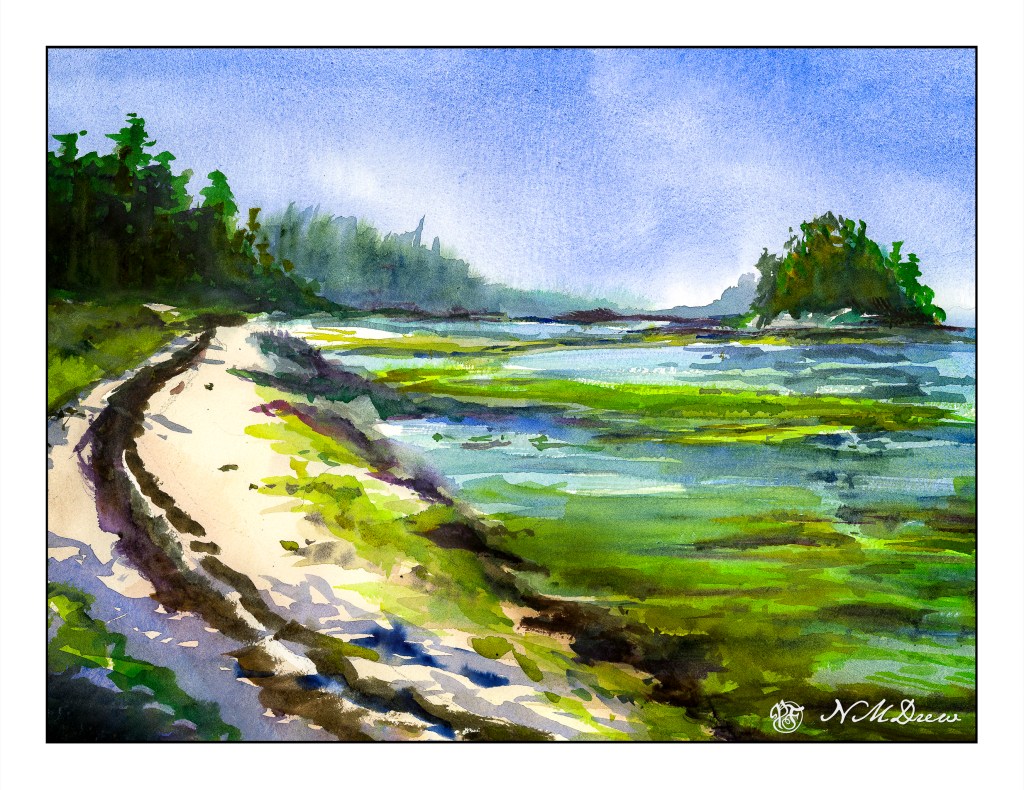
The same painting, scanned with an Epson V600 and merged. However, two different software were used to merge. One was Microsoft Ice. The other was the photo merge bit of Lightroom. It’s hard to really tell which software impacted the final image more as both were manipulated a bit in post. However, the difference was that the LR version had dark paper around the edge and was rather muddy. The MS Ice was lighter and more clean in overall appearance.
This is the image merged in Lightroom. .
This is the one merged in MS Ice.
It’s hard to see the difference in some ways, but I think either is fine to my eye.
Anyway, I am rather pleased with the result here. I think I got the depth of field properly done for once. Perspective doesn’t seem off. The sandy berm really pleases me because sand is hard to do! I mixed together ochre, alizarin, and cobalt blue and then added a gallon of water to make the wash. The shadows are ultramarine with a bit of carbazole violet.
Another thing I like is the murky, seaweed filled foreground on the right that fills the shallow water. And, too, I did some justice to the reflections of the island in the right background. In the end, I applied a light glaze to the foreground water on the right and to the grasses to the left of the sandy shore in the middle left background. Painted on 300# Kilimanjaro from Cheap Joe’s.
I have few other WIPs, but they need a bit more consideration at present.
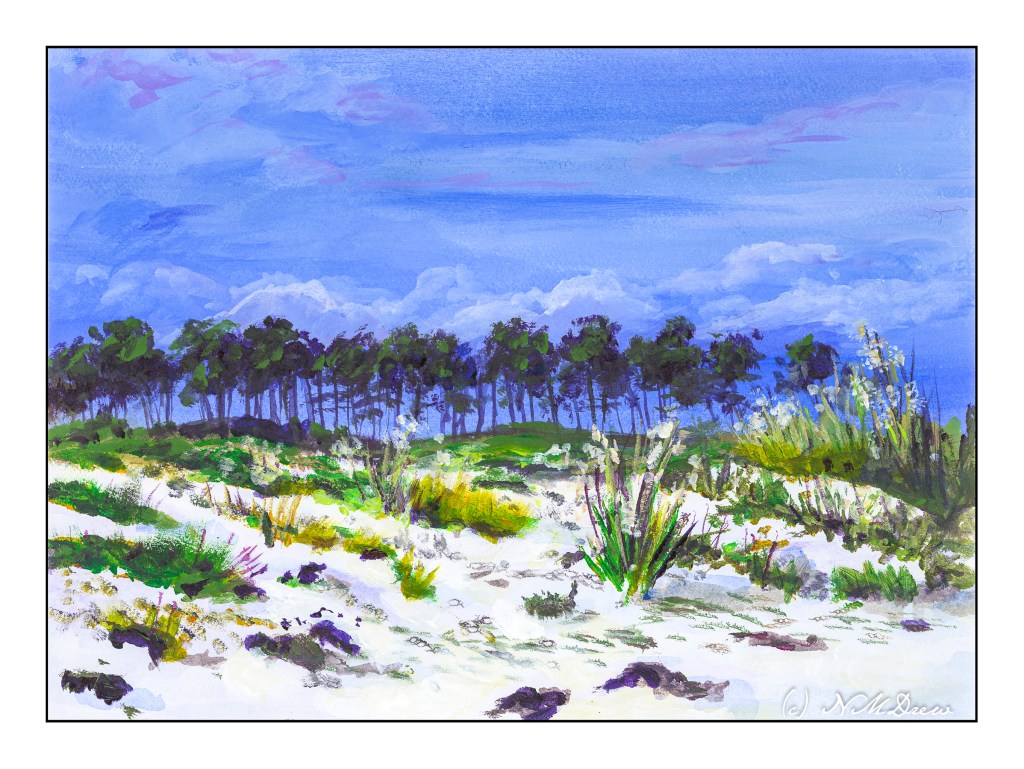
I enjoy gouache a lot because you can rework places and easily blur edges to soften them. That is a lot harder in acrylics. I decided to give it a shot. It worked rather well for the sky, but like gouache, the whites in the clouds darkened more than I thought they would. On the other hand, I did work on the sand a bit, using very thin water glazes for the shadows. That worked out pretty well.
I realize the key to “getting” acrylic painting is to just keep doing it, experimenting, trying. Each painting, successful or not, is a lesson.
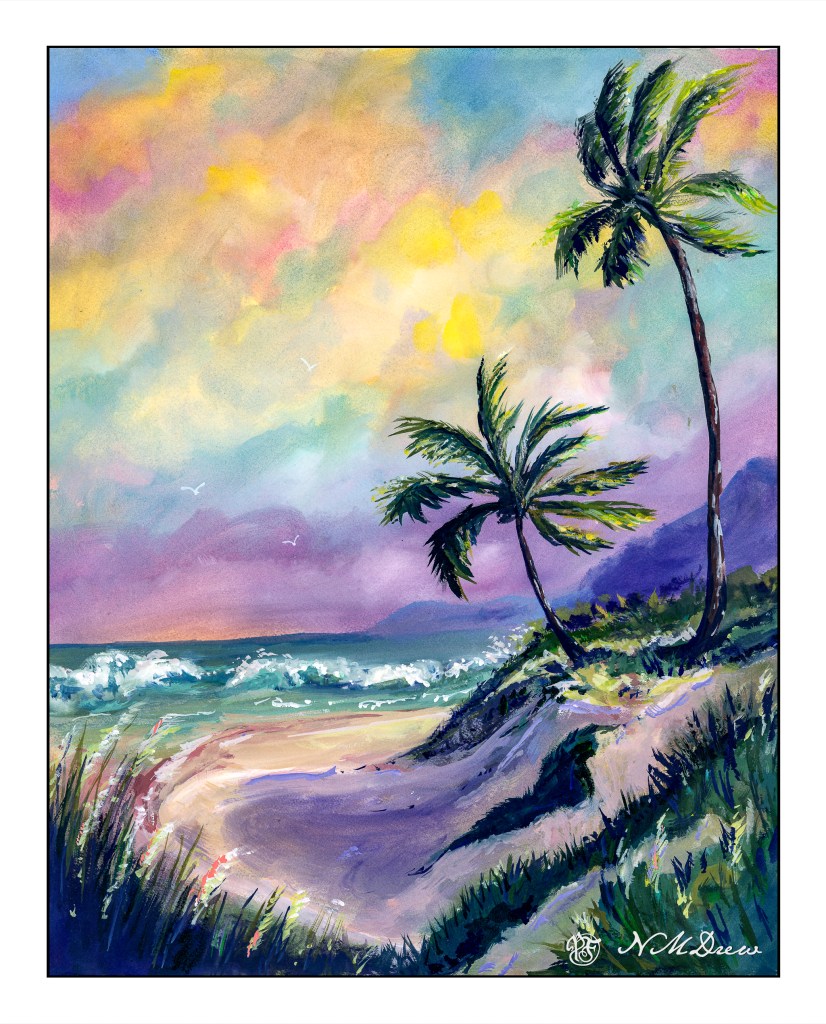
This is a tribute to the African-American painters of Florida known as The Highwaymen. Some of their numbers include Sam Newton, Alfred Hair, and so many others that I cannot name them all. In a time of racial unrest in the U.S., these painters somehow managed to thrive despite the Jim Crow laws of the South, and unfortunately, their work was not appreciated as it should be. However, today we know more about them, and can enjoy their work – the internet is so helpful in that regard.
I love bright colors and cheerful landscapes, and the tropics beckon. Palm trees are alluring and the brilliant light of these areas make colors more alive and intense. The Caribbean is filled with islands and azure seas, trade winds, towering clouds. States such as Florida, on both the Atlantic and Gulf sides, throughout the Gulf of Mexico and down along the coasts of Central and South America have such beauty in common.
The Highwaymen were not untalented amateurs. Some were self-taught, others learned from A.E. Backus. Each painter in this group sought an income otherwise denied them, as well as perhaps a way in which to express the beauty around them. Read up on them – they are a fascinating slice of art history.
As with the painting I last did, “Swamp,” this one is done with watercolors mixed with gouache on 16×20 inch 140# CP Arches paper. I used more gouache this time than I did with the last painting, and it was quite a challenge. I started out with bright colors and a totally different idea of a painting, but as I started blending the gouache with the watercolor, the gouache became a driving force. However, all color represented is simply toned with white or black gouache.
These artists worked in oil on masonite. Oils lend to blending colors more so than does acrylic paint, and I found that the gouache and watercolor worked similarly. I may try to do something similar in acrylic, and expect it will be a serious challenge as acrylics dry so quickly. Often The Highwaymen sold paintings still wet!
This is perhaps the most fun I ever had with a painting. I referred to paintings by some of the artists to see how they used color, photos from the internet of palm trees and Floridian sunsets. The composition is similar to a number of seaside ones, and I attempted to emulate the colors used by the painters for sand, sea, sky, and palms. I hope I caught some of the liveliness and spirit of The Highwaymen. I know I will be back to visit them, and Florida, again soon.
Several weeks ago I started thinking more and more about what I am doing in my spare time. It is then I realized that, for me, the best way to spend my time is to learn new things, in particular, new art techniques. Thus, colored pencils; I signed up for an in-person class with masks and social distancing. I plan to continue this summer with the class.
At the same time, I thought it about time I learned to paint with acrylics, something I always avoided because I just didn’t like the idea of painting with plastic! Add to that, years ago, acrylic paints were not as good as they are now. I was also a considerably more impatient person, and less experienced painter, than I am now. Thus, I enrolled in “Intermediate” painting – I’ve been using gouache, so I have experience!
The first class was yesterday afternoon. I always wonder about teachers and how “good” they are. It takes time to become a good teacher, and honestly, I have found the quality of teachers for arts and languages at adult schools a mixed bag. However, I know I am going to enjoy this painting class. Students I spoke to said they have been coming to the class for 4 years – that says something for the teacher.
I totally enjoyed this first class. People paint what interests them. The teacher helps when asked, offers appropriate and spot on suggestions, and has a really fun personality that doesn’t become overwhelming. Teacher and fellow students are pleasant, delightful, and fun. Can’t go wrong with that, I say.
Because I didn’t know what to expect in class, I decided to bring a kit of paints I’d boughten several years ago, one with about 10 colors, to play with. I used this same kit to begin a painting – after all, play and doing are the best ways to learn. Along with paints and tentative beginnings of a painting, journeying in my cart were rags, water containers, dish soap, brushes, paper palette, an apron, and other bits and pieces.
Above is the underpainting I had done prior to arriving in class. Then days went by – about a week – and I got too busy to do anything with it until I arrived in class.
This is where the painting was at the end of class – nearly there. The sand on the left bank was re-shaped after the river was moved (ah! I feel like God when I get to change geography!) and relocated. And since we are mentioning God, there are two rather eyelike things up in the upper left sky that definitely need removing.
This morning I finished the river, refining this and that. Altogether, I am not displeased for a first acrylic in 40 years. The final painting is the one at the very top. Below you can see them in progression.
The process of learning is often best by doing. By doing, you know what it feels like, you have experience. I struggled here and there, such as with the sky, with the viscosity of the paint, with the shadows and coloring of the sand on both banks. I rather think I like the river in the 2nd version, but decided to change it by adding reflections and ripples for the final version. I took out the “eyes” in the second version, added more fluffy and high-altitude clouds, and worked to create a sense of sand and shadows on the left, along with that wonderfully mucky sand in still water.
This was painted on 11×14 Canson XL, gessoed, and taped to frog board. The kit is by Daler-Rowney, which provides good basic colors for the beginner.