South Toward Cannon Beach

South Toward Cannon Beach

Earlier this month a friend and I flew up to Eugene, OR, and spent about 5 days exploring Eugene itself as well as the Oregon coastline. I took a lot of photos but only now am taking a bit of time to edit them and post them.

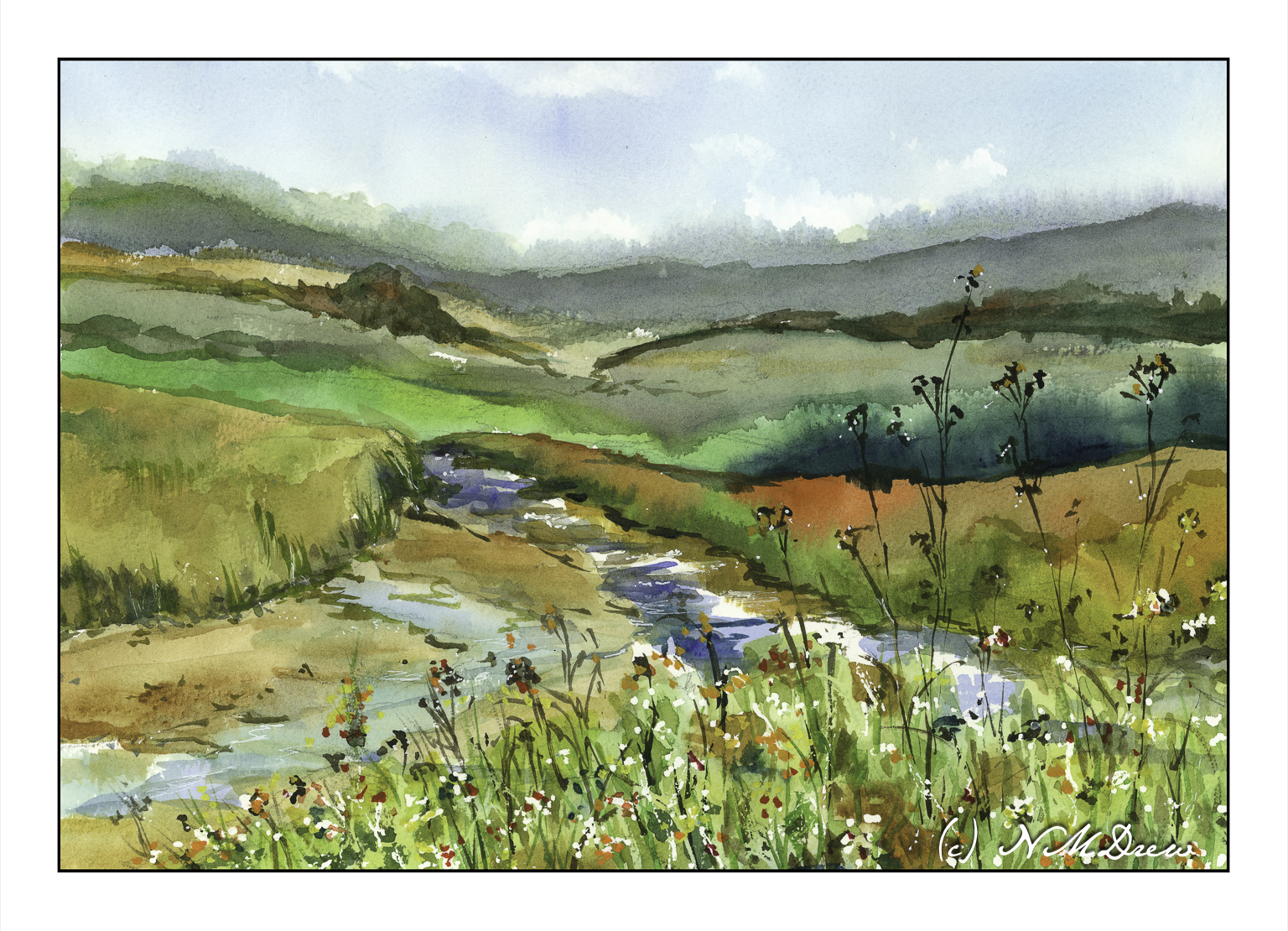
The Oregon coast is known for its sea stacks, as is the coastline further north into Washington and Canada. Some are quite small, others are rather dramatic, such as the one known as the “Haystack” because of its domelike appearance. It’s visible on the far left of the ocean’s horizon line, faint and lost in the atmospheric haze.

I took this picture, merged from two photos, looking southward from Ecola using my G7X, a great point-and-shoot camera I use a lot for traveling. Being a Canon, it doesn’t have the rich colors of Nikon (my opinion, but many agree), but it caught the overcast qualities of the coast beautifully.
North Coast

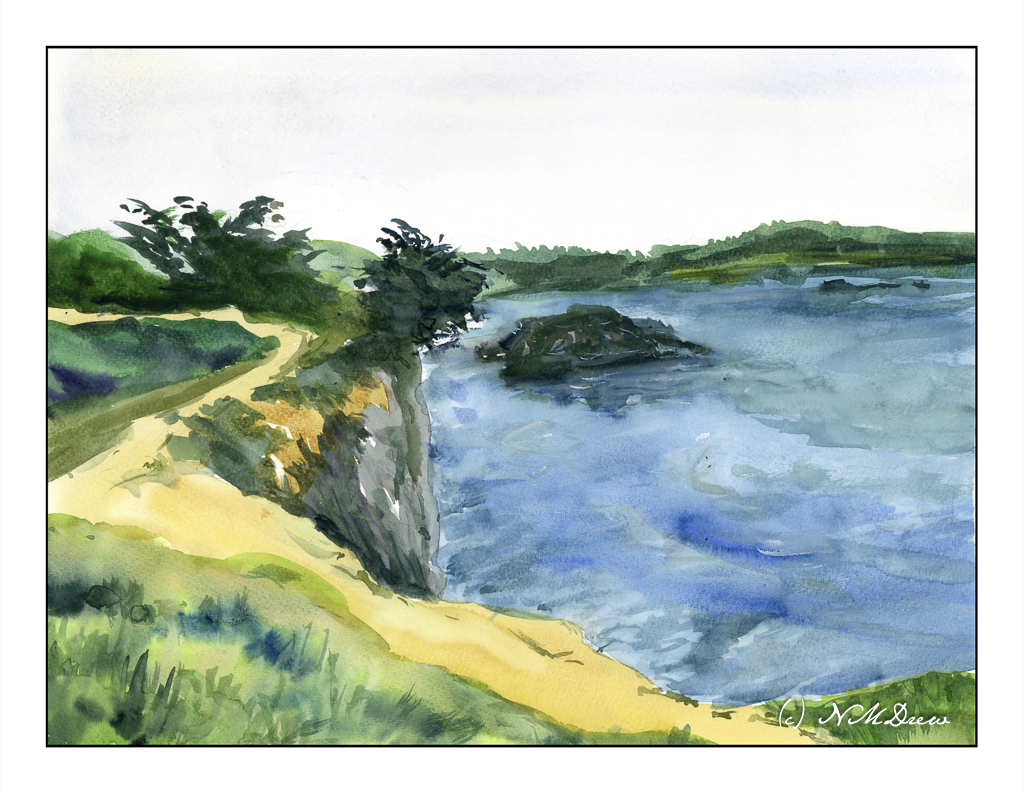
Once more – should I put something in or take it out!?!? The original of this painting, along the northern coast of California, is originally painted with a small island offshore. Looking at it I didn’t like it – perhaps too close to the tree on the left overhanging the beach. Thanks to Photoshop, I removed it.

The above painting is the one that exists in the real world. The one below is the one edited with Photoshop’s “generative fill” – poof! No island.

Because I am feeling kind of spartan these days, sometimes I think I have too much in a painting. Maybe it goes along with limiting my palette of colors?

And my palette? A bit more expansive than the previous, but the subject matter seemed to need a bit. I used umbers, sienna, ochre, Indian yellow, phthalo blue, a touch of ultramarine, a bit of dioxazine purple, and Hooker’s green.

My technique was to use oodles of water as I wanted to see how well the Bockingford non-cotton paper would hold up. It did quite well! Every large area – sky, ocean, land above the cliff – was wet with clean water, and then painted with the colors. The sky had one wash, but the ocean had multiple wet washes. The land in foreground and distance had a big wash later accented with dry on wet.

I am also pleased with this painting, even with my thoughts about the island.

St. Cuthberts Mill, Bockingford 140# CP, 12×16.

And what are your thoughts – island or no island?

Estuary

Estuaries are important connections between rivers and fresh water to the sea. The land may be marshy, the water brackish, and adapt to the influx of waves and sea water and the outward movement of fresh water. Consequently, the estuary provides high levels of nutrients in both the water and the sediment, creating highly productive habitats. Plants, animals, birds, fish, and all sorts of life thrive in the estuaries.

Additionally, the estuaries form a protective barrier between land and sea, but with the loss of estuaries, the damage from the sea increases. A good example of this is in areas where hurricanes and other fierce storms sweep inland, causing great damage – estuaries can survive such storms and recover, but further inland where the land and water are not adapted for saltwater, valuable land may be lost.

Estuaries are found worldwide. In northern California, the Pescadero Marsh Natural Preserve is found near San Francisco, and offers a wonderful environment for hiking and observing birds and plants. Currently, many trails are closed, but the visit to Pescadero State Beach is beautiful, as are many of the beaches found the length of the coast of California.

And, if you didn’t know, all beaches are public in California, so even if someone’s house fronts the shoreline, the beach is there for all. There may be a couple of exceptions to this law, but by and large, no one can tell you that you cannot walk along the shore.

Watercolor, Arches Rough 140#, 12×16.

Beach Day at Low Tide

After a busy several days, including the winding down of my summer painting classes, I needed to do some watercolor and landscape painting! Oil painting and portraiture require a lot of focus, but it is so restful to just think about colors and shapes, as I do in watercolors.

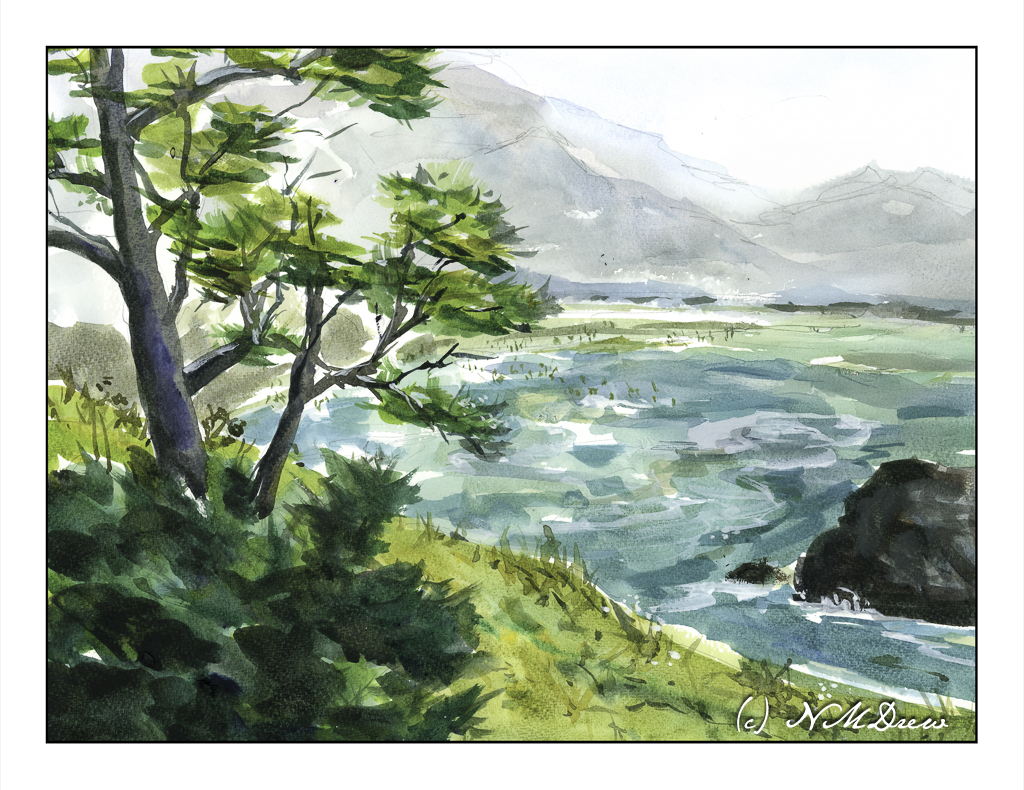
This painting is inspired by travels along the Oregon coastline. I tried to capture both the color of the sea as well as the mistiness of the distant mountains. The little dots representing a beach filled with people was a bit inspired because I needed to do something with some empty space in the middle. Nothing like being the god of your landscape, eh?

Watercolor, St. Cuthbert’s Mill Bockingford paper, 140# CP, 12×16.

North Coast

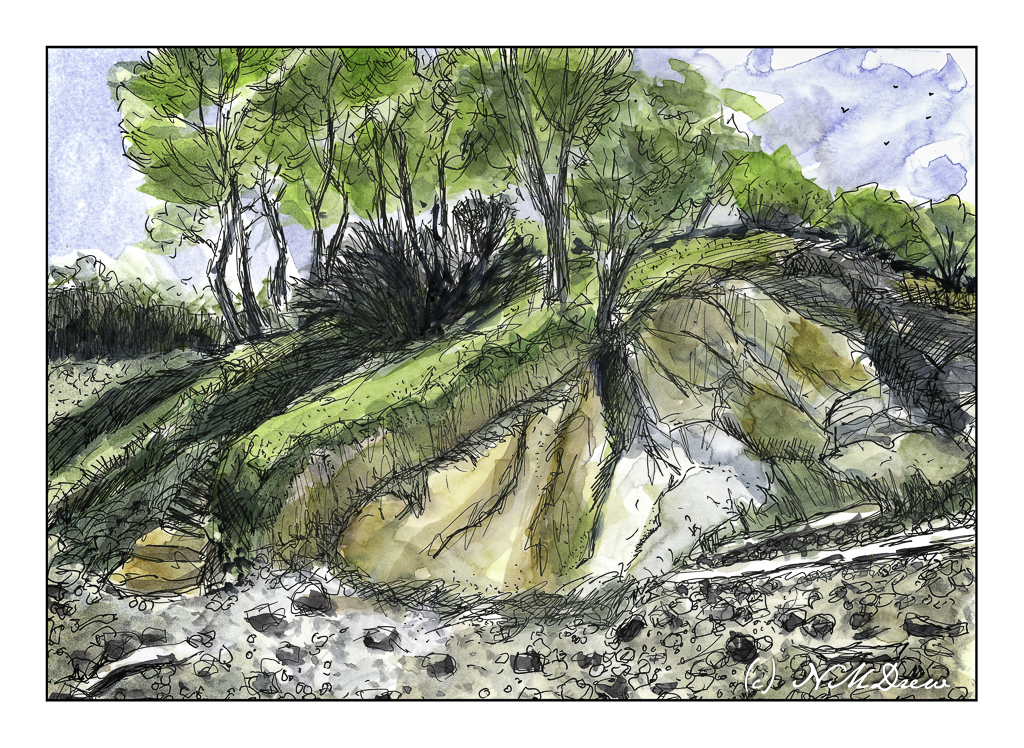
Rocky coastlines are always fascinating because the first time I ever saw the ocean was along a wide, sandy beach with gentle waves. Not so here! You can see the debris – fallen trees stripped to bare logs, rocks, erosion. You can only imagine what it is like during a storm.

Years ago, we drove up the California coast, heading into Oregon and points north. It seems once you hit the central coast, about 100 miles from where we are, the coastline begins to change. Highway 1 leads into Big Sur, that fabled and beautiful land, and it is here you see rugged cliffs. Then, north of San Francisco, you move into the wide beach sands of Stinson Beach and move further along to the rugged Mendocino coast and then beyond. This picture is based on a photo I took there years ago – no idea where we were, but it was stunning.

Ink, watercolor, bristol paper.