3 Pears: A Study in Simplification

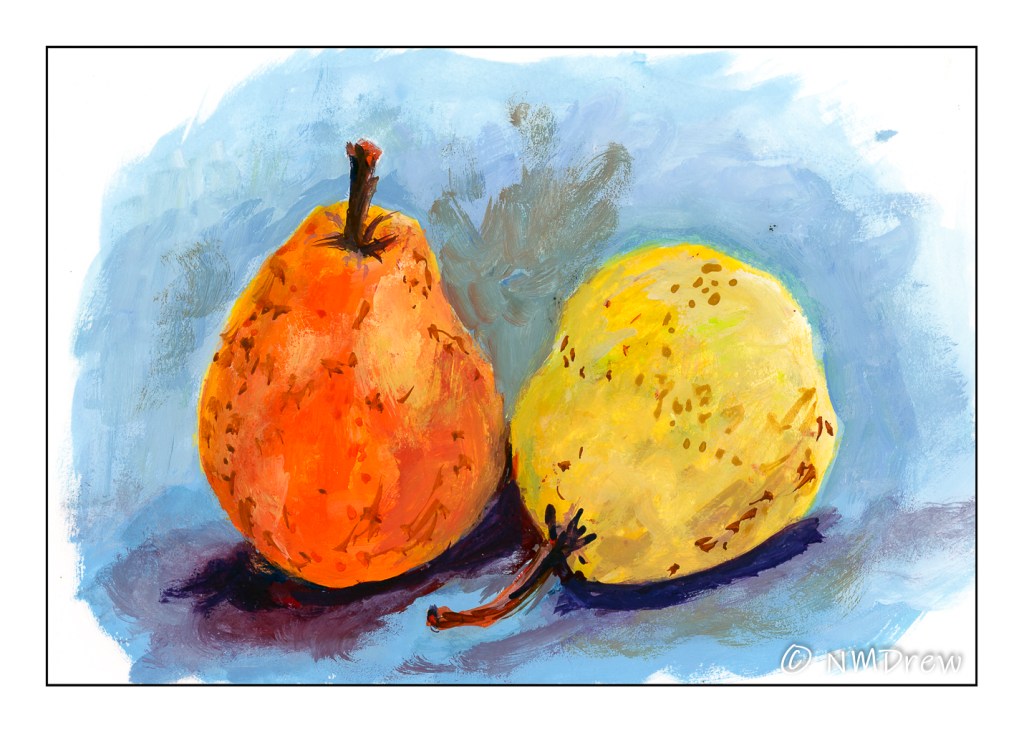
Pretty fancy title for an attempt to 1) take a color photo of pears, 2) reduce the colors in the photo to 16 so that fields of color appear, thus allowing an easier visualization of values, and 3) painting observed fields.

First, let’s put this out there: I really do not like painting outside at this point. I used my gouache paints for this study and had to take the following out to the table on the patio in multiple trips – paints, brushes, water, paper towels, image on a tablet, palette. Of course I forgot this and then forgot that, and it really just riles me up! If I ever want to have a plein air experience, everything needs to be consolidated in one thing to take all the little things out at the same time. Inefficient usage of my art supplies really makes me crazy. It is soooooo much easier to have everything in one place on a shelf rather than having to traipse hither, thither, and yon.

Okay, gripe session over. Using gouache on hot press paper, I used green in different values to depict light and shadow, somewhat successfully. I referred to my simplified image (which kept turning itself off on the tablet – another reason why painting from a reference photo indoors is so much nicer), and worked from there. Some areas of the pears were more yellow, as pears can be, and other areas were a colder green. This did end up showing in the simplified photo, and you can see it in the above painting.

I like to desaturate color photos or paintings to see how they read in black and white. This way I can get a sense of values in the colors I used. In the above painting, you can see that, overall, it worked in the pears. The shadows beneath the pears were nothing special and honestly not something I paid much attention to. Using desaturation, I see faults and areas for improvement. For example, the neck of the middle pear would benefit from more dark shades – middle values – to create a sense of the cylindrical nature of that part of the pear.

This was actually fun once I got into it, despite my frustrations with the outdoor set up. I have to think more about how I go about painting outdoors. The fact is the day was beautiful and nearly 70F for a bit of the afternoon. No wind to fight with. Later this week the rains will return (hooray!), so getting outside was probably the main point! Painting was just something to do . . .

21-24 / 30

I am getting burnt out on these drawings! I decided to take a few days off and will pick up again tomorrow. Since I have committed to 30, I only 6 more to go by 4/17. I think I can handle that!

Day 21

Cannon Beach, Oregon. Figure is too big, some foot prints too dark and too big in the distance.

Day 22

Initially I had drawn this shack so that the beach and waves in the distance were parallel to the edge of the paper. After scanning it, I realized it looked better with a bit of an angle to it. Interestingly, a comment said it made no sense because the ocean is out there, straight ahead. Obviously, too realistic of a person, or someone who hasn’t taken a photo. Really, to me, a very interesting and odd comment and viewpoint!

Day 23

Here is a scene of looking down onto a beach. The distant cliffs look okay, but the descent to the shore in the midground is definitely confusing.

Day 24

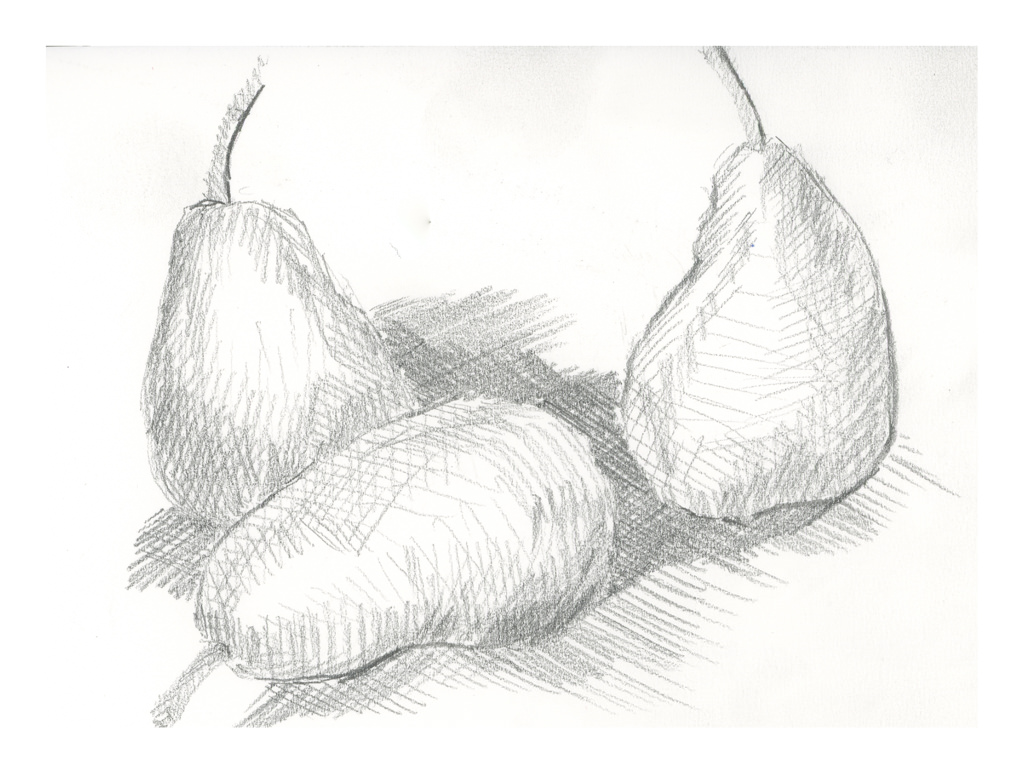
During last Saturday’s zoom meeting, Ian talked about cross hatching. I use it a lot in ink drawing, but not in pencil since the idea for a lot of this 30-day challenge is to limit marks to horizontal and vertical. The idea is to create value studies, not finished drawings. Interesting lines do not make for good value studies of light, medium, dark. However, a simple use of lines, cross hatching, vertical, diagonal, horizontal, helps delineate shapes, such as curves. I based this drawing off a study of 3 pears by Cezanne.

Commentary

These studies are making more sense and getting easier to execute so that shapes have shape, even if not always understandable.

A Pair of Pears

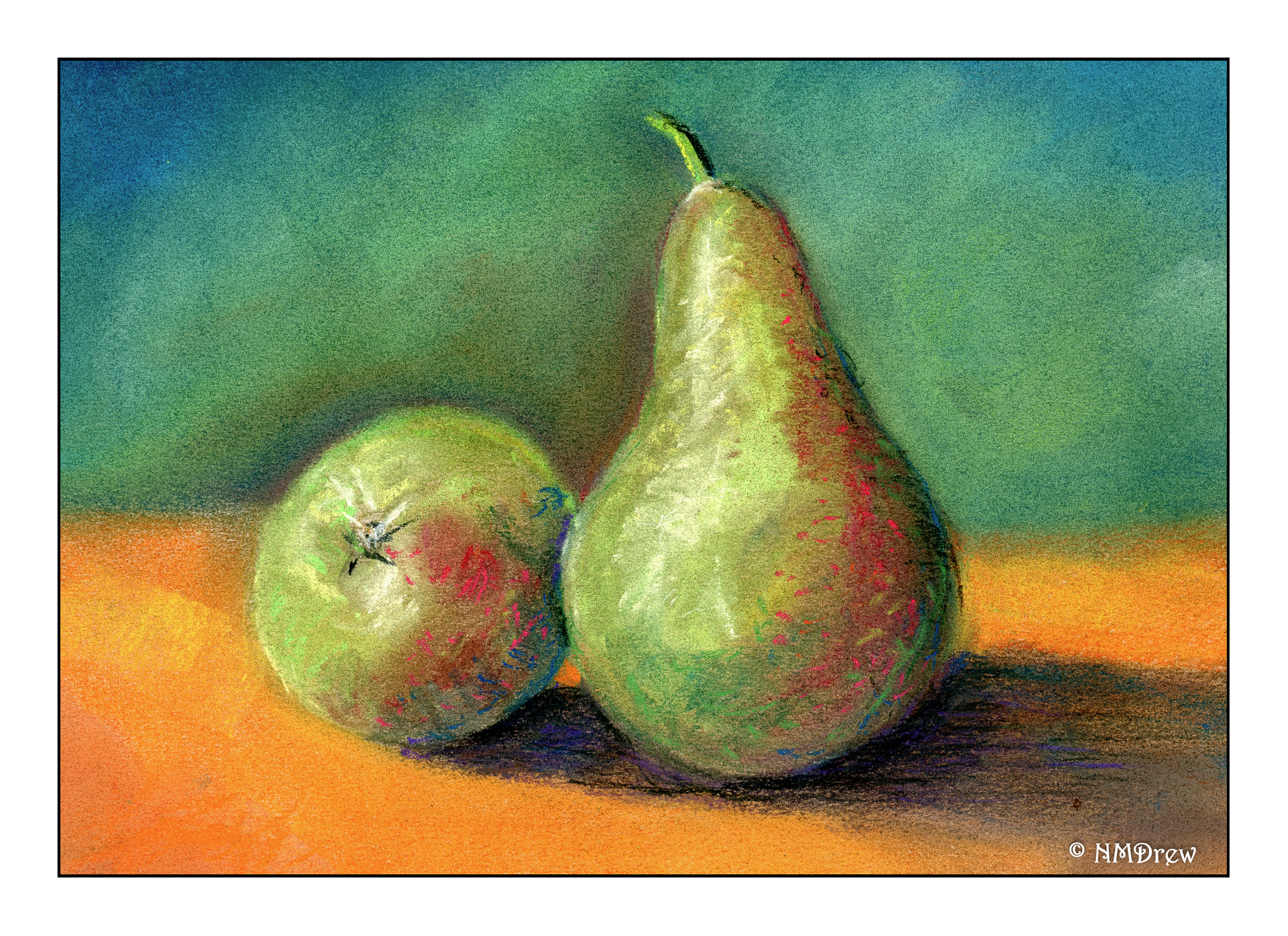
By far, this is the best of the 4 pastels I have done thus far.  It sort of came together.  Watching a YouTube video helped, too, to get an idea about how to proceed.

I used my fingers for most of the blending, and used a baby wipe in between to clean up dirty finger tips.  I also worked the primary background and foreground first, working around the pears before doing the pears themselves.  For the Saguaro painting, I had done the cactus first and then the sky – not really successful as the sky became a bit smudged with the greens.  Live and learn!  I used a torchon / stump for the areas closest to the pears and in the shadows to help isolate things.  I cleaned them off with rough sandpaper – 100 grit.

Another thing I did was consider color and complementary colors in the painting.  I simplified and did big areas before moving into smaller and more defined regions.

Of course, not all paintings will be this successful!  It’s fun to compile knowledge and start using it when creating a picture or painting.  The simplicity of this painting pleases me, but it was a more complex process than may appear because of the multiple layers of color put down.