Adobe

Yesterday was Easter, a quiet time for us. The day was gorgeous and the weather so pleasant – perfect Spring. I love the way the light catches as the seasons turn, and the clear, dry air of the southwest pushes colors to a harshness which at high noon can be glaring, but early or late in the day, when the shadows are long, the light is clear and bright but doesn’t hurt your eyes.
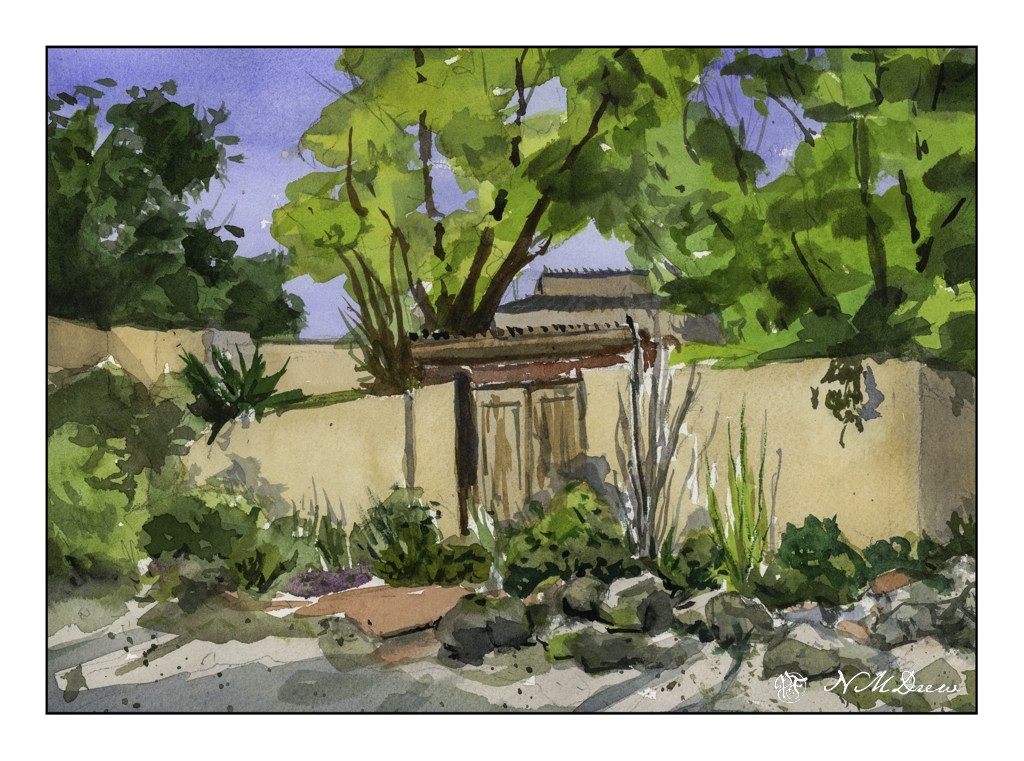
For the past several days I have been working in watercolors on smooth paper to practice pale colors which would work well with ink. I think I am getting it. Easter Sunday, though, I was getting a bit bored with the colors I was using as well as the lack of papery tooth to hold colors. As a challenge, I decided to paint a building. I realized why I am intimidated by buildings – they have straight lines and a jerk of the brush can ruin a good, hard edge.

A few straight line glitches, but I will say I am pleased with what I did here. I took my time and tried to create a simplification of a complex structure that works well with shape, shadow, contrast. I know where I messed up my straight lines, but you can find them and tell me if you like!

Watercolor, Arches CP 140# paper, 9×12.
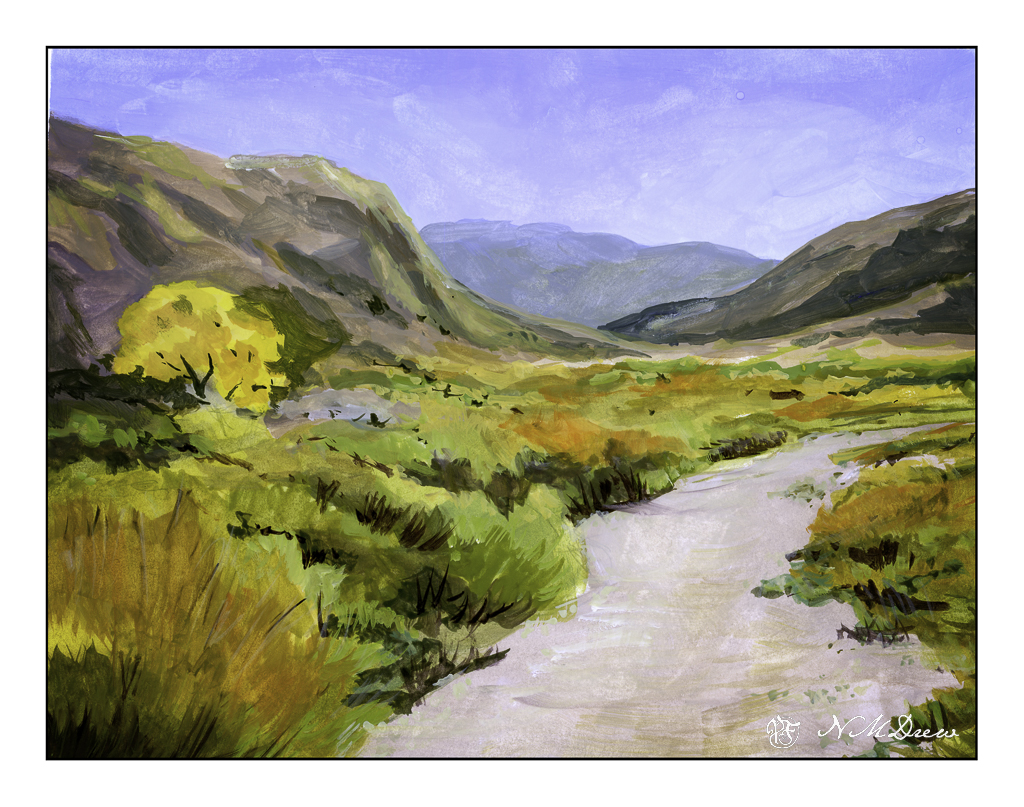
Back Country, Amargosa River

The Amargosa River is located in Nevada and California, moving into Death Valley National Park of the Mojave Desert. As a river, it flows freely both above and below ground, providing much needed water in an otherwise dry climate. Because of it, there are many rare and unusual plants and animals, some found nowhere else in the world. It is managed by the Bureau of Land Management (BLM) to conserve it . . .

This is another gouache painting. I wanted to capture the contrast of the river basin to the mountains it runs through, as well as illustrate the wonderful colors you can see in a desert or riparian area. Dry, rocky mountains, flat areas from flash floods and trails, the occasional tree, low-growing plants adapted to a dry environment. Plant colors are generally pale – sage green being a dominant one as well as bright yellow flowers. Dry air lets you see for miles into the distance and at times you wonder if you will ever see a cloud in the endless blue sky.

Gouache, Strathmore Vision 9×10 140# CP paper.

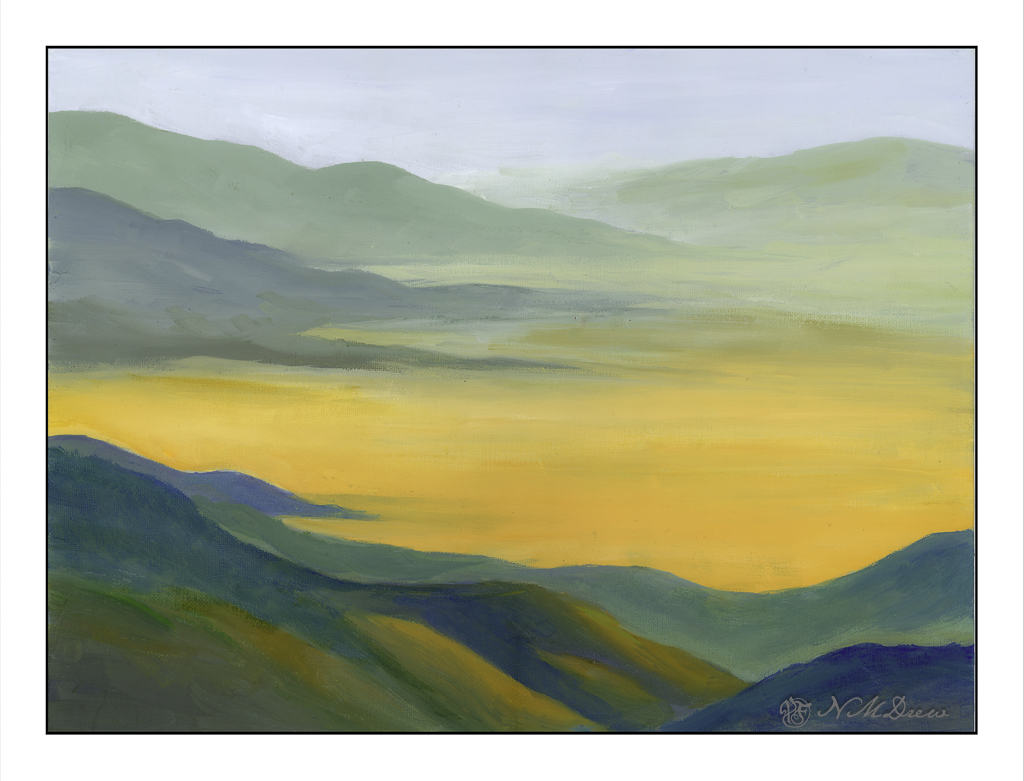
Between the Mountains

One thing I love about California is the fact that the geography varies so much! Oceans with flat beaches, oceans with cliffs, mountains with snow and mountains with pine trees, and deserts stretching flat and hot, surrounded by mountains and creating a secret world fascinating and forbidding. Worldwide, deserts host animals and plants and insects which survive on little water, are stark and seemingly dead – but of such beauty. Deserts are not for everyone – familiar and comfortable landscapes full of trees and greenery are very different. It took me a long time to appreciate a more stark landscape than the rolling green hills and woods of the midwest and eastern seaboard.

This is a painting I have been working on in my weekly class, inspired by multiple memories and photos taken. I had a limited palette of white, ultramarine blue, Indian yellow, and light green. I tried to catch a golden glow as well as give a yellow-orange cast to the desert floor and hillsides – and create a softly blended painting.

Oil, 12 x 16 canvas panel.

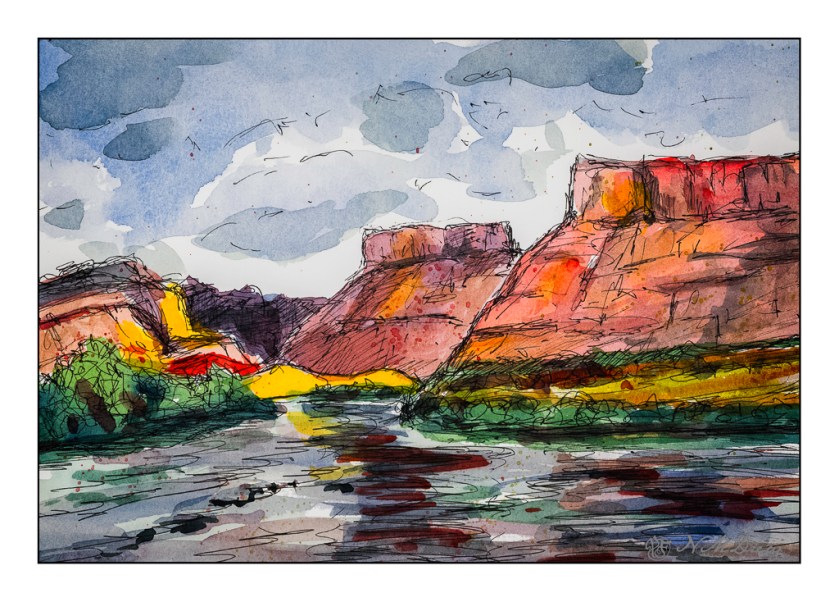
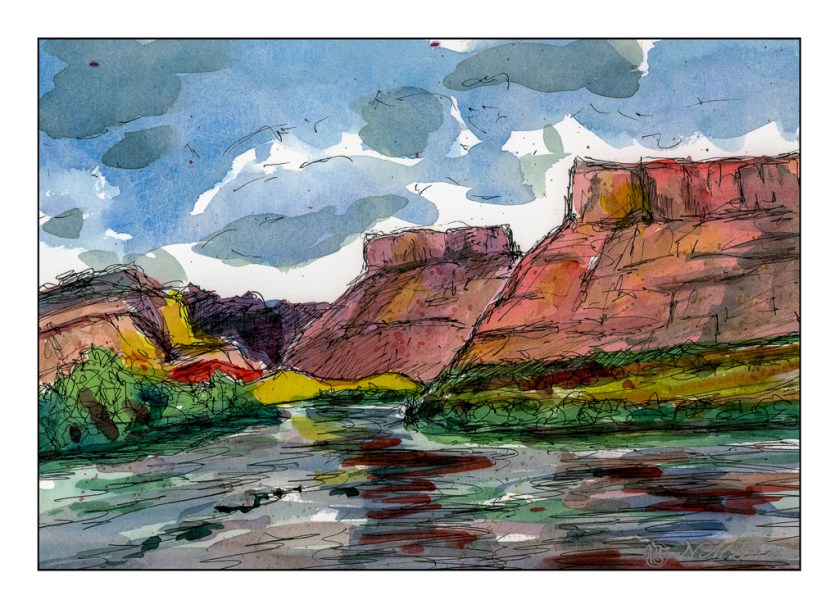
Along the Colorado

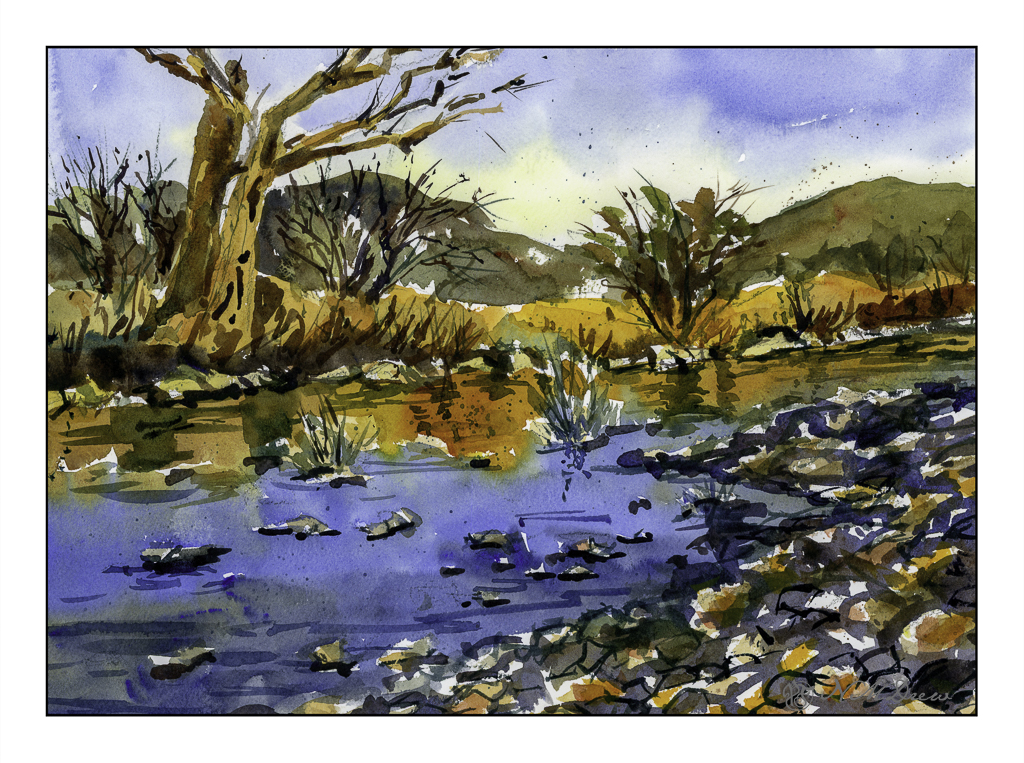
Two different scans, and neither is truly exact. That was planned. I decided to change the mood of the scans – one in Epson Scan and the other in VueScan. Don’t remember which is which. The moods were to be bright and sunny, breaking through rain clouds perhaps, and the other just rather cold and gloomy when the sun has vanished behind heavy clouds.

Above, the warm colors are being pushed – yellow, orange. A bit of glow to try to express that sudden brightness you see when the light changes rapidly because of the weather.

And now the light has changed – potential rain and bad weather. I expect there is a bit of wind, too!

Technically, I drew in the landscape with a waterproof pen, painted, and then drew some more. The mesas’ slopes are a bit steeper than reality as these are about 45 degrees, and in real life, I think they are more shallow, about 30 degrees. Artistic license?

Watercolors, ink, Hahnemuhle 300gsm CP paper, about 9×12.

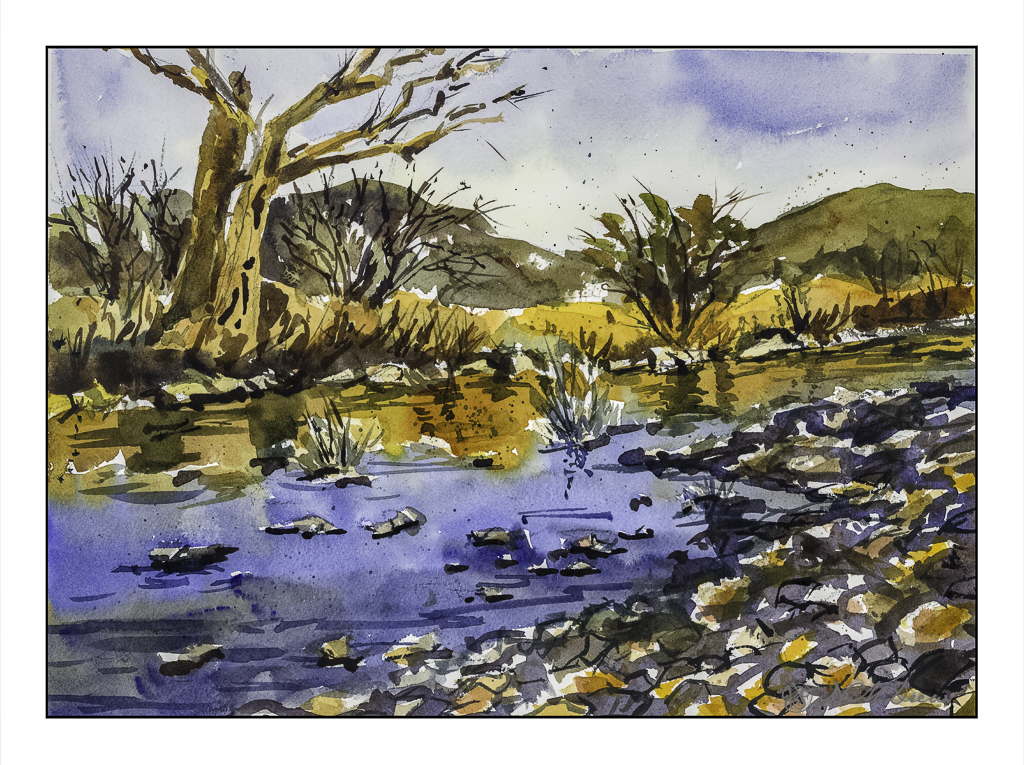
Watercolor Triad – Desert Wash Scene

Well, the electricity is off again. I feel like I am living on a little island because only a few people in my neighborhood are affected. Fortunately, we have our generator! So, light, electricity, internet, and the opportunity to continue with my course on color triads by Shari Blaukopf.

I did the first one, a tropical scene in Florida, and this is the third, the Arizona desert. The second one is winter and since it is cold and rainy outside, the desert appealed to me a bit more. The color triad used here – and easily, too – consisted of New Gamboge (yellow), Ultramarine Blue, and Burnt Sienna. I did not have the New Gamboge, so I mixed Cad Yellow Medium with a bit of Pyrrole Orange to get the color she suggested. These colors are perfect for a late evening in the Arizona desert.

The above scan is with VueScan. It is a bit more subdued than the one below, scanned with Epson Scan. I like both of them, but think the richer colors of the Epson Scan are a bit more to my liking. The warmth of the scene is well done here, and matches my own colors perhaps more closely.

All of Blaukopf’s courses have been a real pleasure to follow. If you like watercolor, I suggest her more than any other online teacher. I never fail to learn something new. For instance, in this class, the golden middle ground, just above the opposite shoreline, included painting the colors up into the trees on the left. From there, at a later point, more detail was added.

The other thing I learned was a really interesting and unique way to do reflections in water. The two colors – golden yellow and then blue – were mixed up in big puddles. First the golden yellow was laid in, with a bead of color at the bottom. Then, with the blue, with space between it and the gold, the blue was brushed in with only a touch onto the golden yellow here and there. This allowed the colors to merge, but not become murky or form blooms. Finally, the darker water of pure ultramarine was mixed with a bit of the golden yellow mixed with burnt sienna.

This triad study was so much fun to do! Time to try some of my own from my own photos.

Watercolors, Arches 140# CP, 9×12. Cad Yellow Med, Pyrrole Orange, Ultramarine Blue, Burnt Sienna.