A Bit of Summer

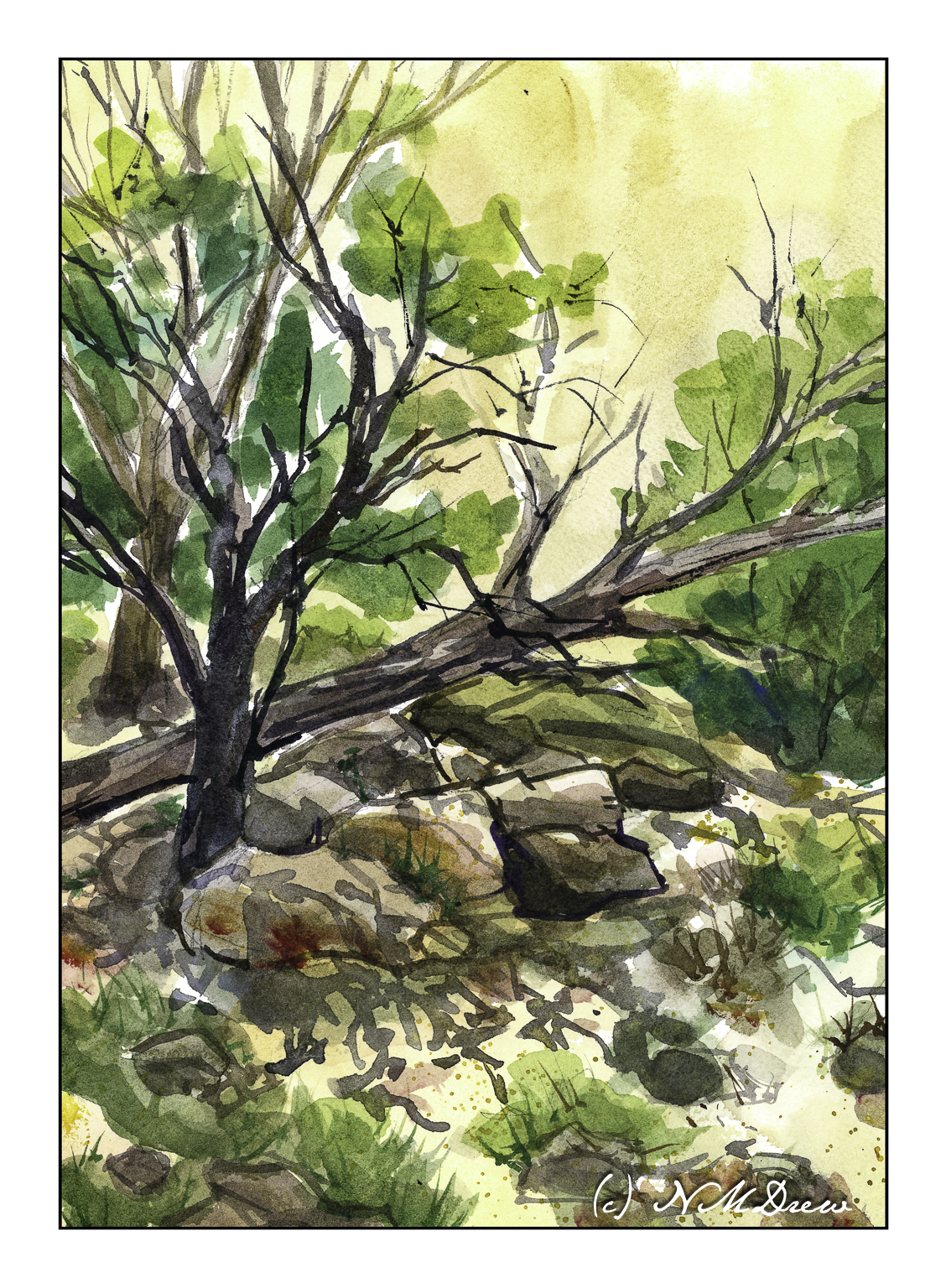
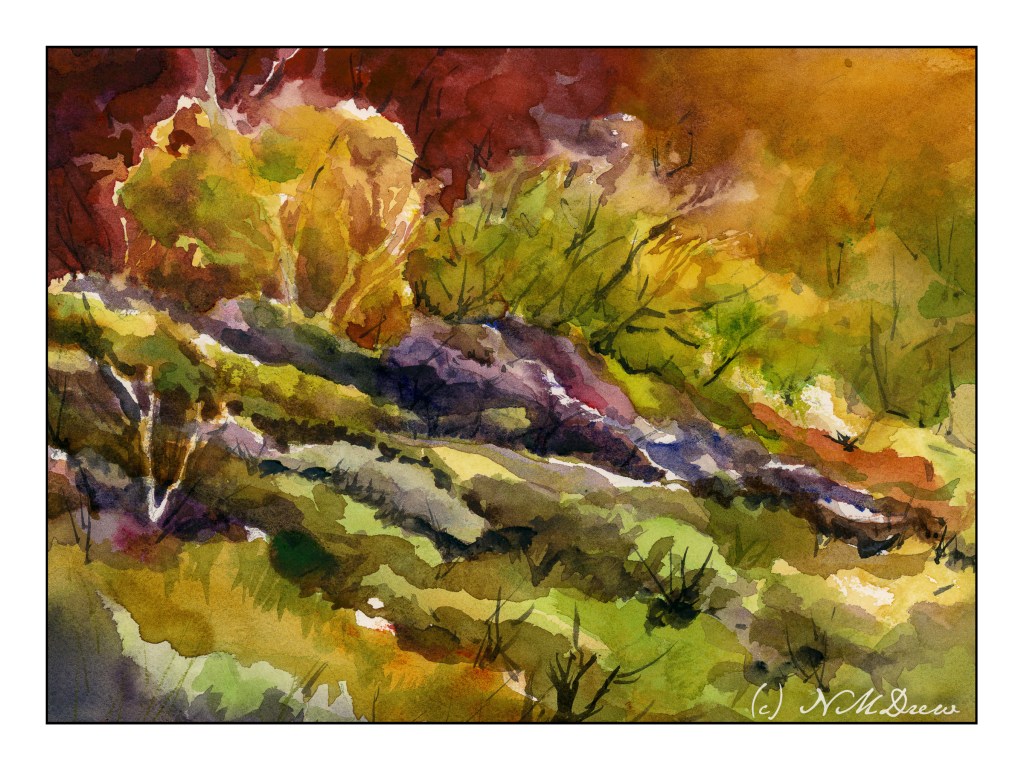
My sister lives in Colorado where they are expecting some nasty, cold, snowy, icky weather. Nice to visit, but I don’t like living in it! As a result, a bit of summer, or certainly a bit of desert heat. As there is rather lush vegetation out in this neck of the woods, or desert, I think it must be early summer. And where I am in California, our 63F day has not been exactly summery. I need some heat – just like a lizard – to bask in. We’ll get it this weekend.
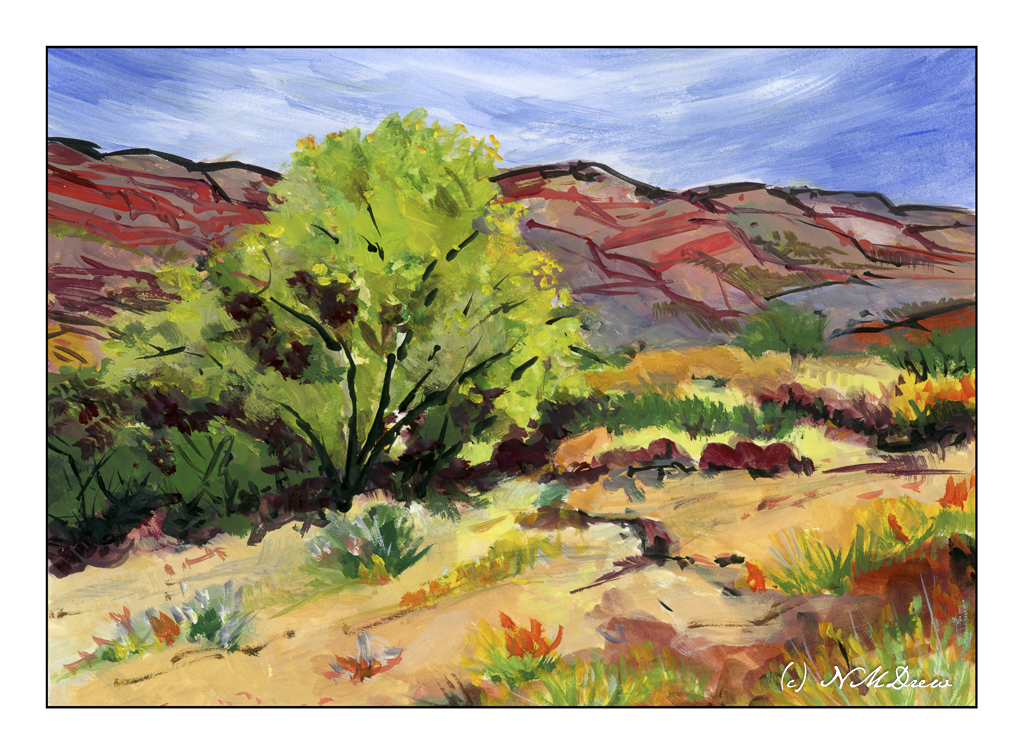
The more I look at the desert, the more I like it. The colors are a challenge as are the rock formations and plants. The light can be harsh and bright compared to the coast. The dirt varies from pale ochre to deep reds and oranges, with everything in between. Even the sky has its intensity and harshness, from sunny and bright to dark and foreboding with the threat of cloudbursts and thunderstorms.

I took my gouache paints with me to my painting class. I’ve missed a number of sessions just because my back was not happy and lifting or carrying became a challenge for several days. My oil paints are heavy to lug around, but gouache takes up a lot less room and weighs a lot less, too. Paper is less cumbersome than canvas, and what I used to paint on weighs very little as well. I made it to class with a shopping bag and my purse for all I needed.

Gouache always makes me happy – the colors are so ridiculously gouache-y! They have a vibrancy which nothing else equals, and so they are fun to use. Some people dislike their in-your-face quality. Add to that, the artists gouache is water soluble and clean up is a breeze. A few soft brushes, some water, smooth paper (I prefer Arches hot press 140# all-cotton paper, FYI), and a fairly extensive color selection. Zinc white is used for mixing, but titanium white is useful where you need a bright white or a bit more opacity. Ivory black is also part of the color selection. Altogether, gouache has a lot of qualities that other media have while have a unique quality all their own. Fast drying, opaque, dilutable, etc., etc., etc.

Try them, you might like them.

Gouache, Arches 140# cotton hot press watercolor paper, 9×12.
Deep in the Canyon

Utah is home to many amazing national parks. These include Zion, Bryce, Canyonlands, Arches, and Capitol Reef. All of these are located in southern Utah and feature many different geological formation. In addition to the deep red canyons, there are ginormous hoodoos and sandstone arches. Rivers and streams run through the canyons, sometimes dry, sometimes filled with raging torrents, other times calm and serene. Flash floods are something to beware as they can come out of nowhere – storms elsewhere can cause floods miles away.

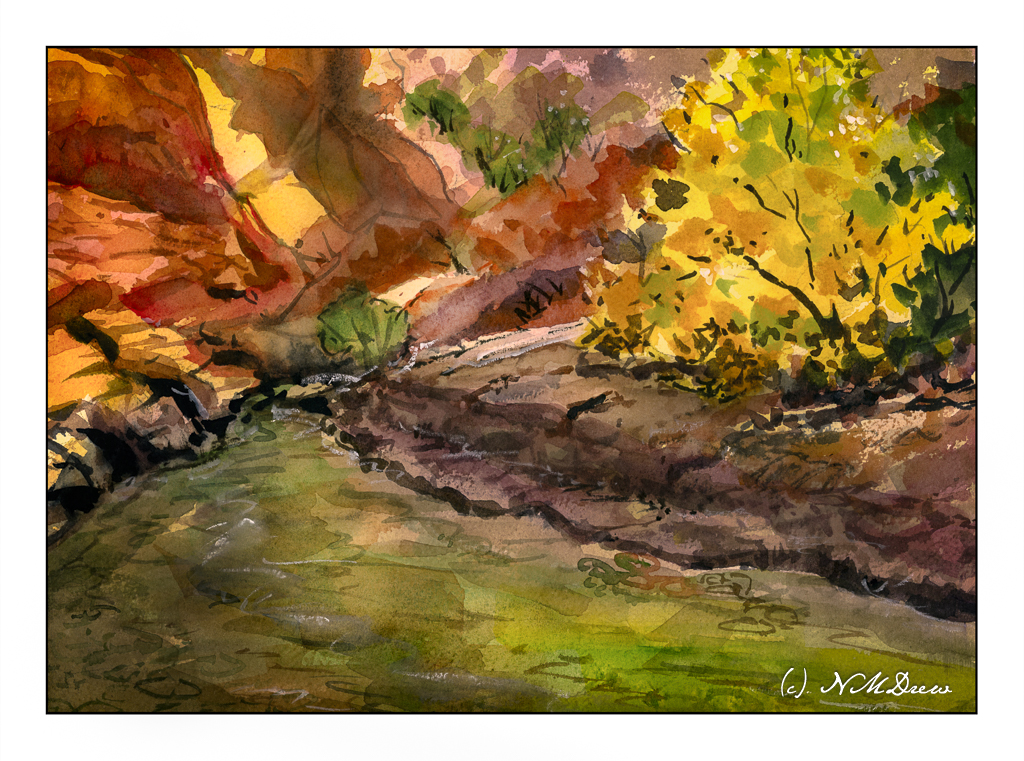
Here, an imaginary canyon in the autumn, complete with red sandstone and cottonwoods and evergreens. Colors are strongly contrasted when the sun slants into the canyon, bright and dark.

Getting the colors and the contrast “just so” is really challenging. I am playing around here with applying thin washes to tint large areas of the paper and then moving to more highly pigmented paint for deeper and brighter colors. I don’t normally paint like this, and it really makes me think a bit. More practice with this technique is necessary to find that fine balance.

Anyway, Arches 10×14 rough 140# paper; watercolor.

Deep in a Canyon

In the corners of southwestern canyons, near seeps, there is always something growing. These places are subject to harsh conditions, but somehow nature has evolved and beautiful trees and plants provide food and shade and protection for wildlife. And me.

I was really drawn to the contrast of the dark trees and shades of green against an ochre canyon wall. The shadows and the trees and brush create complex patterns in what is often a very barren landscape.

Watercolors, Arches 9×12 140# CP paper.

A View of Zion National Park and the Virgin River

Pixabay is home to a lot of great pictures! I used one of them – as you can see below – to create this watercolor. Unfortunately, the scan doesn’t show the real warmth of the rocks as painted very accurately as it could, but c’est la vie.

I chose this subject because the warm rocks on the left and right of the photo move into cooler ones as atmospheric conditions work their magic. The foreground of the photo is very dark and trying to catch the details and put them all in shadows was also a challenge. I also tried to create a focal point for the watercolor, namely the point at which the Virgin River, in the lower middle center of the painting and photo, turns. At this apex I also tried to create some visible interest to lead the eye into the canyon beyond. Of course, the big rock structures also add to this sense of depth.

Painted in watercolor on Kilimanjaro 140# CP paper.

In the Canyon

Another rendering of another artist’s work! This is from a (what else?) YouTube video by Roland Lee, an American watercolorist who paints the national parks of Bryce and Zion with a beautiful and delicate touch.

The subject here, of course, is landscape, but here are more subtle renderings of nature – here, more trees – using negative painting. I added a few of my own touches, of course, but the point of the lesson was observed and learned to a degree. Not easy to do, not easy to follow, but I rather like the results. More practice to come, too.

Learning from a paint-along is rather fun, at times daunting. I used to think of my paintings all as “failures” because I never replicated the teacher’s work. Of course, that is silly, but until I could let it go, as well as become more adept at watercolors and skilled in their handling, my own paintings would be disappointments. Now I am getting comfortable with my own style, if there is one, as well as how I handle everything. Skills are building.

Done on Arches CP 140#, 9×12.

And here is the video to enjoy – Roland Lee is a good presenter – clear instructions and a deft hand. I know I will be looking at more of his over time.