A Bit of Summer

My sister lives in Colorado where they are expecting some nasty, cold, snowy, icky weather. Nice to visit, but I don’t like living in it! As a result, a bit of summer, or certainly a bit of desert heat. As there is rather lush vegetation out in this neck of the woods, or desert, I think it must be early summer. And where I am in California, our 63F day has not been exactly summery. I need some heat – just like a lizard – to bask in. We’ll get it this weekend.
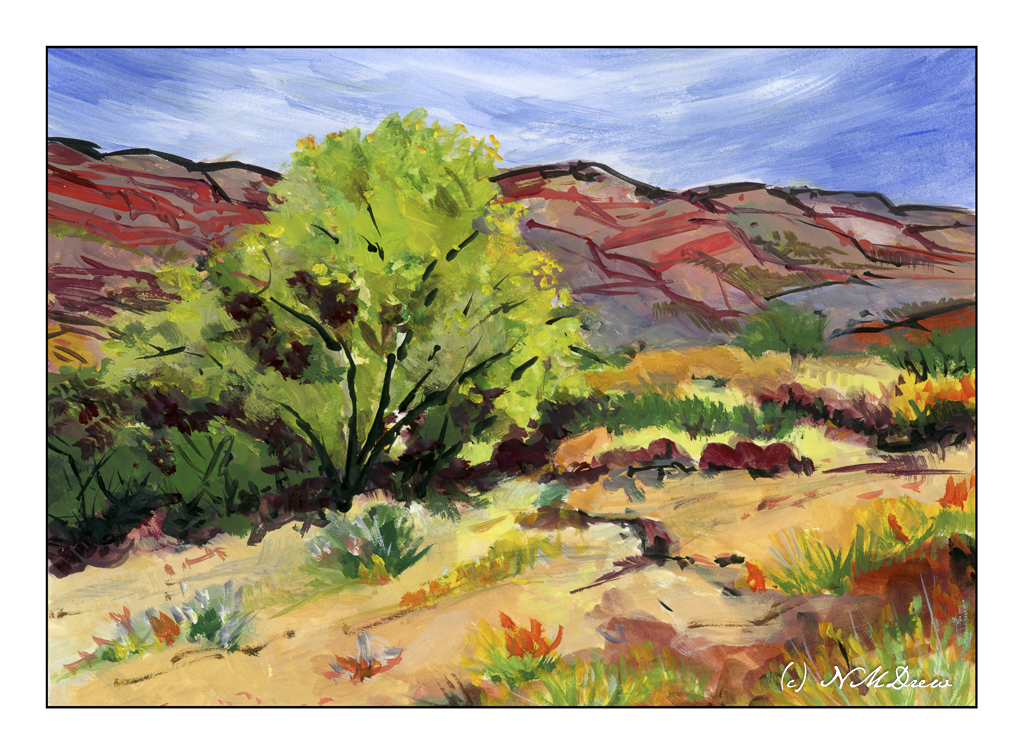
The more I look at the desert, the more I like it. The colors are a challenge as are the rock formations and plants. The light can be harsh and bright compared to the coast. The dirt varies from pale ochre to deep reds and oranges, with everything in between. Even the sky has its intensity and harshness, from sunny and bright to dark and foreboding with the threat of cloudbursts and thunderstorms.

I took my gouache paints with me to my painting class. I’ve missed a number of sessions just because my back was not happy and lifting or carrying became a challenge for several days. My oil paints are heavy to lug around, but gouache takes up a lot less room and weighs a lot less, too. Paper is less cumbersome than canvas, and what I used to paint on weighs very little as well. I made it to class with a shopping bag and my purse for all I needed.

Gouache always makes me happy – the colors are so ridiculously gouache-y! They have a vibrancy which nothing else equals, and so they are fun to use. Some people dislike their in-your-face quality. Add to that, the artists gouache is water soluble and clean up is a breeze. A few soft brushes, some water, smooth paper (I prefer Arches hot press 140# all-cotton paper, FYI), and a fairly extensive color selection. Zinc white is used for mixing, but titanium white is useful where you need a bright white or a bit more opacity. Ivory black is also part of the color selection. Altogether, gouache has a lot of qualities that other media have while have a unique quality all their own. Fast drying, opaque, dilutable, etc., etc., etc.

Try them, you might like them.

Gouache, Arches 140# cotton hot press watercolor paper, 9×12.
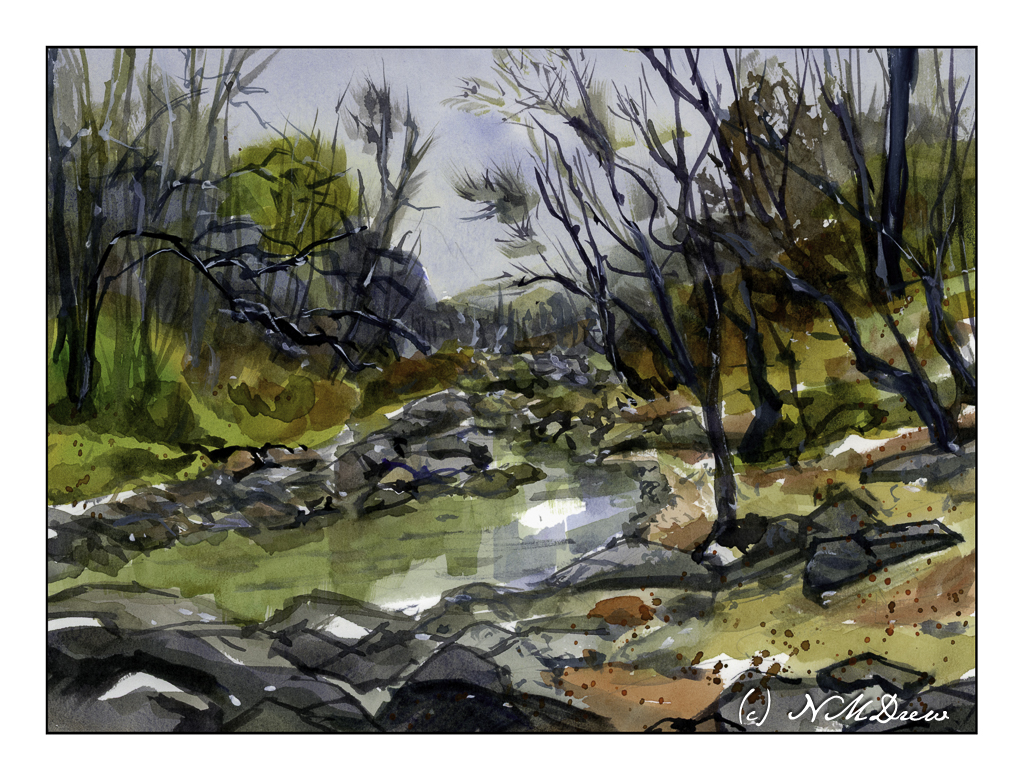
Transition

Even though seasonal changes in SoCal are subtle, elsewhere in the state, further north or at higher elevations, shifts in color and temperature are more apparent. The tilt of the earth changes the light, winter pushes trees to change colors and lose their leaves. Temperatures drop. While today is about 73F, two weeks ago it was in the 50s (no snow, yay!) and nights are chilly. So, let’s celebrate the shift of summer to fall, and now fall to winter.

For me, this is a rather complex painting. Rocks and sandy shore, trees and brush, water, sky and reflections in the creek. Remembering the “rule” – simple big shapes, moderate shapes, details last, I worked by creating the most noticeable areas – or certainly the ones I felt could be the most challenging. This meant the creek in particular – keeping the water marked out. As well as that, the shoreline in the foreground coupled with bits of sandy shore on the right. After that, the rocks on the left and foliage of trees. I was all over the place working larger to smaller, light or dark, and then on to light or dark details.

Overall, I think this painting worked out. Analyzing its complexity and then breaking it into its larger components and areas of color helped. It is still not quite what I would have liked to produce, but much of it did succeed.

Watercolor, Hahnemuhle paper, about 10×12.

Halibut Point

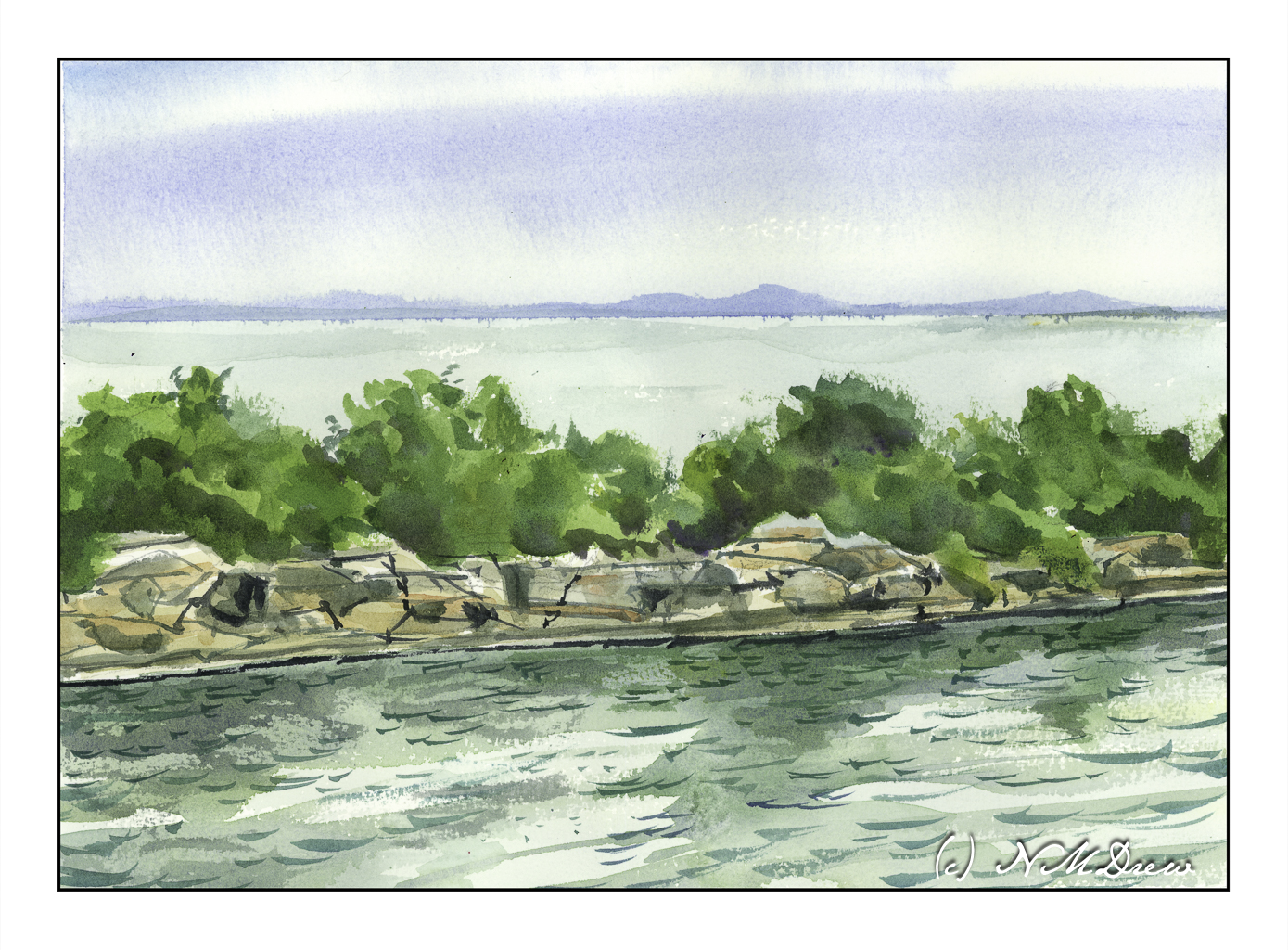
Halibut Point State Park is along the coast of Massachusetts. According to the park’s website:

Halibut Point is a granite edge between the Atlantic Ocean and the mainland. On this rocky coast, people have quarried the robust stone, built military structures to defend the nation, and today the park supports a wide variety of wildlife.


On a clear day, visitors to Halibut Point State Park will be able to see Mount Agamenticus, located 40 miles away in Maine, and the Isles of Shoals off the coast of New Hampshire. You can explore the park’s trails and tide pools, picnic on the rocky ledges, and learn about the park’s World-War II history and the Cape Ann granite industry history.

What draws me to Halibut Point is the quarry, its cliffs, and the geometric properties of the stones themselves. Water is everywhere. All these present challenges as the weather changes or the view changes. The East Coast is definitely different than the West Coast!

My focus here is the graphic quality of sky, land, sea, trees, stone, more water. The scene is quite simple but the detail can be a bit overwhelming – I want to be specific and show every leaf and grain of stone and wave in the water. I needed to make it very simple for it to work, keeping the sky and distant land and sea simple before moving to the middle ground trees.

And, I think it does. I like the way my trees tuned out – masses of greens in different value to add depth and suggest the denseness of its growth. The rocks of the quarry walls are filled with straight lines which can be vertical, horizontal, or diagonal. The color of the stone is a rather warm white to ochre, but light, too, renders it warmer or cooler. Finally, the water itself in the foreground. A calm water, but a bit of wind. Reflections in the water and ripples on the surface. More detail, but hopefully not too much.

Watercolor, Arches rough 140#, 10×14.

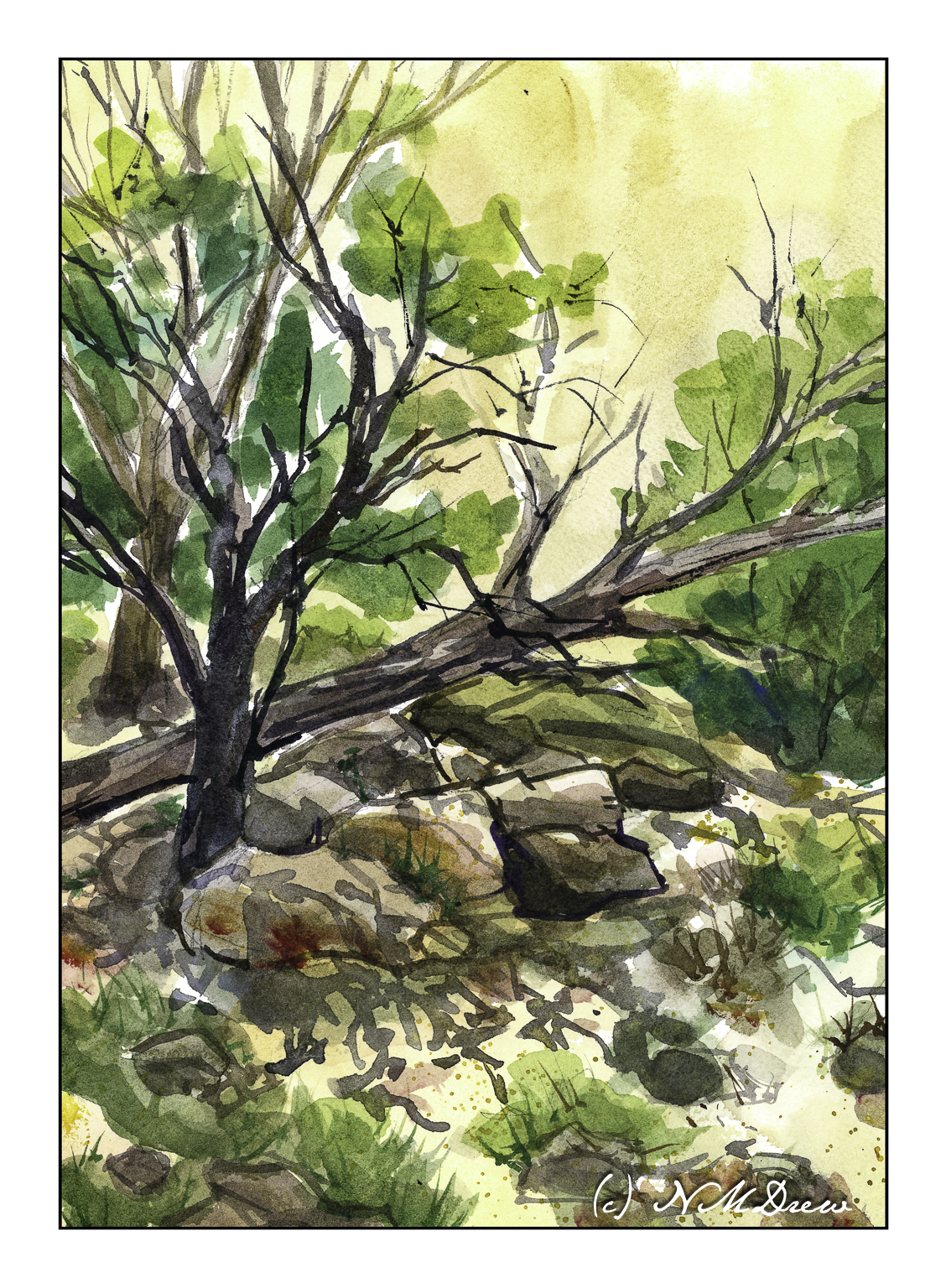
Deep in a Canyon

In the corners of southwestern canyons, near seeps, there is always something growing. These places are subject to harsh conditions, but somehow nature has evolved and beautiful trees and plants provide food and shade and protection for wildlife. And me.

I was really drawn to the contrast of the dark trees and shades of green against an ochre canyon wall. The shadows and the trees and brush create complex patterns in what is often a very barren landscape.

Watercolors, Arches 9×12 140# CP paper.

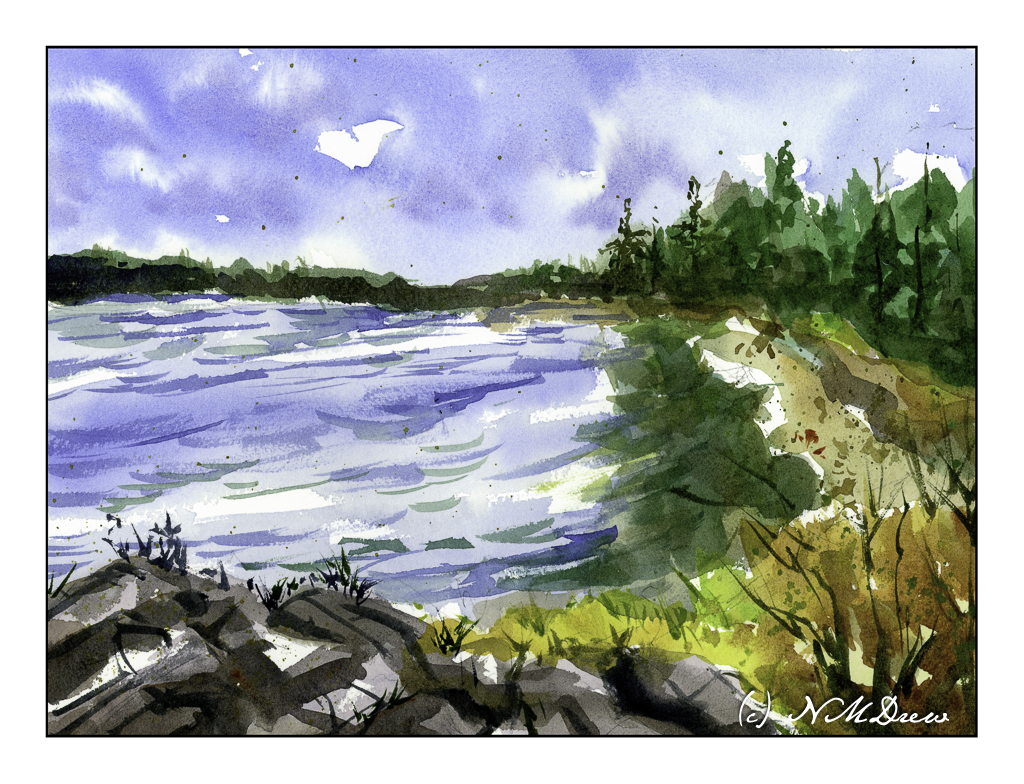
Above the Lake

Lately I am not interested in pretty pictures so much as I am in simplifying or working on specific techniques in watercolor. Here, the main goals were the foreground rocks – making simple but still suggestive of a bit of an outcropping – and a sense of wind on the water and reflections of the trees. Well, the rocks turned out to my liking, the waves on the water okay, but the reflections are a total flop. More careful planning next time around!

Watercolor, Arches 140# CP, 9×12.