Crocus – A Flower I Have Never Seen

I am not inclined to enjoy painting classes online unless they are done in chunks of short amounts of time. Shari Blaukopf’s most recent class, Sketching Spring Flowers, is one such class. In fact, all her classes are very much like this. Her style of teaching and painting are very fresh and direct, and up front, I think she is one of the most talented and unique watercolorists of our time.

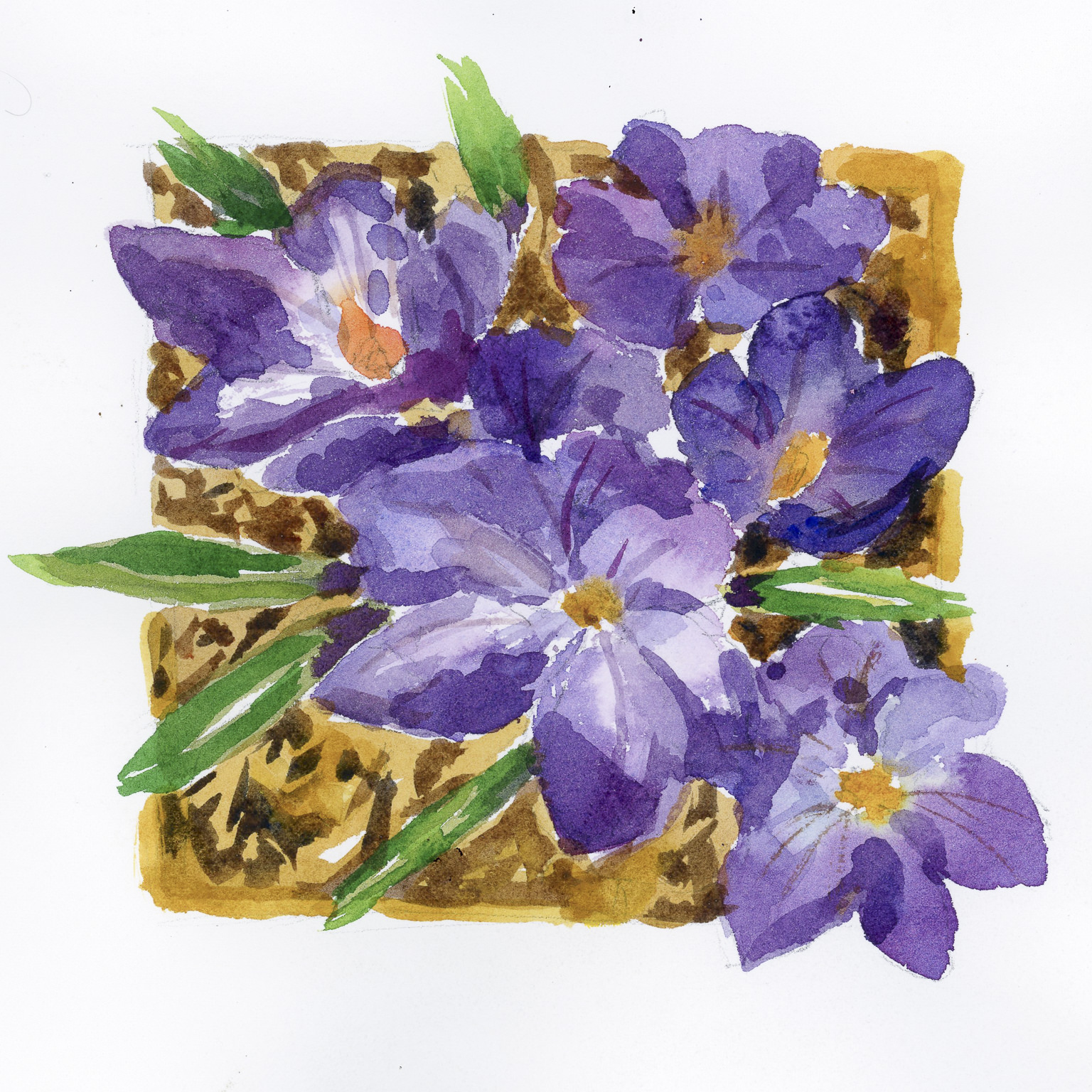
So, taking the first section of the class, we are doing a small batch of purple crocuses blooming in her garden, bright colors after a long, cold Montreal winter. Well, I have lived in cold places, have seen tulips and hyacinths emerge from the snow, but never have I seen a crocus. One day! Anyway, this is the first of her flower studies. I can only hope someone else can tell what it is supposed to be.

My own painting is a bit muddy-looking as far as I am concerned. My paints were not as fresh as hers, but that is not the point. It is more about learning technique. It is hard to paint something from a photograph, and hard, too, to paint something completely alien. However, technique and color mixing are the point. For instance, thick wet paint. Let water do the work in the lighter areas. The experience is the point – but my problem is I am hasty. This painting took me about an hour, watching the videos and thinking about things. I wonder if ever anything sinks in! Despite that, exercises like this are always valuable …

Shari Blaukopf class; crocus; watercolor on Arches CP 140#. About 8×8.

Lone Cherry Trees Along Figueroa Mountain Road

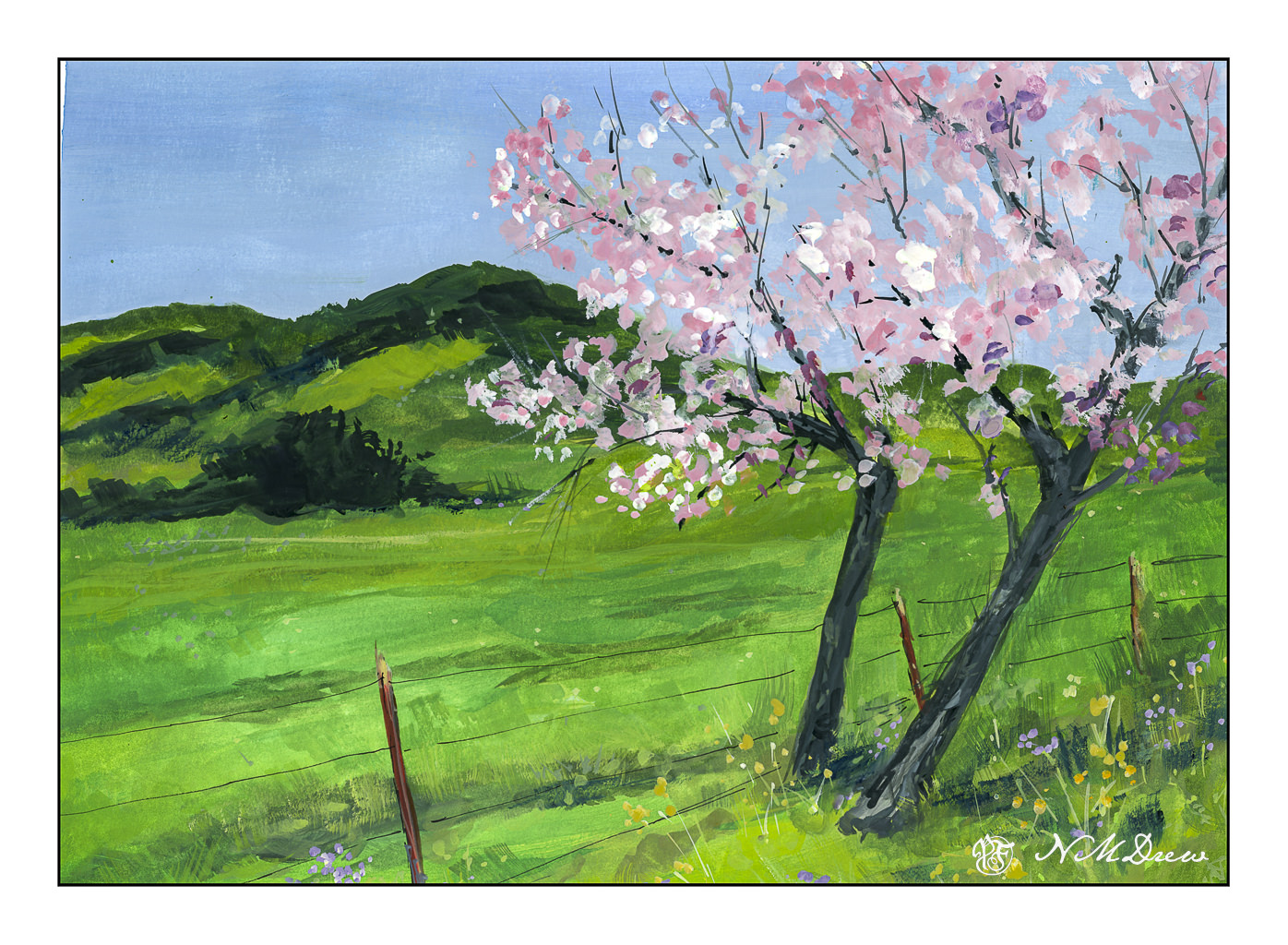
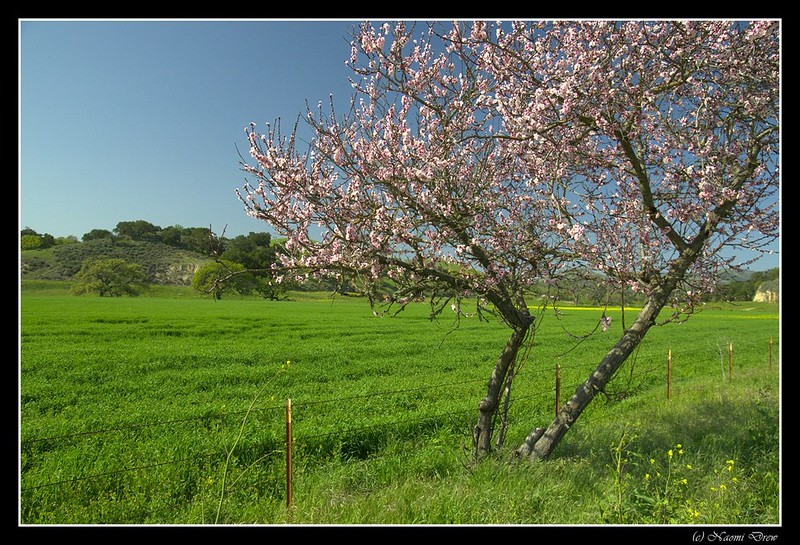
These two trees have long since vanished. I photographed them in 2012 in Santa Barbara County along Figueroa Mountain Road in the early spring. I thought they were a beautiful spot of color against the greens of the California hills, which in themselves, during a superbloom, can be covered in shades of lavender, orange, and gold.

I mixed together gouache paints – whites (zinc and titanium) and some ivory black with my watercolors. This allows for layers to be built and bits painted over, as in gouache, but allows for a bit of transparent and opaque. I’ve done this before and always find it is a lot of fun. Gouache, when thickish, is best with small paintings, but mixing whites with watercolor gets an effect like gouache but at a much lower price point.

The photo – linked from Flickr – is not an especially good photo, but I do feel it catches the beauty of these two trees. When I went back looking for them a few years ago I could not find them, so I am glad I have captured them!

Lone Cherry 3

Watercolor paint mixed with white and / or black artist’s gouache. 11×14 on Canson watercolor paper.

Daisies, Daffodils, and Basil

With a break in the cold and rain, a relapse of my cold, and sheer need to get out into the afternoon sunshine (74F! – 23.3 C!), I sat down and listened to Lord Peter Wimsey on Audible, pulled out a pan of paints, and looked around me. There are a lot of daffodils in various pots, a bunch of daisies, and a basil plant I just bought. The rains have kept me from replacing and modifying my drip system, but as today we probably had the last of the seasonal rain, it is time to reset them as as well as clean up various beds.

This potted basil was the first bit of painting. I wanted to focus on the lights and darks, the shadows and bright spots. It is quite a complicated bit of greenery to paint – enough detail to get depth and separation of leaves, as well as a sense of the direction of light. Pencil first, and then a try at a bit more than a lick and a promise. Not great, but I did accomplish a bit of what I wanted.

Once the basil was done, the paper was flipped over. I have a huge pot where some spring daisies are just jumping up with an enthusiasm that always frustrates my own when I try to paint them! I tried to paint them as masses – but the white daisies are very clear in shape, white with bright yellow centers – and all this in a field of varying green. The sun was in and out behind the clouds, so the two patches look a bit different. Again, complexity being simplified. The one on the right is my favorite as it feels somehow “cleaner” if that makes any sense.

And then, the daffodils. The one on the left is better than the one on the right; the spiky leaves are okay. What I focused on here were colors and their shapes, not a daffodil. The same with daisies on the right. This meant I did not use pencil, but painted directly.

Altogether, a few hours in the afternoon spent playing and relaxing. Some success, some failure.

Watercolor, 9×12 Arches CP 140# paper.

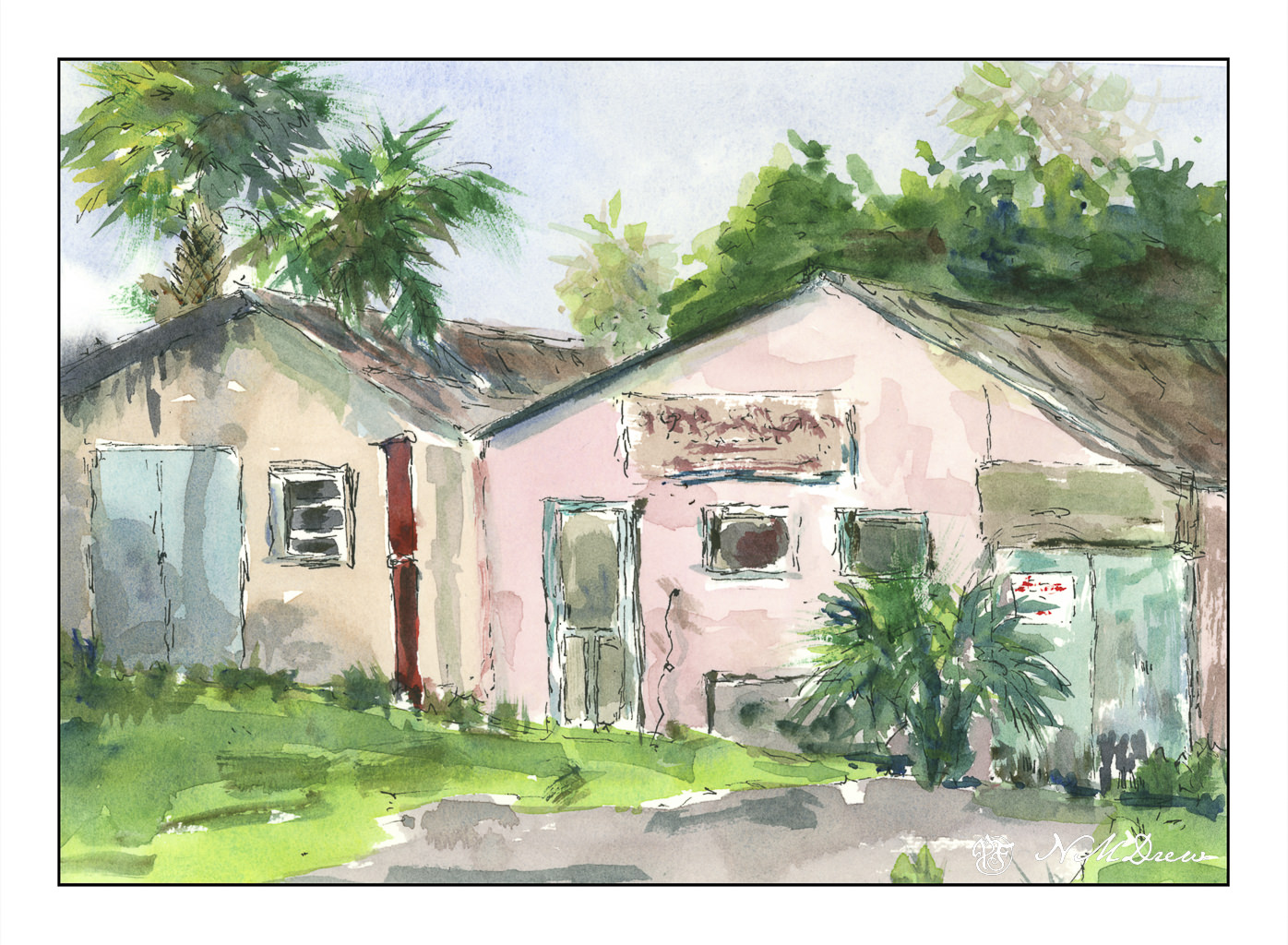
Abandoned

Yesterday’s splish-splash was fun, and it seems that I need to take time to paint in watercolor and acrylic as I work toward mastery of oils (on some level!).

I love watercolors, and some days I find I have no patience and just do not want to be too serious. This is when play and messing around are best. Because of yesterday’s madcap painting, today I felt calm and inclined to taking time to pay attention to detail and think. Watercolor really does require thinking as you cannot correct a lot of mistakes.

When I draw with ink and then add color, I never use a pencil to create the rough outlines. Ink and I just get along really well, and usually proportions and details are sufficient to get me started. After painting, I go back and add more ink in areas I think need it, but as today was a minimal ink day I used the watercolors to create more details and information. It is also interesting to note the amount of time a painting takes – sometimes hours, sometimes minutes. I spent about 90 or so minutes here, and am pleased with the results over all.

9×12, Hahnemuhle CP 140#, watercolor.

Storm Break

Heavy rains and foreboding skies give way to ragged clouds and brilliant blues as the storms recede. No snow here, but memories will do! I tried to express this sky in the distance, beneath the blue and white with the dark clouds moving away. Not so sure how it reads, but you can decide that. Could be trees, could be clouds, could be space ships. And there is a river behind the trees and the snow across the way.

Kilimanjaro Natural White Rough, 300#, Rough, 12×16.