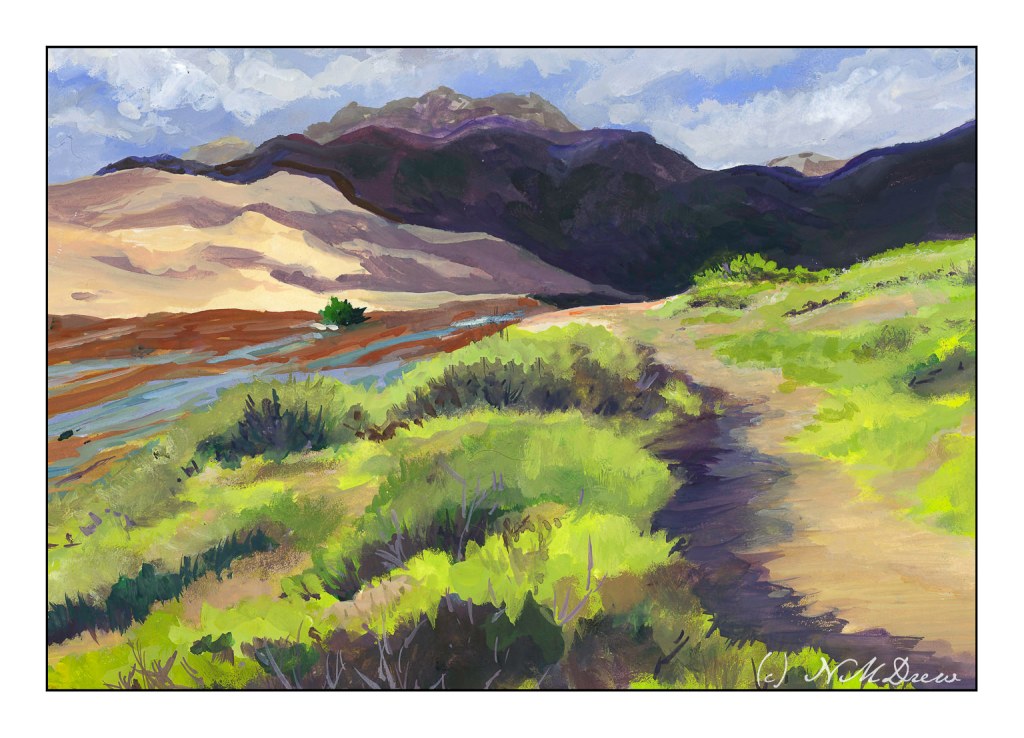
The tallest dunes in North America are the centerpiece in a diverse landscape of grasslands, wetlands, forests, alpine lakes, and tundra. Stay on a moonless night to experience this International Dark Sky Park’s starry skies.
I never ceased to be amazed by the beauty of the natural world.
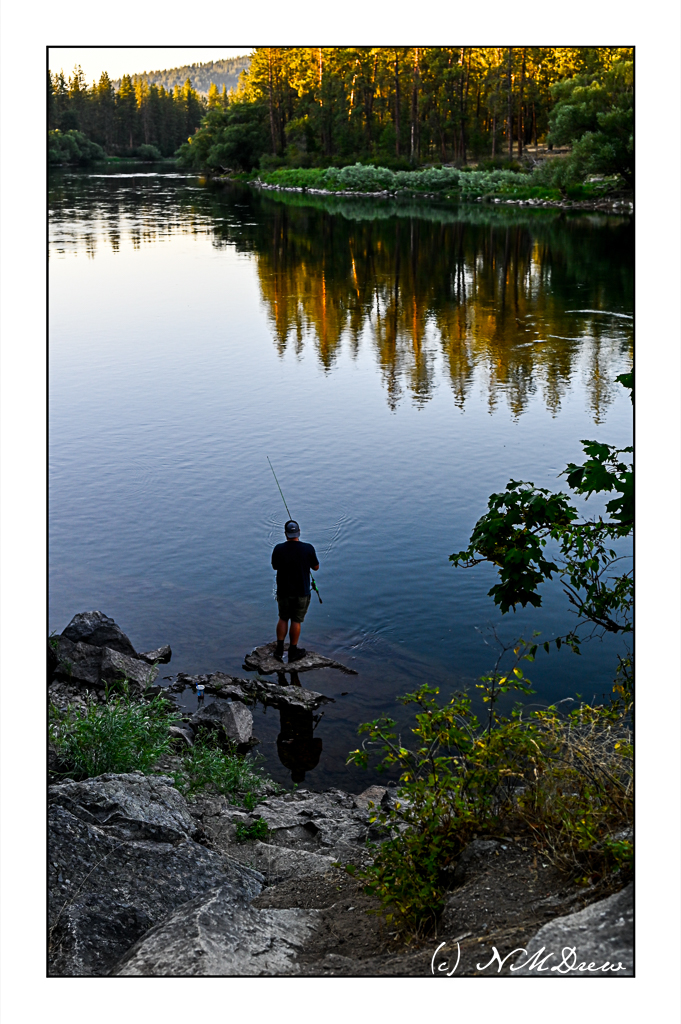
High summer, early evening. What more perfect time of day to take a stroll along a river’s edge, enjoying the reflections in the water, the lowering sun, and sweet scent of a the piney woods?
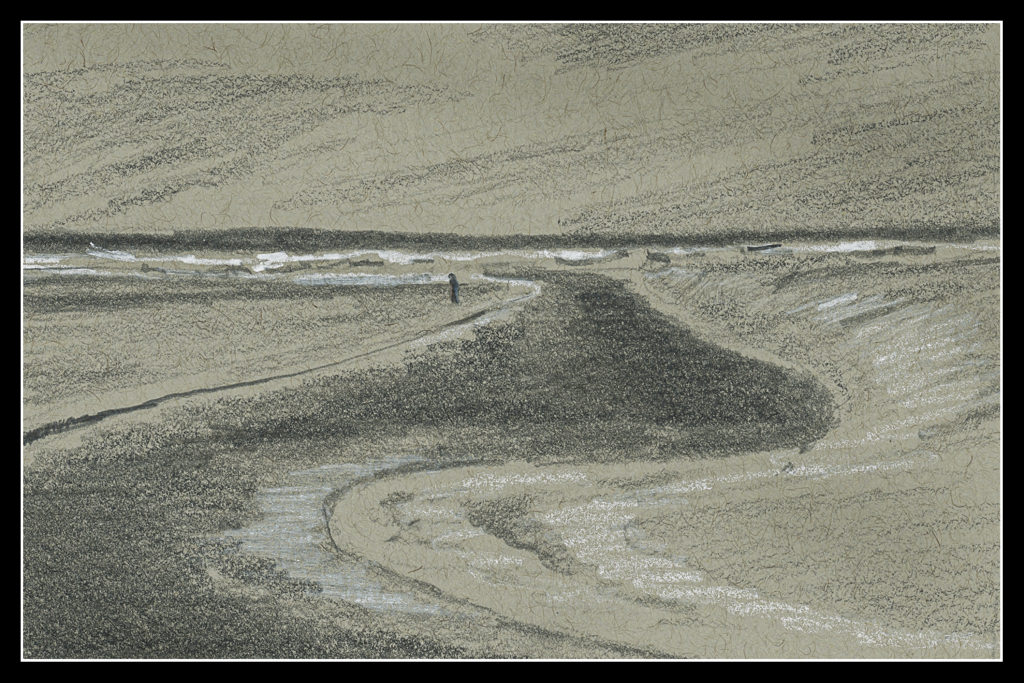
Again, behind on the 30-Day Challenge. I do see the results. For instance, this drawing is very simple, done on grey-toned paper. It’s not an especially exciting picture, but I am beginning to think differently! That is the whole point.
What are the changes?
Focal point of the picture. Here, the lone figure.
The lines of the estuary into the distance.
Contrast – white (light) sand, crashing waves on shore.
Line direction to show changes in terrain, vertical, horizontal.
This paper – the grey – is very toothy, and the result is the lines are not very smooth. Midtones are a bit difficult to achieve – that is supposed to be represented by the plain paper – but that just doesn’t really seem to fit into my brain. This makes it difficult, challenging, and rather a bit of a visual tweak.
Overall, the point in these studies is to look at values, and to simplify. It is not easy as I am used to doing detailed work in pencil. Making simple marks on the paper which interplay well is difficult. “Noisy” marks distract from the point of the value study. In other words, lines which are scribbled and curly distract from the values. Value, value, value!
When I first started to paint in watercolor – like when I was a teenager! – the advice was to use a brush bigger than what you think you need. Yeah, right. Over the years, I have resisted this, but lately I have been doing the majority of my painting with a 1.5 inch flat brush. From there, different brushes with different ideas in mind.
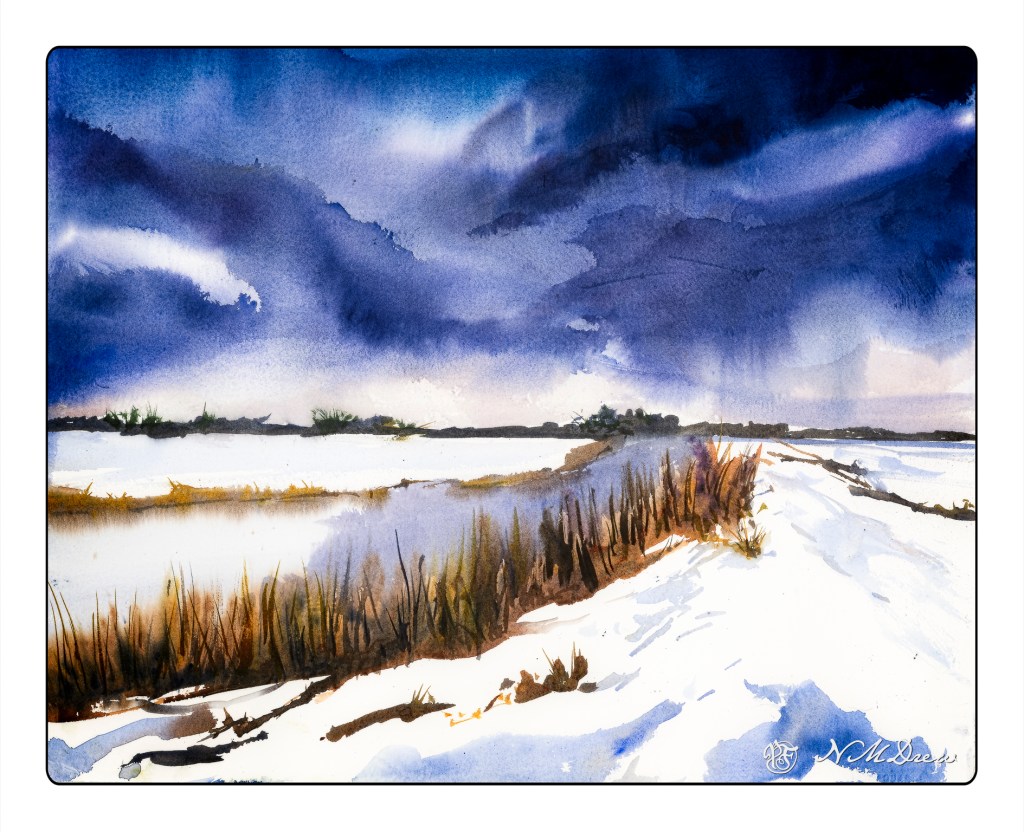
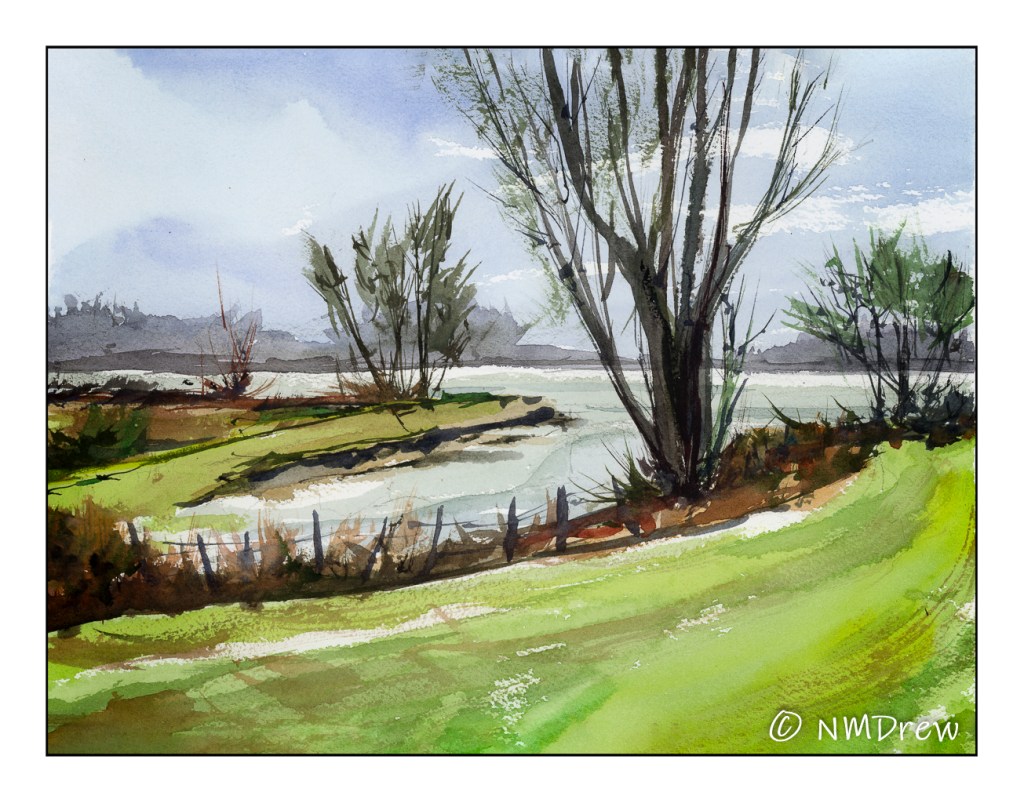
Here, 16×20 CP 140# Arches. I sponged the entire paper with water and then set in the sky. From there, the water and grasses along the shore, working to get blurring of colors into the wet paint. Then, the horizon with the same 1.5 inch brush. I let it dry.
From that point, it was a matter of thought. Initially, the sky dried to a pale color, so I laid in more dark paint for the sky, using a spray bottle to move the paint around, and holding the painting by hand, tilted the paper this way and that to run the paint in various directions.
Looking at it upside down always gives a new perspective, sometimes good, sometimes not. I added some dry brush for the weeds, and used a wet mixture of blues for the snow shadows. I also painted a darker version of the same snow blue into the distant water, moving it into the weeds / reeds. Then, more dry brush once the water had dried to overlap the paint I applied.
This is a stronger painting than some of my more more recent ones, and I will credit the large, flat brush forcing me to work simply. It’s actually much more fun, and easier, in many ways, because I am not getting finicky to the point of crazy.
This is a week for meeting up with old friends! After working in acrylic for several weeks, having eye surgery, and not doing much artwork of any kind, it felt great to do gouache yesterday, and this morning, watercolor.
It is interesting how some days just push me to the limit in frustration and dissatisfaction with what I do, and other days just move along in a calm and serene way. Why is this? My mood was patient and willing to wait today, whereas on other days, freneticism is the dominant emotion. I think watercolor especially requires a serene approach, more meditative than other media, simply because once the mark is made, it is there. With gouache and acrylic you can hide your messes a bit more easily!