I don’t like flies. I have a couple buzzing around. Mosquitos are worse. So, in my irritable mood, a few poems recognizing the fly, for whatever reason!
The Fly – by Ogden Nash God in His wisdom made the fly And then forgot to tell us why.
The Fly – by William Blake Little fly, Thy summer’s play My thoughtless hand Has brushed away. Am not I A fly like thee? Or art not thou A man like me? For I dance And drink and sing, Till some blind hand Shall brush my wing; If thought is life And strength and breath, And the want Of thought is death, Than am I A happy fly, If I live, Or if I die.
Summer Serenade – by Ogden Nash When the thunder stalks the sky, When tickle-footed walks the fly, When shirt is wet and throat is dry, Look, my darling, that’s July.
Though the grassy lawn be leather, And prickly temper tugs the tether, Shall we postpone our love for weather? If we must melt, let’s melt together!
Summer is ending, but birds sing, bees buzz, flies annoy, the beach beckons, and life goes on!
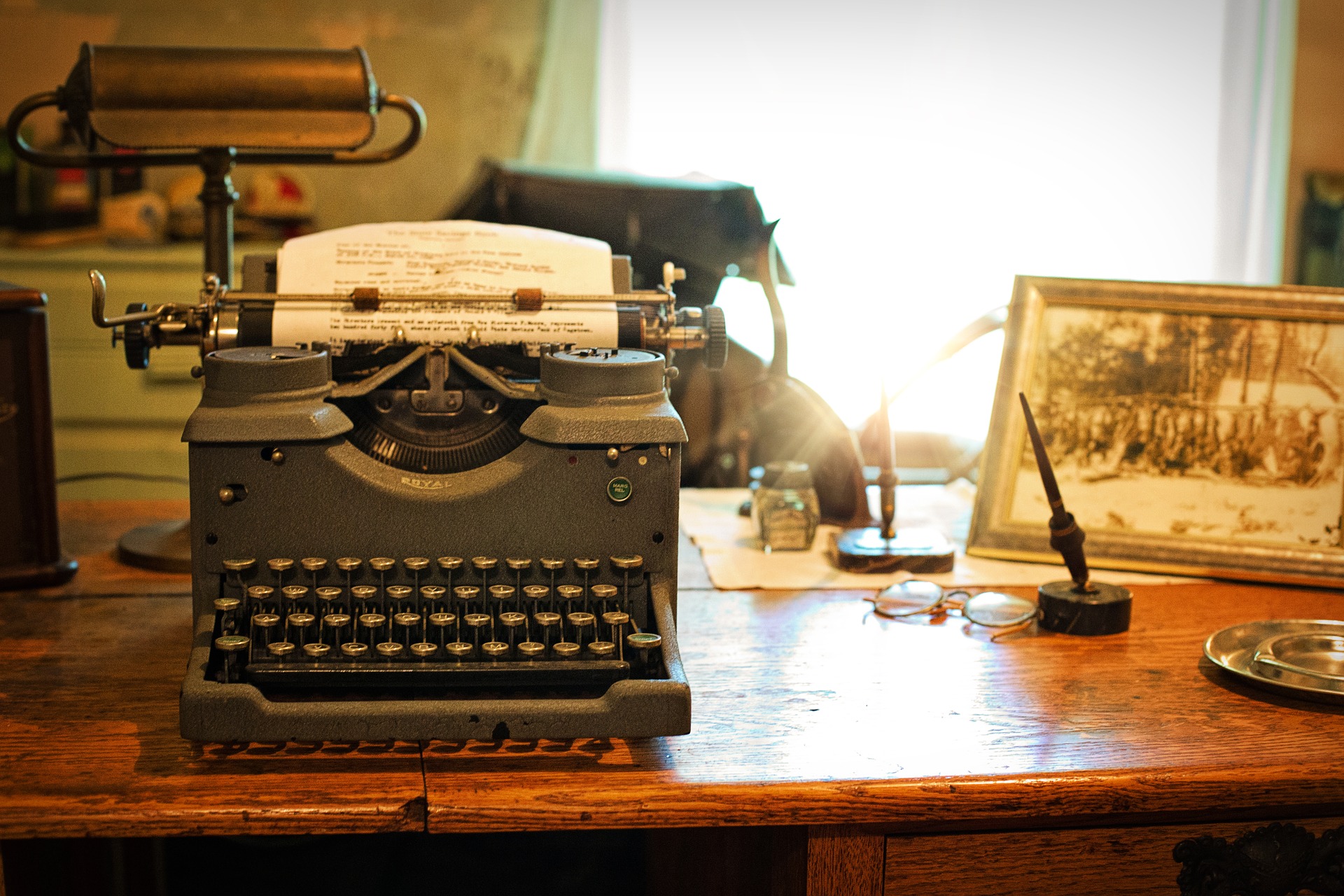
Paper is wonderful! Recently, it has been replaced by the computer, which makes a lot of things easier and convenient, but it is not quite, quite the same.
For the last several days, off and on, I have been working on a story I started last January, using Scrivener as the editor. My Chrome book is also seeing use. And finally, paper and pen when I just don’t want to look at another monitor, or just want to go outdoors and enjoy myself.
While I am not going to go into what I am writing, I do want to explore the process of writing. As the title of this entry suggests, words are very important. One of the things I find so irritating in an author is a failure to provide a variety of terms. For instance, I recall a very popular recent author whose use of the same word within a few sentences has driven me to distraction! What is wrong with finding a synonym? In prose, variety is important, but in poetry, the repetition of sound creates a very different pattern, and so the usage of a word numerous times may be very appropriate and artistic.
This is where paper and pen can come to the aid of the computer-produced manuscript. I like to take what I have written and give it double- or triple-spacing. Then, stapled together, I take it someplace outside or at a coffee bar and sit with a pen to edit. I circle, I cross out, I re-write. In short, I edit with a different perspective because I am seeing the writing on paper.
While I love the convenience of computers and such, I also love the feel of a good pen on a piece of paper. The experience is physical and sensual and intellectual all at once. And it is a very real experience – just like we are trying to create for our readers.
Now that I’ve pulled out my brush and sumi again, I start rummaging through the drawers of the internet. I’m not quite sure how I found Yosa Buson, 1716-1784, but I did; I’d forgotten about him. He was both a poet, and an artist, frequently combining the two. As a painter in ink, his skills are more than evident in the work below.
Two Black Crows and a Hawk - in Snow and in Rain
Both Crows and Hawk show many techniques that allow expression of the elements in sumi-e. Snow is painted by going around the flakes – dark ink makes the white flakes fly. Rain is expressed by using a wide brush, such as a hake, that has been dipped in light / medium ink. The ink is squeezed out by hand or blotted on towelling, and the bristles squished between the fingertips to create an uneven edge. Rain is painted in one long sweep; two or three strokes may be all that is needed. These two paintings are very Japanese in approach to working with sumi.
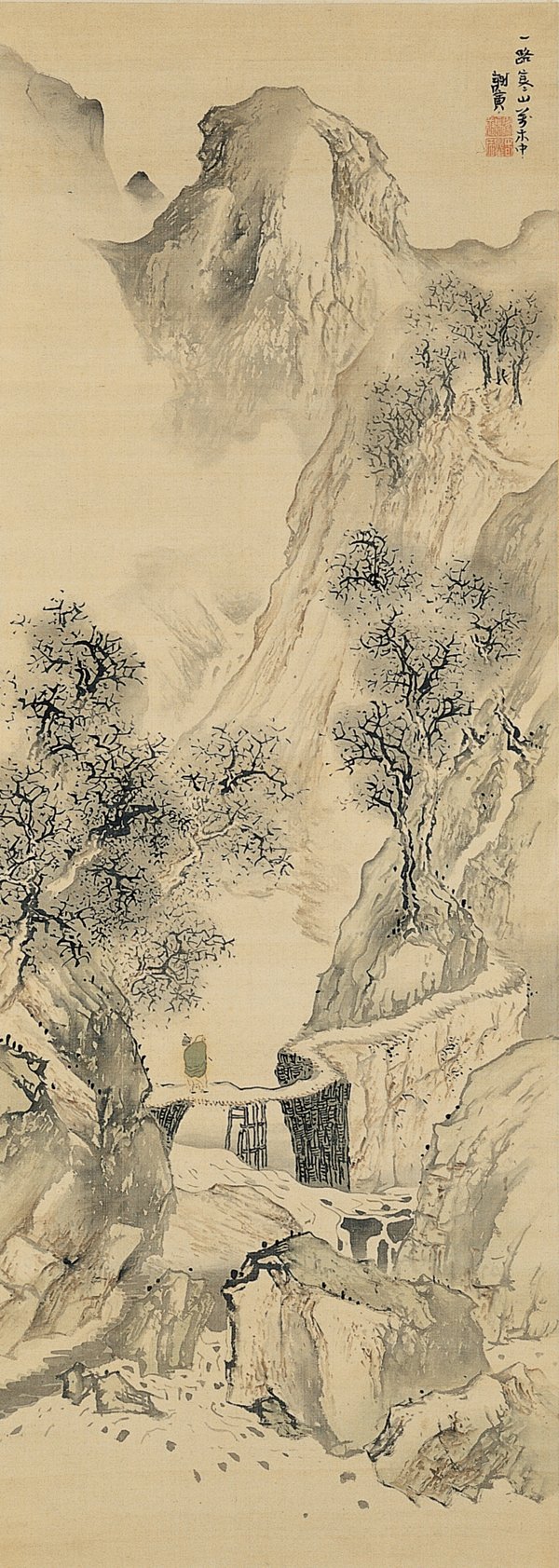
Landscape with Solitary Traveler - 1780
In Landscape with Solitary Traveler, we have a more Chinese approach to ink painting. The theme and constructs are familiar – mountains, water, a path, a bridge, a pedestrian. As in Western painting, Asian painting has its own history and symbolism. The beauty is that these familiar subjects become personal and unique in the hands of the artist. This painting is done in ink, with only a touch of color added to the traveler.
As I mentioned, Buson also wrote traditional Japanese poetry. Here are some translations of his haiku.
coming back—
so many pathways
through the spring grass
in seasonal rain
along a nameless river
fear too has no name
more than last year
I now feel solitude
this autumn twilight
Before the white chrysanthemum
the scissors hesitate
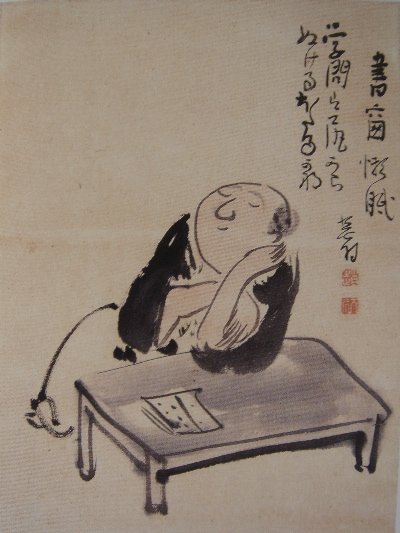
Besides being a master of wash and line (in word and ink), Buson was quite funny. I came across this painting and could not help but laugh. And here, both painting and poetry mingle, albeit not too politely. Dave Bonta writes about this picture quite well. Understanding the language – and the humor in the translation – may be read about here.
Bonta translates the writing,
gakumon wa ketsu kara nukeru hotaru kana
as
All this study—
it’s coming out your ass, oh firefly!






 Ink, Yarn & Beer