Practice, Practice, Practice!

I am continuing the varied steps from Birgit O’Connor’s excellent video.  Upon her recommendations for brushes, I ordered the DaVinci Cosmotop Mix B in size 30, and the Cosmotop Spin Mix F in 20 and 14.  The brushes I have been using have been either pure synthetics or pure Kolinsky sable, neither of which seems especially suited for the painting methods she demonstrates.  I also bought the Pebeo drawing gum, which is thinner and more manipulable than the Winsor Newton masking fluid.

Shapes, Pebeo, and Color Splatters

Above is the very first step in the current practice piece.  I laid out my masks, then used Winsor Newton’s masking fluid and a toothbrush and splattered resist all over.  This fluid is thick and drops in blobs, big and small.  Some will become pebbles and ocean glass by the end of the painting.  Then, using the toothbrush, splatters of color, to make the sand, were used.  My colors were combos of burnt sienna, ultramarine, umber, and yellow ochre.

Splattered Shapes

After letting everything dry, I removed the masks, splatters and all, and set them aside on a piece of typing paper.  (Maybe I will use them again!)  You can see what a mess there is!

No Shadows

The next step was quite long.  The shells, stones, pebbles, glass, and what is supposed to be seaweed, were painted.  O’Connor demonstrates some really cool techniques in her video, and the new brushes made all the difference in the world.  I am also getting some control, at last, in the shadings of the shells and stones.  In particular, I like the stone in the upper left corner, and the seaweed.

Shadows #1

As you can see, adding shadows to the painting give the illusion of depth.  If you look closely, though, you can see that the shadow in the upper left hand corner is very over worked, and the shadows vary in lightness and darkness.  This is because of a number of things.  I did not mix up enough watercolor wash for all the shadows.  This is very important to create a consistent hue.  Another thing is that these shadows are far more challenging that you might think – a single stroke is best.  The one in the upper left I revisited two or three times.  I think it might have been best done with a layer of water laid down first, as it is so large, and then working the shadow is as a wash, being careful to tilt and shift the paper so the shadow color is evenly distributed.

Shadows & Sand Ripples

The final step was adding the ripples in the sand.  These are fun to do, and remarkably easy.  And, they can really add to the overall composition of the picture, helping to move the eye in and out of the shapes.  Part of me thinks that I need one or two small ones moving from upper left to lower right between the upper left rock and the tip of the mussel shell, but I am not sure.  Below is the final painting, cropped to remove all the distractions of the in-progress pictures.

Final Impression

To sum it up, this has been a wonderful learning experience, and has renewed my confidence.  Yes, I am doing exercises, but exercises are necessary for mastery.  I will do a lot more because there is a lot to learn in these seemingly simple studies.  Again, O’Connor’s video is definitely a worthwhile purchase.

One Thing Leads to Another . . .

Watercolors

After finishing the sweater a few weeks ago, something shifted. Doing things with my hands, and completing a project, flipped a switch. I’ve been putzing with knitting, playing with photography, spending time doing post-processing, but it really is not the same as starting and finishing a project. My creative world has become increasingly more narrow as I have focused on photography.

Photography is more comfortable now. I think I “get it” at times. That is satisfying – but it is never as satisfying as creative projects seen from beginning to end. The fact is, I am not a photographer at heart, but the most satisfaction comes from a photo when it reflects something of how I see the world. What that is in photography seems to be snippets of things, the casual portrait, or a good landscape. I am curious as to how understanding photography will affect other creative parts of my life.

Paint brushes are like knitting needles – they are held in the hand, moved and manipulated. Color knitting is something I love – magpie eyes! – and color has been in my head for weeks. Suddenly, greens must be more intense, and red has allure like it has not in some time. Sumi-e and brushes are wonderful, but color is winning now – paint brush to hand, colors on the palette.


An Afternoon in Thought

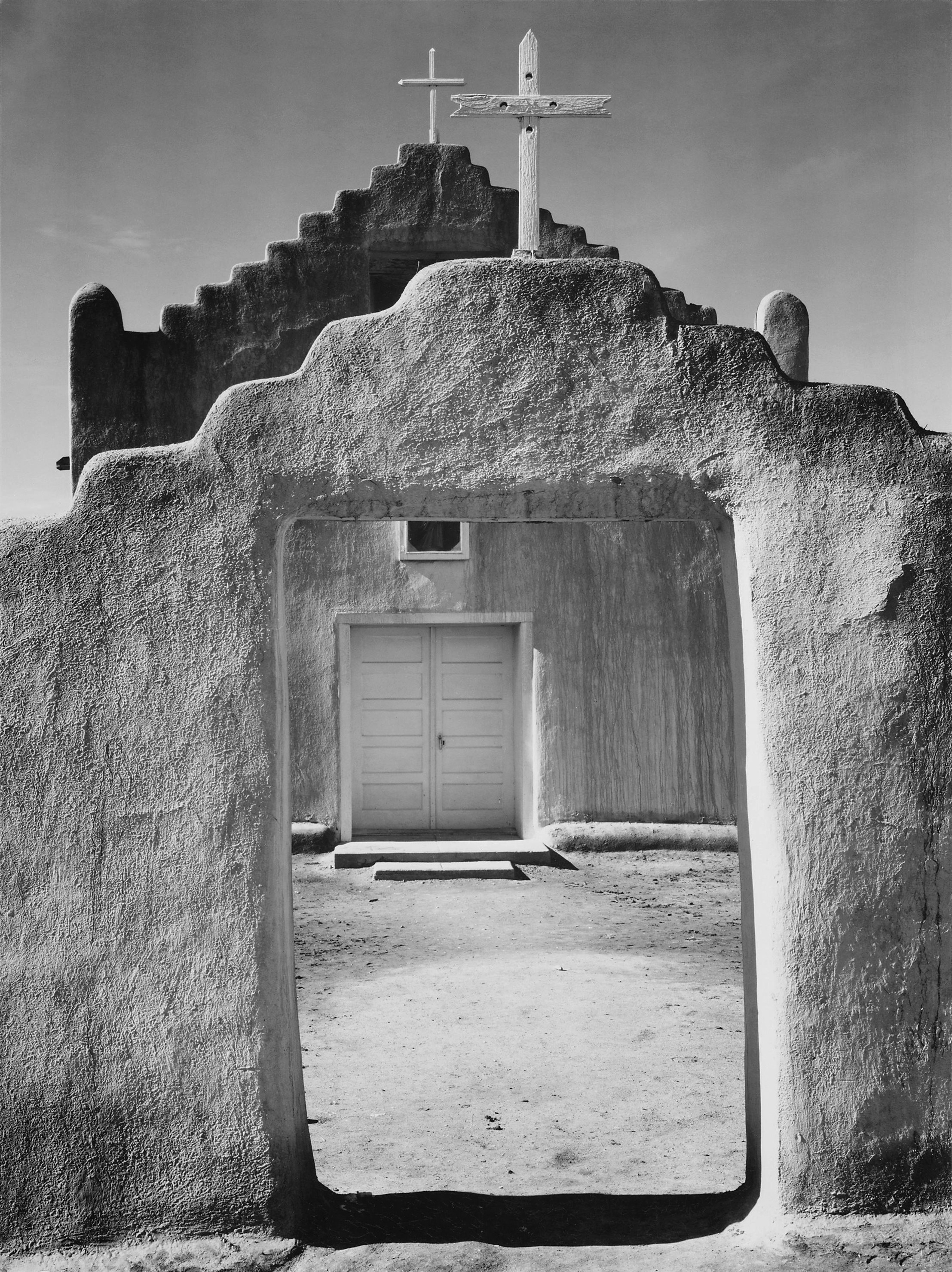
With sensing a bit of accomplishment in the field of photography, it is beginning to take a place for me in the world of creativity.  I am beginning to see what I could not see before.  This ability to relate to photography pools it into other arts, specifically, painting.  Consequently, I am re-reading about and re-evaluating the works of Georgia O’Keeffe, and as an extrapolation, the life and works of Ansel Adams, both whom I admire as artists.

Georgia O’Keeffe – Blue & Green Music – 1921

Their creative viewpoints resonate with my own.  While I doubt I shall ever meet their productivity, or creativity, I can appreciate their work as individuals.  What interests them interests me – looking at landscapes, parts of things, plants.  The natural world in color and in black and white, both lush and sensuous, and stark and contrasting.

Ansel Adams – Church, Taos Pueblo – 1942

In particular, I like the fact they do not put people in their works.  I cannot think of a single painting by O’Keeffe in which there is a person; few photographs by Adams include individuals.  And that is not to say I do not enjoy images of people, but it is more likely I am not going to go out of my way to pursue then.  People like Kirk Tuck and Vivian Maier are wonderful photographers, both of whom photograph people.  Kirk works often in his studio, but also does street portraiture; Maier, on the other hand, was a street photographer at its finest.

I may at some point venture out to take pictures of the random person, but for now, the textures and colors of the world around me intrigue me enough to focus on them.  And perhaps I shall begin painting again – my period of apprenticeship in photography may be ending.

Local Talent, ii

Last night’s workshop was presented by Tom Gamache and Van Webster.  This was the least photographic workshop about photography I have ever seen!

Oh, yes, there were photos, but the key was what makes up a photograph.  This means the history of painting was pulled in, with landscape paintings from the Renaissance and later being used as examples for composition, light, and action.  While this may be obvious to a landscape artist, it was rather an eye-opener to hear someone say what I have thought  – like the little girl in The Emperor’s New Clothes, I needed someone else to point things out to me that I already knew.

The value of this is revisitation to the elements which create drama or visual excitement in a painting.  Triangular shapes.  Repeated patterns.  Contrast in color.  Nuance of light.  Light on dark.  Dark on light.  S curves.  Z curves.  Diagonals.  Soft versus hard.  Graphic versus romantic.  Close focus.  Distant focus.  Foreground.  Background.

One thing that stood out was pointing out that art is planned.  Thinking about it, it is.  The artist pulls together what they know from experience and theory, and create something.  While the results may not be exactly as anticipated, the elements of composition and light and contrast are often considered before work is begun.  This means preliminary drawing, value studies, whatever.  In short, a bit of conscientious effort before will pay off later – and art emerges, not a lucky accident.

Definitely a thought-provoking workshop.

Too Much!

Some people learn things as they go along, living life on a daily basis and incorporating the new stuff without the disruption of everything else.  Not me.  When I am curious about something, I jump headlong with both feet.  This has its good points and bad points, the worst being it can become obsession – luckily, it never does.  The thing is, I am a collector.  I collect information.  I collect things.  And I don’t usually get rid of stuff, either in my mind (though I will as senility approaches), in my closet, under my bed, or in the garage.  Granted, when I return to that interest, costs are very insignificant!

Lately, in case you have not noticed, I have been doing a lot of photography, to the point I decided to set up a blog separate from Ink, Yarn & Beer.  Here, I really want to get back into more personal things, such as the painting and knitting design, as well as just discussions or whatever I fancy.  At that other blog I can focus on photography and what I am doing there, create my little encyclopedia of links, blither on about what I am doing.  I’ve gotten a few hits there, mostly spam, but that blog, like this one, is for my own pleasure.  And to create balance.

My artistic side finds photography rather frustrating, but I am beginning to see how it is tweaking me at the same time.  Thinking about how something is made – effects, colors, process – begin to move into other areas.  Looking at the petals of a rose make me wonder how I can capture them with a brush using ink or watercolor.  Looking at the light shadows in an image make me consider contrast and detail in a painting and why something in a painting works, or does not.  Realism does not need to be done, but the impact created by color, shadow, tone, shape gives an illusion of reality or its impression.

The fact is, any form of art is limited only by the person doing it.  This can because of a lack of tools or innovation, or because one is still in the process of becoming or doing.  I am limited by my interests in a lot of things – painting, knitting, reading, writing, photography, gardening, hiking, traveling – and it keeps me from doing anything well.  On Outlook I have different activities scheduled weekly – creative activities – and that doesn’t help either!  Regardless, the plan is to try to do a bit more of all of it, and be focused on it when I can.