A View From Yaquina Head Lighthouse

In early July I flew into Bend, OR, to visit an old college friend. We drove to the coast, staying in Newport, at an area known as Nye Beach. One of our outings was a trip to the Yaquina Head Lighthouse. The area was beautiful and we spent some time in the visitor’s center as well as wandering around. Of course, photos had to be taken.
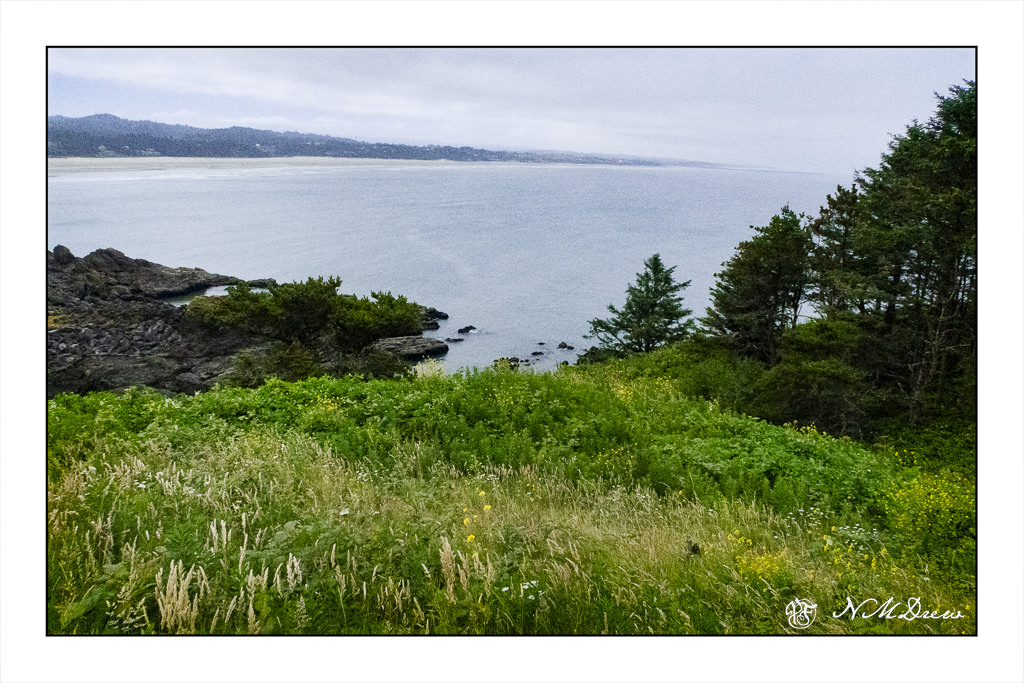
The day was overcast and rather cold and gloomy – I think maybe 60F at the most in the dead of summer! Wind, too. Despite that, it was a great place to be, in part because of the whole area is so different than Southern California, as it is very lush in summer, rather than our drying vegetation and overall beige coloring. Here, the view is from a pathway leading toward the lighthouse, looking across the cove to Newport. You can see the wide expanse of beach, which is very flat, leading to another headland where I think another lighthouse may be found.

Every Tuesday I spend about 2-3 hours in my painting class. We paint what we want, but have a wonderful pair of teachers who give good advice. Classmates are friendly. Altogether, it is a good place to spend time for many things. I thought this photo would make a good landscape, so I decided to paint it. Initially, I had used acrylics, but it was flat and uninteresting, and the graphic effect I was trying to achieve wasn’t there. Acrylics may be painted over with oils, but not vice-versa, so I already had the colors, values, and mood laid out – and the oils proved far more satisfactory in the end.
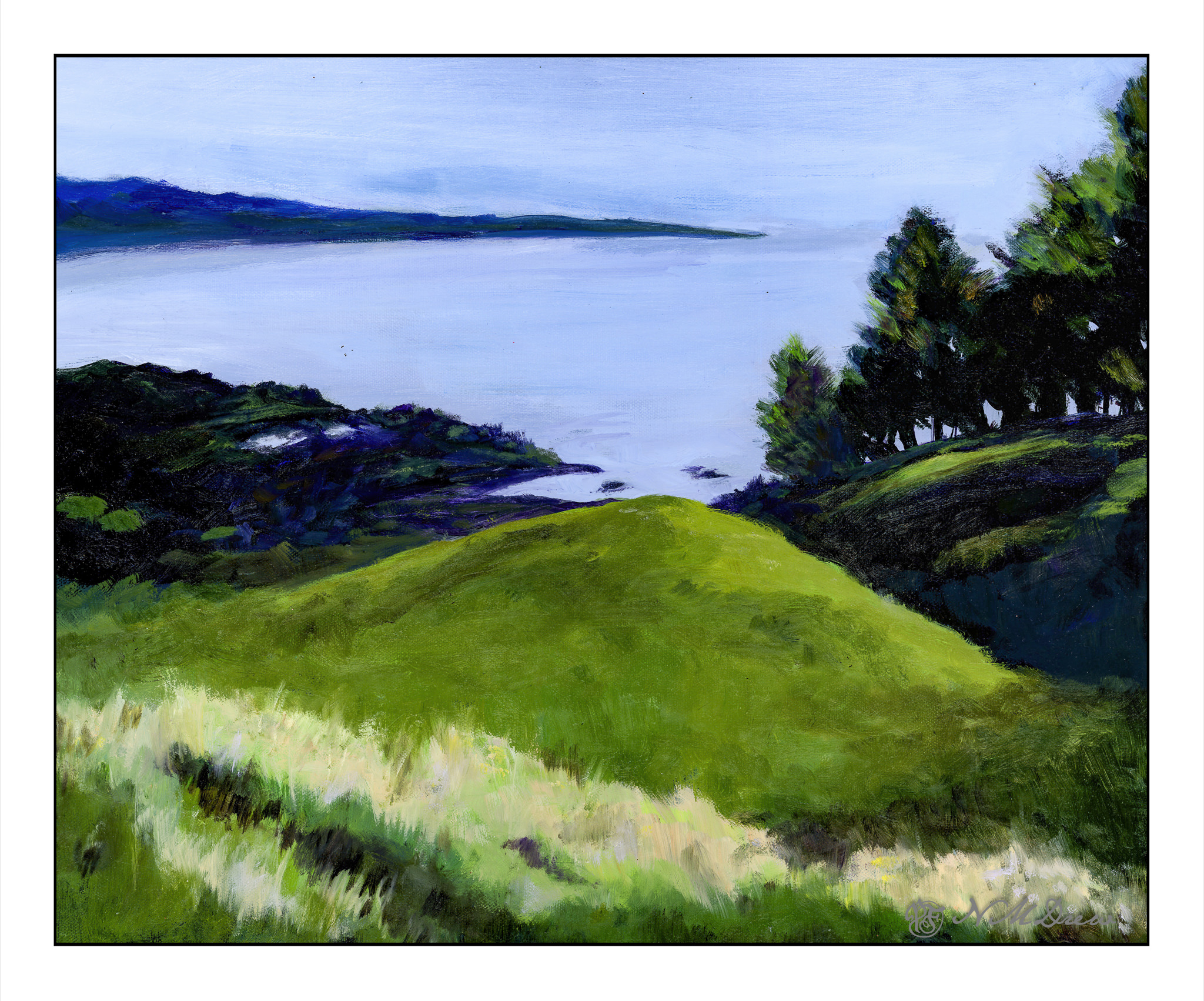
Scanning art work is always a crap shoot and I had to do this a few times to get it to my liking. I did manage to capture mood and color. The overcast day dulled the original greens but in post with my photo, I brightened things up to my liking. It may be that the dull colors of my SoCal surroundings really make me push the greens, but the photo was the basis of the painting, even if not reflecting reality quite as it was.

I spent about 3 classes doing this painting, reworking it several times, especially the foreground. In the end, I am rather pleased. It is a bit gloomy and dark, but so is the photo.

Oils, 16×20 stretched cotton canvas.
Surviving the Wrath of the Flying Gods!

My travels to and from Oregon were good. Flights were on time for the most part with perhaps a 15 minute delay between them. As there were at least 90 minutes between Burbank – San Francisco and San Francisco – Redmond, and on the reverse, nothing happened there.

A few days before I left I had to jump out of the way of a car that could have hit me and wrenched my left ankle, but I decided to go on my trip despite my discomfort. On the way home, it was really acting up, so I requested and got wheelchair service, and that made a big difference. I used United to fly, rather than Hell-ta, and am glad I did after seeing their meltdown after the CrowdStrike disaster.

And so, I survived the wrath of the Flying Gods – they attacked after I came back with CrowdStrike’s catastrophic push of a Windows-based patch. How did that happen? Didn’t they test it in a development environment before pushing it to production? Hard to believe.

Oregon! I do enjoy visiting there – such beauty, from wild beaches, woodlands, to high desert. I reconnected with a college room mate from years ago, and with whom I have remained friends with for 50 some odd years.

The first night in Bend, Oregon, I spent at my friend Stephanie’s house. Our plans were pretty low key – a few days on the coast, and the remainder inland in Bend. First, though, get settled for the night before heading west to the coast.

I landed, Stephanie picked me up, we had something to eat and then went to settle down for the night. Visiting good friends like Jay and Stephanie is always wonderful – we pick up where we left off as if time and distance do not exist.

Oregon Coastline – Your Thoughts?

The Pacific Northwest – Oregon, Washington – has some of the most dramatic and beautiful coastlines. I could easily spend a summer just exploring them. The rock formations, deep beaches, wildness all hold such an appeal. Any rugged coastline fascinates me, and perhaps someday I will get to spend weeks in Maine, Nova Scotia, and other places of such beauty.

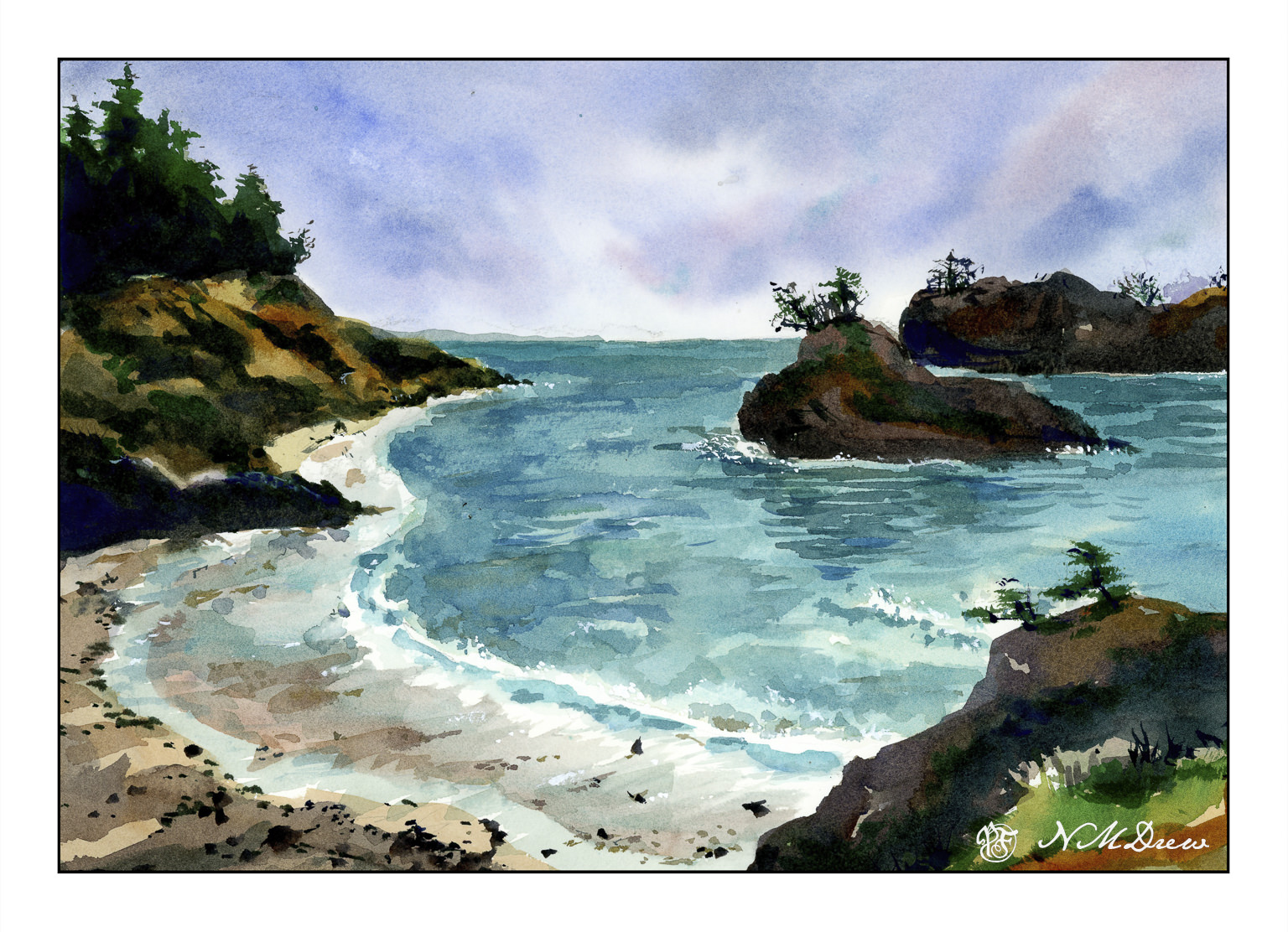
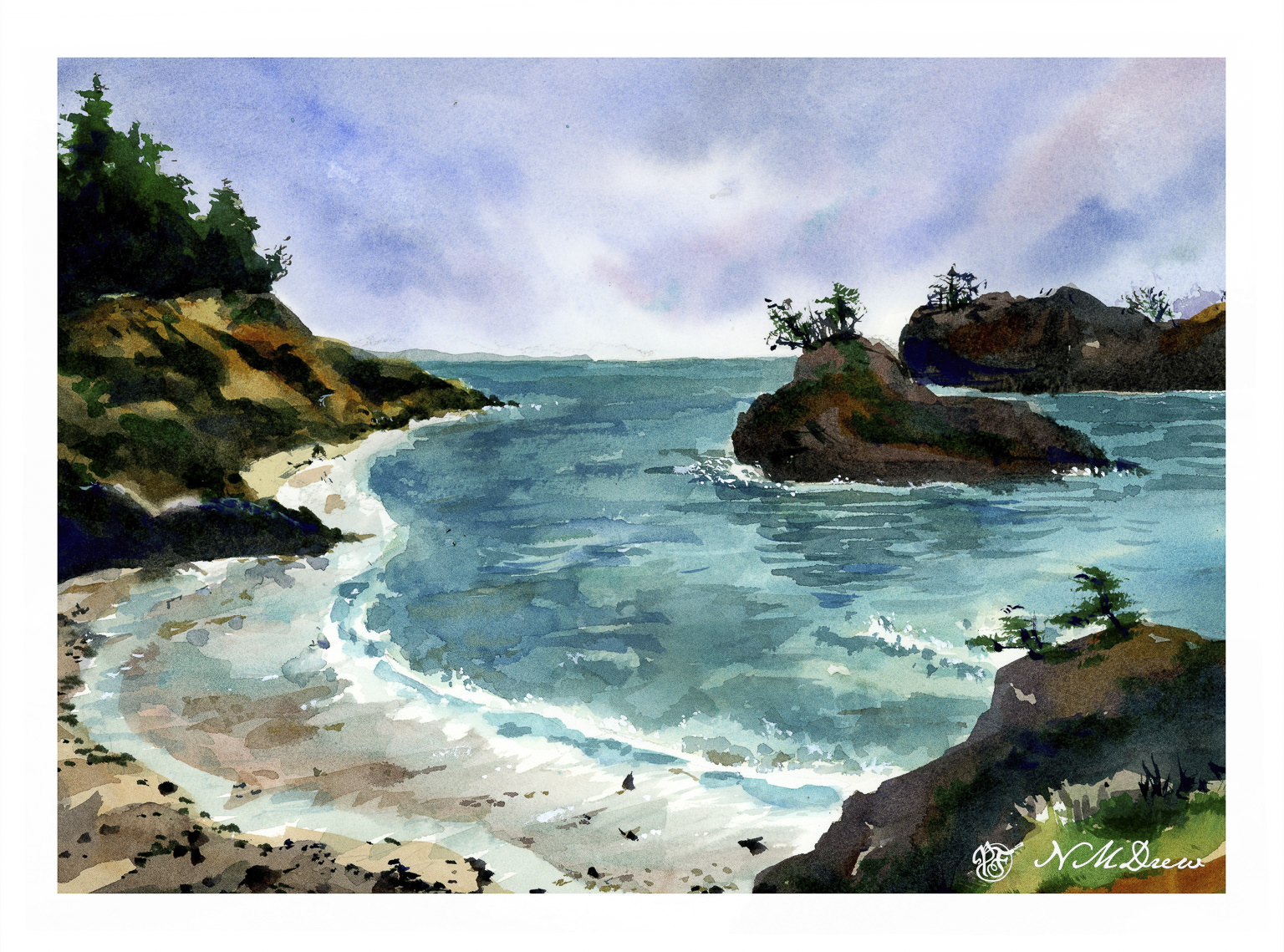
Today, I decided to revisit Oregon from a trip awhile ago. Sea stacks run out into the Pacific, some merely rocks, other crowned with pine trees. Take a look at the two paintings below – the same, but with a bit of variation.

This is the painting as it now stands – but what do you think of the one below?

They don’t vary a great deal – and I am not going to tell you what I did – but if you have some thoughts as to which you like, and why, let me know.

Meanwhile, painting this, I worked really hard to create a sense of depth. The photo I used was an overcast and rather murky day. The distant sea stacks were not much different in value than the nearer ones; the coast itself was a bit brighter. Overall, the light was flat here and twas a bit hard to conceptualize it altogether. I am fairly pleased with it, but as with any painting, I see areas for improvement, some I like, some I think are great, etc. Anyone who paints knows this!

Watercolor, CP 140# paper, about 10×12.

Haystack Rock

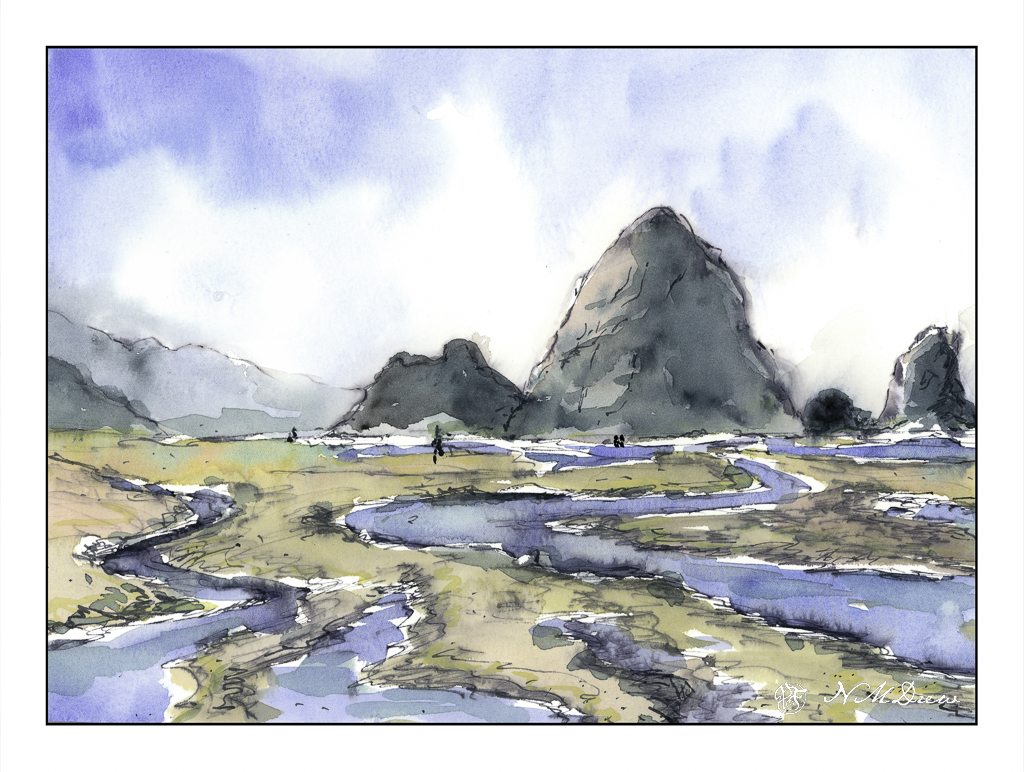
More of the northern coast along the Pacific Ocean. Here, Cannon Beach in Oregon, possibly one of the most dramatic beaches I have ever seen. Sea stacks, tide pools, sand, mist and fog. When the fog lifts and the sky brightens, there is a glare that cannot be explained. It’s not a summer day brightness as we have in SoCal, but a brightness that is cold but not like on a snowy day. There is a lot of moisture in the air, from sea and fog, and perhaps that is what magnifies the light to such a degree.

If you look closely, you will see some of my ink bled into the paint. I used my iron gall in, not my waterproof micron pens, and a stub nib to draw. From there, I wet the sky, dropped in colors, and then let things dry to dampness. I wanted to create soft edges for the mist in the distance which blurs and softens edges. The rocks themselves were painted wet-in-wet initially, and then other colors applied to either dry or damp paper. The sand and the rivulets were painted in the same manner. In the end, I drew again with my iron gall ink to add texture or detail.

Keeping this sketchbook is so much fun! I have room to paint as the sheets are big, the paper is strong so I can use both sides, and I can paint with a lot of water should I wish. It is proving to be one of the best decisions I have made of late!

Grass Lake

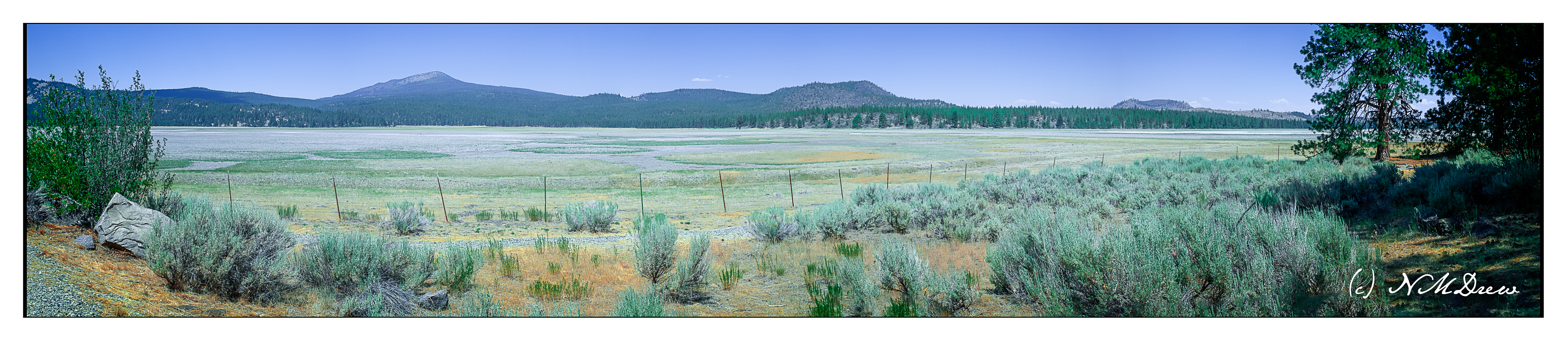
Eastern Oregon; Grass Lake.

Apparently back in the early part of the last century, this was a really nice place to come. The lake was renown for fishing and there was a hotel – resort, anyone? So, to kill a lot of fish all at once, someone decided to do it with dynamite. The result? The area is volcanic and beneath the lake was a cave or something, made from cooled lava. The dynamite broke the roof of the cave . . . drained the lake . . . lots of dead fish, and that was it.

The End.

Now it is a lovely rest stop alongside the road, with a trail, picnic grounds, pet area, and a much welcomed spot. When it rains, I think the lake may fill with water, but for now native grasses fill the lake bed.