Autumn along the Virgin River is filled with trees turning orange and yellow from the greens of summer. The sky is bright, bright blue. The red-orange mountains all around are dynamic and rugged. The river is aqua and blue and green.
The light is full of contrast – bright, dark, shadow, reflections. The leaves add texture, as do grasses and trees and rocks. Wind plays through the canyons and trees. The whole world shimmers and vibrates with energy and color. Simplifying it seems impossible.
I love San Francisco, like so many people. And, like so many people, I am sad to see how challenging it has become as a city in a lot of ways – homelessness, cost of living, among other things. Still, it has a lot to offer, and Land’s End is one of them. Part of the Golden Gate National Recreational Area, it is a beautiful bit of nature on the edge of the Pacific Ocean.
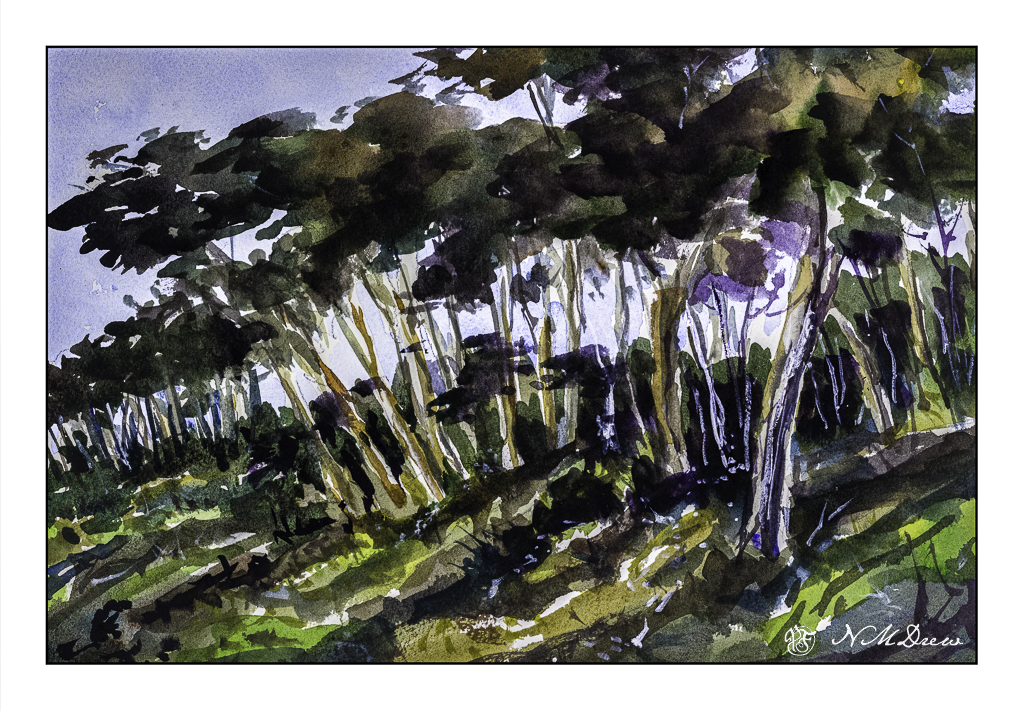
There are paths within Land’s End, and this row of trees on a bluff is a signature landmark of the area itself. Golden Gate National Recreation Area is wonderful, and I have spent time here, and in the city and around the Bay Area often, more so when I was younger. I had friends who lived in the city itself and have great memories of all it has to offer.
This painting was a bit of a challenge. The tree trunks are bright and clear in the foreground and sharply contrast the foliage of the trees and undergrowth. In the distance, the shapes of the trees and their leaves merge into fascinating shapes. What I find so interesting about these trees – I believe they are Monterrey Cypress – is the trunks and branches seem to vanish within the leafy canopy. The hillside is variegated in vegetation, and while I caught some of the bright green and dark browns, the lights and darks were evident.
I tried to paint as directly as possible, putting paint down and then, while it was wet, varying colors within the shapes. The foliage was a good example of this, as was the hillside below the trees. The sky was painted first and brought down between the trunks near, leaving the trunks to be painted later. Bushes were also painted this way. Finally, trunks and foliage, near and far, and final touches such as a bit of titanium white gouache and a few dots and lines here and there.
For me, this was a blast. I picked up the ukulele about a year ago after Josh took a class through our local parks and recreation services. I took the same class myself just awhile ago.
For a lot of people in America, of my age, we watched Tiny Tim play away on the ukulele – and that was, for me, a turn off. I didn’t think he was funny and altogether I sort of cringed when I watched him on the Smothers Brothers. It made me dislike the ukulele altogether because of its connections. Now, remember, this is me – and my own reaction from way back when. I wonder how I would feel about him today as a much older and less narrow minded. Anyway, I guess I will look up some YouTube videos to watch and re-think Tiny Tim.
Since I started playing the ukulele, I’ve gotten a few (GAS is bad in my family) and find that I like having soprano, alto or concert, and tenor with both regular and low G strings. I’ve watch oodles of how-to videos, and find my own preference is for finger picking tabs. I do single notes pretty well and am now moving into playing multiple strings at a time. My first exposure to learning music was piano, and I didn’t like it that much. The same with the flute – I could never get enough air and nearly fainted a few times! Because I am self-taught, I am not in competition with anyone – I make my own plans. At some point, perhaps lessons on an individual basis or joining a strumming group – there are several here in my area, just showing how popular the ukulele is!
In addition to learning to play, I’ve always liked music, all kinds. I never thought I would pick up an instrument. Lately, I picked up some software that let’s me input my own compositions or variations of a song. This is great as I can make up something I can work with at my current level or within my limitations.
Moving far beyond the common ideas of an ukulele, I am amazed by the music that is played by people all over the world on this instrument: Classical, jazz, folk. Finger-style, strumming, singing along with chords, strumming patterns, flamenco, etc. The fact I am enjoying myself and learning music and not taking it too seriously, but seriously enough to map out goals, is not a bad thing for an old bat of my unknown age . . .
I hope you enjoy this video – great history, old and new!
It appears to be human nature to procrastinate and avoid the potential dangerous realities that lie ahead. We are certainly guilty of it. One thing we have decided is to get our proverbially acts together on many levels. Today’s job is to prepare for possible evacuation. The fires in Los Angeles make it very clear. And having seen the beginning plumes of the Palisades Fire as it began while sitting in an office, I need to be realistic.
Today has been taking a lot of time for me – Josh is easy enough. I, though, need more to keep my little mind from going nuts. He can put together a backpack of stuff, and I need more than a back pack . . . I need to pack papers and documents, electronics and their attachments, cameras, musical instrument(s), basic art supplies, writing supplies. Inky (our dog) needs food and water. We also have put together our hardly gourmet instant food pack, water. The cars have full gas tanks.
Why these preparations, some of which will be completed later today? The winds are returning over the next two days and so is the possibility we could be burnt out. After spending hours today, I am glad we are doing what we are doing as it would be a terribly slap dash and not well thought out way have to beat a hasty run for safety.
After all the stress of fire and fears of fire, no electricity, setting up a generator, yesterday was just a nice, normal, and pleasantly dull day. The usual daily chores got done, things were cleaned and straightened, the yard cleared of debris. My fig tree is also pruned and ready for its next crop – the first new tips are already pushing their way into the world and bulbs are sending up new growth. Little things like this make for a much better day.
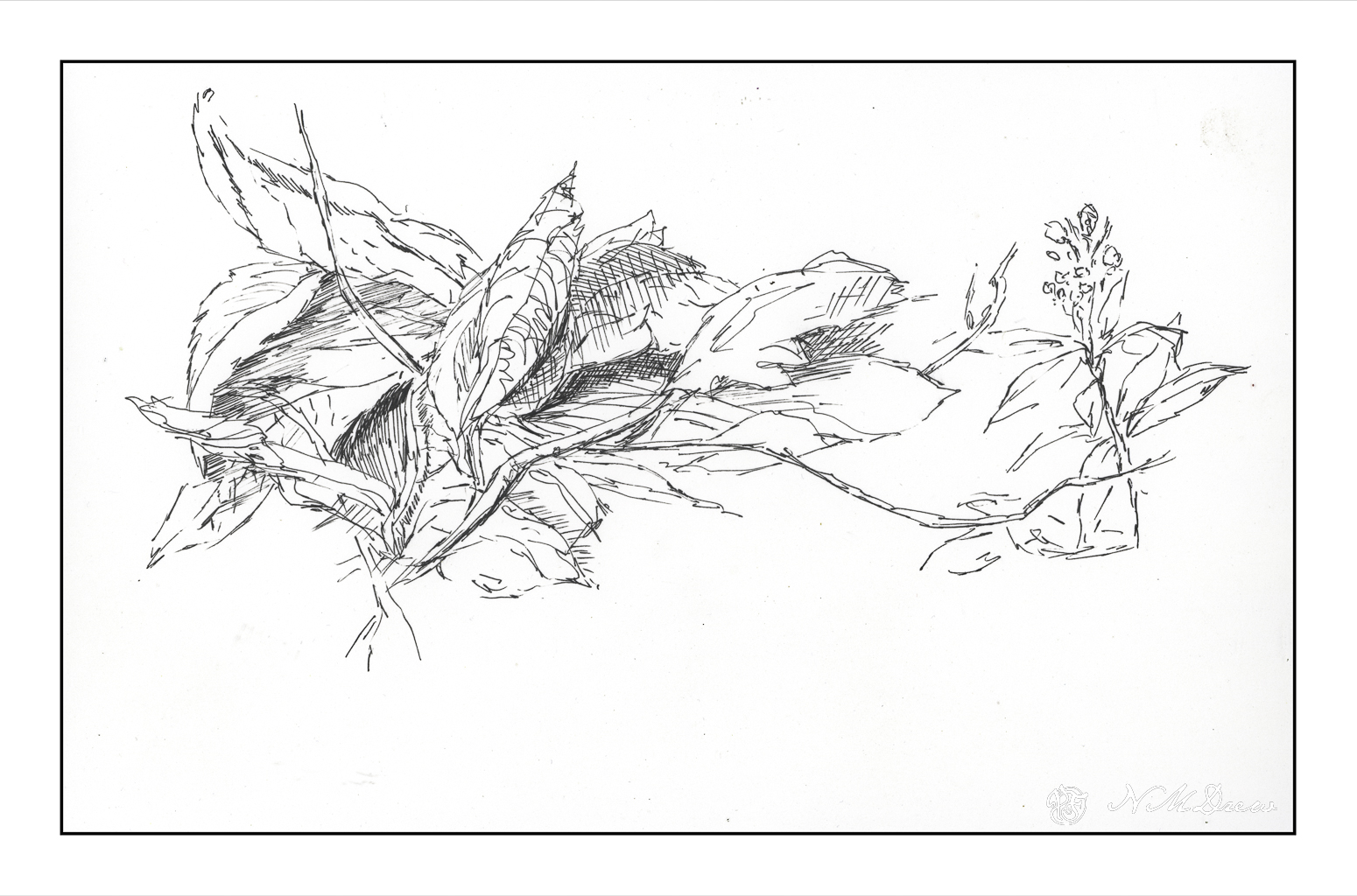
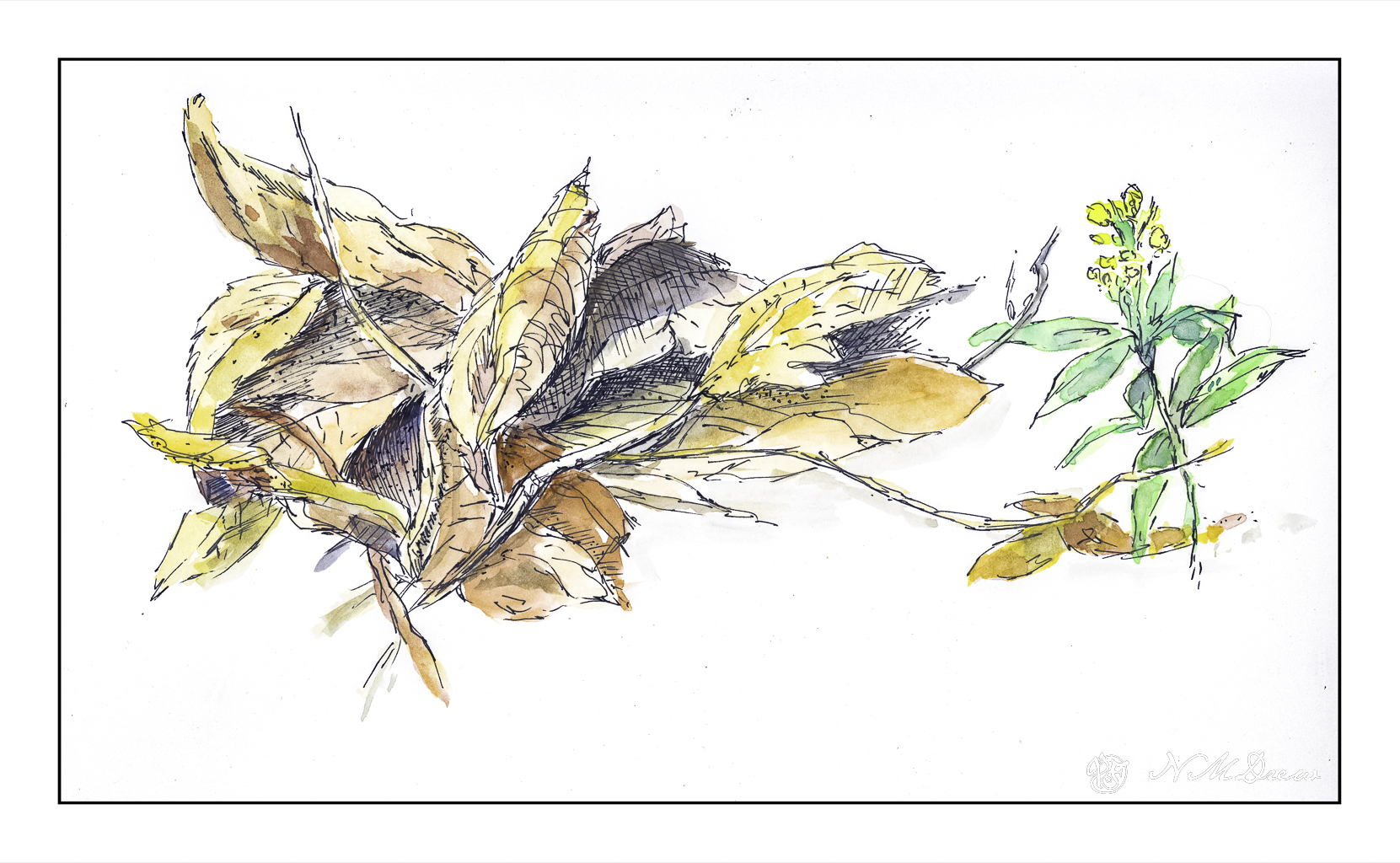
I got to see all this, and then settle onto a patio chair just to look around. With wind and cold, being outside was not much fun, and certainly not a place to sit with pen and ink. With it gone, I could settle and sit, enjoying the warmth of the day. And draw . . . above is a sketch of my dead foxgloves – the leaves are dried and flopping over the edge of the pot, under and over each other, and into the milkweed plants.
A friend gave me a wonderful pen, a cheapie from Amazon. The ink is waterproof, and the tip is fine. The paper I am drawing upon has a bit of tooth, and the result, for me, is wonderful. When lines are drawn more quickly, the ink breaks up and gives texture. The pen point is sharp enough to deliver beautiful dots. In between, the lines are steady and solid. All together, a great drawing experience.
A few years ago, Josh and I spent a number of days in Decorah, Iowa, and there I found a lovely little stationary – art supply store. An inexpensive set of pan paints was available, and I have found it to be perfect for adding color to an ink drawing. The colors are intense but not overly so, and seem to be of a transparency many fine watercolors possess. I have been using it a lot for such pictures. The colors mix together well, and with a light touch with water and brush, these paints (with a bit of help from yours truly) work very well with delicate drawings.
Ink, pen, watercolor on multimedia paper. About 5 x 10 inches.



 Ink, Yarn & Beer