It’s Green Around Here

After playing with yellows yesterday, I decided to try to mix greens.  A very green landscape seemed appropriate.  Most of the greens were mixed using hansa yellow, quin gold, and cadmium yellow along with cerulean blue, ultramarine, and cobalt.  At times, I pulled in Hooker’s green, which I really like, along with some sap green.  Others at times, too, mixed with yellow or blue, or even orange!

Looking at the painting, the sky seems to not really match much of the linear quality of the rest of the picture – technique, I expect.  I had wanted the trees, foliage, and foreground to be softer, more blurred perhaps, but still full of greens.  One thing I should have done is to have not painted the sky across the entire upper portion of the picture – this kept the green foliage from being more discernible or distinct.

Overall, I am rather pleased with the final result.  The goal was green, which I certainly got, but the composition and style, while not what I envisioned, are not too bad.

Mellow Yellows

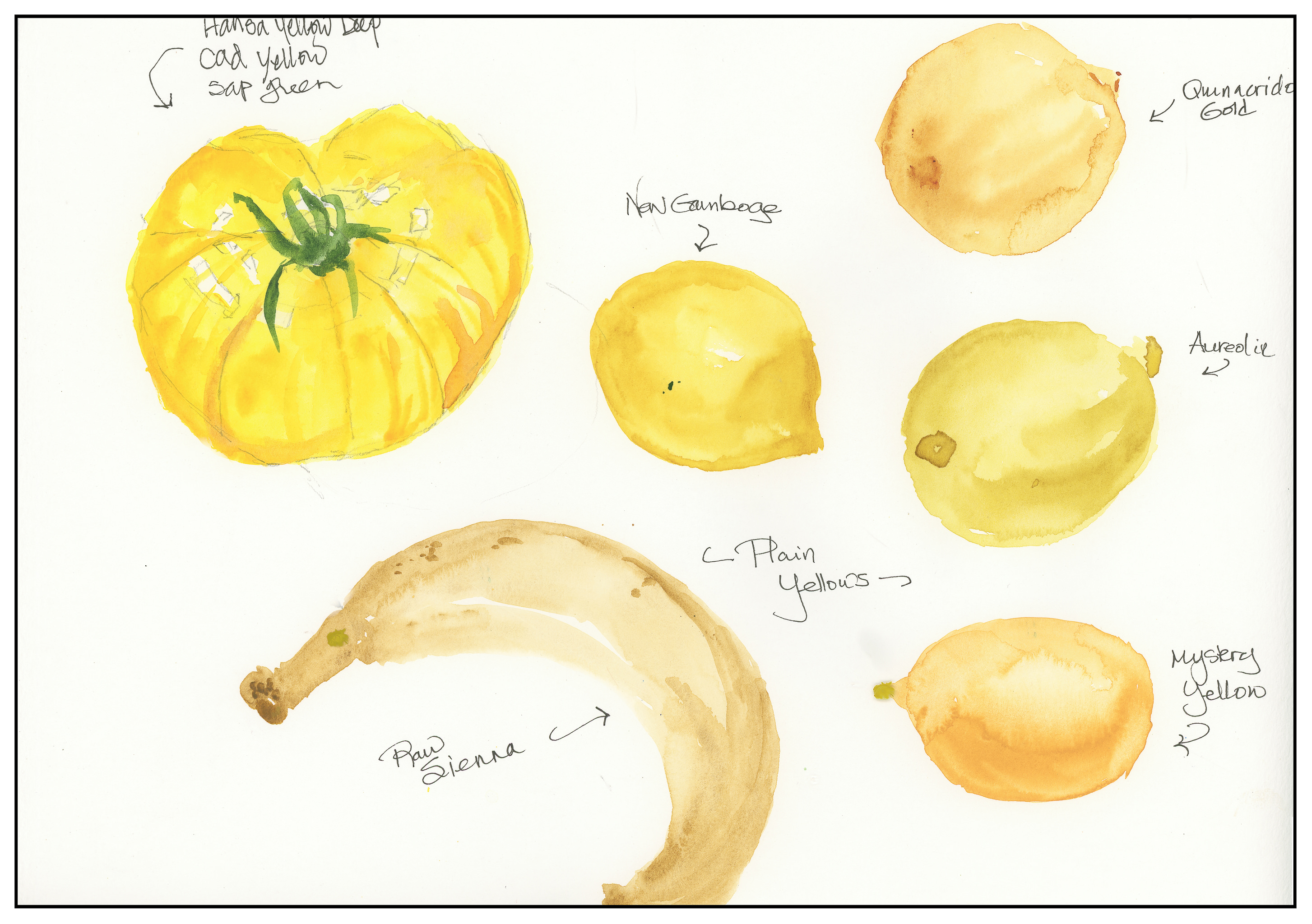
Today I did what I had hoped to do yesterday, but I painted a temple instead.  So, this afternoon, I sat down with my studio palette and decided to take a good look at the yellows I have, use them individually, as well as mix them.  The colors include aureolin, new gamboge, raw sienna, cadmium yellow, hansa yellow, quinacridone gold, raw sienna, and “mystery yellow,” named thus because I didn’t label it!

Above are my first paintings, mixing colors and not happy with the results.  So, I did pure color studies of the lemons to see what I could get.

Above, pure colors in varying densities to see what they could do.  It was quite interesting!

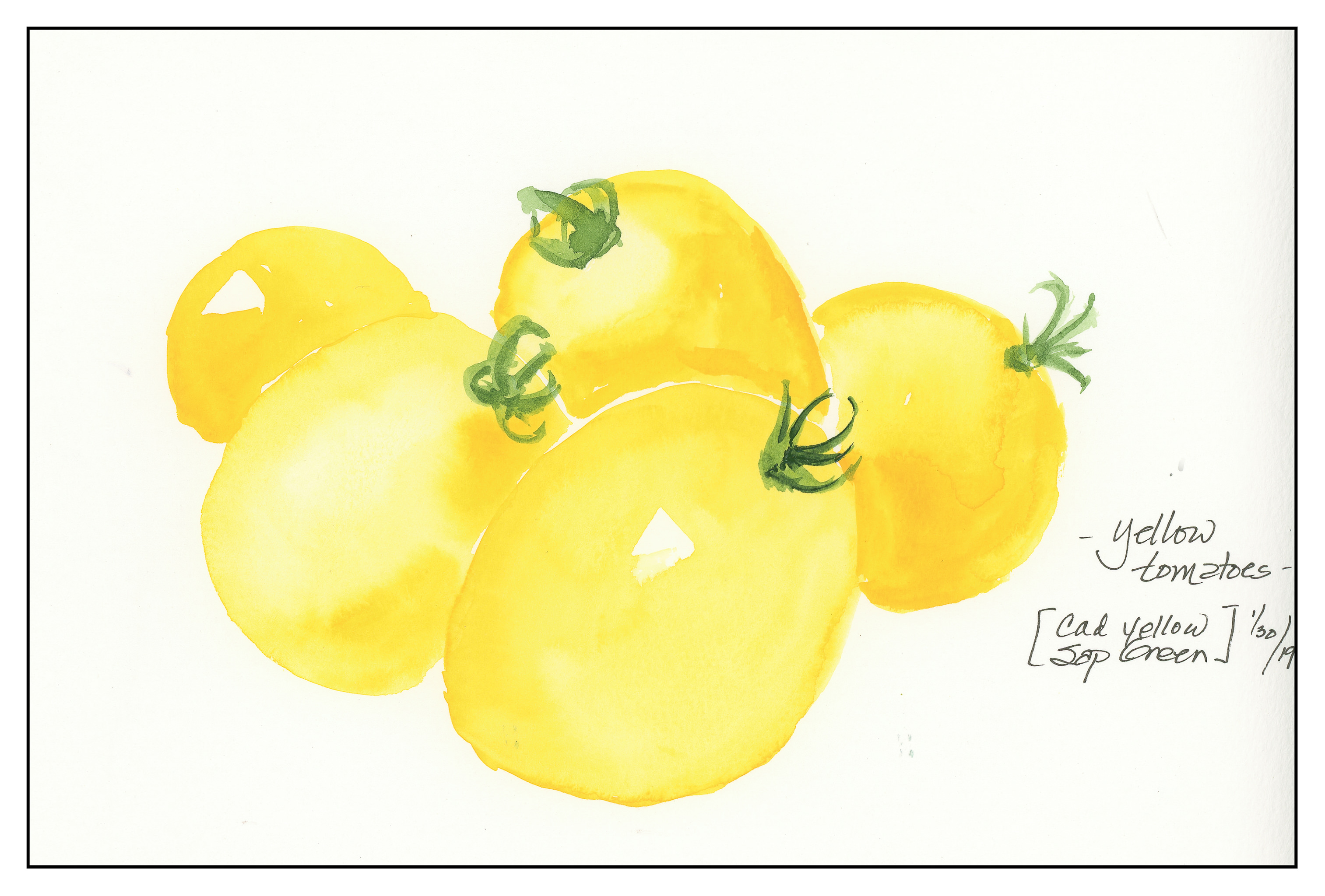
In the studies using only one yellow, I varied the density of the paint from very watery to rather heavy.  I did the same in the above picture with sap green.

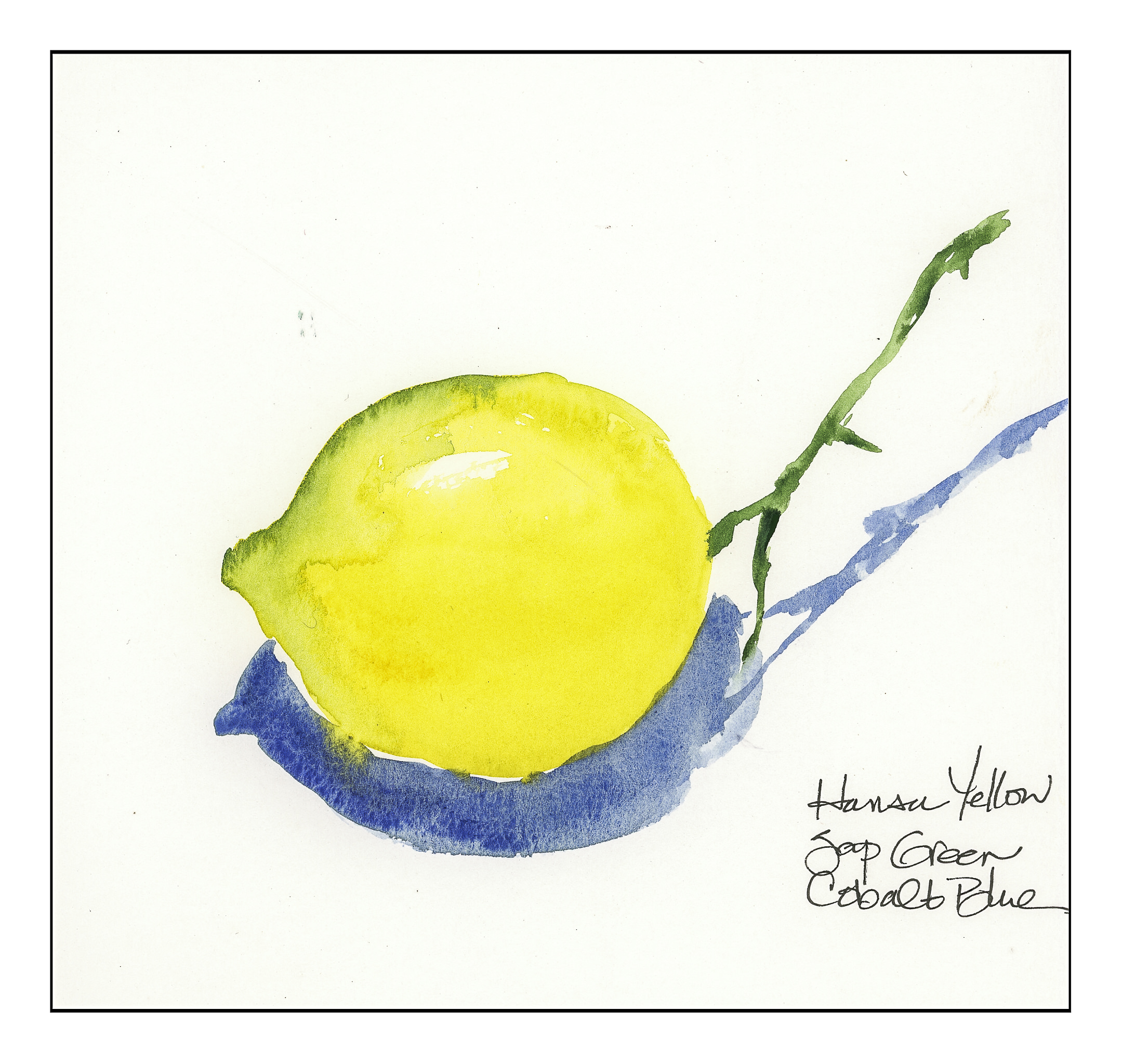
In this one, I used pure hansa yellow, sap green blended into the yellow, and cobalt blue for the shadows, with some bleed from the lemon.  The stem was pure sap green.

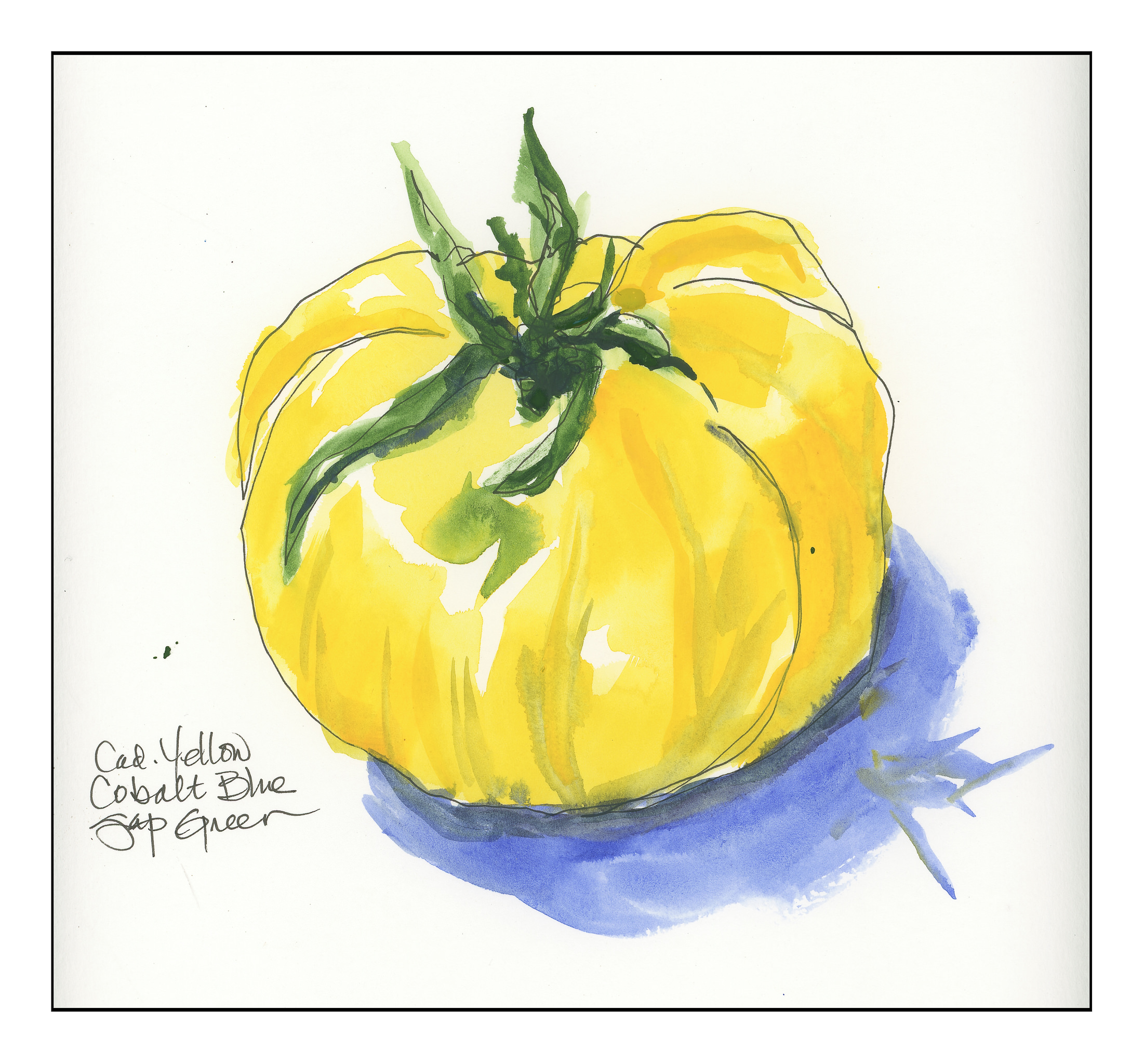
Heirloom tomatoes are always interesting – they are rather like aliens in the produce department!  Again, limited palette with varying uses of the colors individually and mixed.

Another alien, but this time I created a swatch of the colors as I did the painting.

If you want to scroll through the paintings, click on an image above.  I like doing that because I see things in a sequence.

Anyway, I really got a better sense of the yellows and how I might use them.  Cadmium yellow, hansa yellow, raw umber and raw sienna are my most-used yellows, but can see where others may be valuable, such as in shadows and so on.  Hansa yellow is a cold yellow, in my opinion, and the warmth of the cadmium yellow cannot be beat.  For rotten bananas, raw sienna isn’t too bad!


A Bowl of Tulips

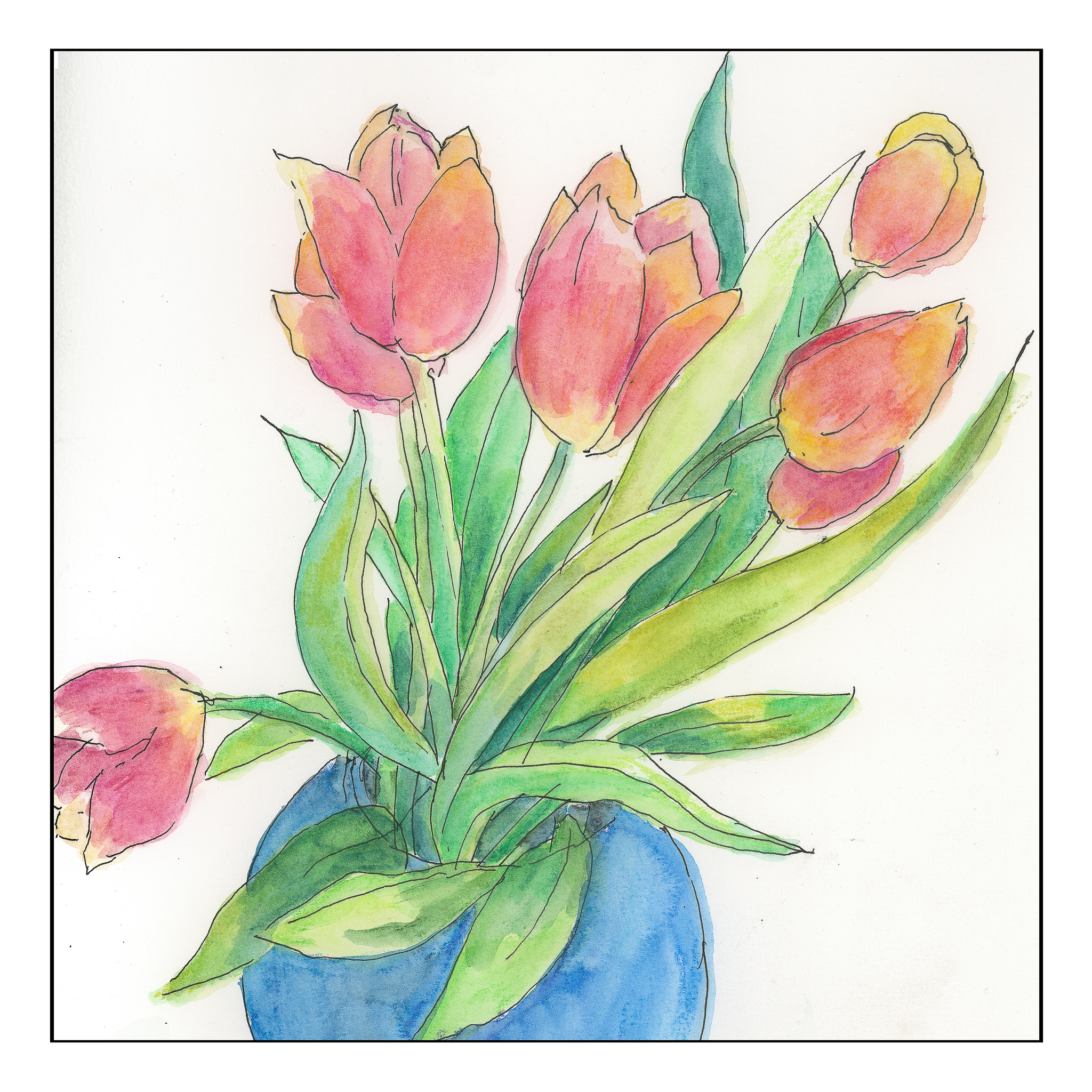
Today I had a morning appointment.  After I came home, I had lunch, took a nap, and then migrated all sorts of toys to the patio.  My neck got sunburned!  Amongst the toys were a set of Albrecht Durer watercolor pencils by Caran D’Arche, a bowl of tulips, a brush pen, ink pen, and paper.

This is probably the third time I have used these pencils, and this time around I am happier with the results.  I have watched a few videos from YouTube on using them, and the tips were worthwhile.  For example, layering and laying down glazes to get better results.  Being patient!  My own painting skills are better than they used to be, so my sense of light / dark is not as klutzy as it was a few months ago.  And, without having the need to produce some work of art, I was a lot more relaxed.  Of course, sitting in the sun didn’t hurt any.

In general, my own experience with watercolor pencils is that they are not strong enough in color to produce the type of strong contrast I seem to prefer visually.  Maybe it’s just my limited experience.  Nonetheless, I am happy with the results demonstrated in this little study.

Daffodils

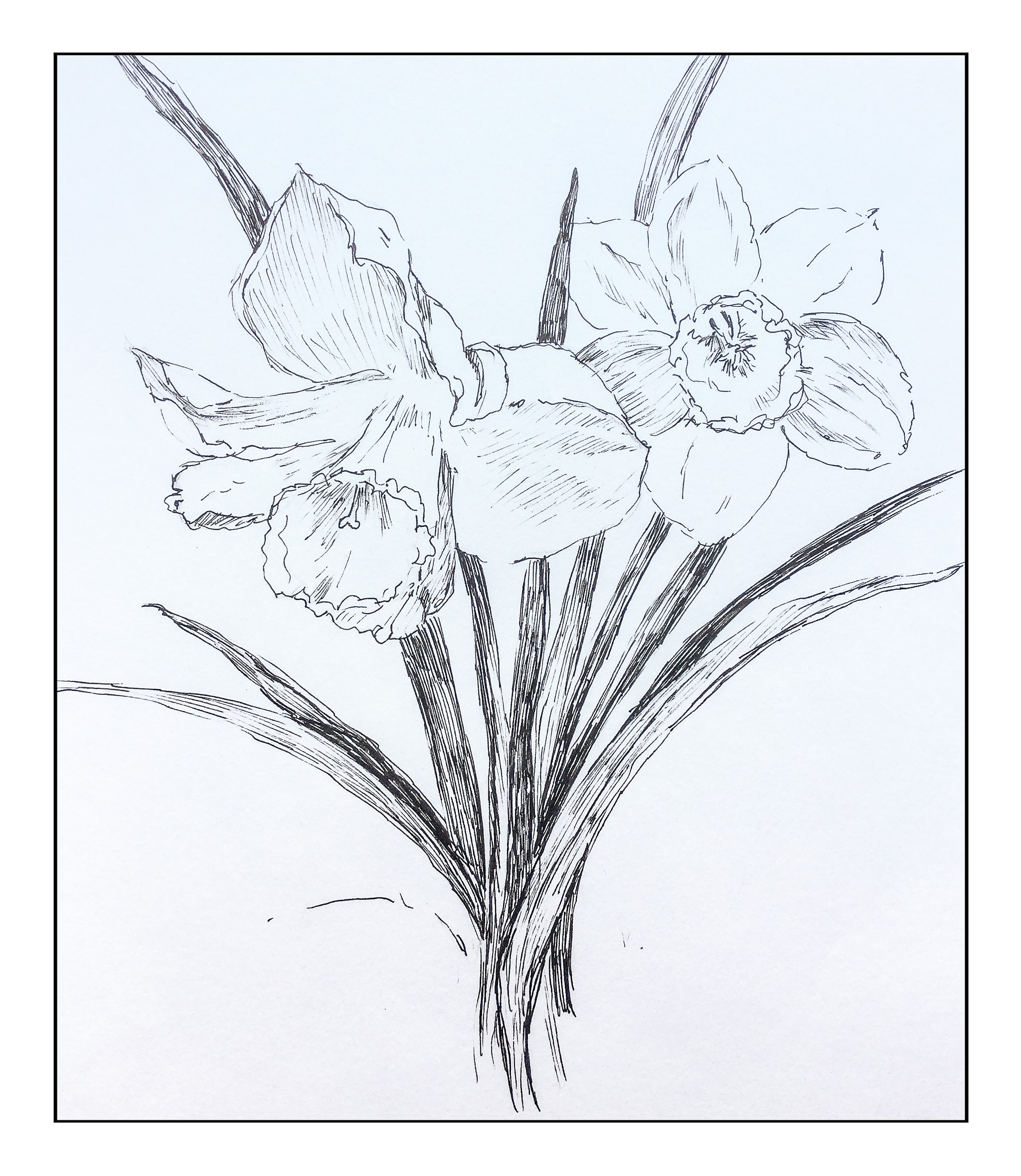
Today was just too nice of a day to stay home, so I headed out to the local botanical garden, cameras in hand, pen, and paper.  Bulbs are up and beginning to blossom; the ones in the shade are getting there – more for later visits!  Birds, butterflies, bees, cool breezes.

Since I have been playing around with the exercises in Alphonso Dunn’s fine book today, I decided to continue the adventure and draw some daffodils with pen and ink, but follow through using watercolor pencil.

I laid down the major lines in pencil, and followed through with a fine pointed Namiki pen with waterproof ink.

Next, direct application of Faber-Castell’s Albrecht Durer watercolor pencils.

And finally, using a water brush, I wet the colors, taking time to use a light touch.  A few lines of extra ink, and it was done.  Below is a gallery if you wish to cruise through the sequence from pen, pencil, and water.

Wet Work

I read too many spy novels!

So, if this isn’t about the darker sides of life, what is this about?  It is about watercolor painting.  As you may recall, I have been trying to work on my drawing and painting, between other life activities.  While I try to do one or the other daily, it doesn’t happen.  The thing that is happening is a beginning of focusing on various elements of watercolor.  Rather than just paint, I began to focus on retaining white space.  White space in watercolor is the paper itself – that is the only way to get a “true” white when painting, unless you put in white paint, such as a white gouache.  Many people frown on this.  So, retaining white means you paint around white areas, which have to be considered as you lay down color, or using a rubber-based frisket.  The frisket is great as you can paint right across it once it dries.  Both methods have their advantages and disadvantages.

In addition to retaining white space, I have added another focus in my painting.  Watercolor paper is painted on when wet or dry.  Painting wet-on-dry means applying paint to a dry paper.  Wet-in-wet means prewetting the paper, or painting onto paper where a wash is still wet.  Wet-in-dry allows for hard edges.  Wet-in-wet allows the paint to blur and blend, and how much it does this is dependent on the wetness of the paper and the slope of the easel.

The above picture was from a photo I took at the Monterrey Bay Aquarium of jellyfish floating around in their water.  The aquarium is backlit, and the light shines through the diaphanous membranes of the fish.  This was simply ink, followed through with a bit of color.  Drawing the jellyfish was fun – and in the lines of the tentacles, it almost became a dance with the jellyfish.

The jellyfish were drawn with a very fine point pen.  The Joshua Tree was done with a thick, permanent ink pen, about 0.5 in diameter (I think).  Here, the ink was used to create texture, with watercolor being secondary.

This is the point at which watercolor, ink, and white space became a focal point. I think these are a variant of snowbells, and they are found in the shade beneath trees. In such dim light, the white flowers are strikingly in contrast to the mulchy undergrowth, and in photos often are rather flat in appearance. This drawing demonstrates that flatness, but with the whiteness of the flowers preserved.

From the flatness of the line and watercolor drawing, I now worked on creating white in a dark painting. The flowers themselves look very flat because the paint I used to create – try to create – a 3D effect just pooled. The white is now filled with flat paint, which creates a flat picture. Here, the paint was applied wet onto dry paper, and the result is a bunch of hard edges. It is this realization that made me move into working a lot with wet-in-wet.

The pictures above are more attempts at preserving white, and working wet into wet. Probably the most successful one is the painting of the winter sky with the silhouetted tree.  Click on one of the paintings to cycle through the images in a slide show.

From the deliberate paintings I moved to wetting the paper thoroughly with water for the first of the two paintings above – soaking the paper with my brush, painting into the wet paper, and then painting again into the wet paint. The fir trees were more deliberate.  Here I tried to work with white space and with snow, trying to capture ways in which white can be interpreted with paint.  Again, click on one of the paintings to see the slide show.

While doing all these paintings, I started thinking about watercolorists whose work I admire, and who, I know, did wet-in-wet particularly well. Winslow Homer is one of the best watercolorists of the 1800s, and his skies have always appealed to me. The painting above is my rendition of his painting The Palm Tree, Nassau. I changed a few colors and compositional elements, but I used this as an exercise to study how Homer may have painted. He used wet-in-wet on the sky; white space for the waves and tower, and varying techniques for the palm trees and foreground.

Besides trying to understand how an artist created a painting, I also searched YouTube for artists working wet-in-wet. I came across Edo Hannema’s channel and was so impressed! He is a master of wet-in-wet, as well as working with white space. I learned a lot from observing and copying his examples; this painting may be from one of his videos or an interpretation of one I saw online – don’t recall. I think seeing his work, and copying his exercises, has started my being able to move forward. I plan to follow his lessons more in the near future. His paintings have a lovely simplicity as well as demonstrate a finely honed skill in wet-in-wet. He is from Holland, so many of his paintings show very flat land, which for me is fascinating as I live in an area with a lot of hills and mountains and valleys.

Finally, I did this one today. I was up at oh-dark-thirty, having my coffee, and thinking about all the things I have been painting over the past few weeks. It was time to try to paint something that used a lot of wet-in-wet, had a modicum of white space, and finally wet-into-dry, meaning wet paint applied over dried paint. I am pleased with what I have learned, from copying other artists’ works to my own experiments. Everyday is an exciting new adventure, and out of all of my interests and hobbies, watercolor is the biggest pleasure of all.

Below is a gallery of all the above paintings, and a couple of others as well.  Enjoy!