A Frisket, A Frasket . . . .

I’ve been taking a basic watercolor course at the local adult school with one of my favorite teachers. I decided to do this as it never hurts to return to basics as it can be eye-opening. Here, one of our studies. This one made me rethink using frisket as a resist quite a bit, and while I may never really embrace this – using frisket to maintain white paper – I really learned a lot from this little study.

First, the teacher provided us with a template to use – namely the rose. We transferred it to our watercolor paper by using graphite on the reverse of the template. We were to outline the white areas and then, using the liquid frisket, paint out the white areas. This way we could apply very wet washes to the paper without losing our hard edges and white paper.

Once the frisket dried, we wet our paper around the rose. Colors were dropped in using viridian, quin rose, and phthalo blue. We kept our paper flat and worked relatively quickly. Once the outside colors dried, we moved into painting the rose. Wetting the rose, the colors were then applied using cad red light and quin rose. The violet was a mixture of blue and rose, but I also used carbazole violet as it is a very clean purple. Once more, paper kept flat as the colors dried.

From there, little details were added, such as leaves, extra contrast, and so on, all using various tricks common to watercolor. In the end, once all was dried, the frisket was removed and little bits of color added here and there over the white areas. Lines, bits of color.

And this is the result! It is an abstract and very watercolory and painterly rose. Techniques were wet-in-wet, masking with frisket, and some dry brush. I also splattered a bit of quin rose and carbazole violet onto the surface to make it a bit more interesting to my eye.

Watercolor, frisket, 10×10 Canson XL watercolor paper, wet-in-wet and splatters. Colors were limited to carbazole violet, viridian, phthalo blue, cad red light, quin rose, and a smidgen each of burnt sienna and cad yellow.

Another Bit of Snow

Today I played around with the same subject of the other day – a covered bridge with a bit of snow. The goal for today was a much more direct use of the colors, with very little returning to fix this or that with a glaze. Consequently, it is more casual and not especially refined – such as the bridge itself – but I like its simplicity and clarity of color. I met my goal in this painting. Below is the original from the other day.

I may choose to do this same picture a few more times – pen and color as well as another one more direct but done more carefully. It’s a good subject overall.

Watercolor, 10×14 Arches 140# CP.

A Bit of Snow

It is this time of year, the end of October, when I dream of autumn fading away and the first snows of winter arriving. I was born in mid-October, and my mother says she went into labor with me on a warm, sunny autumnal day and came home in a blizzard. I always remember this story, and as a kid loved seeing bright autumn leaves and berries still on the trees and bushes breaking through a fresh layer of snow. Weather like this was always a birthday present from Mother Nature!

Covered bridges spanning creeks are still in existence in various bits of the east coast. I imagine they were welcome resting spots for those on horseback or in open carts or wagons, out of the wind and snow or rain. For me, they are part of my own nostalgia for “the good old days” – and really lovely bits of historical architecture.

It has been a long time since I have witnessed the autumns and winters of hardwood woodlands. They always linger as some of the most beautiful memories. The mid-west and eastern states of New York north are where I want to be this time of year. But, where I live, in sunny SoCal, this is not the case, even though the Sierras have much to offer this time of year. And, admittedly, I am glad I don’t have to deal with chains and mukluks and woolies and long johns. I will admire the change of seasons from afar, more so in my dotage.

Watercolor, unknown watercolor paper with poor sizing, 11×14.

Summer Fields

Tomorrow is a family gathering, quite possibly the first since last year. This morning I cleaned up clutter and sorted out things, did all the first-of-the-month stuff, and so on. Meanwhile, the esposo is working from home and making both beef and chicken barbacoa in between saving database lives. I have already run around town collecting goodies, as have other family members, so we call enjoy a bit of a feast and each others’ company tomorrow with good food and good company.

Of course, a girl can only do so much and then the painting gods and goddesses beckon. Once more, lavender fields call, so here some are for your enjoyment.

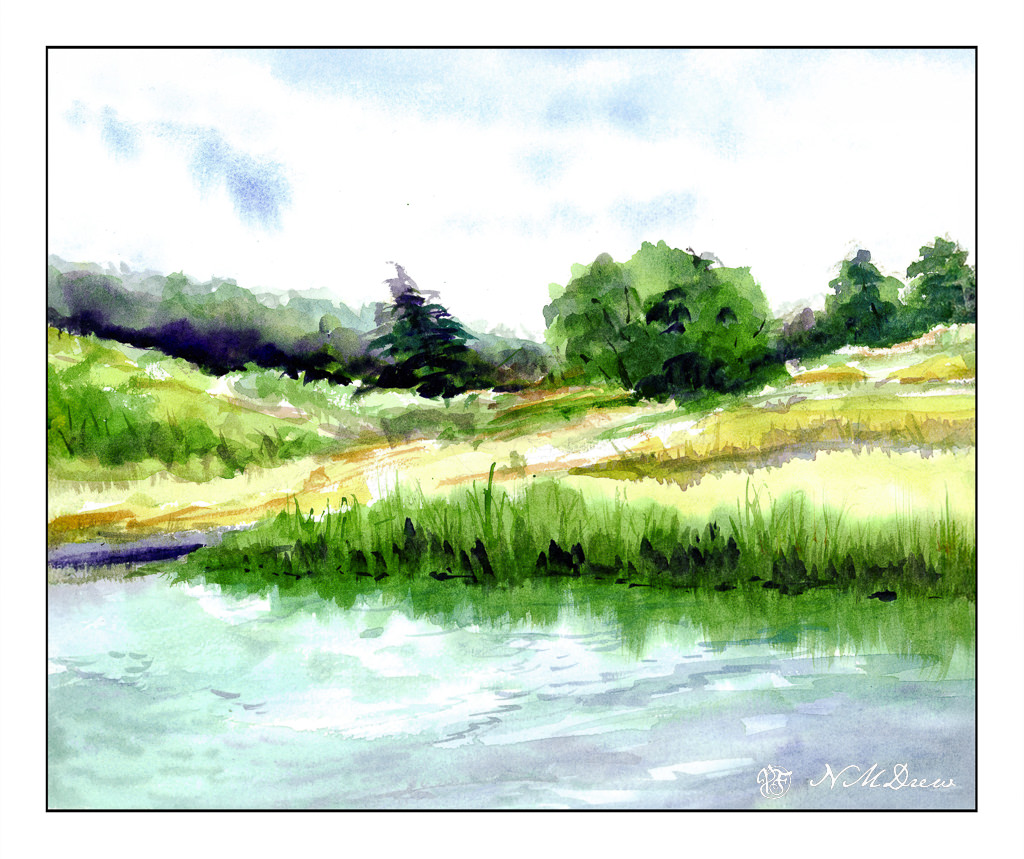
Technique was primarily wet, beginning with they sky and distant mountain and trees, letting things bleed into each other. I like the misty effect and sense of distance it creates, as well as the suggestion of tree-covered hills. From there, greens and lavenders, lines and directional shapes. Final details were some dry brush lines in the foreground and in the tree shapes to create texture and vertical movement. I used a large mop brush (#6, Princeton Neptune) for the entire painting until the end. At that point, I took a small stiff brush to add some of the finer lines and dots.

Part of me thinks I could have done a bit more of a light lavender color, but overall, I am pleased with this painting.

Watercolor, Arches 140# CP paper, 9×12.

In Acadia

Acadia National Park is one of the most incredible parks – wild, rugged, beautiful.

Another painting with watercolor on Vision paper; again more direct approach. Not sure how good this looks online as the scan was not especially good.

This was a challenge altogether. Goal was simply to simplify. The rocks were not so easy to do as they are complicated in a lot of ways, at least here. They are very rectangular and sharp. I used broad strokes – and then some more – and then some more, each getting smaller. The trees, foreground, lighting were difficult as it was sunset or sunrise and catching the colors felt elusive. It feels overworked to me, but this is practice with both the paper and subject.

Vision watercolor paper, 140# CP, watercolor, 9 x 12.