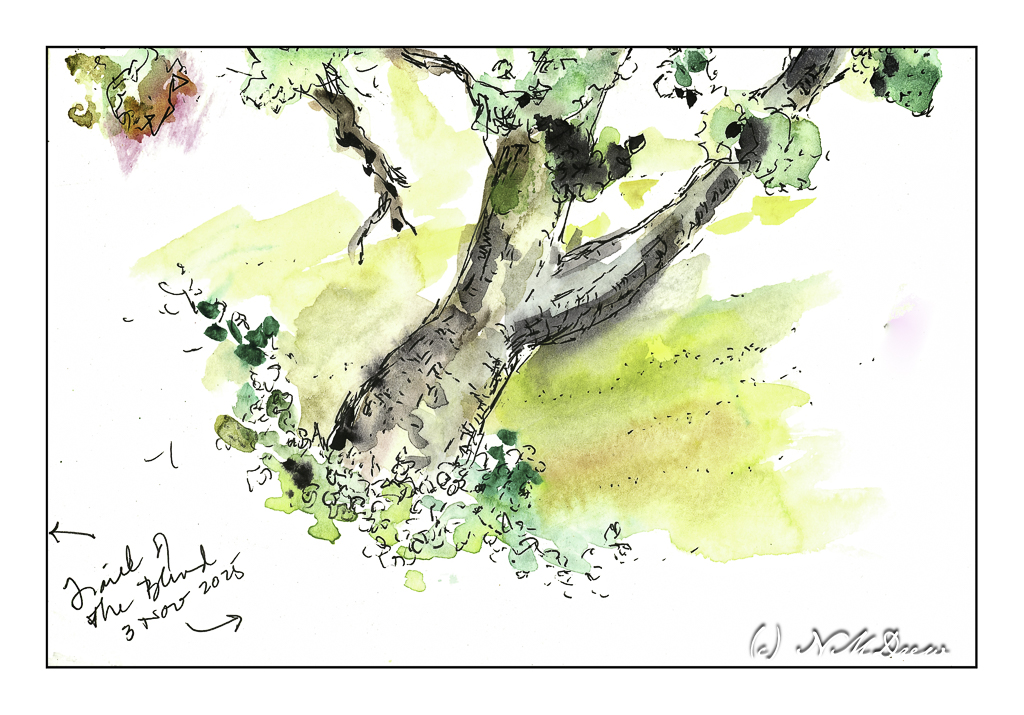
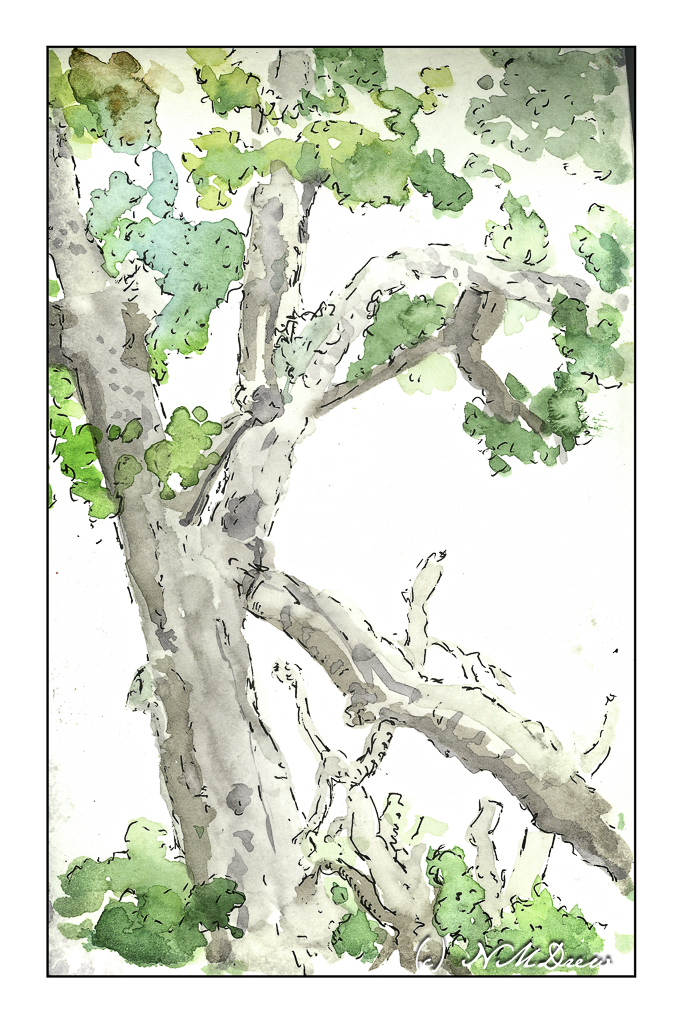
I don’t know why, but I always thought these were called “plane trees,” but it turns out they are poplars. We don’t have them here in SoCal. The ones we do have that look similar – in the sense they are narrow trees that grow tall – can be a type of juniper or eucalyptus. I am really drawn to these trees because of their fine branches and leaves which change in the fall.
If you read my blitherings, you know that I am enrolled in an oil / acrylic painting class which meets weekly, and have been in it for several months. I chose oils as they can be worked on over several days with the paint remaining wet over a period of time. What I like about oils is they blend easily and a softness can be achieved (by me, at least) that I can never get when I use acrylics. In this painting, I worked on both simplification and abstraction of various elements of the painting as well as atmospheric perspective. I only considered this painting “finished” when I added some squiggles in the water to suggest movement.
Overall, I am pleased with my results. I have spent several months gazing at it. It never seemed done until those little squiggles showed up. Crazy, huh?
Once more, a class by Shari Blaukopf, “Sketching Boats: Simple Solutions for a Complex Scene,” has changed my approach to subject matter in watercolor and other media. I think this class amazed me the most in how it affected my own painting. As Shari writes:
I love painting boats, but this course is not really about that. It’s about simplifying a complex scene. So, while boats and their reflections are our ostensible subject, I’ll be sharing my tips and techniques for making visual sense from any scene of complexity.
Complex scenes – other than landscapes – overwhelm me when it comes to painting. I just have no idea where to begin. Looking at a bazillion things cluttering up the subject matter and deciding what to do is sometimes so much that it is better to walk away and try something simpler. For me, buildings are often the culprit, and this means city scenes go unpainted. Certainly scenes of harbors and boats and marinas are even more complex as boats sit on the water and are all about the same height – masts being the main difference in a marina full of sailboats. However, this class broke it down quite nicely, and while I am not especially enamored with the results, I am really happy with what I learned from this class and the general success of the painting.
Essentially, the process is very logical and simple. The scene is drawn in pencil. The horizon line is determined, and then the drawing is begun. The boats, as they are the main subject, are drawn on an even level – they all are pulled up against a dock and the water is the surface. There are no hills or valleys. The boats closest to the viewer are drawn in detail, and the rest are suggested with shapes and lines, with their “oh, that’s a boat” qualities indicated when painted.
The sky and the forefront water first were painted along with the land in the distance behind the boats. Areas for larger masts, the white ones, are left unpainted. Then the detailed boats were generally limned in with color. Masts and reflections are indicated in this early period. From there, the painter works back toward the more distant boats and such. Eventually, details are added and final, tiny touches with color and white gouache complete the painting.
In summary: the simplest areas are completed first. The complex areas where detail counts is narrowed down to the first row of boats. Large to small. General to specific.
Writing this does absolutely no justice to Shari’s wonderful short course. I recommend it for watercolorists and any painter intimidated by complex scenes. Her breakdown of a complex scene is very simple – but I personally would never have thought about painting this way!
I was floored by my results – I did not expect to be able to do this painting at all.
Watercolor, short course by Shari Blaukopf, Arches Rough 140# paper, 10×14.
This is sort of an amalgamation of pictures and buildings. It may be part monastery, part hospital, part something. So, “Insititution”.
A few goals here. First, a building of some complexity. Next, contrast on the building with sunny areas and shady areas. Mission accomplished, sort of!
I also used gouache, white and black, for different areas of the painting.
Once more, it is hot and sticky, but not as miserable as yesterday. Today, I am a bit more energetic but still not running around in the 90F and then some heat. And I am in a far better mood, too! No flies. No mosquitos. And a replacement package for the stolen one arrived today. Now, September is here, and though summer is not yet over, Labor Day (American holiday always on the first Monday of the month) is, for many of us, the official end of summer.
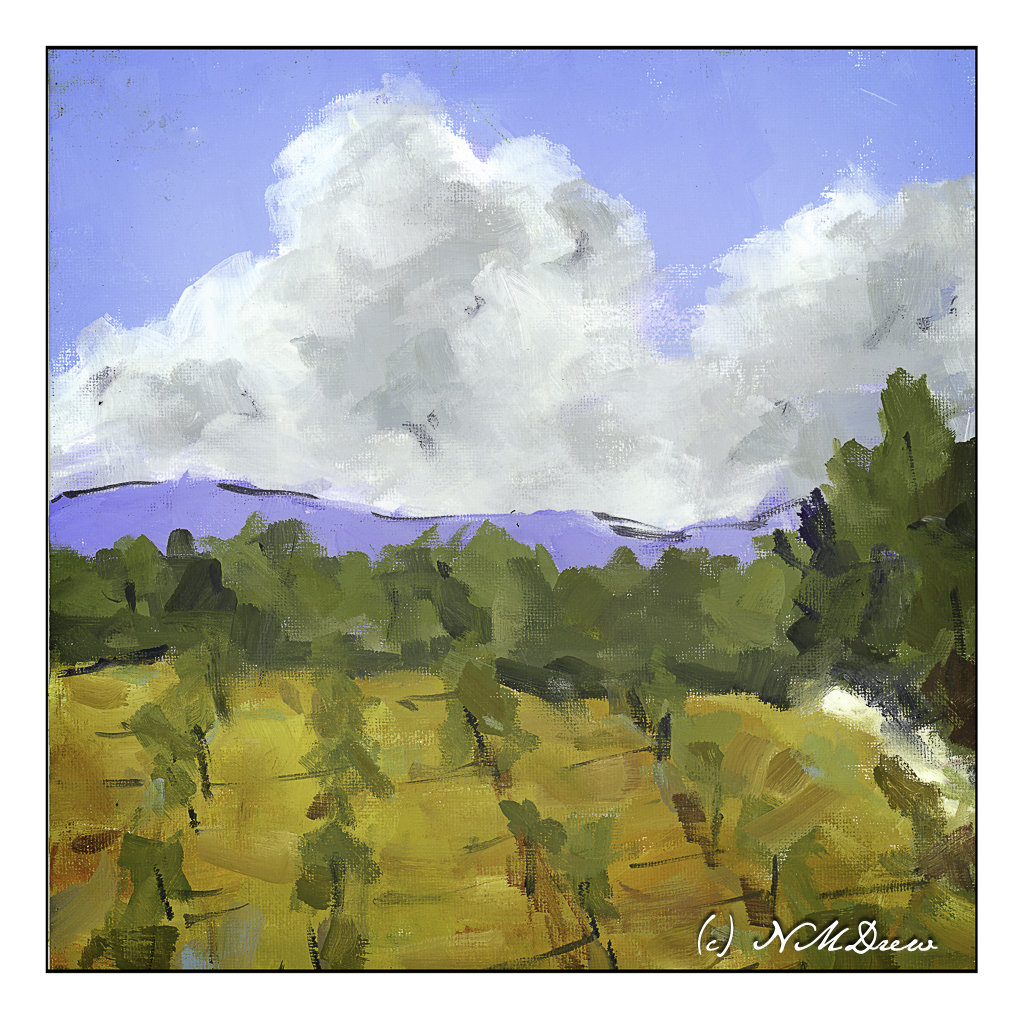
The end of summer means the fields are mown, crops and hay gathered in. Tracks and stubble leave lines behind in the shorn meadow. Heat, light, late afternoon.
That is all that this painting about. I did it after the one I posted the other day and, as with the other “Two Trees”, I am happy with the results here. I like the long shadows in the lower right, but if they are realistic or not is not the point – they just make for a bit more of an interesting picture!
In landscapes, you are the goddess of your painting!
With little to do other than post about flies (see yesterday) and gripe about the heat and a missing package, it is always best to move on to things which please you the most. For me, it is waterolors and landscapes. These are two things that usually give me a lot of delight and certainly act as a balm when I am feeling really pissy!
Okay. Heat doesn’t do me well, so I have the air conditioning on and the house has cooled down from 81 F to about 76 F. The latter is manageable. Lots of water and electrolytes, too. And then, watercolor and color and trees and skies and the feel of brush on paper. Even better, a painting I like, and a second one, which will posted after this one.
I am not really sure what to write about this painting. It is pretty simple. It is a simple scene of trees sits on the edge of a sandy bit of land and is backed by a few distant trees, grasses, and shrubs. The palette was simple enough. I worked to make my painting simple, too, and focused on shapes and contrast as well as recall of some lessons learnt from classes. I think it shows summer, too, and a bit of the sultriness I am feeling – humidity, heat, balmy. And very lazy.