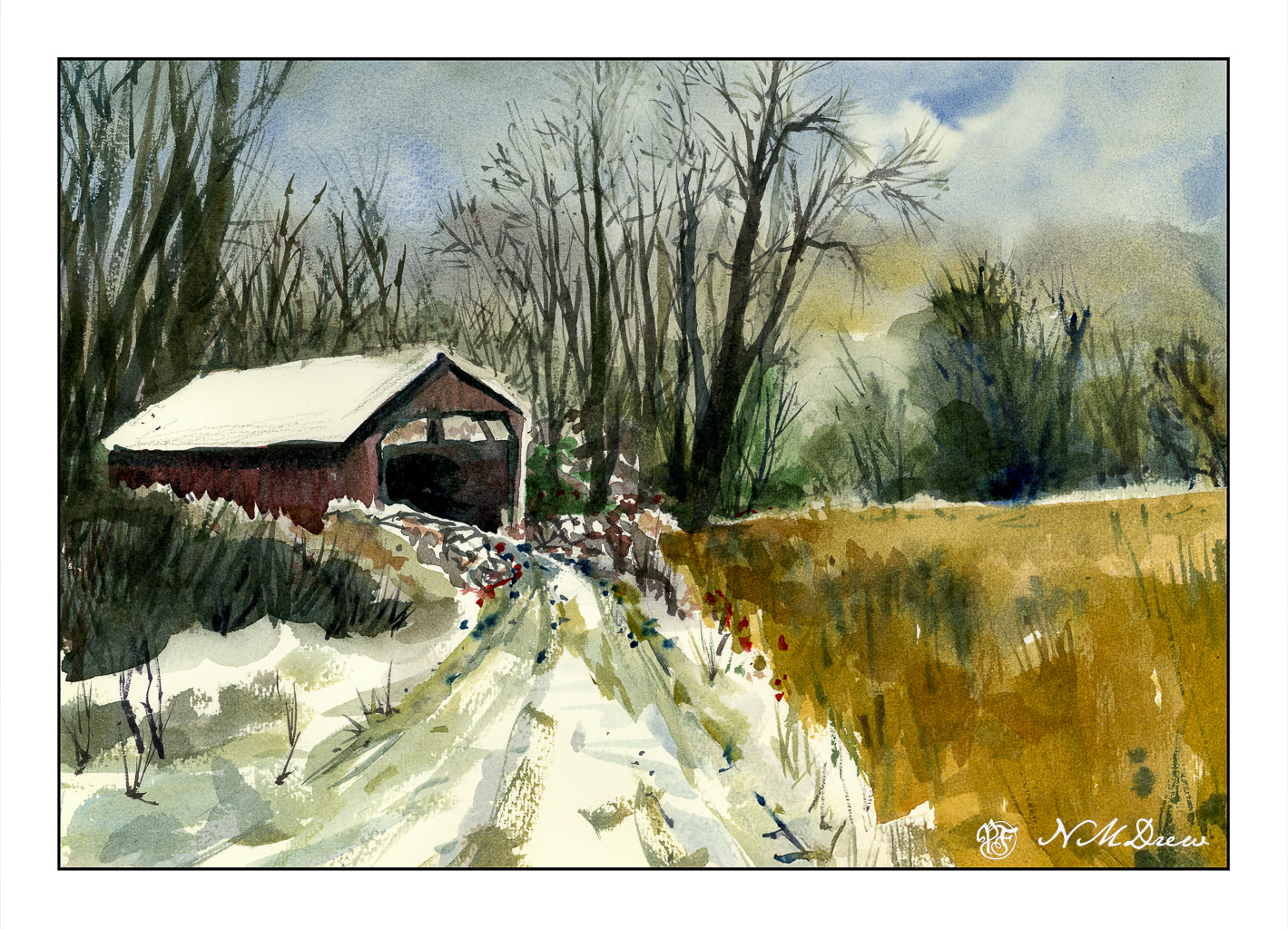
A Bit of Snow

It is this time of year, the end of October, when I dream of autumn fading away and the first snows of winter arriving. I was born in mid-October, and my mother says she went into labor with me on a warm, sunny autumnal day and came home in a blizzard. I always remember this story, and as a kid loved seeing bright autumn leaves and berries still on the trees and bushes breaking through a fresh layer of snow. Weather like this was always a birthday present from Mother Nature!

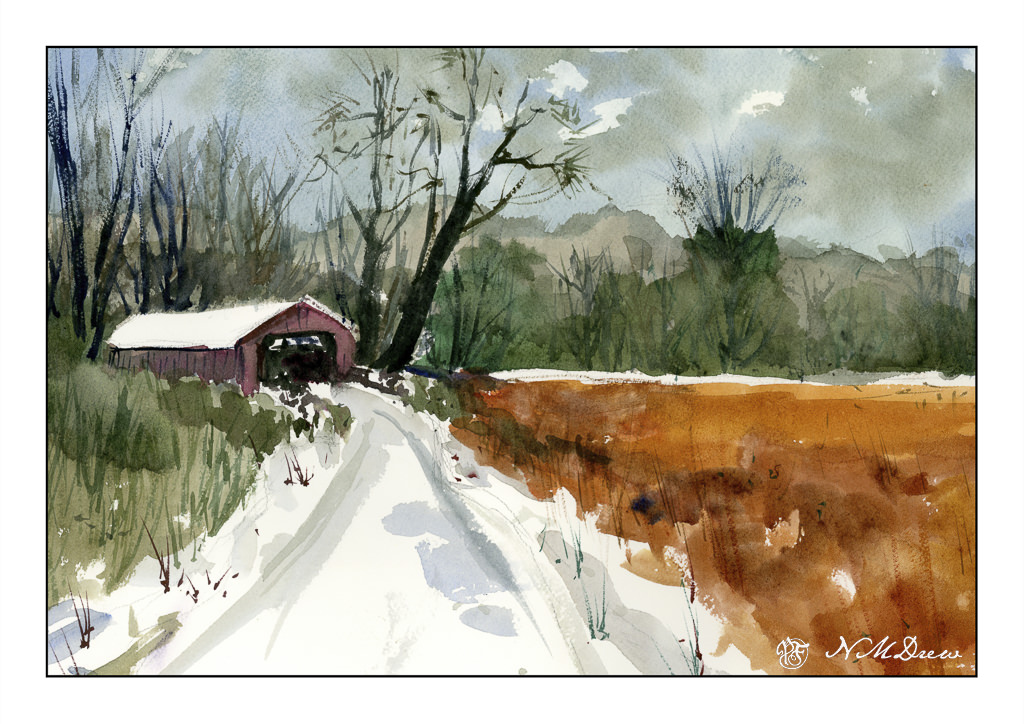
Covered bridges spanning creeks are still in existence in various bits of the east coast. I imagine they were welcome resting spots for those on horseback or in open carts or wagons, out of the wind and snow or rain. For me, they are part of my own nostalgia for “the good old days” – and really lovely bits of historical architecture.

It has been a long time since I have witnessed the autumns and winters of hardwood woodlands. They always linger as some of the most beautiful memories. The mid-west and eastern states of New York north are where I want to be this time of year. But, where I live, in sunny SoCal, this is not the case, even though the Sierras have much to offer this time of year. And, admittedly, I am glad I don’t have to deal with chains and mukluks and woolies and long johns. I will admire the change of seasons from afar, more so in my dotage.

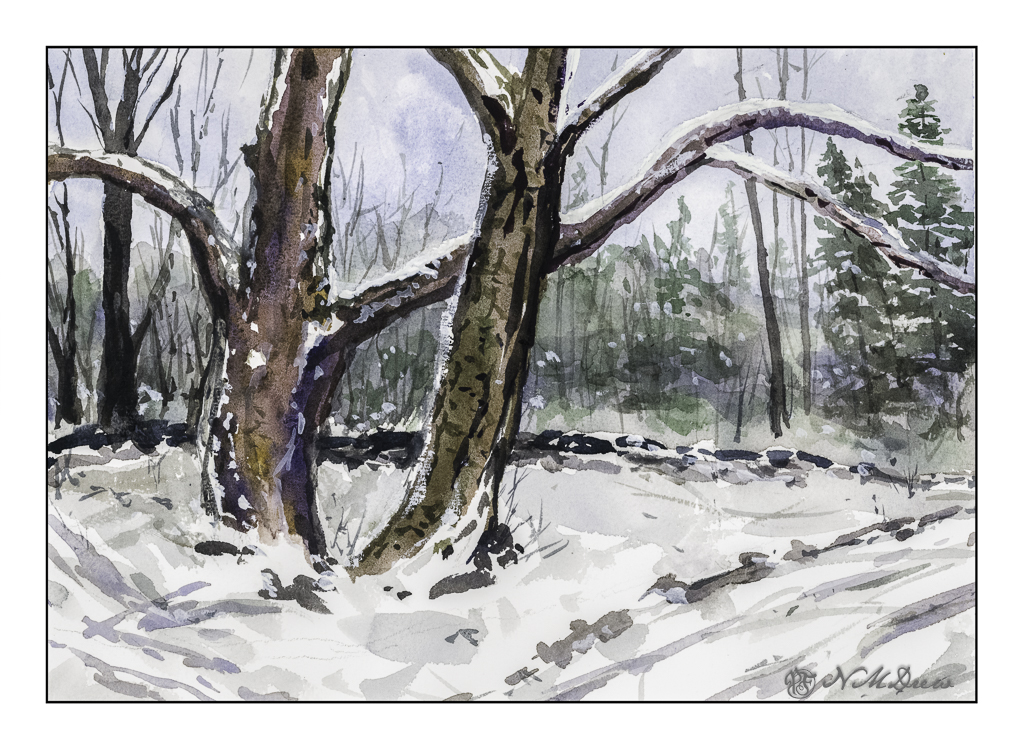
Watercolor, unknown watercolor paper with poor sizing, 11×14.

Winter Creek

First, I am not at all sure where I found the photograph upon which this painting is based – public domain? If not, and it is yours, I am sorry I cannot give you credit. Let me know, ok?

Oil paints on Canson Oil/Acrylic paper.

Initially I started out with a brush and soon realized that whatever I tried to paint was just not working. The grasses were not clear and sharp and the clouds were blobby. In the end, and out of frustration, I took a palette knife and used it to smear color into the painting – and all of a sudden I found out what painting in oils with a palette knife is capable of doing.

I am prejudiced against heavy impasto just because I don’t find it interesting to look at. First in my mind is how much dust it could collect and what a pain heavy impasto paintings could be to clean. Much impasto is done with a knife – though brushes also do the job, as seen in the work of van Gogh. So, I have avoided it to date.

Smearing paint around with a knife gives some dimension (3D) on a flat surface, but the way the paint moves is so interesting! I also used the knife tip to scratch away in the colors for the grasses, and that was both doing what I wanted to do, as well as somehow felt deliciously rebellious against my conformist self.

The snow, though, and the river, are done with brush. Brushwork was laid down first pretty much throughout the painting, and my aggravation then brought out the knife. Learning experience. And, I don’t think I could have rendered either sky or grasses anywhere to my liking with a brush of any size.

Live and learn.

11×14, knife and brush, on paper.

New Pen, New Ink

These past several days just seem to have been filled with stuff that needed doing, not necessarily things needed and wanted. Getting taxes done, going to the dentist, etc., are not my ideas of a Fun Life, but things Needing to be Done.

Despite duty, I have been putzing around. I realized that I don’t have a fountain pen and permanent ink for drawing any more as I lost a pen somewhere – which, no doubt, will soon be found as lost objects always are once replaced – and used up all my waterproof fountain pen ink. I now have a new drawing pen, a $17.00 job from Amazon with an extra fine point, and some of Platinum’s Carbon Ink, which is a long time favorite of mine for drawing. My Not Taken Vacation sketchbook was easily accessible, so off I went to the sunny patio to do some drawing. I used a few reference photos for ideas, and then began with ink and pen.

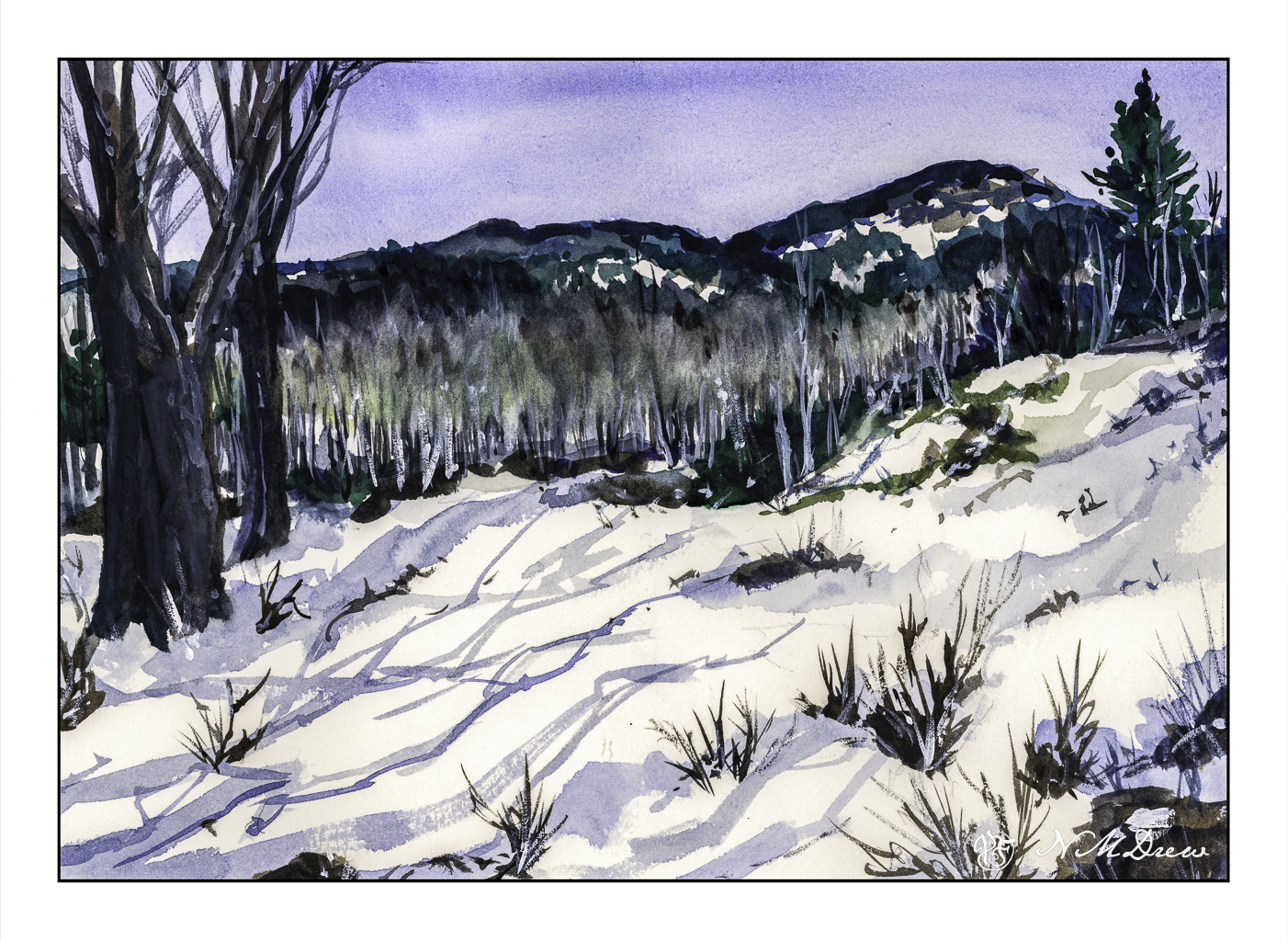
I chose to draw some snow drops in a vase, Pigeon Point Lighthouse here in California, a little cleft in the landscape, and a wintry farm somewhere. From there, my box of Schmincke pan watercolors, some water, and a brush. All this was sort of awkward as I have not done ink and wash for a bit, but it always feels so good to just sketch and paint, more so when it is out on a sunny patio on a beautiful spring day between last week’s rains and this weekend’s expected downpour.

I am quite pleased with my inexpensive fountain pen which came with the fillable screw adapter I prefer to cartridges, and coupled with the Carbon Ink, I think I have landed a rather happy combination for my drawing pleasure. Hopefully you like them, too!

After the Snow

There is a lot more “ink” these days than beer or yarn, but as far as those go, there is a lot going on in the background. I guess I will need to post some of my knitting projects or sewing projects (“yarn”). Cooking, too (the “beer” part). Paint (“ink”) takes up most of my time, though.

I am continuing with the oil paints and just love the sensuality of mooshing it around on a canvas! I also like being able to work on my sense of contrast – lights and darks – as I have done with a few pears.

When I am finished with a painting, even though I use low odor solvents, the smell lingers, more so when the house is closed up to keep it warm. Because of this smell, I have some drying shelves set up in the garage, which is pretty cold. It takes a long time for the paintings to dry unless I use Gamblin’s Galkyd Gel, and then they dry almost overnight.

Now that you know this, I painted this painting about 2 weeks ago using linseed oil as the vehicle as well as Gamblin’s solvent-free gel, but not the Galkyd. Drying time is very slow. I just got some walnut oil mixed with alkyd by M. Graham, which should speed up drying time and, I hope, give that lovely ooziness that makes oil paints a lot of fun. Maybe I will check that out later today.

I chose this subject to work on a few things: values, color, distance, depth, contrast. Overall, I am pleased with this painting. I like the brighter yellow between the tree branches on the right as I think it leads the eye in. Someone on a forum said it was too bright and might need to be dulled down a bit. That is something to think about, but my magpie self likes that but does see what the person means. But how much should that yellow-orange be dulled, and so on. Maybe I will play with it in PS.

Above is the desaturated image. I do this to look at my values. Success! Isn’t it interesting to note that the bright yellow-orange becomes a middle grey when in black and white?

I have a couple of other paintings out in the garage drying. I’ll get those out in a few days. Scanning a painting is far nicer in result than photographing as there is minimal glare. The only problem with the scanner is that sometimes the software does not like to merge the sections – luckily I have a few different ones as back up and seem to work quite well.

11×14 oil painting on cotton canvas panel; scanned on Epson V600 at 600 dpi and 48 color bit depth.

Storm Break

Heavy rains and foreboding skies give way to ragged clouds and brilliant blues as the storms recede. No snow here, but memories will do! I tried to express this sky in the distance, beneath the blue and white with the dark clouds moving away. Not so sure how it reads, but you can decide that. Could be trees, could be clouds, could be space ships. And there is a river behind the trees and the snow across the way.

Kilimanjaro Natural White Rough, 300#, Rough, 12×16.