
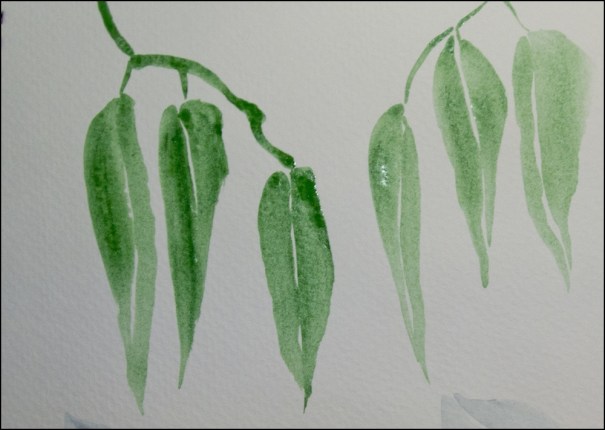
Having been doing sumi-e with some regularity for several years, I am finding it helpful in watercolor. Because the brush is the vehicle for watercolor, as it is in sumi-e, it is important to understand how the brush works.
Kolinsky sable watercolor brushes can be considerably stiffer than the white-haired sheep brush used in sumi-e, but much more flexible than the wolf and horse brushes, which have darker, more stiff bristles. Basically, a western watercolor brush combines both qualities in one brush, but this does not mean that it is the same at all! A good point is important for a Kolinsky round (I am using DaVinci Maestro Series 10s and Escoda Series 1212) just as it is with sumi-e brushes, as is the ability to carry water and color.
Many of the same techniques used in sumi-e can be applied to watercolor. These include brush strokes, such as increasing and decreasing pressure to change line thickness. Two or more colors may be applied to a brush, as in sumi-e when different ink intensities are applied. In Western watercolor, a brush stroke may be modified, working wet-into-wet, wet-into-dry, dry-into-wet, and glazing or layering colors. This does not work well in sumi-e, unless one is doing fine line Chinese painting.
The major differences between sumi-e and western watercolor are responsiveness of paper. Japanese and Chinese painting papers are generally much more porous than traditional Western watercolor papers. Heavily sized Asian papers are used for fine line painting, where color layers are used, and bleeding of ink, so characteristic in sumi-e, does not occur. Western watercolor papers will vary in the amount of sizing used, and this, in turn, affects the absorbent qualities of the paper. Knowing how a paper responds takes time and practice, whether in Asian painting, or Western.
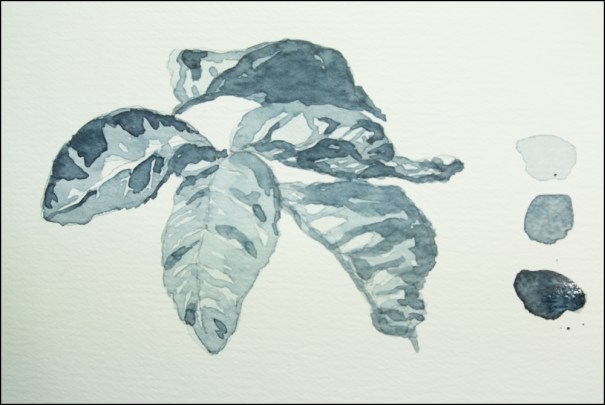
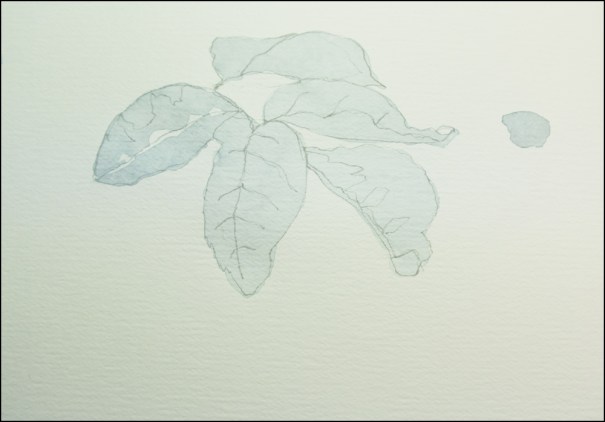
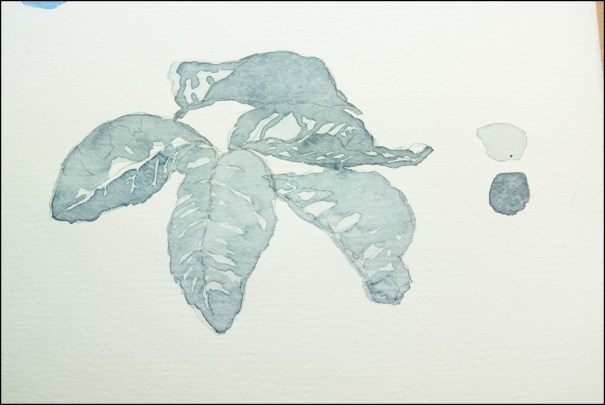
Value in sumi-e is achieved in how the brush is loaded. Ink can be very pale, and while it is still damp, darker ink may be applied to good effect. A sumi brush can also be loaded with pale ink, then a medium ink, and finally a tip or dark, or even one edge of the brush in dark ink. The stroke of the brush creates all the gradations. In watercolor, value is achieved by layering, as well as working wet-into-wet. Layering, also known as glazing, is the application of wet paint on a previously painted layer which has dried. Glazes are also built up light to dark. Wet-into-wet can be sopping wet, or in varying degrees of dampness. In some ways, wet-into-wet requires more self-discipline than glazing, which requires patience and forethought.
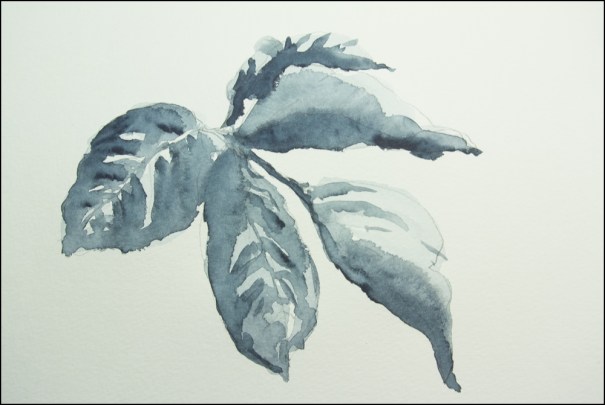
Each painting technique, sumi-e and watercolor, have similar techniques, as well as some which are exclusive to that medium. The key is to learn from both, and to master each.
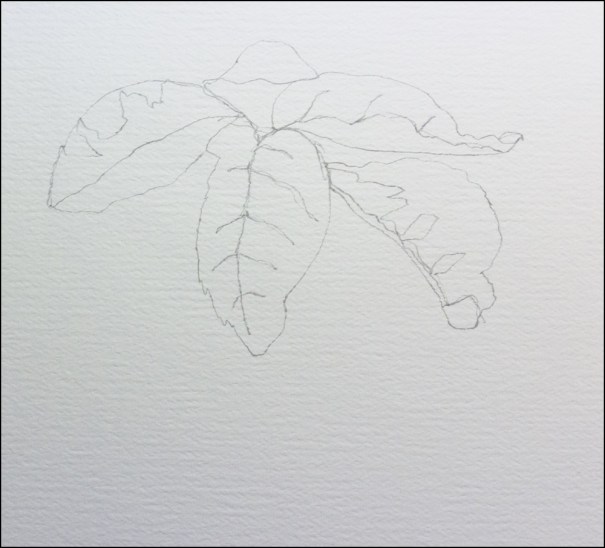
All these paintings were based on demonstrations from Linda Stevens Moyer’s book LIght Up Your Watercolors Layer by Layer.

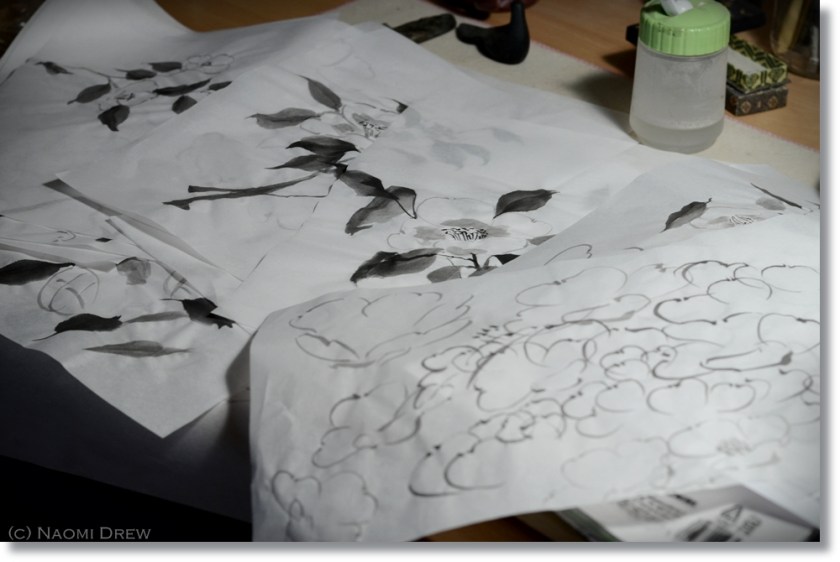


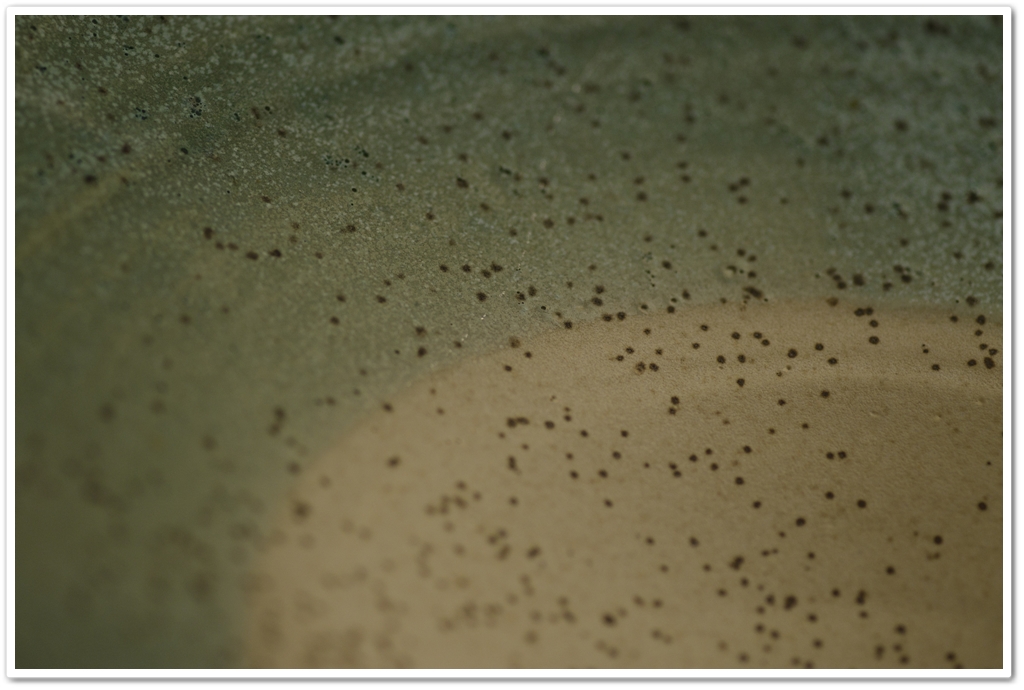

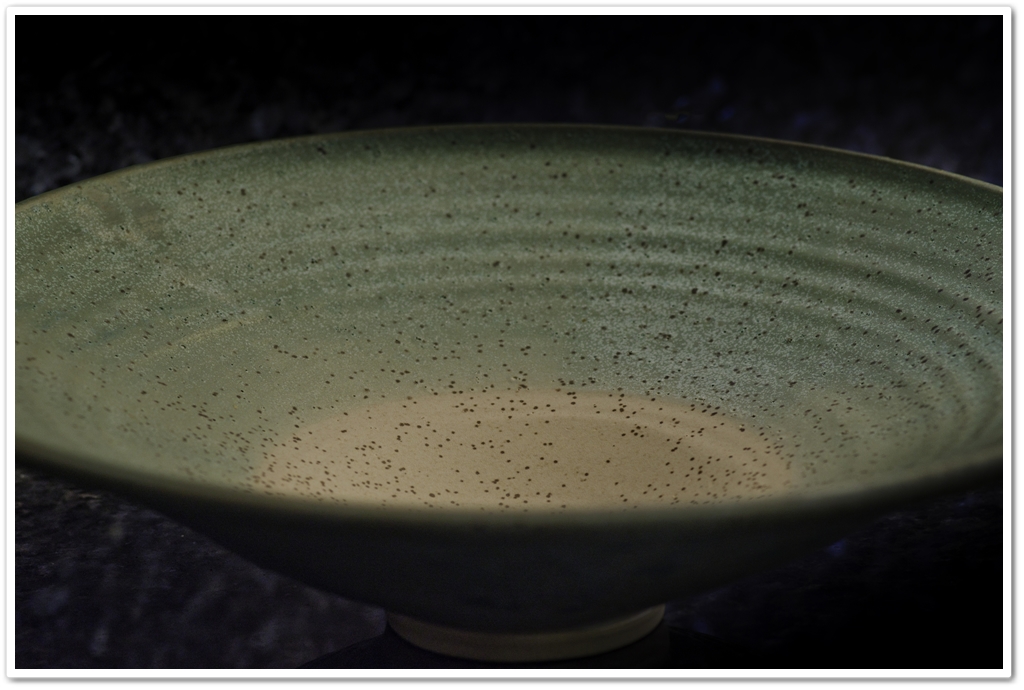
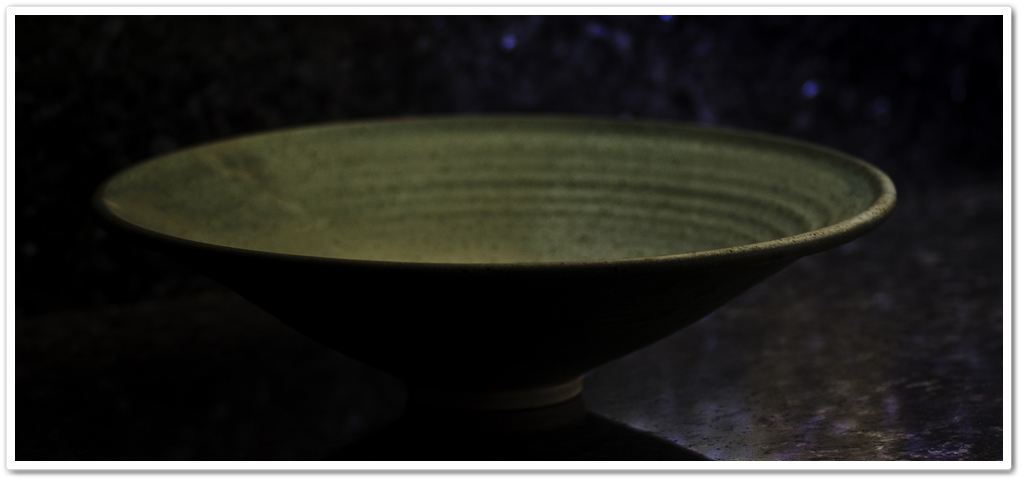
 The visual is a primary part of our lives. Eyesight, unless you have a serious problem, is taken for granted. However, looking and seeing may be two very different things.
 To see is a subjective experience. Seeing is taking the act of looking to a deeper level. This is where we may interpret a facial expression. We may delve deeper into an object, moving in close to gaze on minute detail, or move back to take in a wider vantage point. Whatever we do to see, we do to experience on a personal level, from whatever motivates us to go beyond the cursory glance.
 I find that my photography is influenced by my study of sumi-e where the essential of something is far more important than the actual object. I also enjoy strong, graphical compositions, which can be seen in my favorite photos, and in some of my paintings. Dynamic lines and shapes are visually exciting and interesting as they lead your eye. Lines and shapes can also draw the viewer inward, into the heart of the artist.
 In a gallery, whether physical or virtual, the first thing we do is look. Something suddenly attracts us, we hone in, and then begin to see. All this is subjective. A critic, though, will step back and look more objectively, and contemplate skill, rendering, compositional elements, contrast, detail, color, and so on. An artist must also do the same of his or her own work. The purpose of this is to learn from what we have done, and this becomes an impetus to continue, to learn more, to move in this or that direction. Critiquing one’s own work, and that of others, is an intellectual enterprise, while also being a subjective experience which leads to a complex of new emotions, thoughts, perspectives, and whatever else lies within. It is also another level of the artistic experience which works in strange and wonderful ways on creativity, vision, and expression.
 Artists work to create expressions of an event, an experience, an emotion. Art can be visual, auditory, or experienced by other senses, such as touch or smell. Art can be kinetic – something we do physically. Art must be experienced – watching a play, seeing a painting, listening to a song, The artist experiences his own art by doing it, and then it is shared, and in the sharing, the artist moves beyond the moment and continues to grow. The same must be said for the viewer who participates by listening or seeing or doing. All together, art creates a mesh we all experience in our own unique ways, and binds us together in our humanity, creating a community whether or not we realize it, or choose to recognize or acknowledge it.
 Ink, Yarn & Beer