I was rummaging through the files on my desk, and came across a collection of sumi-e ink, ink and color, and watercolor or acrylic paintings I did a long time ago. Some of these are “aceo” size, which measure 2×3.5 inches, and others are other papers. I used to sell these on Ebay, too. Maybe I need to go through and scan some more – it’s like tea and madeleines – memories and reminders.
Tag: sumi-e
With Lines, Without Lines

If you have been following this blog of late, you will know that I have been putzing around with watercolor on a more serious level than in a long time. (Really, more serious than ever before.) In the process, I have struggled with control of the medium, like all who begin with watercolors. Lines help when a painting fails, and sometimes lines add to a painting if that is part of its intended style.
Having done sumi-e for many years, I love lines and their expressiveness. I also like colors, and that is where self-control needs to show up the most. Think of Hawaiian shirts or 40s palm frond prints and you get the idea about my ideas of color – louder and more is the best!
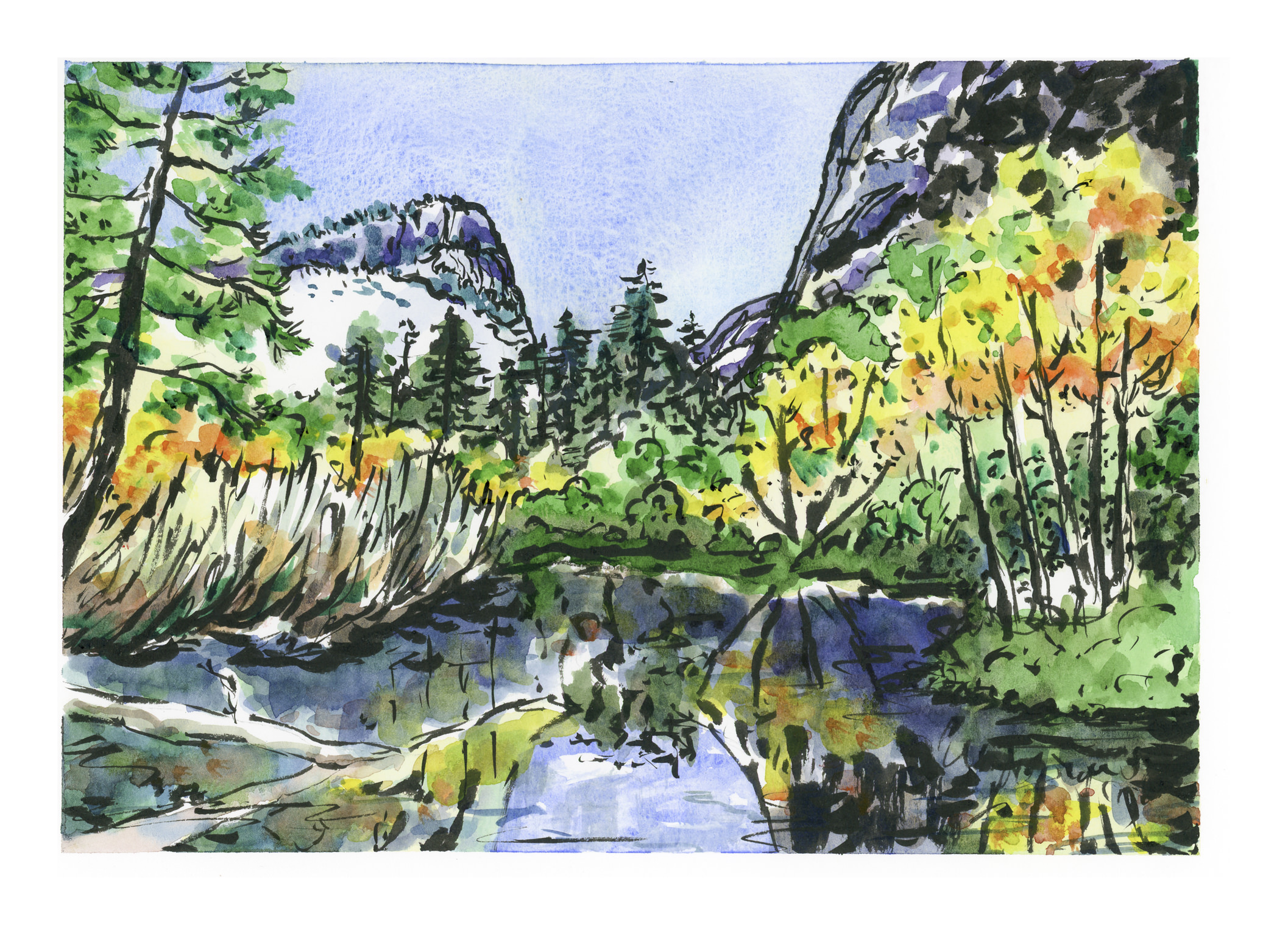
This painting of Mirror Lake was very satisfying as I felt the use of sumi ink and colors worked well.

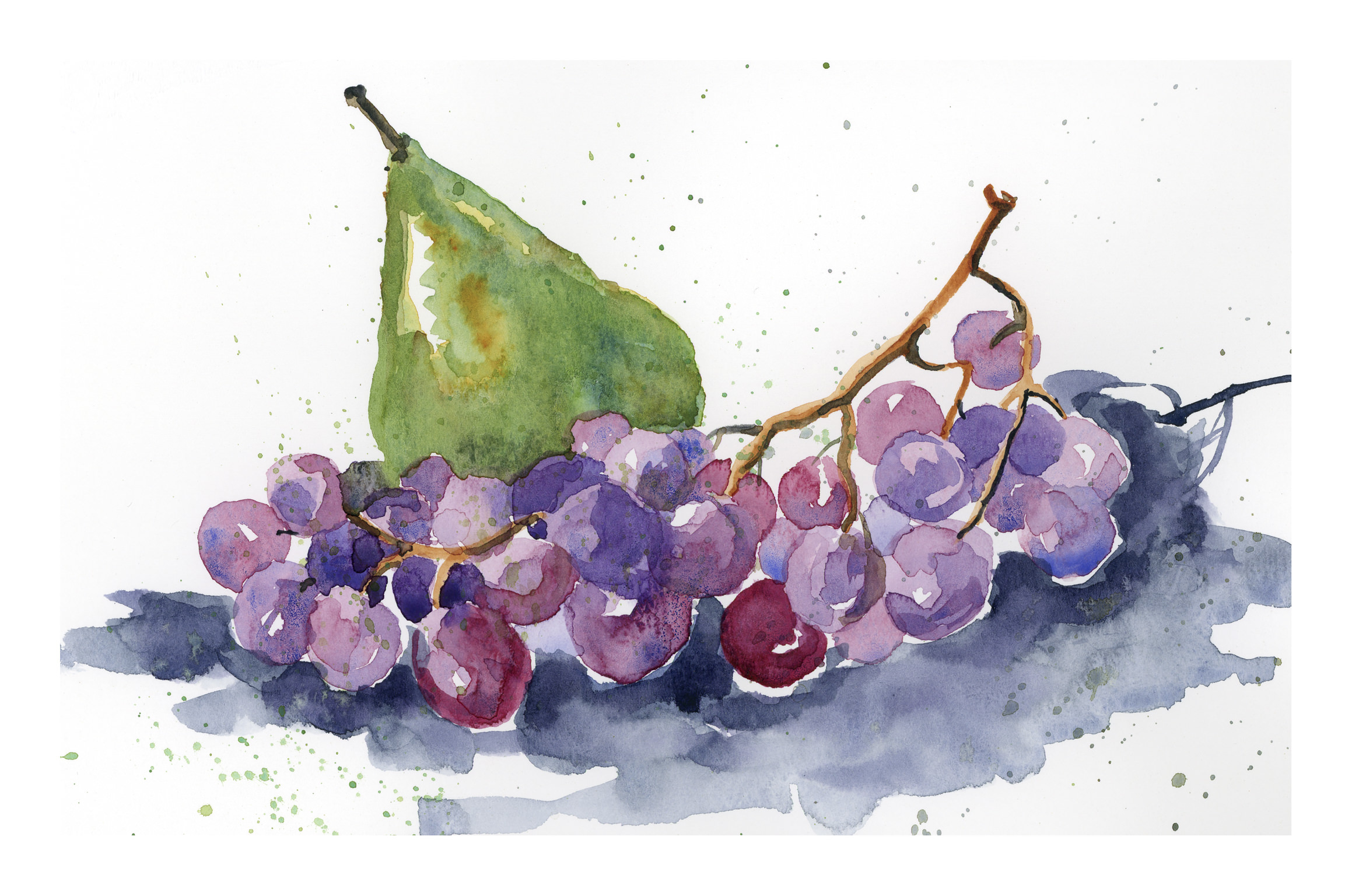
The painting is inspired by a number of paintings I found when I googled “pears grapes watercolor” and chose images. There were a lot out there, and so I painted a number of grapes-and-pear paintings yesterday.
This is the one that pleases me the most. I like its painterly elements and the colors of both the grapes and the pears. It is the most controlled and thought-through of the series. I did not draw any pencil lines prior to painting it, but painted it freehand, recalling brushwork in sumi-e. It’s easy to fall prey to haste in watercolor, to achieve a “painterly” look, but it really requires forethought, just as sumi-e does.
I did four paintings altogether in this series, which you can find under “My Other Lives” above.
Copying the Master(s) and Stealing (Their) Secrets

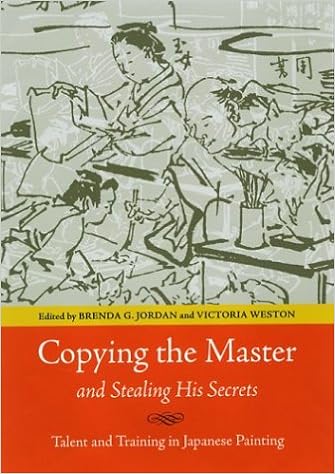
This book remains a favorite of mine, in part because of the history behind art apprenticeships, but also because it serves to remind that in all arts, a period of apprenticeship – with or without a teacher – is needed to gain mastery. As I struggle with watercolor, I remember how I struggled when I was working with sumi ink. In sumi-e, the brushes, ink, and paper are enough to make you scream. Watercolor is perhaps worse!
What makes watercolor difficult? For me, it is always a matter of less being more. With colors, I am a magpie – all those colors! I am hard-pressed to use only a few. With sumi-e, you have one color: black. And shades of grey (50 if you want). Another struggle is to not create mud. I seem to be moving away from that. And finally, lines. I like lines. However, I want to paint without lines . . . sort of like giving up training wheels on a bicycle.
At some point, I expect I will be able to master watercolor far more than I am now, but it is a long, hard haul. And, I admit, one I am not very happy doing. I wasn’t happy with the struggles with sumi-e, either.
Finding a master is not something easily done in this day and age. Rather than being apprenticed to learn a skill or craft from a master, many of us go to school. I am way past spending 4 years or more in college – I am an old workhorse – so I learn by observation. This means finding an artist I admire and trying to copy his / her work, as well as subscribing to numerous YouTube videos. I also have to learn by doing, which is the most challenging part. A part of me expects to be perfect, and my temper flares when I feel frustrated. That is when it is time for the proverbial deep breath, retreat, regroup, refocus, retry. Patience is also taught with such apprenticeships!
Thus, in cruising the internet, yes, I do “steal” from the master. In “stealing,” I learn about color and composition, light and dark, contrast. I do not ever intend to pass someone’s work off as my own – that is not right. But, if you go to a museum, you will find people sketching the work of a master. Why? To learn. The best learning is by doing.
Various painters come to mind whose work I enjoy; when I find someone whose work I admire, I like to look at their paintings and try to figure out how they did it, the order it was done, and the colors used. By copying I learn about color mixing and how to create an image that (might) work. Every artist is unique, and each has something to offer. There is a lot to learn from out there, and I am humbled by the talent I see. And I learn when I copy from the masters.

Remembrance of Things Past
If I want to be honest – which sometimes I don’t want to be! – I never realized that in watercolor, as in sumi-e painting (which I haven’t done for a few years), the brush is important. In sumi-e, brushwork is important as it expresses what color cannot – color is not found in sumi-e, only shades of blacks and greys and white, with the subject hinted at, not indicated in boldface! Playing with leaves made me remember this . . .
Because my chronic struggle in watercolor always seems to be overworking and mixing too many colors together, I decided to pick up a book called Everyday Watercolor: Learn to Paint Watercolor in 30 Days, by Jenna Rainey. I figured some kind of disciplined plan could work. Her style of painting is not necessarily my style of painting, but that was not important as far as I am concerned. My concern was to stop making mud and to relearn what I have forgotten over the years. The examples in Rainey’s book are pretty basic, pretty straightforward, and actually, a lot of fun to do. It has helped me drop that little, nagging, nasty perfectionist who always criticizes. Rather, it is far better to just do, and quit the role of critic. She does studies such as shapes, allowing colors to bleed into one another; she discusses design in the abstract exercises with squares and circles. There are simple exercises in drawing and painting trees with foliage in shadow, and depth, with lighter pine trees in the distance, and darker ones in front.
What do I find the most valuable in this book? Crazily simple lessons. Step 1. Step 2. Step 3. Limited palettes of color. Most how-to-watercolor books are wonderfully full of tantalizing pictures, but few that I have seen really drill down to making it simple. I enjoy the work of watercolorists such as Winslow Homer – people with a loose, free style which I would love to emulate. I am not a contained person in the sense of wanting to fill in the lines, like in a coloring book, but I also appreciate the disciplined approach of people like Birgit O’Connor, who paints huge flowers, beach debris, and so on. I am still struggling with watercolors enough to have no style of my own – I am still attempting to master the brushwork, water, and colors.
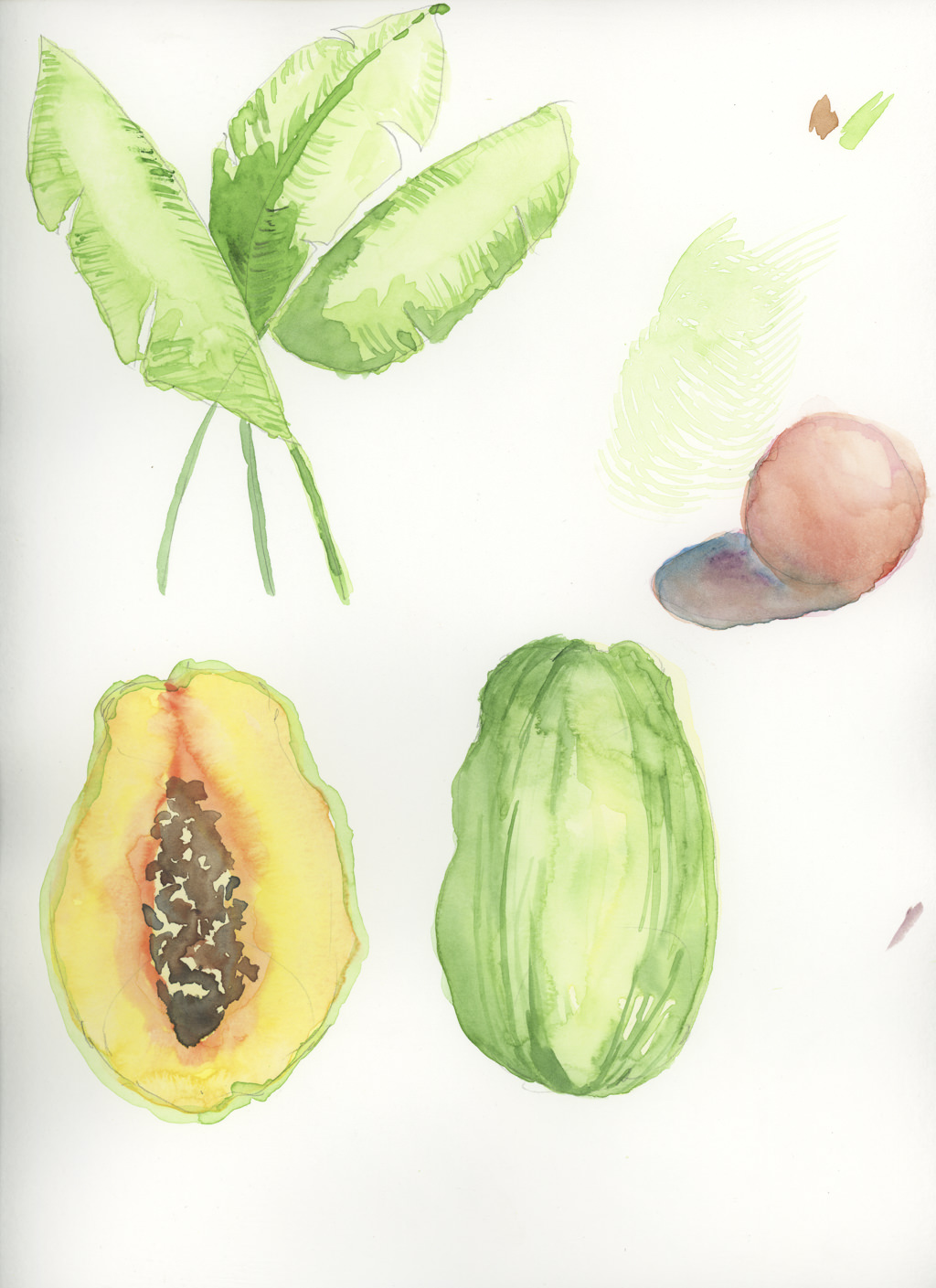
Currently, I have just finished Day 11, which is wet-into-wet and some dry brush. Like in dry-into-wet. Something like that. It’s a papaya.
I’m looking forward to 19 more days … sort of a diet! And to date, no mud!
Rocks & Shells

As with sumi-e painting, in watercolor painting, much is to be learned from observation. Recently, I purchased a video by Birgit O’Connor. As an artist, she excels in vivid, colorful, large and intimate perspectives of flowers, but in looking on YouTube, she also can do a lot more than flowers.
The video I bought is Rocks, Sand & Sea Glass. What makes it excellent for me is that she is very clear in her demonstrations, and more importantly, clear in her verbal explanations. Her voice is nicely modulated, and proceeds at an even pace. I really like the fact she identifies the brush she uses so explicitly, such as “my number 30 natural hair brush.” Detailed as it seems, it allows the viewer to hear while watching. I don’t have to sit and stare at her brush to think about what one she is using because she tells me.
In addition to watching, practice is paramount. Seriously, you have to sit down and do it. And do it again and again. I know this about painting, because brushes vary, papers vary, my mood varies, and colors vary. Self-control is necessary. So is practice. Having something interesting to paint makes it more fun.

Brushwork is so critical – knowing how to use a brush, how to load color, how to move the brush, maneuver it for shape, and how much pressure to apply. How the paper responds is also important, simply because different papers have different characteristics, as well as come in different grades.
These are what I’ve produced. More will come, as my supplies show up, too! Thank goodness for Dick Blick and Amazon!