On to “Brushwork”!

A few months ago I joined Ian Roberts’ online class “Mastering Composition.” First several weeks were simply drawing exercises, learning about values and shapes to create a 3D effect on the flat surface of paper. Two weeks ago we began the “Brushwork” component. I decided to use oils for this section simply because I have not painted with oils since high school – back in the last century.

What I like about Roberts’ class is he makes sense. He discusses things on very pragmatic terms as well as on a bit of a more esoteric plane. Both are satisfying. Exercises are clear and with stated purpose. The key components thus far are values and edges. He says, “If you can’t see it, you can’t paint it.” And that is true. If you don’t look and observe and get picky, well, it’s just not there.

Week One

Simple value studies of a landscape. I did 4, in 4 different mediums in order to decide which I wanted to default to – I chose oils (see above).

Watercolor
Gouache
Acrylic
Oils

I won’t say any of them are great, but by posting them, fellow students give feedback. It’s useful as others see what you do not. As well, it is also useful to give feedback as it sharpens your eyes.

Week Two

Now, onto still life, demonstrated by Roberts and then practiced by students. This was followed by a landscape. The still life focused on edges and values – and so does the landscape. The landscape is ours alone to do – no demo! I tried to make my landscape simple masses. Parts work, parts are illogical, and taking a photograph of both was a pain as they are both still wet. Oh, well.

Still Life in Oils

This was a fun study, and it was a challenge to really take the time to look, and to see, edges, shadows, shapes, etc. Overall, I am pleased with it. My sphere is a bit on the floating side, but I can fix that later. As well, it is fairly bright but monitors make it look darker or lighter, depending on which one I am using.

Landscape in Oils

This one is a challenge. It is wet and hell to photograph! One thing I have learned is that I will need to come back with a fine brush after it has dried to clean up some of the whites on the guardrails and perhaps elsewhere.

Thoughts

By far, this is the best online course I have ever taken! If you want to paint and learn a few things, you might check out Ian Roberts. He is on YouTube, so how he is there is how he is in the Zoom class meetings.

Stay tuned for Week Three and Week Four!

WWM #27: Fruits

Summer is the time of year when we live on fruit salads. If we get ambitious, maybe a pie, tart, galette . . . you get the picture. The prompt of “fruits” is perfect for the middle of July, the month of #WorldWatercolorMonth2019.

This year looks like it will be a really good year for our fig tree, a Brown Turkey. We used to have a Kadota, which is a lovely green fruit, and a perfect foil for the Brown Turkey, which are a deep purply-brown color. Figs are something I look forward to every year, to just walk out to the tree and enjoy a sweet treat . . .

Besides anticipating figs, we have also enjoyed grapes and apricots this season.  Cherries, nectarines, melons, raspberries, strawberries, blackberries, blueberries.  Abundance!

The first painting is not quite where I want it to be.  I was focusing on contrast and shadows to separate one piece of fruit from another.  The same for the grapes and apricots, which is a bit more successful although I am not quite pleased with it because I think it is a bit overworked.  It’s interesting how I feel pretty good about some things – more confident – and less so with others.  I guess we all do.

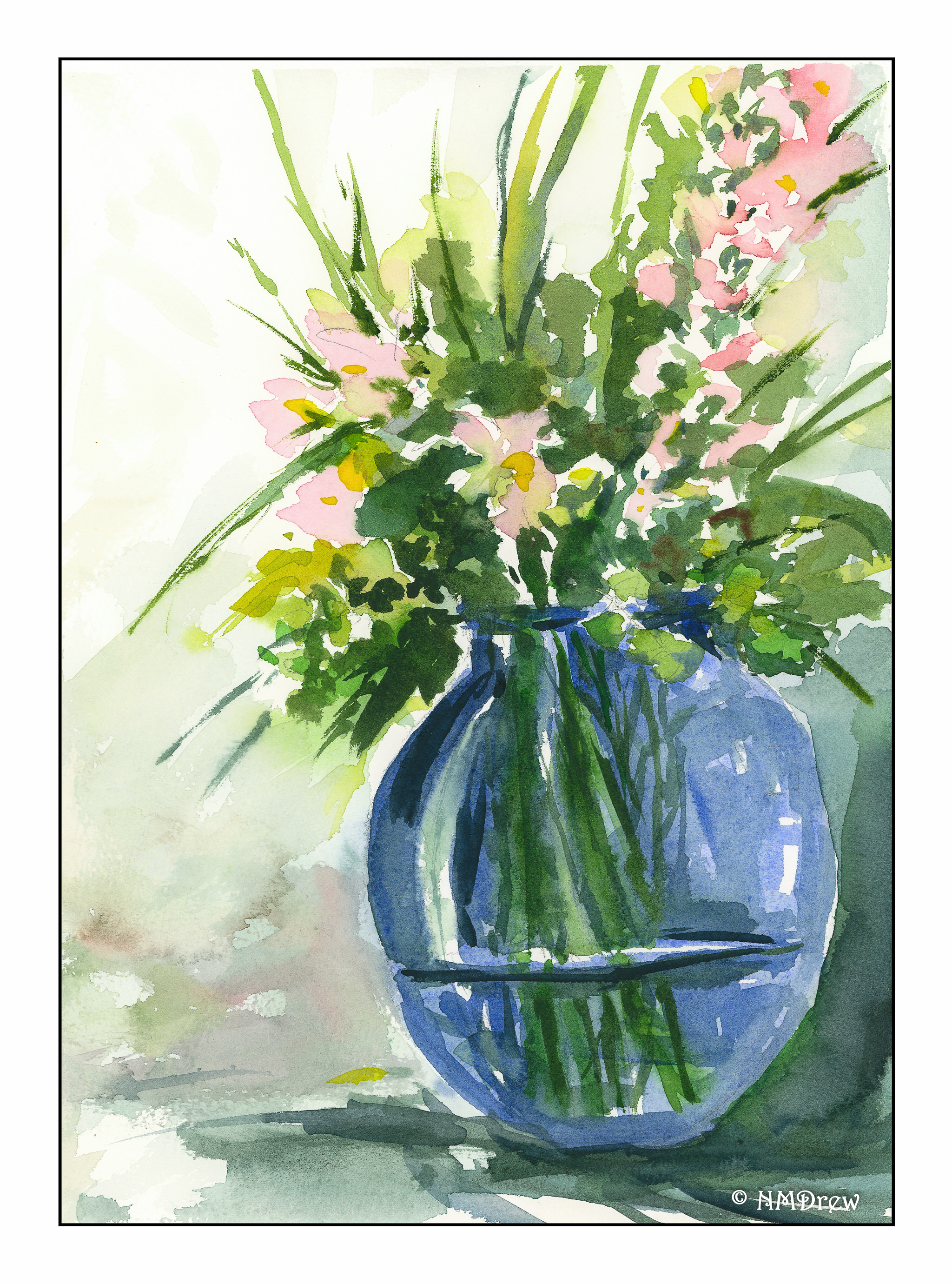
Just A Bouquet

Yesterday was one of those days filled with things to do, with more things to do added last minute.  Toward the end of the day, I really was not in the mood to do much more than veg out, be a blob, and sink into a stupor.  Nonetheless, I girded up my proverbial loins, and sat down with an imaginary bouquet in my head and a reference picture for light and shadow to use with the imaginary bouquet.

I didn’t set out to do too much – but in the end, it worked out pretty good.  I kept in mind light to dark.  I also kept in mind working over the whole painting, shifting back and forth from one area to another, and applying a hairdryer when things needed to dry out a bit more than my patience was willing to wait for.  All of a sudden, I swear, my mind said, “Hey, let’s paint around these flowers!”  There were not any flowers in that area, but I did negative painting without too much thought.  Wow!  That was a big shift for me – I’m still quite the newby in this area.

So, here we are.  Colors include sap and Hooker’s greens; Payne’s grey; ultramarine and cobalt blues; hansa yellow; quinacridone rose.  There may be a few others.  I used one brush, too.  The paper is Fabriano’s 100% cotton Artistico, and that alone helped a great deal – evident as the other side of the paper was already used for a wash-heavy exercise!