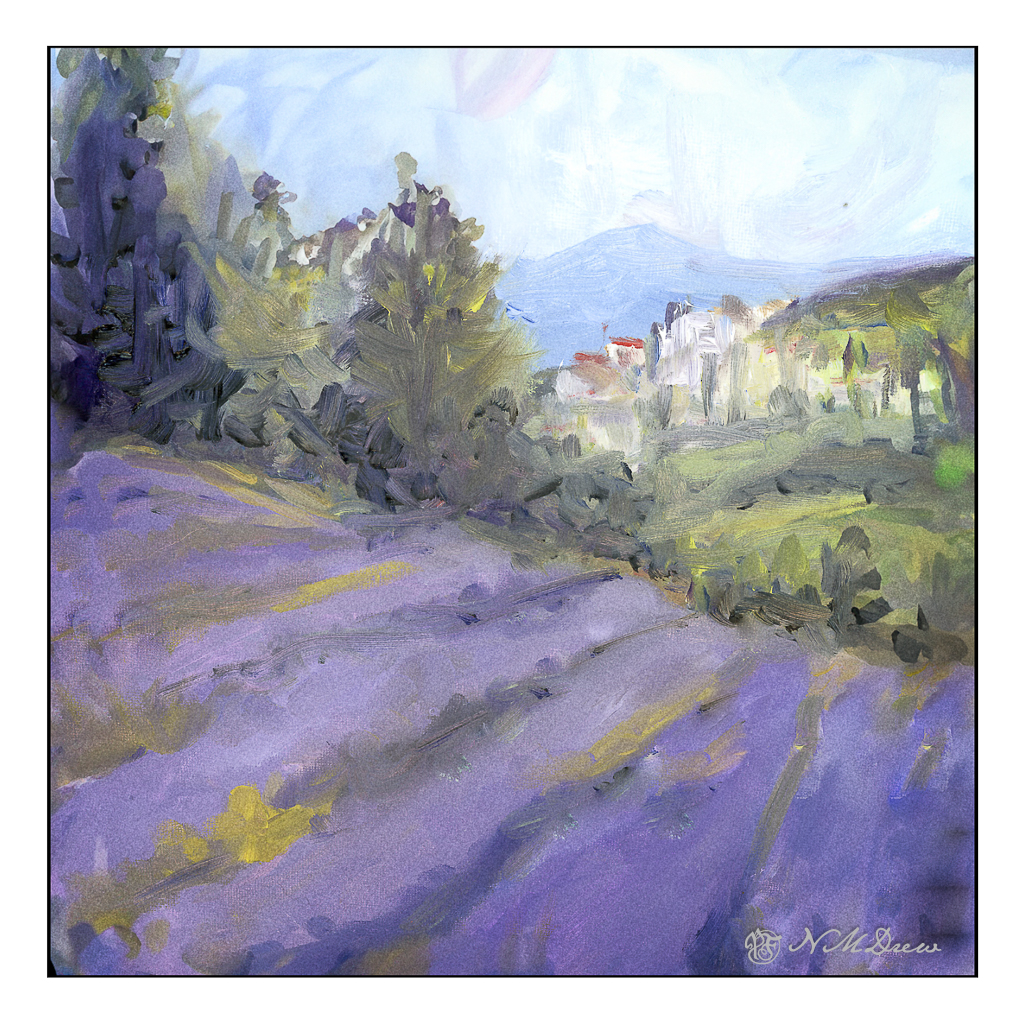
After the Snow

There is a lot more “ink” these days than beer or yarn, but as far as those go, there is a lot going on in the background. I guess I will need to post some of my knitting projects or sewing projects (“yarn”). Cooking, too (the “beer” part). Paint (“ink”) takes up most of my time, though.

I am continuing with the oil paints and just love the sensuality of mooshing it around on a canvas! I also like being able to work on my sense of contrast – lights and darks – as I have done with a few pears.

When I am finished with a painting, even though I use low odor solvents, the smell lingers, more so when the house is closed up to keep it warm. Because of this smell, I have some drying shelves set up in the garage, which is pretty cold. It takes a long time for the paintings to dry unless I use Gamblin’s Galkyd Gel, and then they dry almost overnight.

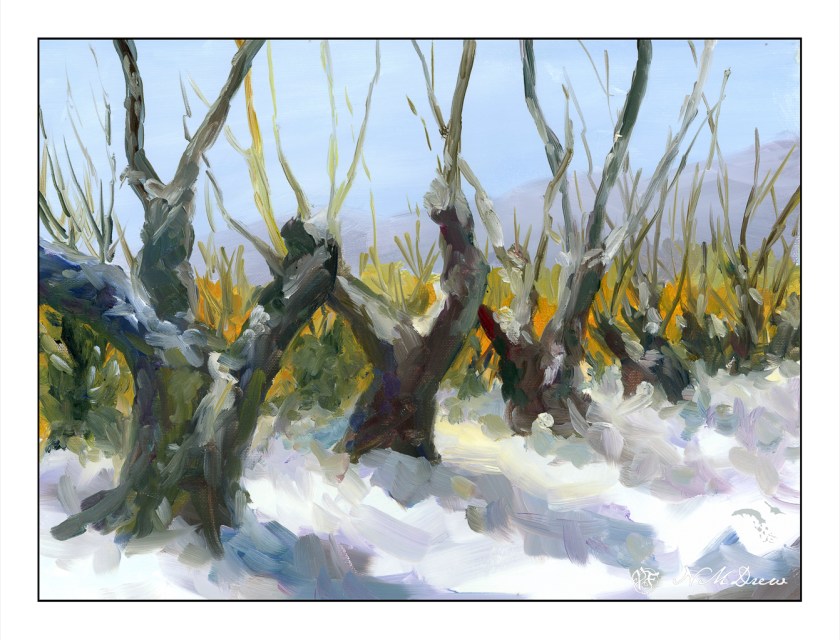
Now that you know this, I painted this painting about 2 weeks ago using linseed oil as the vehicle as well as Gamblin’s solvent-free gel, but not the Galkyd. Drying time is very slow. I just got some walnut oil mixed with alkyd by M. Graham, which should speed up drying time and, I hope, give that lovely ooziness that makes oil paints a lot of fun. Maybe I will check that out later today.

I chose this subject to work on a few things: values, color, distance, depth, contrast. Overall, I am pleased with this painting. I like the brighter yellow between the tree branches on the right as I think it leads the eye in. Someone on a forum said it was too bright and might need to be dulled down a bit. That is something to think about, but my magpie self likes that but does see what the person means. But how much should that yellow-orange be dulled, and so on. Maybe I will play with it in PS.

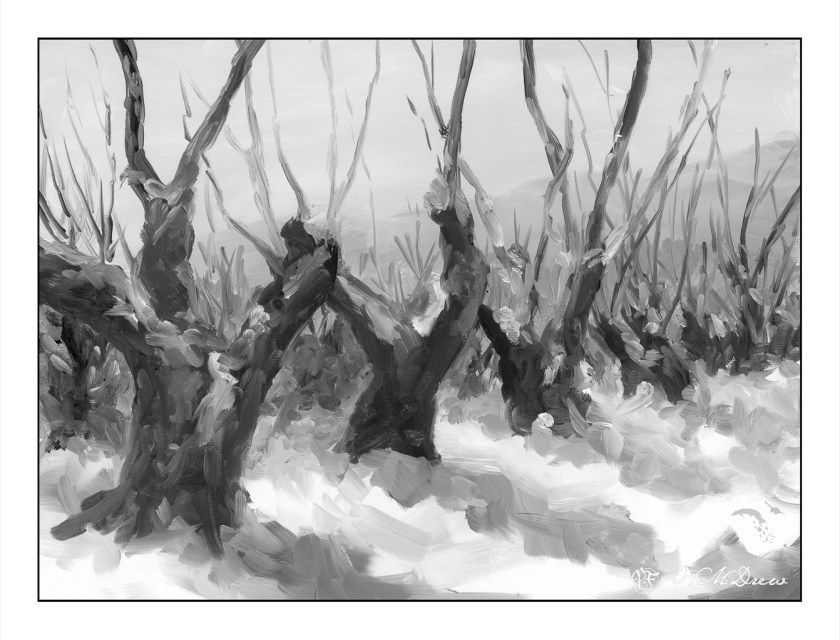
Above is the desaturated image. I do this to look at my values. Success! Isn’t it interesting to note that the bright yellow-orange becomes a middle grey when in black and white?

I have a couple of other paintings out in the garage drying. I’ll get those out in a few days. Scanning a painting is far nicer in result than photographing as there is minimal glare. The only problem with the scanner is that sometimes the software does not like to merge the sections – luckily I have a few different ones as back up and seem to work quite well.

11×14 oil painting on cotton canvas panel; scanned on Epson V600 at 600 dpi and 48 color bit depth.

Pear on a Reflective Surface

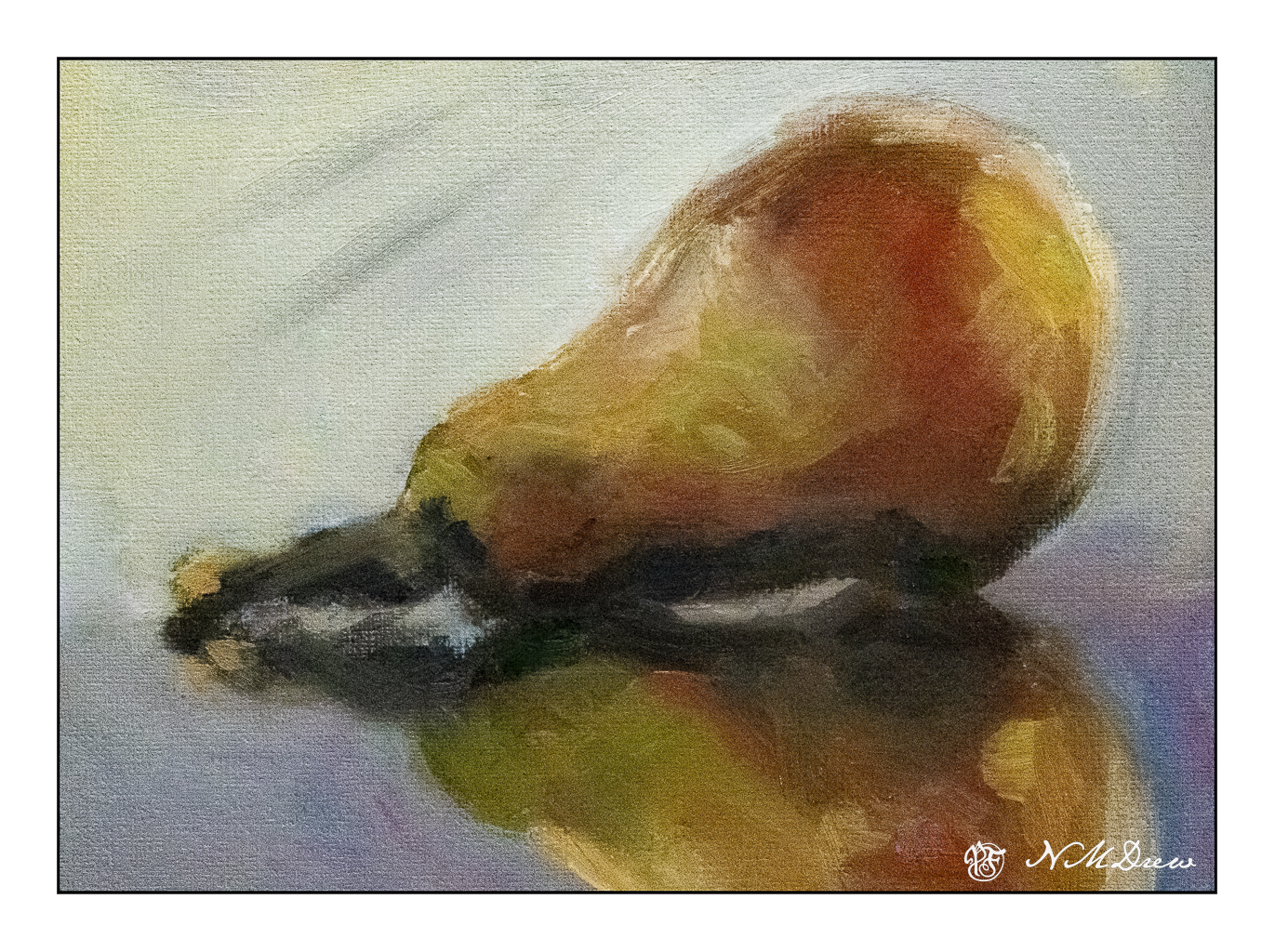
For the past 4 weeks I have been taking a short course in oil painting – we have not laid a bit of oil on canvas in this entire time period! Instead, we have learned so much about color – theory and real world (too complex for here) – contrast, tone, value, intensity, neutrality, and so on and so forth. Finally, in the last 30 minutes we finally got a painting demonstration of painting values on a pear. Some people painted along, but I just watched the instructor.

First thing, we mixed a dark value of burnt umber and ultramarine blue. Then we made a middle value grey by mixing in some white, and then the lightest value by adding even more white to the middle grey. After that, we used cad red light, cad yellow light, and yellow ochre, doing the same to each, but for the middle and darkest values, we added some of the middle and dark greys to darken and tone. I was really surprised to see the beautiful green the middle grey made when added to the yellow ochre, and I absolutely hated the cad yellow light’s greenish cast. Ugh. I rolled out cad yellow deep instead as it was much warmer and orange-ish.

The photo we used was blurred a bit, and then a notan (the rendering of an image into values of white through black, with shades of grey in between – in other words, a grey scale of the image) of the same was printed onto a piece of paper. We painted our values onto this paper, using the methods described above. Some people just kept their areas as values of color, but it made me a bit nuts, so I blurred mine together. The result was much more to my liking but more challenging, too. I made a lot of messes and lost my values quite often along the way.

Our teacher, Harvey, is really good. I have another 8 week session starting in a couple of weeks and I think it will be a good adjunct to a 4 week private class with him starting mid-March. Harvey is not just an artist, he is also an experienced art teacher as he has taught high school art for many years. Experience as a teacher is showing here – he is articulate, logical, and clear. No complaints, and I feel fortunate to have made his acquaintance – I like him, too, as a person, and that adds to the enjoyment of a class.

Oil on paper, about 5×7, value study of a pear. Colors used are titanium white, ultramarine blue, burnt umber, cad yellows and red, yellow ochre.

Practice

Over the next several weeks I am enrolled in a couple of oil painting classes. Acrylic paints really do frustrate me in a lot of ways, and please me in others, but it is time to work with oil paints on a more serious level. Let’s see where it goes.

To get ready for these classes, I pulled out some of my supplies. Of course, the oil paints come out – I have a smaller selection of colors than any other medium! I also have canvases in panel and mounted format. However, I did need to stock up on linseed oil, solvent, and other such stuff. And then paint.

Canvas mounted on panels is actually, I think, the easiest way to go. Canvas pads flop around and easily bend. Mounted canvas on stretcher bars takes up a lot of space but can provide a gratifying surface to paint on if properly and tightly mounted and prepared. For now I am using canvas panels which, while not super high quality, are relatively inexpensive and easy enough to prepare, if at all, prior to painting. 

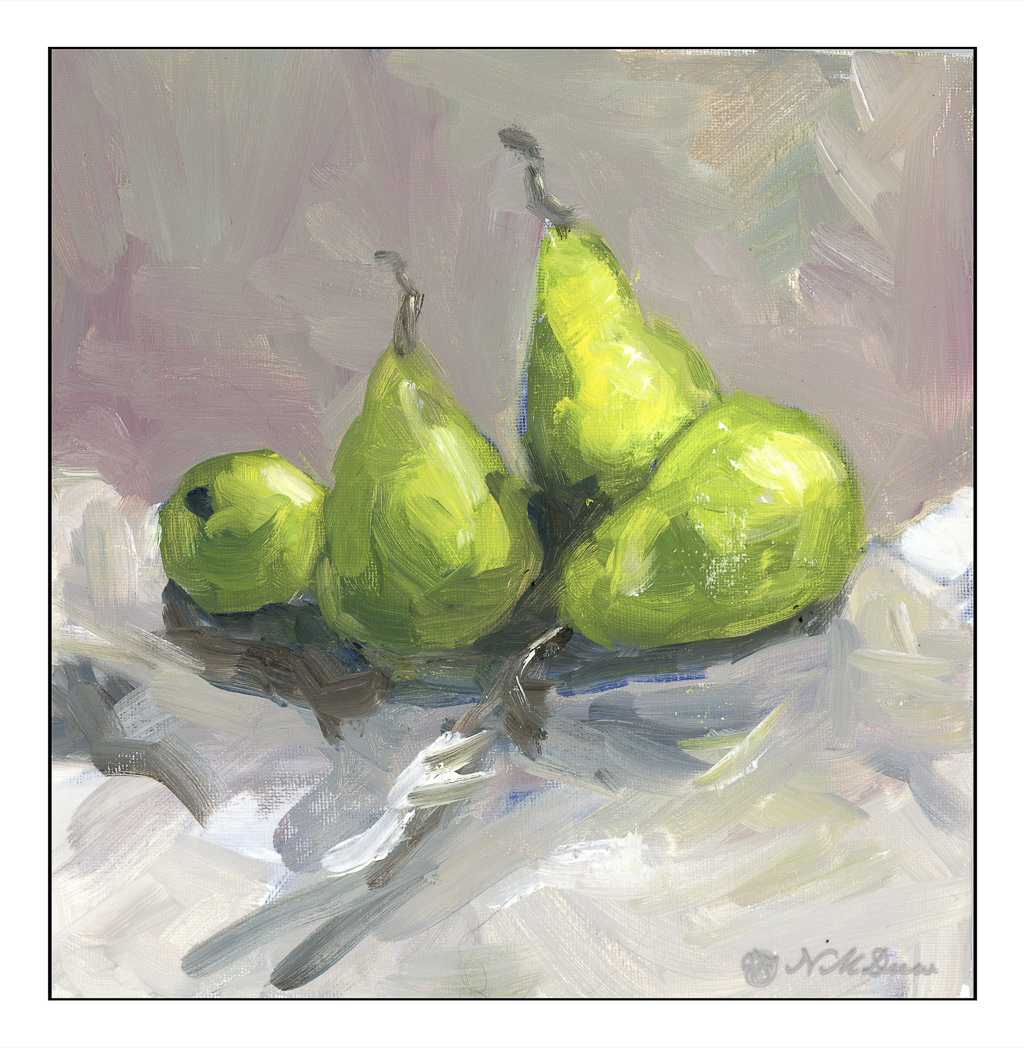
I love pears! Painting them is far less tasty than eating them, but they are by far one of my favorite winter fruits. Here, some d’Anjous, all cuddled together. My focus here was brushwork and getting a sense of the unctuous quality of oil paints. Some people use the paints straight out of the tube, but I like mine to slide around a bit. It really makes for fun blending. The colors, too, were rather limited here for the purpose of seeing how they can interact. 

Here, more lavender fields. Why so many? It is because lavender and purple are honestly rather nasty colors to create from the standard mixes. I find that I like to have “convenience colors” on hand – namely, a good violet such as carbazole or dioxazine. Mixed with other colors and / or white, I get lavenders and such that appeal to me. I initially tried to just use variants of red, blue, and white for the lavenders, but gave up with frustration. Not worth the sweat! Maybe later I will master a good orchid lavender, but for now . . .

As with the pears, playing with the things you can add to the oil paints to thin them out. I used Gamsol and Soy-Thin, both low odor solvents. I didn’t use any linseed oil in either painting – that will come later – as will other things, such as drying agents like alkyds. 

The pears and the lavender field were painting on pre-gessoed 10×10 cotton canvas panels measuring 10×10 inches square.

On to “Brushwork”!

A few months ago I joined Ian Roberts’ online class “Mastering Composition.” First several weeks were simply drawing exercises, learning about values and shapes to create a 3D effect on the flat surface of paper. Two weeks ago we began the “Brushwork” component. I decided to use oils for this section simply because I have not painted with oils since high school – back in the last century.

What I like about Roberts’ class is he makes sense. He discusses things on very pragmatic terms as well as on a bit of a more esoteric plane. Both are satisfying. Exercises are clear and with stated purpose. The key components thus far are values and edges. He says, “If you can’t see it, you can’t paint it.” And that is true. If you don’t look and observe and get picky, well, it’s just not there.

Week One

Simple value studies of a landscape. I did 4, in 4 different mediums in order to decide which I wanted to default to – I chose oils (see above).

Watercolor
Gouache
Acrylic
Oils

I won’t say any of them are great, but by posting them, fellow students give feedback. It’s useful as others see what you do not. As well, it is also useful to give feedback as it sharpens your eyes.

Week Two

Now, onto still life, demonstrated by Roberts and then practiced by students. This was followed by a landscape. The still life focused on edges and values – and so does the landscape. The landscape is ours alone to do – no demo! I tried to make my landscape simple masses. Parts work, parts are illogical, and taking a photograph of both was a pain as they are both still wet. Oh, well.

Still Life in Oils

This was a fun study, and it was a challenge to really take the time to look, and to see, edges, shadows, shapes, etc. Overall, I am pleased with it. My sphere is a bit on the floating side, but I can fix that later. As well, it is fairly bright but monitors make it look darker or lighter, depending on which one I am using.

Landscape in Oils

This one is a challenge. It is wet and hell to photograph! One thing I have learned is that I will need to come back with a fine brush after it has dried to clean up some of the whites on the guardrails and perhaps elsewhere.

Thoughts

By far, this is the best online course I have ever taken! If you want to paint and learn a few things, you might check out Ian Roberts. He is on YouTube, so how he is there is how he is in the Zoom class meetings.

Stay tuned for Week Three and Week Four!

Sumi-e Palm Trees, ii

I had hoped to create a video over this past weekend about painting a palm tree, as requested a couple of weeks ago.  Unfortunately, the flu and other life circumstance (like work!) have gotten in the way.  Just recently I came across the quote by Basho about the pine tree and the bamboo, and it made a lot of sense.  After all, in sumi-e, the point is to catch the spirit of something rather than render it as realistic as possible.  Observing palm trees is possible here in California – we have them in our yard, over the fence, down the street.  They are part of much of our landscaping.  However, for many of us, palm trees are rare and exotic creatures.

Thinking about this, I recalled the American artist Winslow Homer.  His paintings – oil and watercolor – of the Caribbean islands and its inhabitants – came to mind.  Palm trees!  His paintings show them in high wind, in a gentle breeze.  Tall ones, short ones.  If you click on the image below, you will be able to see these in greater detail.

If you really want to learn about palm trees, you can experience them, although perhaps not first hand. Looking at another artist’s work is a good way to learn, and it is traditional in many cultures to copy from the master. It is also possible to find movies with palm trees in them – maybe hit YouTube – as well as to do web searches for photos. For my own painting, I will use the palm trees in my neighborhood, and will provide some pictures as this mini series evolves.