Sparkly Day

The way the light shimmers through leaves on a bright day is something so difficult to capture in a photograph or a painting. The contrasts between light and dark shift and change to be almost blinding.
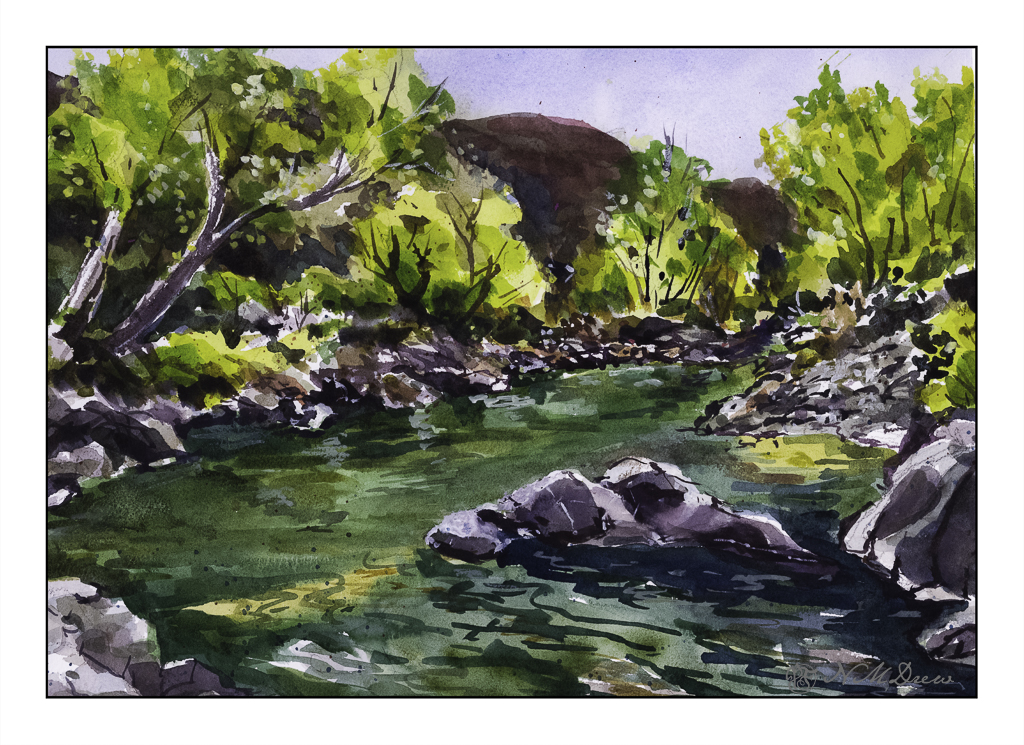
This is a creek running through the Coconino National Forest in Arizona. It is near Flagstaff and Sedona, and the terrain varies from alpine to the red rocks of Sedona and creeks and forests of Ponderosa pines. The above scan is a VueScan image with some corrections. Below is one using Epson Scan.
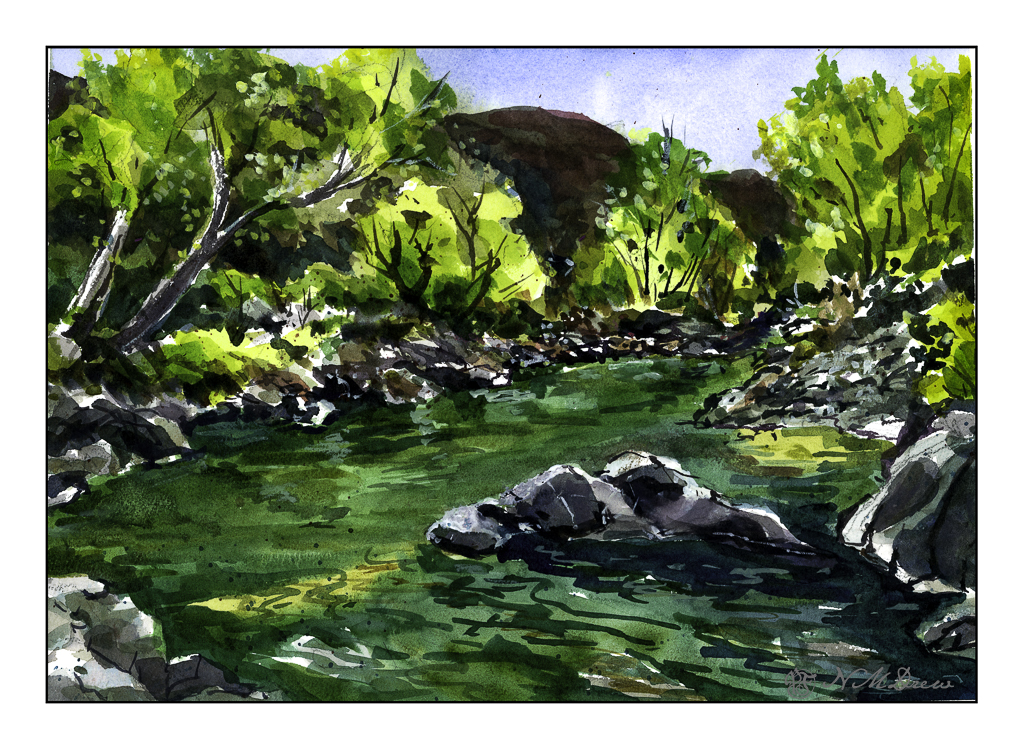
Neither scan really does justice to the colors, but the sparkle is caught. I think like a camera a scanner and software has difficulty with subtle variations from light to dark.

Sigh.

So, what did I try to do today? First, a bit of a limited palette. I didn’t do a triad, as with yesterday’s painting. I used (off the top of my head) mostly ultramarine blue, cadmium yellow, and burnt sienna, but into that mix I added Hooker’s green, cobalt teal, phthalo blue. The greys of the rocks came mostly from ultramarine and burnt sienna. Hooker’s provided a basis for some of the more obvious greens, but the cobalt teal mixed with yellow were used for the lighter, brighter greens you seen in springtime. Some titanium white gouache was applied here and there.

Additionally, besides limiting my colors, I tried some of the techniques for the water. Here, there were swaths of shallow water with an ochre coloring, reflections of rocks and trees in the water, and shadows beneath the rocks in the foreground and lower right. I didn’t use enough color and water to create a bead to allow blending – I have been told I would make a stingy bartender! – but still managed to get some of the colors to blend with one another. I also did glazes to show direction of water and movement. It turned out better than I thought it would – if nothing else, I need to be more generous and allow more paint and water than I think I will need. This something we all need to learn – how much is too little, how much is too much. Of course, the Goldilocks effect is best!

Watercolor, Arches 140# CP paper, 10×14.

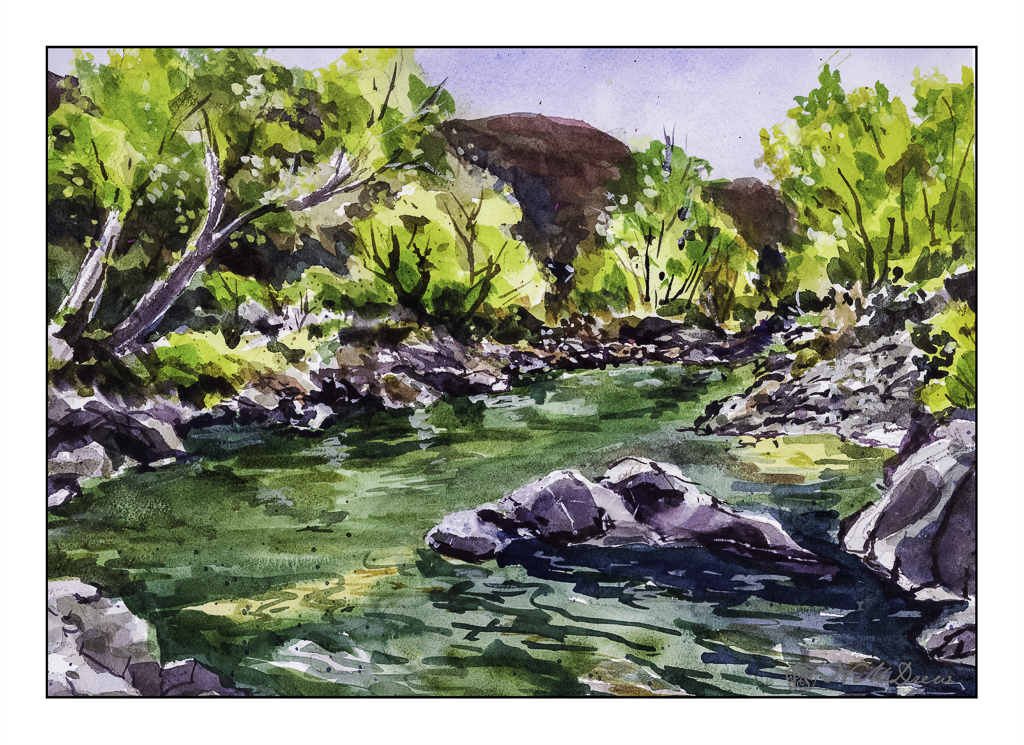
Oh, hell – here’s another scan!!
Let’s Just Say It’s Colorful!

Autumn along the Virgin River is filled with trees turning orange and yellow from the greens of summer. The sky is bright, bright blue. The red-orange mountains all around are dynamic and rugged. The river is aqua and blue and green.

The light is full of contrast – bright, dark, shadow, reflections. The leaves add texture, as do grasses and trees and rocks. Wind plays through the canyons and trees. The whole world shimmers and vibrates with energy and color. Simplifying it seems impossible.

Watercolor, 10×14, Arches 140# Rough.

Sand Dunes in Death Valley

Death Valley is up and off Hwy 395 along the Eastern Sierra Mountains in California. It’s a strange and eerily beautiful place with a lot of surprises and history. It is preserved as Death Valley National Park. The website is filled with great information and it is one of the best places to visit – in the right season, and in the right weather. People die in the desert because they do not understand it, so if you go, be careful!

Sand dunes always amaze me. I am still stuck in my child’s view of the world that sand dunes exist only in the Sahara, and can only be found by riding a camel. Silly, yes!

There are sand dunes everywhere – beaches and deserts mostly, but sometimes in places you least expect. Their shifting shape in the wind and blowing away foot prints or burying ancient cities all lead to a fascination as they make everything seem so temporal.

Anyway . . . . this is an oil painting using a limited palette. Some of the goals in doing this painting included smooth, smooth brushwork for the dunes. I tried to catch the gradual gradations and color changes I saw. In the distance is the flat valley before the towering mountains. For each I used directional brushwork and a deliberate vagueness to create a surreal effect. The mountains, when I look at them afresh, can also be visualized as swirling clouds. Interpretation I will leave to your eye.

Oil on canvas panel; 16 x 20 inches.

Playtime

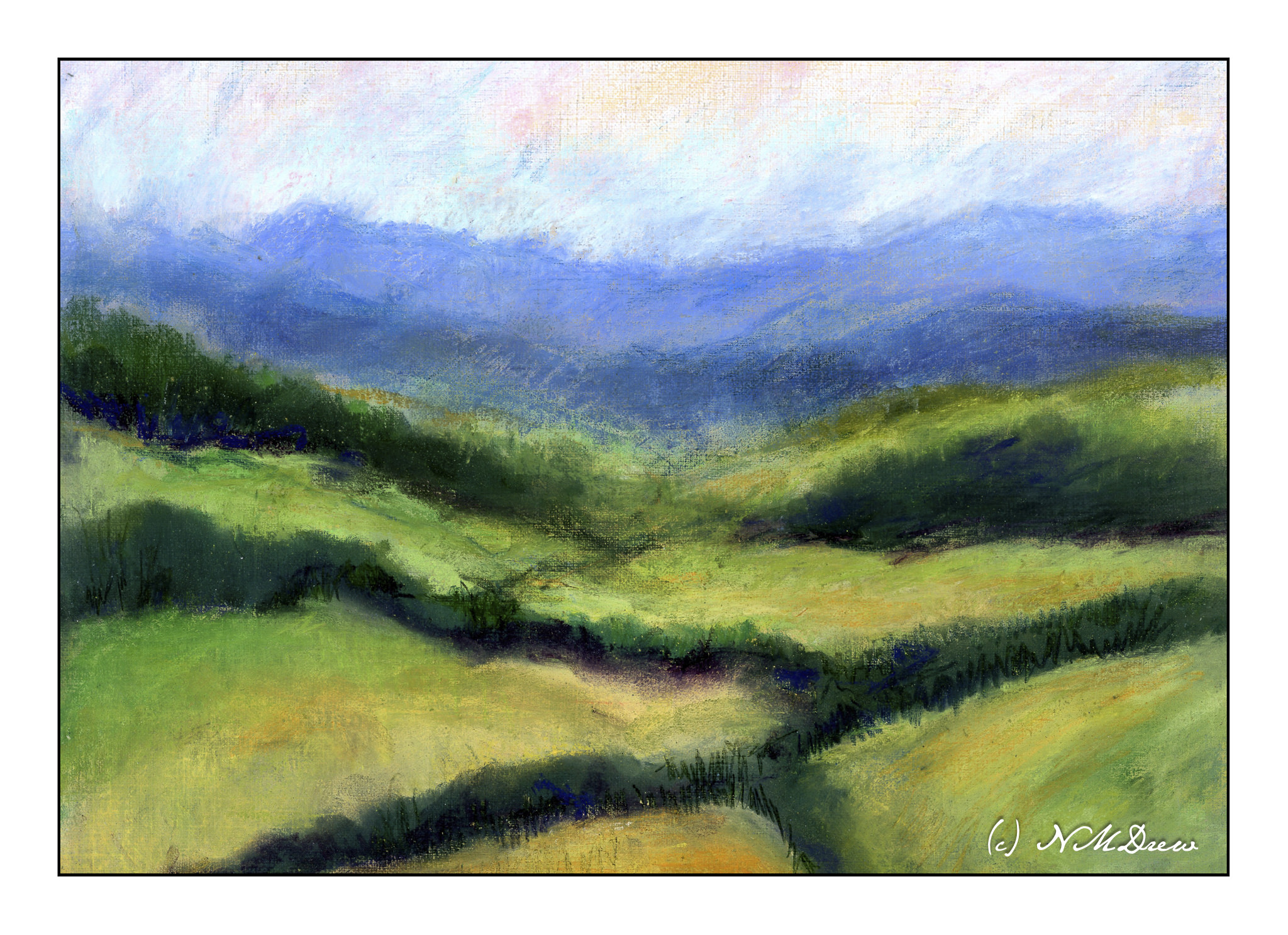
For some reason I remembered the fun I have had with pastels – soft, hard, pencil. I dug them out yesterday afternoon to play with, not to do anything great. I have not used them in a year or two, and with that comes the need to re-learn what to do with them. I figured an imaginary landscape somewhere would be good territory for exploration, so in the Land of Something, I began.

The first thing I did was to used Golden Pastel Ground which I mixed with some fluid yellow ochre acrylic paint and water, thinning it to the consistency of cream. I applied 3 thin layers onto Canson XL oil / acrylic painting paper, letting it dry in between each layer. This give a sanded surface with a bit of grit, and it held up really well.

After the paper and ground were dried, I pulled out all my pastels. I have soft pastels by Rembrandt and Terry Ludwig; harder pastels called Nupastel, and some reputable pastel pencils by Derwent and Faber-Castell. The first layers were done with soft pastels to lay in the values. I used rubbing alcohol and a paint brush to establish values. The alcohol seals the pastel pigment and once dried the colors do not flake off.

I applied layer after layer after layer of soft pastels, blending as needed, and using a very fine mist spray bottle with alcohol in it to settle each layer. In the end, I used the Nupastels and the pastel pencils to see what they can and cannot do. When finished, I sealed the painting with more alcohol and used a hair dryer to hasten the drying.

Last time I did pastels I got frustrated, and it seemed everything I did got worse and worse! My own thoughts are I am more accomplished or skilled with colors and such now than I was a few years ago, so this may be why I feel this is a successful foray into a forgotten medium. I expect I will be carrying on with pastels as they are a lot like drawing and painting, messy and bright. I think I may attempt a building with the next painting.

Working with pastels produces a lot of dust. I wore a face mask and damp wiped my work area after I finished. If I continue to paint in pastels, I plan to get a good air purifier with a HEPA filter to keep the potential dust hazard to a minimum.

9 x 12 Canson XL oil / acrylic paper; Golden pastel ground with yellow ochre and water; Terry Ludwig and Rembrandt soft pastels with pastel pencils and Nupastel. Rubbing alcohol used to seal dust. (Now let’s see how it works as a final fixative!)

Morning at My Desk

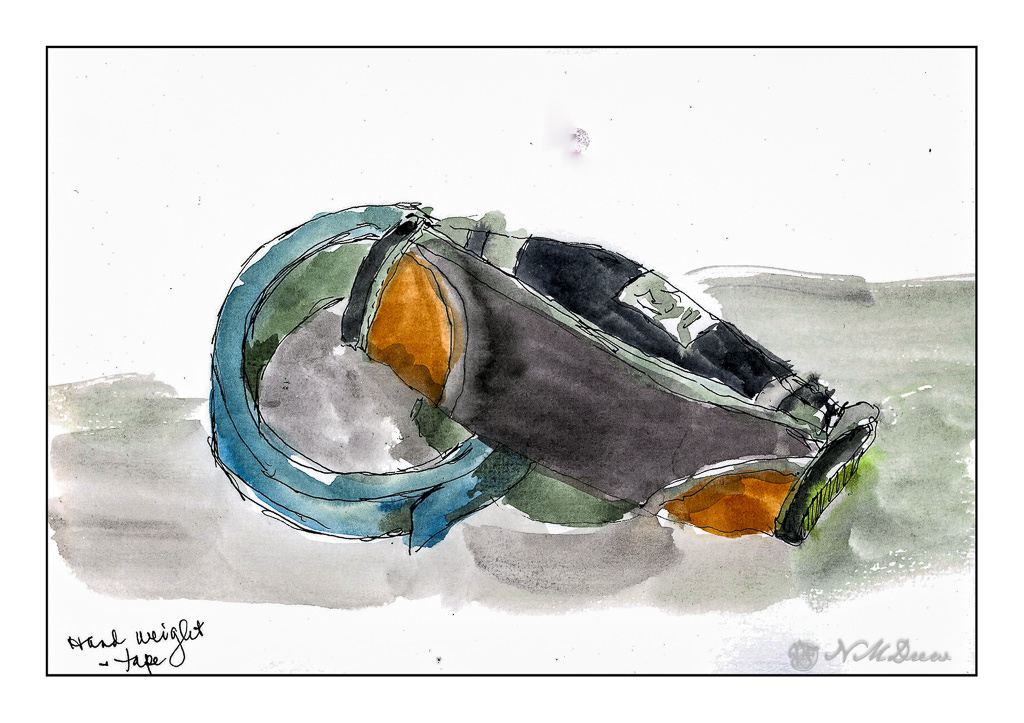
Today there is a bit of running around to do, so this morning I was in a blithery mood. Things to do – like the usual morning stuff – but I also know I won’t feel too focused on any one thing, so sketching with ink and watercolor seemed to be the best of all choices. (After all, life is not all about dishes and making the bed!)

On my desk is a small hand weight and roll of painter’s tape. Warm-up. And now immortalized.

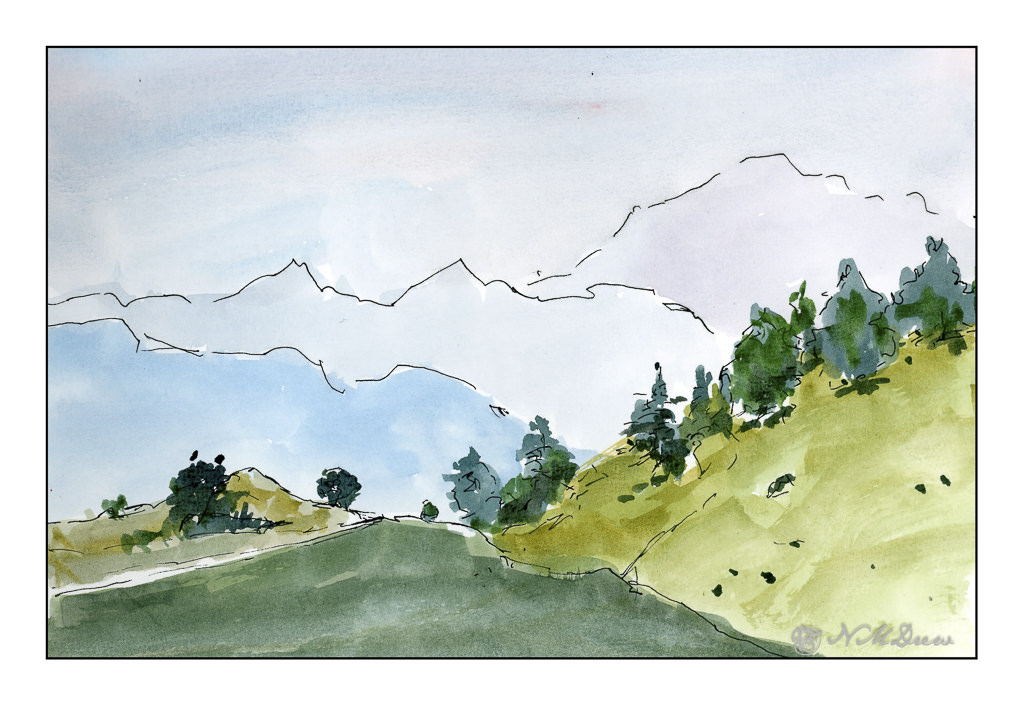
Next, the great outdoors. Mountains and trees. I would love to be walking around here, but sadly my ankle is keeping far more stationary that I want to be. I am getting better, but I have to just keep all to a minimum. I can go to the store and walk a bit, but I need my heel to get better more than anything.

So, the painting. Goal is to get a sense of distance with the gradations of the mountains as they recede into the distance. Accomplished!

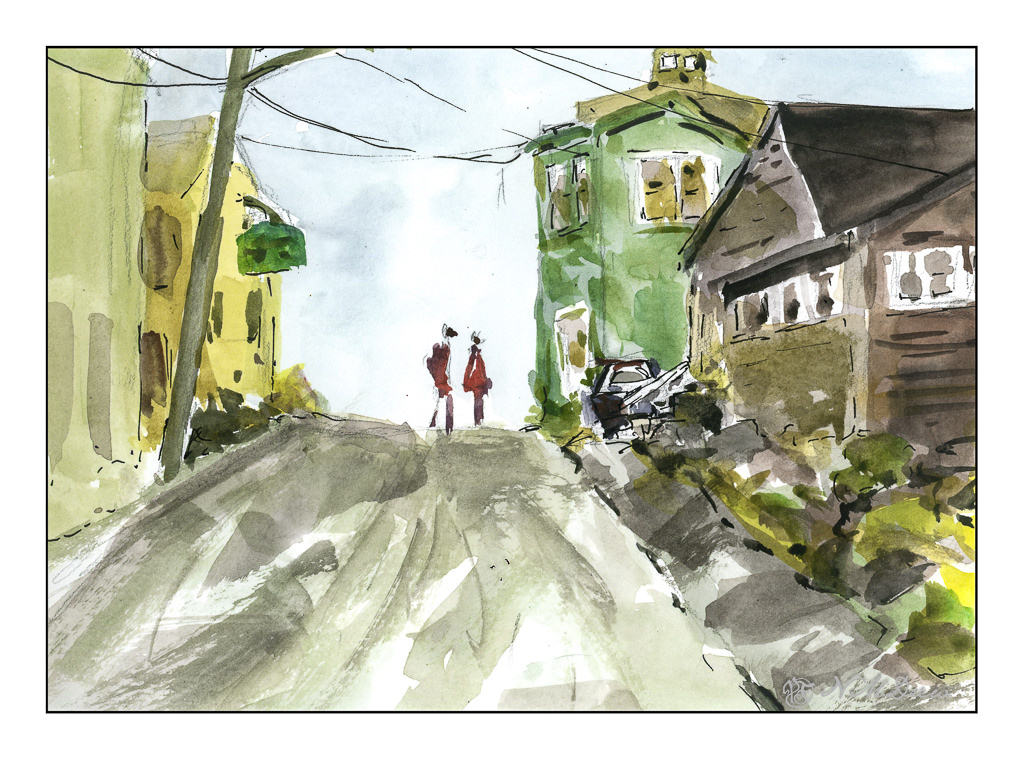
Finally, a scene with some complexity. I figured my warm up and splashing of paint were ready to meet my next challenge which is to paint buildings, people, perspective. Landscapes are comfy but I really want to push myself a bit more, as I did the other day, with direct painting and more patience and planning.

The first two sketches were done in very short order, but here I pulled out my pencil, limned in lines and worked on perspective and size. I think my people are a bit too tall, and I put them in before I did the painting of the buildings and the road. The buildings, too, are a bit wonky, but they work fairly well. I painted everything and then, once okay with the picture itself, I decided some black lines here and there would be good to help pull the painting together. Not perfect, but pleased with the results as I did meet my challenge.

Pentalic Aqua Journal, about 7×10, watercolor, Uniball micro pen.