Scarborough Bluffs

More work on painting more directly in watercolor. It is becoming easier but it still presents a mental challenge. By nature – though experience shows otherwise – I think of watercolor as splashy and fast. Well, it is not! Patience is paying off as I am rather enjoying my latest forays into watercolors.

To enlarge, click on the image.

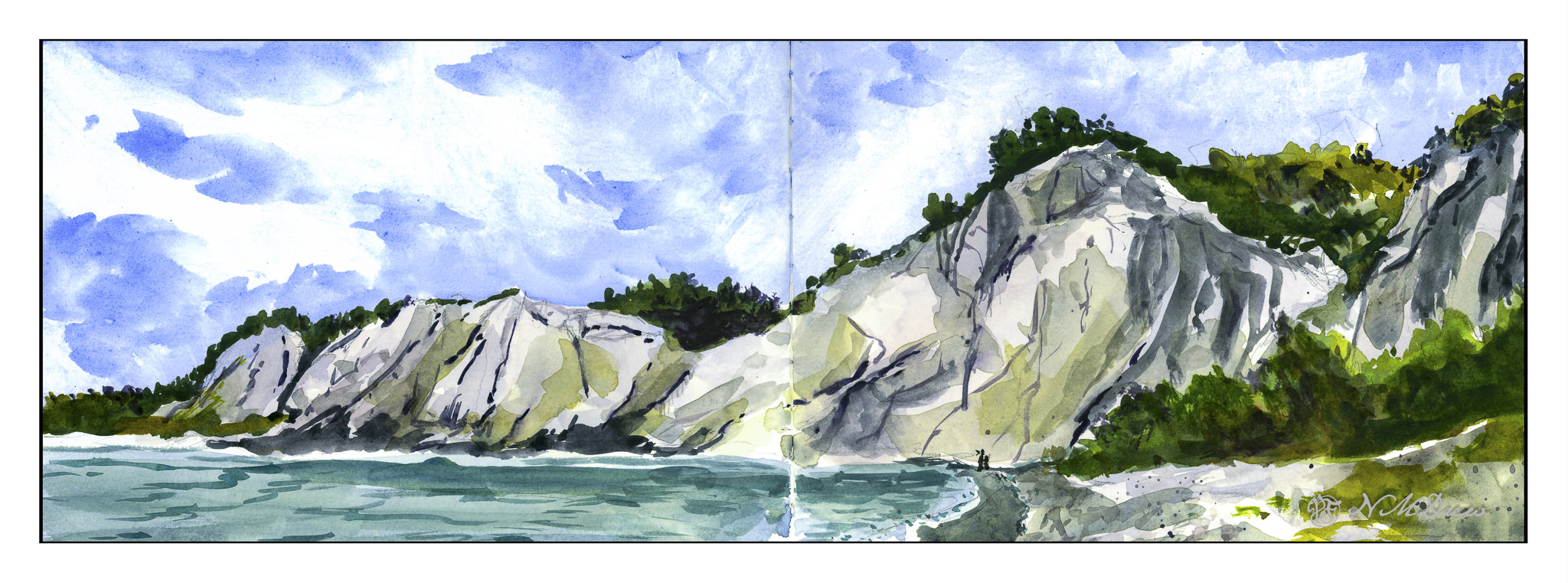
Once more, a panorama in my current sketchbook. This one is simpler, I think, than my previous one, so it did not take as long – about 90 minutes, including using the hair dryer to dry things off.

First, sketch in with pencil the entire drawing. From there, wet the sky, leaving edges for the cliffs and trees, though I really didn’t worry about the trees too much. I knew the trees would be using dark, thick paint. The bluffs, though, needed to be fairly free of color and water, though if you look at the far left, you can see a bit of sky color ended up in the bluffs.

Colors for the sky were essentially ultramarine and cobalt mixed together. I mixed a large area of wash and applied the color after wetting the paper. To create the clouds I blotted out a lot of color. This is always a fun and scary part of any painting!!

While waiting for the sky to dry a bit, I worked on the water, the shore, and the land mass on the right. The lowest tree mass, too, was done with a mixture of colors. I am not really satisfied with it, but it is okay and not too messy or overdone. Once these areas – sea and shore and shrubbery – dried I moved onto the bluffs themselves.

The bluffs will vary in color, depending on sky and time of day. I decided these should be bright as is the sky. Mixing up a light grey is a challenge, so I did a bit of cobalt, yellow ochre, and bit of what I think may be quinacridone rose. (Alizarin crimson would work, too.). I mixed together very small amounts of each and diluted it heavily. I used this to lay int he lighter areas of the bluffs, leaving some areas plain white paper. From there, darker shades, yellower shades, lines and fissures.

The final stages were details. Trees on the bluffs, some green along the right side shore, varying color in the water, shadowed areas in the bluffs, and splattered color on the lower right. Finally, a couple of figures to give scale – these bluffs are really tall!

Watercolor in sketchbook on 140# CP paper, about 8 x 18 inches.

At the End of the World

Today and yesterday were really rather discombobulating. Does getting older mean you are more set in your ways and less able to adapt to changes in the daily routine? Either that or my allergies just make me a bit crazy – this morning I had one of my sneezing fits where I sneeze about 30 times in a row. That is exhausting to the point I need a nap.

And nap I did. But then I decided to do something creative, and back to watercolor (my real first love in painting) and work on something idyllic, wet and watery, full of rocks, and put it in my sketchbook so I won’t take myself too seriously.

Click on the image to enlarge!

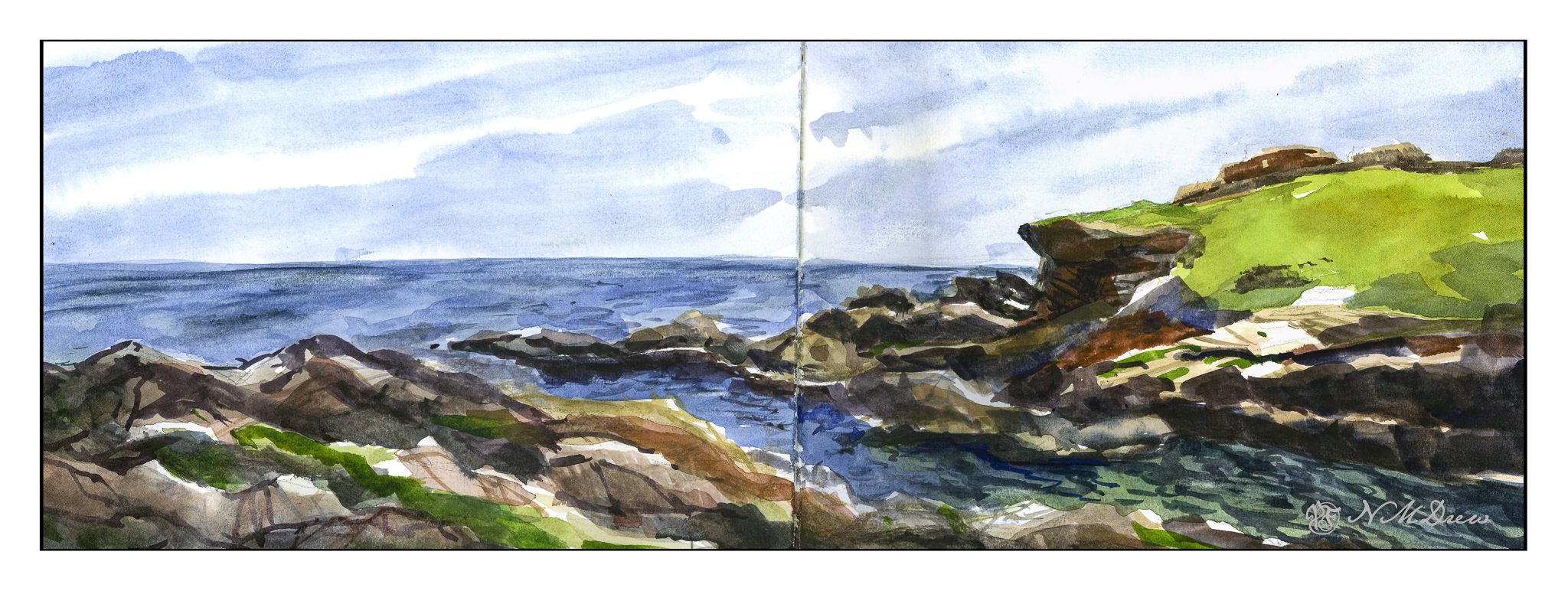
The Strathmore Vision paper works really well with little re-working of any part of the painting. I decided to see how the sketchbook would do with the same approach, as well as the more personal challenge of being more direct in color application.

With watercolor, many artists work with very wet paper, and while I like that, I prefer to have wet paper – as for the sky and the sea – but I also like to have layers. If you paint into wet color, your next incursion must be more pigment and less water than you are moving into, otherwise you get what are called blooms or cauliflowers. You can also paint onto dry paint and these won’t occur, and you can use thinner or thicker paint – less or more pigment combined with water. My sketchbook has good paper – far better than the Vision paper – so I could do all these things, and did.

First, wet the sky area, then drop in stripes of blues. Next, wet in the water, from horizon to the inlet area, all in about the same shades of blue, but darker than the sky. Let that dry. While that is going on, I painted in the greens on the right, blending colors into each other for gradations of green. The rocks, too, were painted with varying colors, working to leave bits of unpainted paper for a bit of pop and to indicate areas with more sun that shadow. Slowly I put in details, such as the waves or ripples in the lower right of the inlet, cracks in the rock, and so on. Large colors and masses first, finalized with contrast and detail.

I am pleased with this painting. I accomplished my task of direct painting with some modification – not a lot – later as I moved into detail. I drew in the general shapes with a pencil. The foreground rocks on the left and bottom were a challenge, but I think I have enough detail to make them interesting but not distracting. The same with the land mass on the right. Overall it took about 2 hours to do complete this watercolor.

Watercolor sketchbook, watercolor, about 7 x 18.

Morning at My Desk

Today there is a bit of running around to do, so this morning I was in a blithery mood. Things to do – like the usual morning stuff – but I also know I won’t feel too focused on any one thing, so sketching with ink and watercolor seemed to be the best of all choices. (After all, life is not all about dishes and making the bed!)

On my desk is a small hand weight and roll of painter’s tape. Warm-up. And now immortalized.

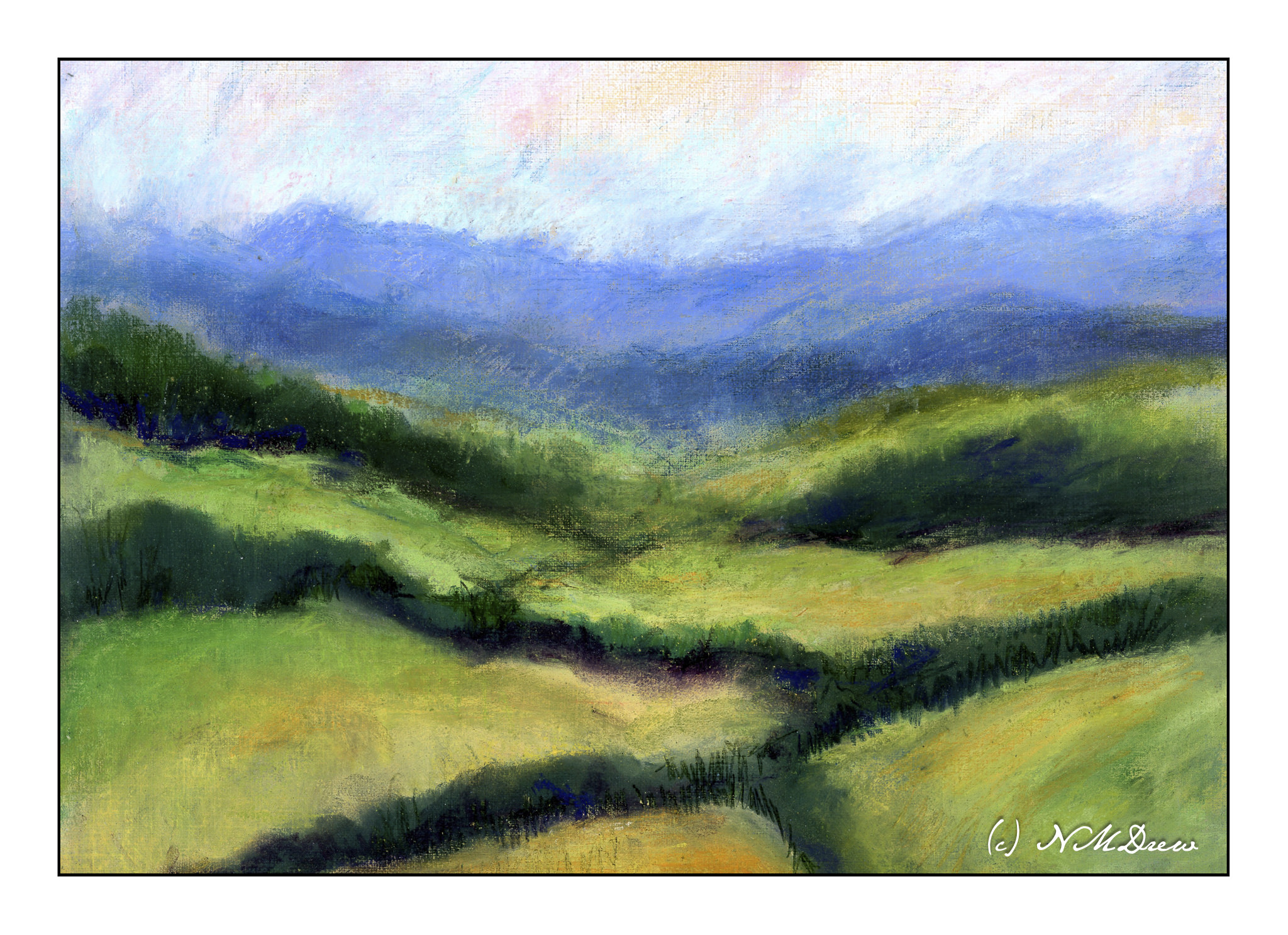
Next, the great outdoors. Mountains and trees. I would love to be walking around here, but sadly my ankle is keeping far more stationary that I want to be. I am getting better, but I have to just keep all to a minimum. I can go to the store and walk a bit, but I need my heel to get better more than anything.

So, the painting. Goal is to get a sense of distance with the gradations of the mountains as they recede into the distance. Accomplished!

Finally, a scene with some complexity. I figured my warm up and splashing of paint were ready to meet my next challenge which is to paint buildings, people, perspective. Landscapes are comfy but I really want to push myself a bit more, as I did the other day, with direct painting and more patience and planning.

The first two sketches were done in very short order, but here I pulled out my pencil, limned in lines and worked on perspective and size. I think my people are a bit too tall, and I put them in before I did the painting of the buildings and the road. The buildings, too, are a bit wonky, but they work fairly well. I painted everything and then, once okay with the picture itself, I decided some black lines here and there would be good to help pull the painting together. Not perfect, but pleased with the results as I did meet my challenge.

Pentalic Aqua Journal, about 7×10, watercolor, Uniball micro pen.

Playing with Paper and Watercolors

I have had a tablet of Strathmore’s Vision watercolor paper, 140# CP, lying around for some time but did not try it out until today. There are some things I liked about and some I didn’t like. Strathmore watercolor papers and I do not get along at all for watercolor painting, yet I really like them for acrylic and gouache. The papers’ textures never agree with me and with the Vision sizing seemed questionable. Canson XL is another watercolor paper I don’t like for watercolor painting but really enjoy for a lot of other things.

This is the first study I did – simple, free-flowing watercolor. The purpose was to lay down color with a bit of density, not overworking either paper or painting. I found it handled direct painting without any lifting or scrubbing quite well. I could paint over dried paint easily – such as where the darker blue wave shapes are – and add gouache to create a bit of sea spray or foam. Blending colors into each other as I moved the brush along in a wash worked well, too. Off to a good start!

This was the second painting. As with the first one, I did direct painting for the most part – specifically the middle and foreground – and used many of the same techniques I used in the first one. However, on this one, I did the sky differently to see how a specific technique could work with this paper.

Clouds are white, right? Well, yes and no. Upper clouds can be quite bright and the paper is usually left untouched in watercolor to show it. To paint a sky with clouds you can use a lot of techniques, but here I chose to wet the paper around the cloud shapes and drop in the blues for the sky and then move the paint around a bit. Once dried, I dropped fresh water into the cloud shapes, at the lower ends, and then added greyish blues to represent the shadow on the underside of the cloud. I have not really worked with this technique, but I have been meaning to check it out, so this seemed to be the perfect opportunity.

I think Vision paper might be able to handle this technique for painting clouds, and I want to practice this technique more before deciding it will or won’t work with this paper. I know that scrubbing the paper will mess it up and as a result I have to be prepared to work very directly. This keeps a watercolor fresh and clean rather than overworked and ugly.

Here, I tormented the paper! I laid down a wash on the upper portion of the painting and then scrubbed out the paint for clouds. Then I came in a few more times and did the same. Some of the paper peeled a bit with the harsh treatment. This is good to know – how much damage can I do??

From there, I did the middle and foreground. The middle ground was pretty directly painted in one go, meaning one layer of color for the most part. I like the way this paper allows heavy paint to merge and blend as it makes for more interesting color areas. The foreground water and reflections is a series of washes, one laid atop the other once the underlying one is dry. I think in some areas I did up to 5 layers of glazing. Other areas I did a bit of wet-in-wet without a lot of scrubbing – just a gentle swipe of the brush.

Now here comes a complaint. In the lower right area of the painting you can see what looks like a thumb print. This is not – it is an area where the paper sizing is not good. You can also see problems with sizing around the upper and right edges of the paper. Poor sizing can ruin many a painting, and this is why professional watercolorists and amateurs alike go toward 100% cotton rag papers from reputable manufacturers.

Overall, I like this paper. I think it is really good for direct painting. Pleasingly, the paper does not buckle and ripple with fairly wet paint, but I have yet to lay down a traditional wash that covers a large area of the paper. That will be another experiment for a future posting. The sizing issue bugs me, but that is okay as this tablet of paper was not expensive. I prefer Vision to the Canson student watercolor paper for a lot of reasons, but in particular the way it handles pigment on its surface. I can see using this paper for practice, for studies, for preliminary work on a “serious” painting. Would I recommend it? Yes – but with some caveats.

Today has been a lot of fun. Being immobile is making me quite dull and uninterested in doing anything, but at least the boot is making life a lot less painful. Yesterday morning I met up with a friend, hobbling a short distance and then basking in the beautiful outdoors for several hours with a good bit of chit chat, croissants, and delicious coffee. Socializing and watercolors always make my day . . .

Watercolor, Strathmore Vision student paper, 140# CP, 9×12.

Through the Trees

Another view of Lands End in the SF area – this time through the trunks of the cypress trees along the ridge line.

This was a day’s project using liquid acrylic paints on Strathmore 300 watercolor paper. Neither photographs or scans really did this painting justice as far as the colors go. That sometimes happens when there is purple in a painting it seems. I like the composition but not sure about the final colors. In real life it looks better. And, it may be, too, the acrylics just never quite sit well with me. Both acrylics and gouache tend to be a bit too bright for me. Maybe I’ll try it in oils.

Acrylic on Strathmore 300 watercolor paper; about 11×14.