
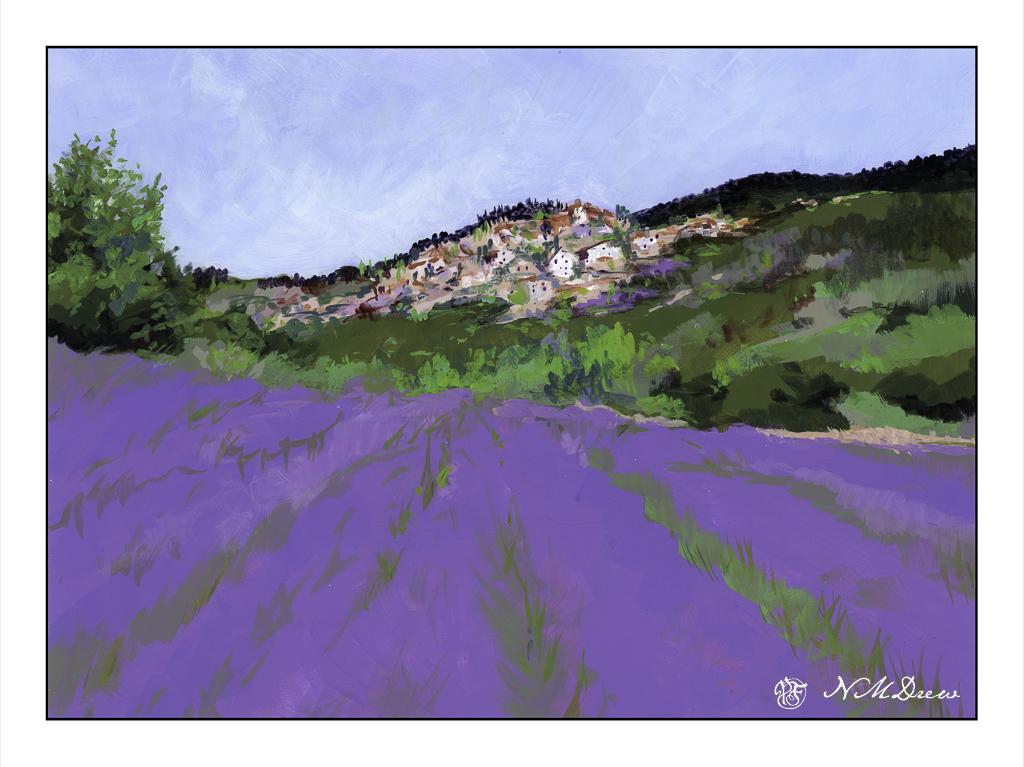
Lavender Field

Pixabay provides such a wonderful range of photos for free! This is based on one, a lavender below a village in France, which I think may be Bonnieux.

Yesterday I bought a number of fresh bottles of Golden Fluid Acrylic Paints. These are thinner than traditional heavy body acrylics, and unfortunately their color range is not equal to that of the tube paints. However, I have a number of small bottles, but my fresh ones are 4 oz. in size, and that will give me a lot of paint for some time. After playing a bit yesterday with the colors, mixing some, and then finding the ones I had did not meet my color needs, I ordered a few more from Amazon. This allowed me to get brighter spring greens and a good color for the lavender.
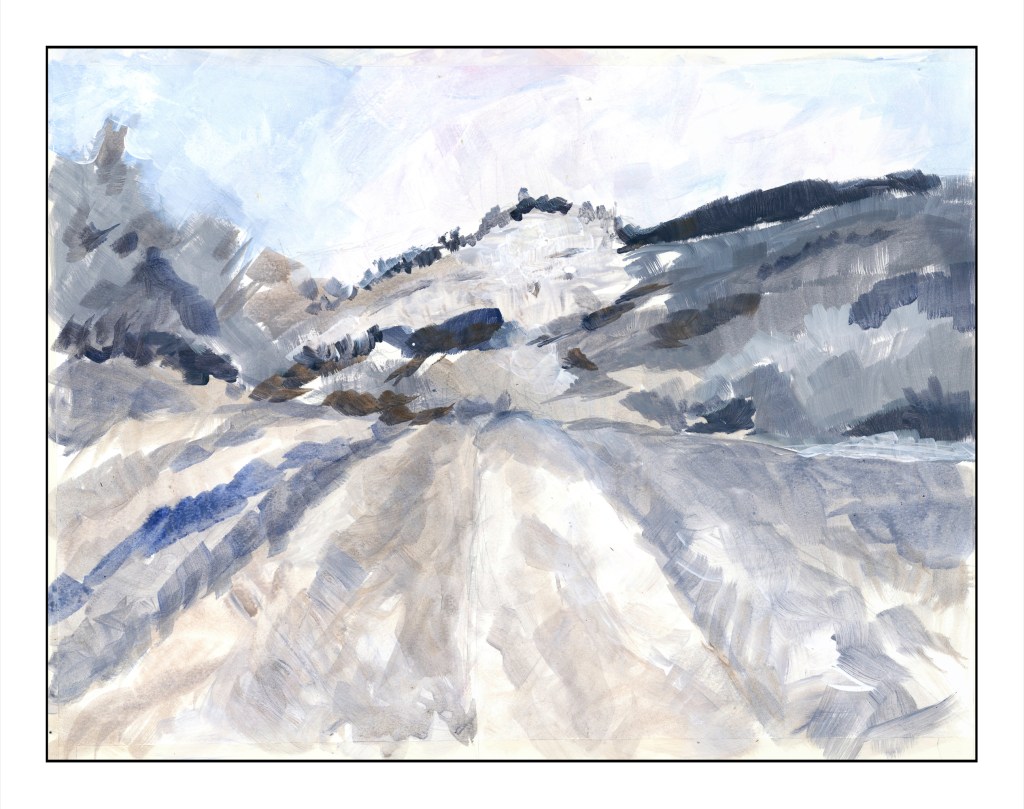
Yesterday I taped 1″ wide tape along the borders of a pieces of Canson XL watercolor paper in block format – 16×20 I believe. Then, I sketched in with pencil and laid down a foundation of values which gave me a sort of road map as to what I was going to do.
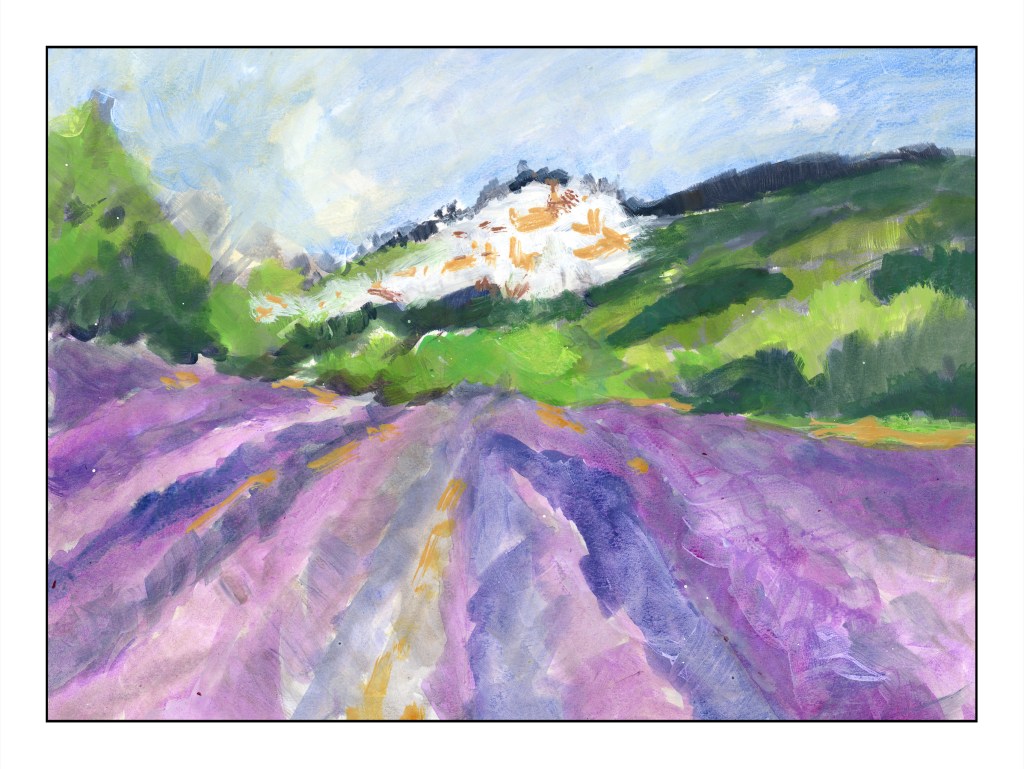
This is my second layer – colors this time with some values. The idea I had when I started out is I did not want to do a bunch of dabbing, which is my normal style, but instead make large swaths of flat color in the foreground lavender with some detail, and lead the eye to the village on the hill. To do this I used the lines of the lavender to lead the eye to the middle ground, but then chose brighter and warmer greens to sort of point to the village – lookie here!

I am not too sure how successful this is as a painting per se, but I am quite pleased with it. This is my first attempt at a big painting with the fluid acrylic paints, and as with all acrylics, I had to work with the quick drying time of the medium. The fluid acrylics were easier to use in a lot of ways than were the regular tube paints just because I didn’t need to work at diluting them. Straight out of the bottle, they work quite well. Shaking them a bit before use is a good idea, too. I will be ordering more titanium white as I have used a lot of it to just make this painting.

I hope you like this! More to come!
Playtime Is Fluid

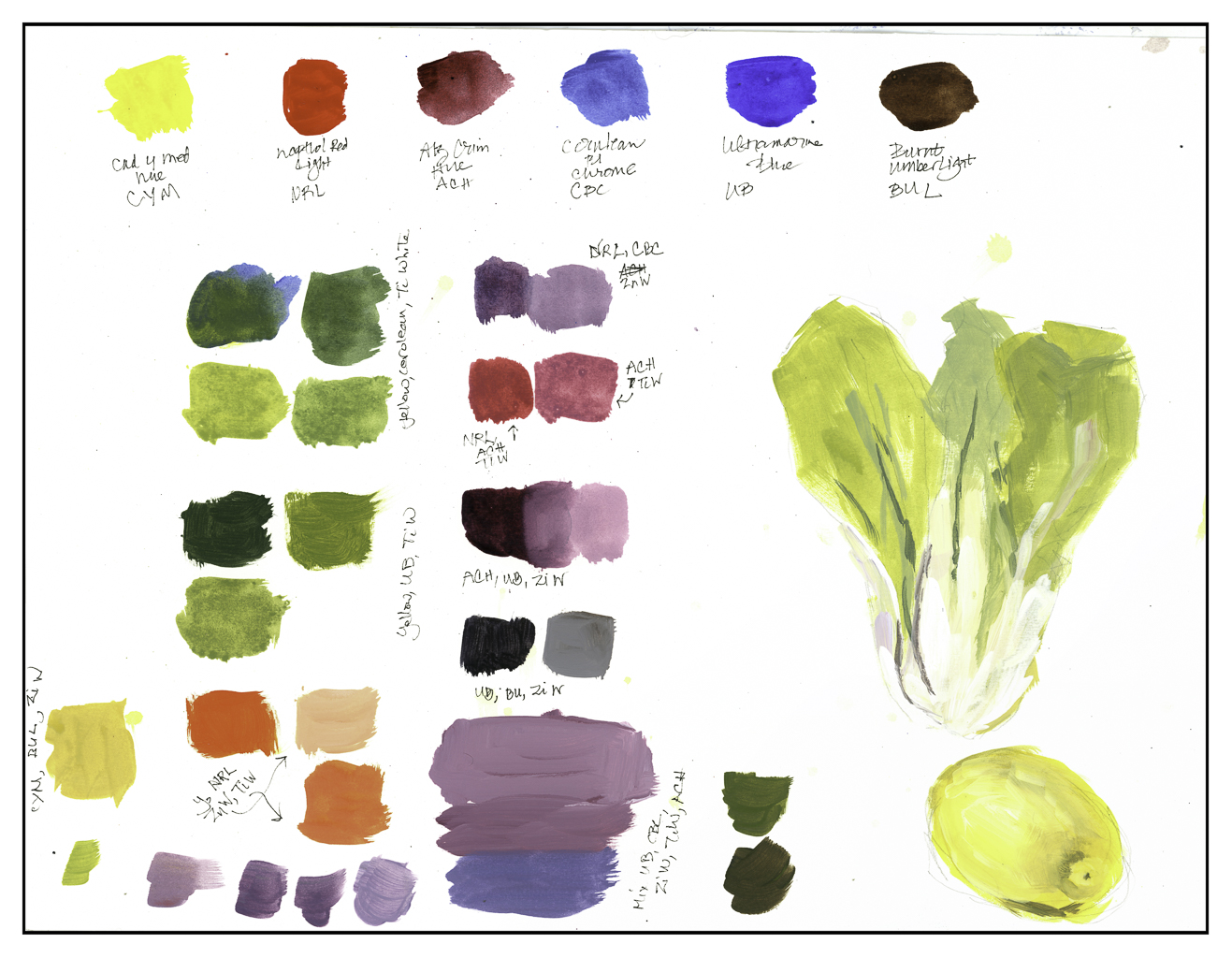
Several years ago I bought some Golden Fluid Acrylics in 1 oz. containers. I really didn’t appreciate them as I wanted them to do something they couldn’t. However, I have pulled them out lately and played with them here and there. Many of them are dried up and old, worthless to use, so I decided to pick up some newer ones and in a limited color palette – one yellow, two reds, two blues, a brown, and two whites.

Obligatory color testing – and mixing – to see what could show up. I like the oranges and red violets, but the greens are not the bright ones I like. I think the blues are not quite what I would like for mixing, so I am getting some cobalt teal. The same with the lavenders – they are okay, but, again, not exactly the shades I want. So, some dioxazine (aka carbazole) violet, as well as a quinacridone magenta as the alizarin is not to my liking either. Oh, let’s add a raw umber to that mix – not sure about the burnt umber.

Anyway, some playtime with the paints, quick sketches to see how the fluid acrylics work. They are a lot smoother, but dry out quickly, too. I did a sad lemon and a decent bit of bok choi. I think the bok choi is worth a bigger glance.

I may actually begin to enjoy the acrylics – working on 140# Canson watercolor paper – 16×20 – gives me plenty of room to explore. I am working on a bit of a landscape to see how to use the paints, and will report on my progress later on. I laid down a value study on the paper, and will next consider colors and layers, probably moving dark to light, and my brushwork, too.

Abstractio

As I wrote a bit earlier in my posts about my Chinese Painting Class, there is a challenge to start painting a subject when the knowledge that is gained by practice and by painting has slid by the wayside.  In an effort to stop feeling frustrated and stressed out by the process, I decided to play.  Play is part of growing up – and part of any art or skill acquisition – a  way to try, explore, experiment, learn.  I forget this way too much!

Relearning

The subject was peonies.  I have done a few good ones.  This is what I did that led to tears.  To put it politely, it sucks.

Becoming very frustrated, I decided to practice some strokes in classical subjects which are the foundation for Asian painting: bamboo, orchid, chrysanthemum, plum.

Some memory returns, but the brush is far too wet.

Break the Rules

Rules exist to be broken. Many sumi painters paint traditional subjects, which are beautiful in variety and subtlety. Others move into areas far beyond the traditional expressions, meeting either excitement or criticism. The beauty of ink is its immediacy, and how it lends itself to spontaneous expression. However, this element of spontaneity comes with practice and experience, and without either, the dilettante remains such. The artist combines the repeated practice, the knowledge, the experience with the moment. All artists are dilettantes and students at times, and other times, they move into that time and space when it all comes together in a moment of mastery.

Next Steps . . .

Given these thoughts, I let it go.

Absorbent xuan paper – washes – diluted ink – pure ink – pure pigment – mixed pigment – water – no water.  Playing with paper, ink, paint is a form of reacqaintance with old friends.  Not having a goal, just going somewhere, and letting it lead you into itself.

I am not an abstract painter, but I am not a realistic one, either.  I prefer suggestion.  Purely abstract adventures are rather frightening – nothing recognizable on which to get a toehold – only a plummeting in, down, out – moving with the moment.

First one done, very timid.  I realize just how much I’ve forgotten!  One thing that is very important to remember is that the color of Chinese paint becomes a lot light – mucho mucho! – when it dries.

These next few, I diluted the paint and ink considerably less. I sprayed the paper in some areas, applied ink and then painted over it, flicked the paint, pushed and smooshed and let the ink or color bleed in.

I rather like the above two paintings.

Continuing along the same path, I remembered that I have some acrylic paints, Golden Fluid Acrylics, which are a dilute paint (not less pigment, just thinner, like cream) and some others with sparkly effects. This painting is ink and dilute acrylic. Unfortunately, the sparkles don’t show up in the photo, but they do add a nice quality to the finished picture below. I’m actually rather pleased with this one. It makes me think of looking up into an oak tree, seeing the leaves against a bright sun.

And finally, this. I think this is my favorite. Unfortunately, the photo is not the best. This one was a bit more planned, with colors more carefully considered, warms and cools placed in some specific areas. Splatters, too, and drips were done with more conscious thought. Not all of it was planned out. Ink was added before, during, and after the colors. The paper was sprayed at various times. The point of this painting was to try to incorporate what I learned from all the above, and work to see if my thoughts would produce specific results.  Did it work?  Yes and no.