Between the Mountains

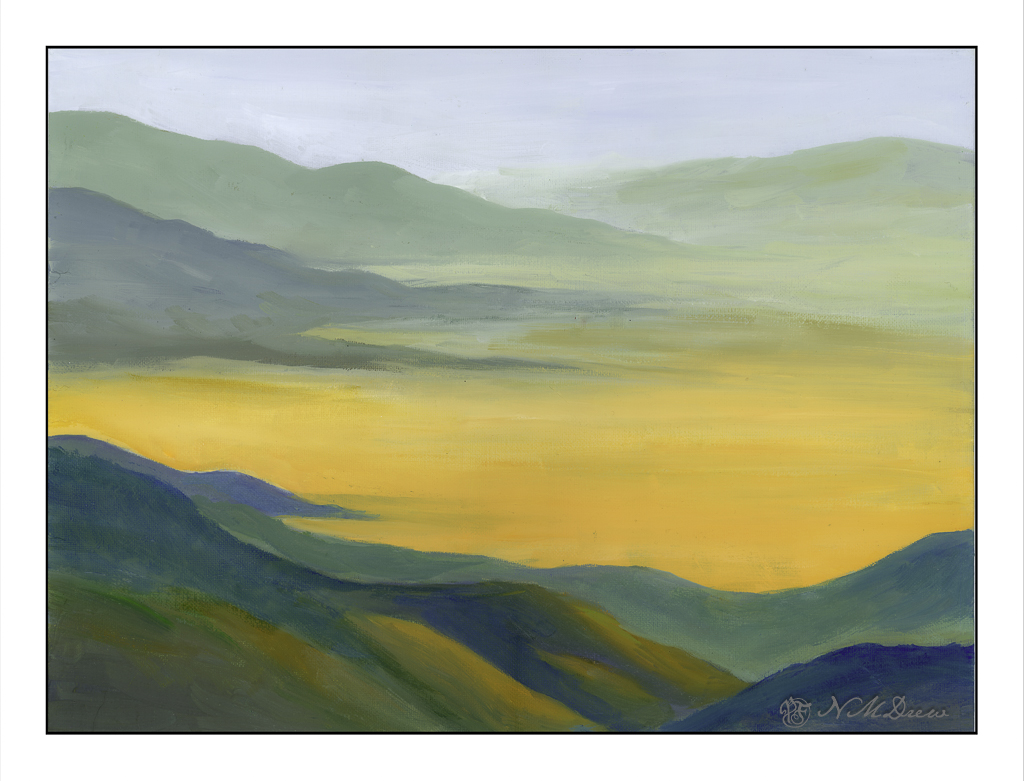
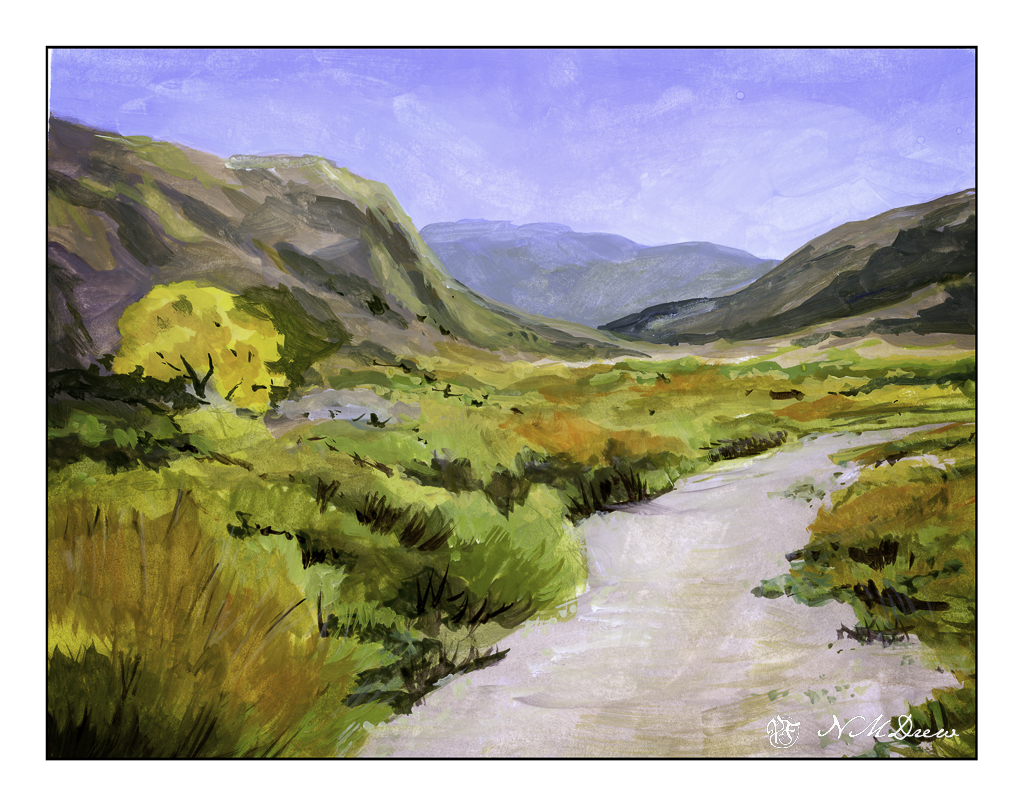
One thing I love about California is the fact that the geography varies so much! Oceans with flat beaches, oceans with cliffs, mountains with snow and mountains with pine trees, and deserts stretching flat and hot, surrounded by mountains and creating a secret world fascinating and forbidding. Worldwide, deserts host animals and plants and insects which survive on little water, are stark and seemingly dead – but of such beauty. Deserts are not for everyone – familiar and comfortable landscapes full of trees and greenery are very different. It took me a long time to appreciate a more stark landscape than the rolling green hills and woods of the midwest and eastern seaboard.

This is a painting I have been working on in my weekly class, inspired by multiple memories and photos taken. I had a limited palette of white, ultramarine blue, Indian yellow, and light green. I tried to catch a golden glow as well as give a yellow-orange cast to the desert floor and hillsides – and create a softly blended painting.

Oil, 12 x 16 canvas panel.

Along the Colorado

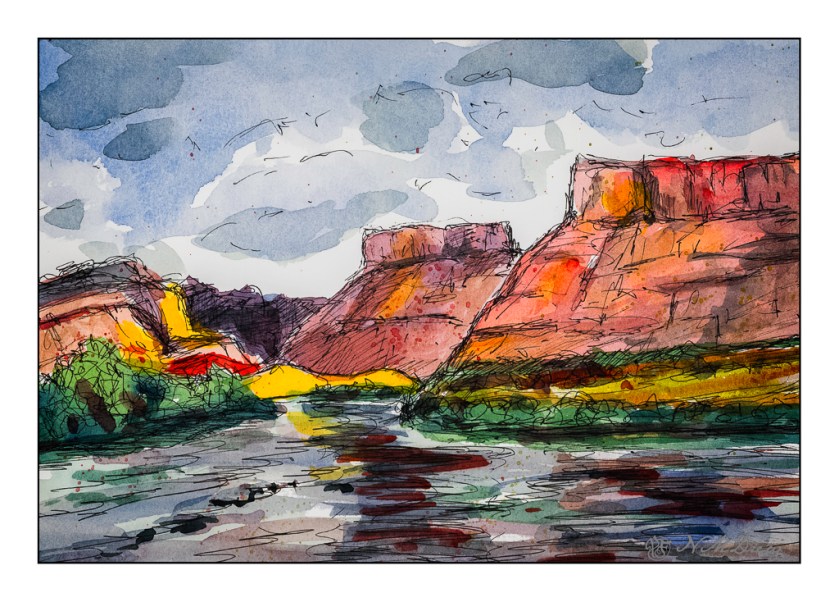
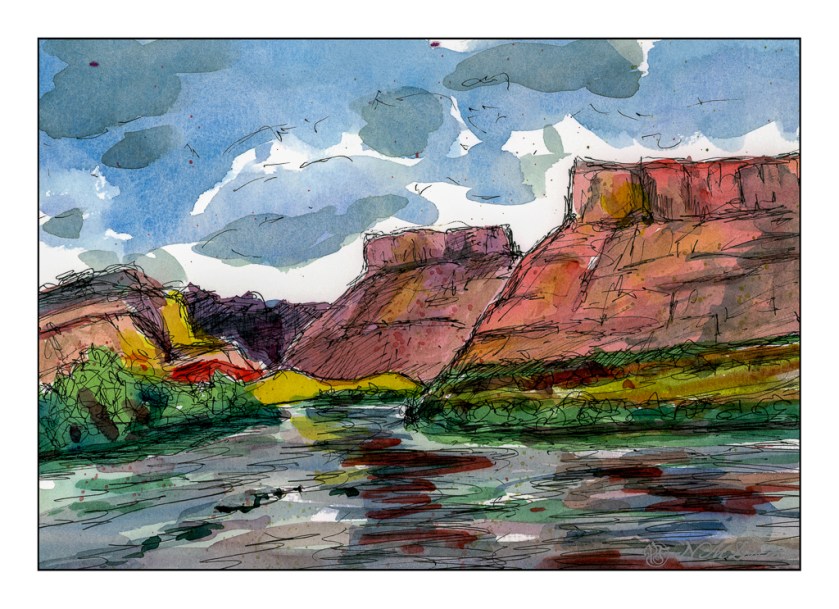
Two different scans, and neither is truly exact. That was planned. I decided to change the mood of the scans – one in Epson Scan and the other in VueScan. Don’t remember which is which. The moods were to be bright and sunny, breaking through rain clouds perhaps, and the other just rather cold and gloomy when the sun has vanished behind heavy clouds.

Above, the warm colors are being pushed – yellow, orange. A bit of glow to try to express that sudden brightness you see when the light changes rapidly because of the weather.

And now the light has changed – potential rain and bad weather. I expect there is a bit of wind, too!

Technically, I drew in the landscape with a waterproof pen, painted, and then drew some more. The mesas’ slopes are a bit steeper than reality as these are about 45 degrees, and in real life, I think they are more shallow, about 30 degrees. Artistic license?

Watercolors, ink, Hahnemuhle 300gsm CP paper, about 9×12.

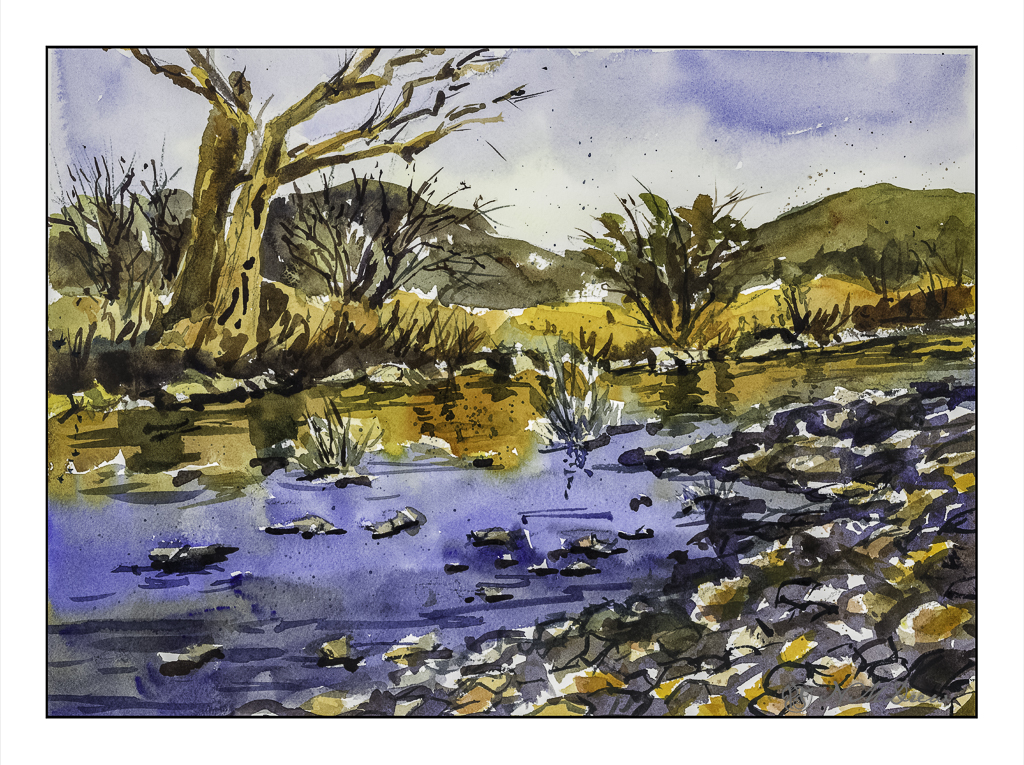
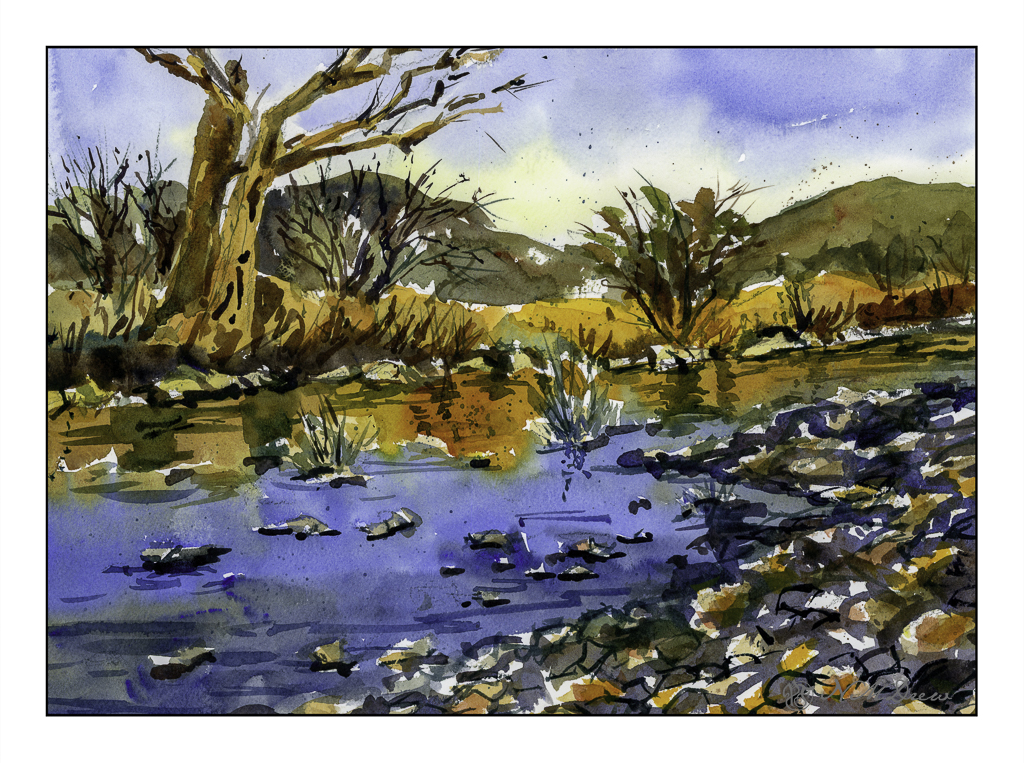
Watercolor Triad – Desert Wash Scene

Well, the electricity is off again. I feel like I am living on a little island because only a few people in my neighborhood are affected. Fortunately, we have our generator! So, light, electricity, internet, and the opportunity to continue with my course on color triads by Shari Blaukopf.

I did the first one, a tropical scene in Florida, and this is the third, the Arizona desert. The second one is winter and since it is cold and rainy outside, the desert appealed to me a bit more. The color triad used here – and easily, too – consisted of New Gamboge (yellow), Ultramarine Blue, and Burnt Sienna. I did not have the New Gamboge, so I mixed Cad Yellow Medium with a bit of Pyrrole Orange to get the color she suggested. These colors are perfect for a late evening in the Arizona desert.

The above scan is with VueScan. It is a bit more subdued than the one below, scanned with Epson Scan. I like both of them, but think the richer colors of the Epson Scan are a bit more to my liking. The warmth of the scene is well done here, and matches my own colors perhaps more closely.

All of Blaukopf’s courses have been a real pleasure to follow. If you like watercolor, I suggest her more than any other online teacher. I never fail to learn something new. For instance, in this class, the golden middle ground, just above the opposite shoreline, included painting the colors up into the trees on the left. From there, at a later point, more detail was added.

The other thing I learned was a really interesting and unique way to do reflections in water. The two colors – golden yellow and then blue – were mixed up in big puddles. First the golden yellow was laid in, with a bead of color at the bottom. Then, with the blue, with space between it and the gold, the blue was brushed in with only a touch onto the golden yellow here and there. This allowed the colors to merge, but not become murky or form blooms. Finally, the darker water of pure ultramarine was mixed with a bit of the golden yellow mixed with burnt sienna.

This triad study was so much fun to do! Time to try some of my own from my own photos.

Watercolors, Arches 140# CP, 9×12. Cad Yellow Med, Pyrrole Orange, Ultramarine Blue, Burnt Sienna.

Sand Dunes in Death Valley

Death Valley is up and off Hwy 395 along the Eastern Sierra Mountains in California. It’s a strange and eerily beautiful place with a lot of surprises and history. It is preserved as Death Valley National Park. The website is filled with great information and it is one of the best places to visit – in the right season, and in the right weather. People die in the desert because they do not understand it, so if you go, be careful!

Sand dunes always amaze me. I am still stuck in my child’s view of the world that sand dunes exist only in the Sahara, and can only be found by riding a camel. Silly, yes!

There are sand dunes everywhere – beaches and deserts mostly, but sometimes in places you least expect. Their shifting shape in the wind and blowing away foot prints or burying ancient cities all lead to a fascination as they make everything seem so temporal.

Anyway . . . . this is an oil painting using a limited palette. Some of the goals in doing this painting included smooth, smooth brushwork for the dunes. I tried to catch the gradual gradations and color changes I saw. In the distance is the flat valley before the towering mountains. For each I used directional brushwork and a deliberate vagueness to create a surreal effect. The mountains, when I look at them afresh, can also be visualized as swirling clouds. Interpretation I will leave to your eye.

Oil on canvas panel; 16 x 20 inches.

In the Devil’s Garden

The American Southwest is amazing. Austere, rugged, rich colors of red barren stone showing sedimentary rock layers in many different colors. Plant life is tough and diverse and needs to be able to withstand extreme heat and cold, as well as arid conditions. Portraying these colors is really a challenge and a lot of fun as well! Here is the Devil’s Garden Trail area in Arches National Park. I thought doing it in pen and color might be the easiest route . . .

Strathmore Vision paper, 9×12, ink, watercolor.