Iris, iv

Irises – in Color – in Ink

The iris – the butterfly flower – is just too much fun to paint!  And quite a challenge as well.  The videos make it look easy, but I assure you, it is not!  The shape of the flower petals is far more difficult to do in a few squishy movements than it appears.  Loading the brush, with ink and / or pigment, is also a challenge.

Of all the videos, I looked at Virginia Lloyd-Davies’ the most.   The reason for this is that she has multiple irises in different positions.  She also uses similar approaches for each iris, but varies the iris enough so that brush variations also occur.  By watching her video repeatedly, it became possible to actually learn a great deal by imitating.

For these pictures, I used the same paper. The paper is double xuan, which is an absorbent paper which is heavier than student grade, and much nicer as a result.

Iris Scribbles

Unfortunately, I did not take very good pictures, but at least they are clear.  In the picture above, you can see some attempts are better than others.  This picture represents my first attempts at painting irises in color. The ones on the left side were done with the paper turned around – what you see are upside down.  The reddish-purple ones are my first ones, the blue ones later on.  You can see there is some improvement.  As always, my sense of value seems very off to me – not enough contrast between the light and the dark and middle tones. The yellow iris was just awful. The yellow paint has a decidedly greenish cast, and I could not find my white paint (I’m using Marie’s Chinese Paints) – or maybe I’m just out of it.  Anyway, it held no appeal once the color was on the paper.

Colored Irises, i
Colored Irises, ii

These two side-by-side paintings were my tries at creating the irises and attaching them to the stem. Not very good. The colors of the irises are not bad, but the shapes leave a lot to be desired. Leaves as well are unpleasant.

Colored Irises, iii

This painting with the reddish irises is better than the blue ones, as far as some of the shapes of the flowers. Those of you familiar with orchids in Asian painting will realize that these are orchid leaves, not iris leaves! Well, I guess I have some sort of hybrid here.

Sumi Iris, i

Once I got frustrated with color, I got out a Chinese ink stick and ground up some ink. I made three shades – light, medium, dark – and went to work. Again, contrast was an issue, but the flowers, stems, and leaves became a lot nicer. This one was the first attempt which pleased me.

Sumi Iris, ii

The second sumi iris also shows a problem with light / dark, but the composition is pleasing to me.

Sumi Iris, iii

And this one, the third one, pleases me the most. Still some problems with light / dark, but not so badly. The entire flower is looking a lot better, from top to bottom. Certainly some of the irises are rather blobby, and the buds don’t quite make it. Parts of the painting are too busy or crowded, but, over all, I think I am seeing some success. Certainly I plan to continue practicing, and I hope that I will be able to produce a creditable flower.

Leftover Ink

This is what I did to use up the rest of my sumi ink – I hate wasting it!

Corn Stalk
Tiger Lily, i
Tiger Lily, ii

All these paintings were done on Memorial Day. A few others were done as well. As far as the photography, well, let’s just say it sucks and I need to work on it. The paper is a warm cream, and perhaps I should have used a flash. Ah, well, always something new to learn.

Art of Ink, i

Yosa Buson

Now that I’ve pulled out my brush and sumi again, I start rummaging through the drawers of the internet.  I’m not quite sure how I found Yosa Buson, 1716-1784, but I did; I’d forgotten about him.  He was both a poet, and an artist, frequently combining the two.  As a painter in ink, his skills are more than evident in the work below.

Two Black Crows and a Hawk - in Snow and in Rain

Both Crows and Hawk show many techniques that allow expression of the elements in sumi-e.  Snow is painted by going around the flakes – dark ink makes the white flakes fly.  Rain is expressed by using a wide brush, such as a hake, that has been dipped in light / medium ink.  The ink is squeezed out by hand or blotted on towelling, and the bristles squished between the fingertips to create an uneven edge.  Rain is painted in one long sweep; two or three strokes may be all that is needed. These two paintings are very Japanese in approach to working with sumi.

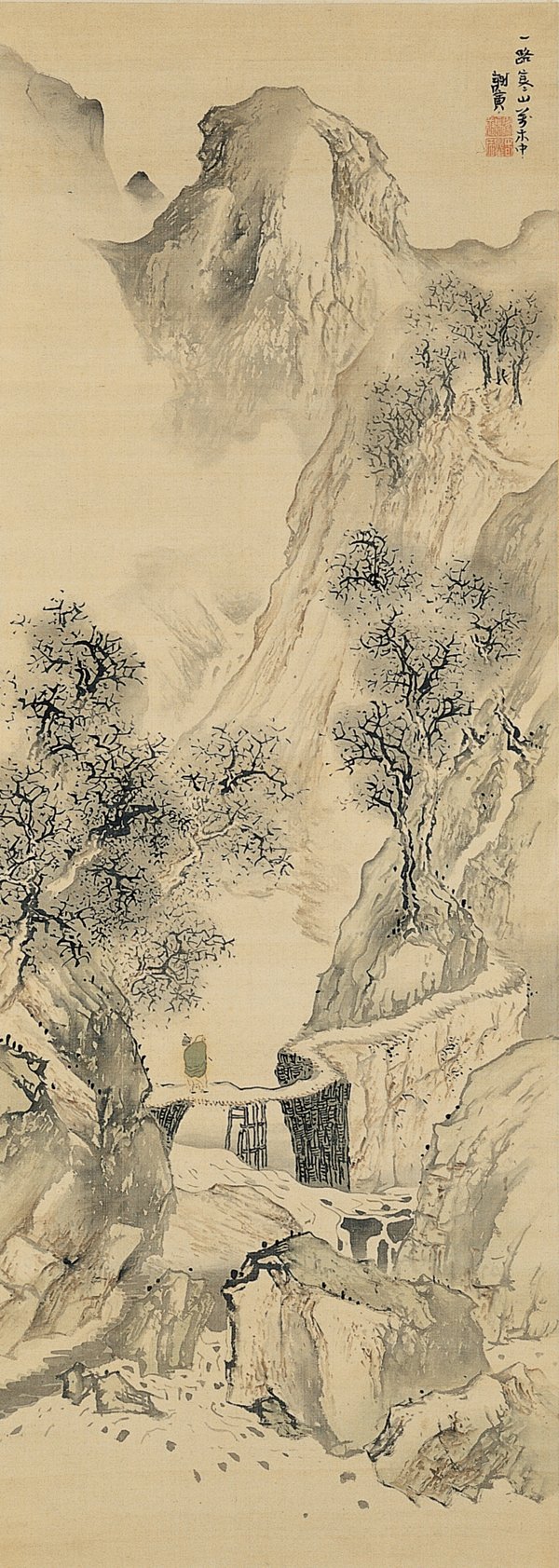
Landscape with Solitary Traveler - 1780

In Landscape with Solitary Traveler, we have a more Chinese approach to ink painting. The theme and constructs are familiar – mountains, water, a path, a bridge, a pedestrian. As in Western painting, Asian painting has its own history and symbolism. The beauty is that these familiar subjects become personal and unique in the hands of the artist. This painting is done in ink, with only a touch of color added to the traveler.

As I mentioned, Buson also wrote traditional Japanese poetry. Here are some translations of his haiku.

coming back—
so many pathways
through the spring grass

in seasonal rain
along a nameless river
fear too has no name

more than last year
I now feel solitude
this autumn twilight

Before the white chrysanthemum
the scissors hesitate

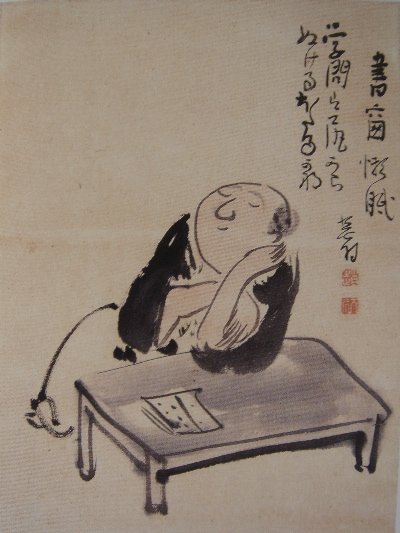
Besides being a master of wash and line (in word and ink), Buson was quite funny. I came across this painting and could not help but laugh. And here, both painting and poetry mingle, albeit not too politely.  Dave Bonta writes about this picture quite well.  Understanding the language – and the humor in the translation – may be read about here.

Bonta translates the writing,

gakumon wa ketsu kara nukeru hotaru kana

as

All this study—
it’s coming out your ass, oh firefly!

Perhaps I should stop while I’m ahead . . .

Iris, iii

I keep thinking about my cochineal dyeing – I still need to write up the rest of it, and post some pictures. Maybe tomorrow when I have more time.

Tonight, though, is painting night. Not a lot of time for it, but in the little time I had, I did some outline drawings of irises. The idea is to get a sense of shape. I drew from some of the photos, and copied some from the Mustard Seed Garden; in fact, I think the best ones were those as the contrast created by the lines was very nice.  My own drawings are quite lacking.  I am so out of practice!

This painting was the first, done early this morning on the same very absorbent paper I used for last night’s wash paintings. You can see just how it sucks up the ink – whoosh! The rest of these are done on tissue thin sulfite paper from Japan, which is much better for line drawings as it is not as quick to wick the ink out of the brush.

All of the above were done from photos. The bottom one was copied from the Mustard Seed Garden – and you can see the refinement compared to my own awkward drawings. Hopefully I’ll get better . . .

Iris, ii

I did my visual research.  I downloaded almost 100 different iris pictures, for color, shape, structure, position.  Too many to post here!  Also copies of famous prints and paintings – Japanese screens, Van Gogh’s fields.  Besides flowers, I also looked at leaves and descriptions.  I pulled out my “how to” books. And, I watched the videos from my last post.

Research

The iris is an impressionistic dream!  It is not a tightly structured flower, but more an explosion of color and shape.  Also, not all irises are bearded, even though there is a similarity of structure amongst the varieties, as far as I can tell.  The color variations are numerous, and vary from subtle to outrageously loud.  The most structured thing about the iris is the leaves, which are a perfect contrast in their simplicity against the frilliness of some of the blooms.

Each video provided some instruction, in shape, in how to move the brush, how to load the color.  Right now I am working in sumi ink alone, so that means grays, whites, blacks, and everything in between.  The paper I am using is a roll, and the paper itself is very absorbent.  This presents a bit of a challenge because the brush has to be very, very dry for control.  And then, waiting for the paper to dry enough to pick up darker lines, but not bleed them away into the already wet paper.

This is what I accomplished this evening.  The main focus of this painting venture was to think about, and to do, the brushwork.  Determining how to manipulate the brush to create given shapes and how to load the ink onto the brush is part of this practice session.  Because the throat of many of the lavender-blue-purple irises have a yellow throat, that pale color has to be represented by white or light grey ink.  Some irises are light on the tips, and darker toward the center.  How the stem attaches to the flower is also important, and deciding how to relay it visually also means deciding what kind of movements need be done with the brush, wrist, and so on.

I’ll stop with that.  Needless to say, the values need to be sorted out at some point!  These are all disasters in that area.

From Sadami Yamada's Book on Flower Painting
Following the Brushwork of Danny Chen's Video
Following Virginia Lloyd-Davies' Brushwork in Her Video

First Attempt Looking at a Photo

Painted from an Upside Down Photo - a la "Drawing from the Right Side of the Brain"

Upside Down Painting Right Side Up!

Iris, i

I tend to be somewhat encyclopedic when it comes to learning about something.  The result is a collection of stuff, and the clutter in my life is evidence.  Given that, here is some info I’ve collected about irises.  For our Chinese painting class exhibit, this will be one of my subjects.

These complex flowers, if well done, may be accomplished with a few brush strokes.

Anatomy of the Iris

Photos, diagrams, drawings.  All these can familiarize the painter with the parts of the iris plant.  Knowing what is what, and where, make the difference in successful rendering.  This does not mean a scientific illustration is what must be done for an artistic or spiritual representation of the iris, but knowing how it is structured helps (me, at least) figure out what an artist is attempting to do – and what I might want to do.

This schematic illustration may be found at the Historic Iris Preservation Site, along with many colored illustrations and information about irises.  Other illustrations may be found by doing a websearch for parts of the iris flower.

Painting the Iris – Videos!

Watching various artists and their approaches to painting is always educational.  And what is caught on video can be watched over and over.  How a brush is loaded, with ink or with color, is as important as how the brush is utilized on the paper.  For this, I am talking about the free-style painting of the iris, not the fine line tradition in Chinese art.  One brush may express a shape with a thin line, a smushing line, and rolling.  Below, you will find a number of artists and their interpretations, as well as a very structured example, with the brush strokes done step-by-step.

This first video is by Danny Chen; you may find his work at Chen’s Gallery.  His mastery of color mixing is astonishing.

Virginia Lloyd-Davies of Joyful Brush is very talented; her website will show you her mastery of Chinese painting.

Next is Henry Li of Blue Heron Arts.  His small business on eBay has blossomed (if you will excuse the pun) into a one from which you might buy a variety of supplies.  Here he demonstrates the iris using a hake brush.

Nan Rae is a California artist who has produces lovely paintings in the Chinese style; she has authored and illustrated a number of books as well.

Next is Kazu Shimura, who I absolutely adore.  You can find his videos on You Tube as well as here.

Rebecca Lynn Cragg on You Tube shows you numerous sumi-e techniques, as well as how to wear a kimono!  Ms. Cragg runs a tea house, Camellia Teas in Ottawa, which I would love to visit.

Finally, Yang Haiying (I hope I spelled her name correctly), has videos on Chinese painting, and many other things.  Her videos are brief, but if you watch her brushwork carefully, you will learn a lot.