Roast duck is something to be savored, and unfortunately most ducks bought in your average grocery store are not worth eating. The last one I bought was years ago, and I was shoved somewhat unceremoniously aside when I was not going to follow the directions on the bird’s wrapper. Some little pop-up thingy was supposed to erupt miraculously when the bird was done. Needless to say – so why am I saying it? – the result was a gastronomic catastrophe.

Most people fail to understand the chemistry involved with cooking meat, or any protein for that matter. Simply put, a high heat will change the molecular structure of protein, and not always for the best. Eggs are a very good example of this: scrambled over high heat, they become tough. Poor cuts of meat benefit from slow cooking, using a low temperature, which is why pulled pork takes all day long on a smoker, and is worth the patience of waiting for it. I think duck is the same way if you plan on roasting it.
Since that last disaster, I think I have had duck twice, both times served in a restaurant, and only the breast. One had cherries, and was quite good – the big problem was not enough of it! When I was a kid, duck was a staple in the family, so for me, it is like an old friend, but a special one.
As I have not roasted a duck unsupervised for awhile, I feel like a prisoner set free! I perused my usual recipe haunts, and decided to do a slow roast at 275 F, and to make an orange glaze, which sounded pretty good. The links I used are this one for the glaze, and this one for the general directions, complete with pictures.
I bought the duck this morning at Whole Foods, and while I did not keep it in the refrigerator in a pan, naked and exposed to the air (why would I want to do this? According to my research, this helps make for the crispy skin!) for 24 hours as is recommended, I did rinse it off and stuff it with a bunch of orange peel and a sliced Spanish onion. There were a few pin feathers to pull out, but this duck was remarkably clean. The giblets were set aside for stock, which will be made when the duck is done and eaten; the fat will also be saved for later use, being poured off before the glaze begins.
The Glaze Most Delicious
Put together in a small sauce pan the following ingredients, bring to a simmer, remove from heat and set aside for later.
- 1/4 c. fresh orange juice
- 3 T. honey
- 3 T. blackstrap molasses
- 1/4 c. balsamic vinegar
- 4 minced, grated garlic cloves
- 1/2 tsp. each ground pepper and freshly ground coriander seed
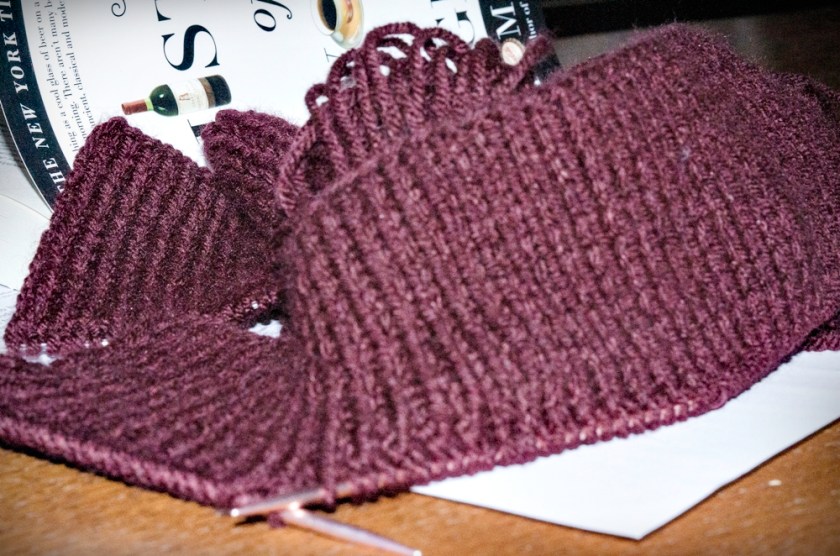
Do this after you put the duck in the oven. Go sit down someplace where you can hear the timer ding one hour so you can flip the bird. Me, I went and listened to Mr. Reacher’s adventure in Mississippi and made some phone calls and knit on the Cloisonne mittens. I also enjoyed the wafting fragrance of the duck as it roasted its way to nirvana.
The Duck So Nutritious
One five-pound duck. If you want, after you wash and pat it dry, let it sit for 24 hours in your refrigerator, unstuffed and uncovered, to make the skin especially crispy. If you don’t want to, then don’t.
Once you are ready to cook your duck, score the duck skin and fat, and prick the duck in several places. This will allow the fat to escape and drip into the pan. Take your giblets, and any other parts, and set aside for stock. Squeeze a juice orange, and save the juice for the glaze. Slice up the orange rind, along with a Spanish or some other onion, and stuff it into your duck. The more the merrier – the onions are great to eat after the duck is cooked, and the peel adds to the final flavor of the meat.

Heat the oven to 275-300 F. Put the duck in a pan, on a rack, and make sure your pan is deep. Not being sure how much fat I would get, I used my largest pan. I could have gone smaller, but better safe than sorry! I could probably have used this pan and rack for two ducks, if I had been greedy, extravagant, or having company.
Place the duck breast side up, tying the legs together with twine after you have filled it full of oranges and onions. Cook it for 1 hour, remove from the oven. Prick the duck, and flip it over. Cook another hour. Repeat so that at hour three the duck is now breast-side down. The recipe calls for cooking about 4 hours; I pulled the duck out after 3 3/4 hours, and then began the final phase. I set my timer for 60 minutes, just to remind me.
Push the temperature up to 400 F. Once that is reached, pop the duck back into the oven, breast side up. While you are waiting for the oven to heat up, you can pull the rack out of the pan and drain off the fat – I did this to use for other purposes. I also scraped the cracklings out of the pan and set them aside for flavoring biscuits and for gravy, and to pop a few into my mouth.
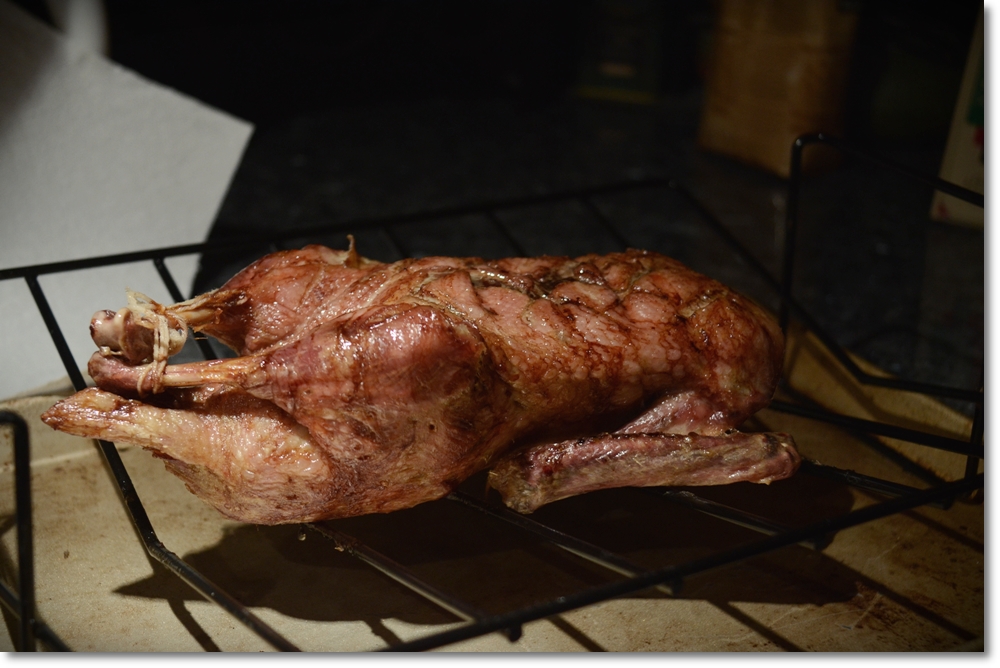
Once you have the oven at 400 F, return the duck to the oven, breast-side up. Set the timer for about 10 minutes – this way you can watch the skin. The linked recipe said do it for 30 minutes, but reviewers said not to do this. I didn’t do it for 30 minutes – ten were fine. Then, remove from the oven. Let it stand, and as you let it stand, mop it with the glaze, letting it soak in between moppings.
Carve Thy Bird!
Anyone can do it better than me! I have not had to carve anything for so long, I’ve forgotten where what is and how it is connected. Still, food is food, and as long as it is not on the floor, who cares? Unless you are trying to win a prize for prettiness, don’t sweat it.

Results
Damned fantastic! You gotta have that skin – crispy, orangey, sweet with a bit of tang. The meat was tender, not dry, and not greasy, either. I served it on a bed of mixed salad greens and arugula, using an orange champagne vinegar as dressing. I was really pleased with the results. Yes, a lot of time, but really not a lot of work.
A Word of Caution
Finally, for those of you who have never tried to roast a duck, I would like to give you some advice. First, make sure you have a duck. A real duck. Get one that is free-range, organic, whatever. Make sure there are no pop-up thingies. Try Whole Foods or a butcher you know. Don’t steal one from the neighborhood pond. And, if you cannot identify a duck, here is a clue from the esteemed Mr. Nash:
Behold the duck: It does not cluck.
A cluck it lacks. It quacks.