Well . . . I prefer the land, the tree, the ocean, the field. I prefer not people or buildings.
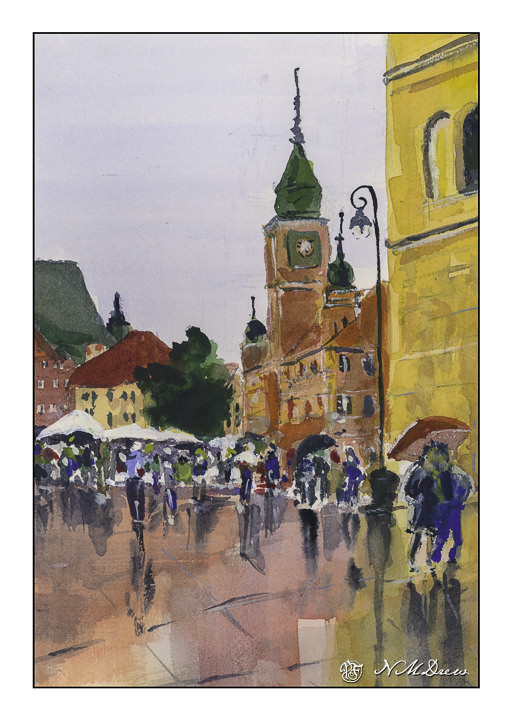
But, I must put aside my prejudices to progress in painting. Andy Evansen’s watercolor course has challenged me to such. I did people, reviewing proportions and where the elbow ends and the knee. People are 7.5 to 8 heads tall, depending.
Buildings and people – crowds – hmm. I usually avoid them, being the reclusive and exclusive and somewhat misanthropic. Nonetheless, they exist. So do buildings. And value studies! This is like trying to fit my tiny foot into a tinier shoe – painful, painful.
I tried this painting in watercolor by starting out on used paper – the reverse of other studies or failed paintings. Cheapness does not do me any good. I was not getting anywhere except PO’d.
I do not like being PO’d.
A new sheet and voila! Life, while not sweet, definitely improved. And I did a crowd of people, and buildings in a plaza, and only one solitary, lonely tree suffocating in the midst of civilization.
This was probably the most challenging painting I have done so far in any class . . . but I lived! Any good? Who knows.
I feel like a school kid – classes are taking up so much of my life! It is keeping me off the streets, so I am sure a few people are glad to know that! The classes are a series with Ian Roberts (online), Andy Evansen (online), handsewing 18th stays with Burnley & Trowbridge (far behind!), and a local class in oils / acrylics with a good teacher. Housework is falling by the wayside!
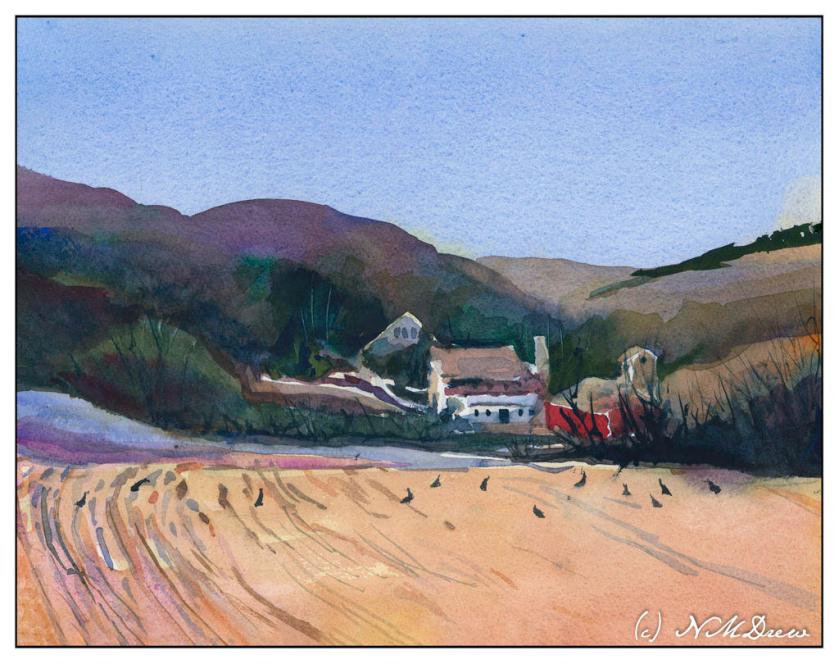
The above is a watercolor exercise from Evansen’s class. It’s a year-long course in watercolor, and the content needs me, the student, to work hard at the lessons. We began with skies – I am pretty comfortable with those. This module works with values, and I think I did a pretty good job with it.
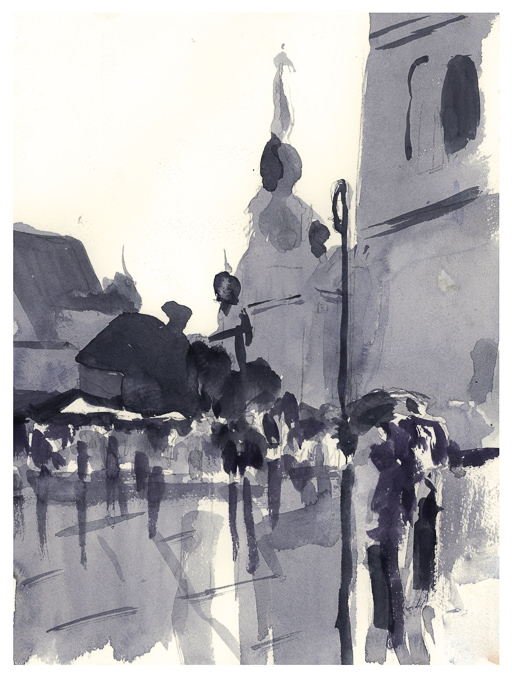
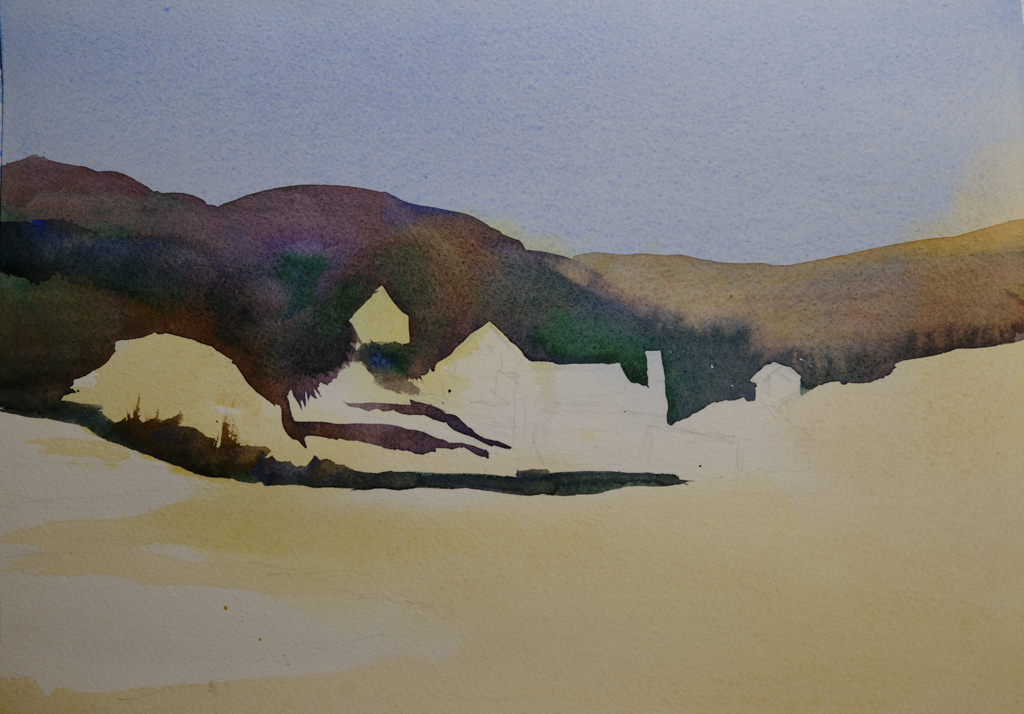
What I found especially interesting was the beginning of the value study. Unlike Roberts who puts in all values in a pencil sketch, Evansen puts the middle value only as the first step. The white areas are bright spots and the sky, but the middle values are all created as one big shape. That was quite interesting, and not the usual route one takes with value studies.
Pencil drawing with middle value only added as a shape.
I messed up a bit, but it did lay out a map that was more clear to me than also including the darks. Once I got the idea in my head, the next step was to lay in soft colors on paper that was wetted on both front and back with a natural sponge. I used 9×12 140# CP Kilimanjaro paper here.
After doing the middle value shape, both as a prelim and then on the final painting, you are supposed to go back and add the dark areas to the prelim. I didn’t get there – I was too involved in the final product!
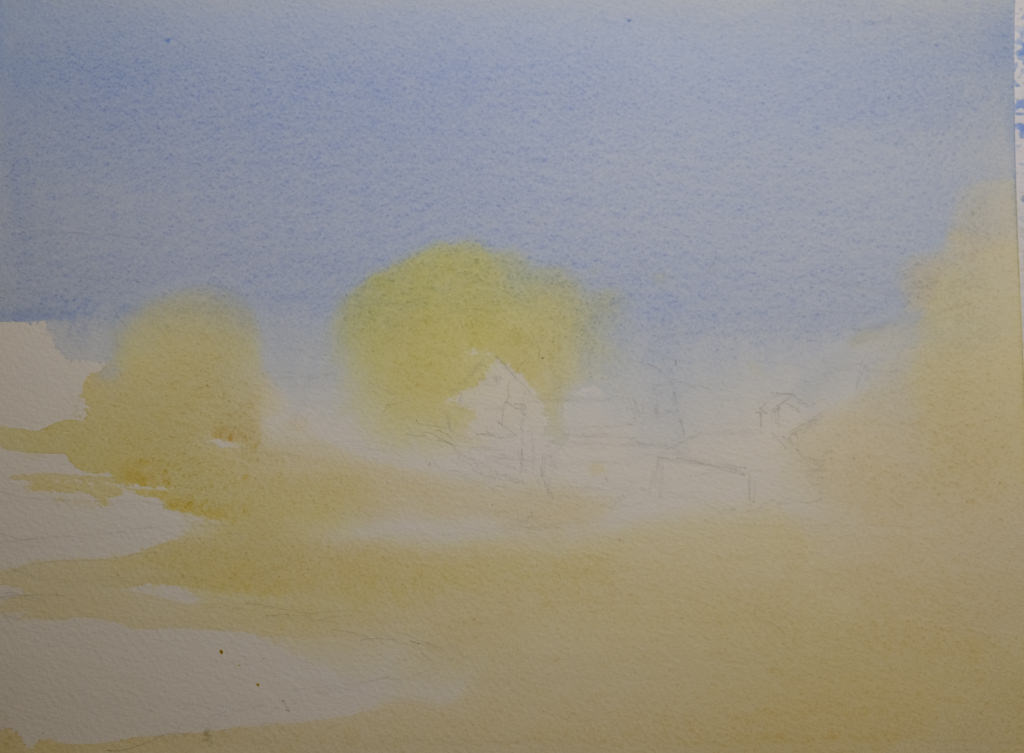
Light areas filled in on dampened paper. Includes the sky, white areas for buildings, and field and trees.
Doing the light areas on dampened paper allows the colors to bleed a bit, and create soft edges.
Thicker paint added once the light areas have been worked.
The next step was to work left to right so that the shape created for middle values in the preliminary study could be made on the painting. The idea is to work in one movement – left to right since I am right handed, but right to left if you are left handed. The idea is to create a bead of color that varies as you paint in a continuous design.
To me, this was really a dark based on the reference photo, but that is life! As I did this, I worked around the buildings and structures, as well as roads. The thicker paint and dryer paper allowed this to happen to create hard edges. I was happy with how easy it was to do!
Almost done!
This was perhaps the 3rd stage in my painting. I added furrows to the field and details to the structures. I scraped in tree branches and such with my finger nail only to realize I keep them trimmed too short to be of any use there!
After all the layers were dried, I did the heavier dry brush as well as glazes over the field and hills to create areas of warmth or coolness. I also did it on some of the structures to keep them from dominating .
Some thoughts . . .
It is really a lot of work to do these classes. My whole purpose is to stop my old ways of approaching painting and create some kind of shift so that I can become a better painter in my opinion. Also, I need to stay busy. I have felt like I have been floundering a bit, so an area of focus was important, especially in an arena I wanted to learn. I am still adjusting to all this, but in the big picture, I am happy I made the commitments.
I am trying to change my slap dash approach to watercolor that occurs when I don’t paint with them for awhile. Then I need to redevelop the discipline and forethought required for the medium. It’s aggravating, but necessary, and if I don’t make it a serious endeavour, it is very rewarding. I learn something each time.
I decided to begin with boats. The shape of boats is really not logical unless you break down the shape into squares or rectangles connected with curved lines. Then it can work. Here I focused on the shapes and shadows of two rusted old girls. Not a great study, but I really tried to see light and dark, searching for warm and cool as well.
Another beached wreck. This one is obviously of wooden construction – the slats along the sides. Building wooden boats is fascinating. I’ve watched some being built as well as seen videos about the process. Where I live, boats live in nice marinas, and sometimes in dry docks, but never are they left moored with an anchor or buoy to rest on the sand when the tide goes out. Of course, the California coast is not full of inlets and bays that are protected – there are a few, such as San Francisco Bay – but that is like a giant lake!
Here, I tried to catch the algae on the hull of the boat as well as the shadows. I didn’t do a very good job with the lines of the slats which make up the shape of the boat itself. I did try to catch her character and age as she lies abandoned on the shore.
After “Fishing Boats, Key West” by Winslow Homer
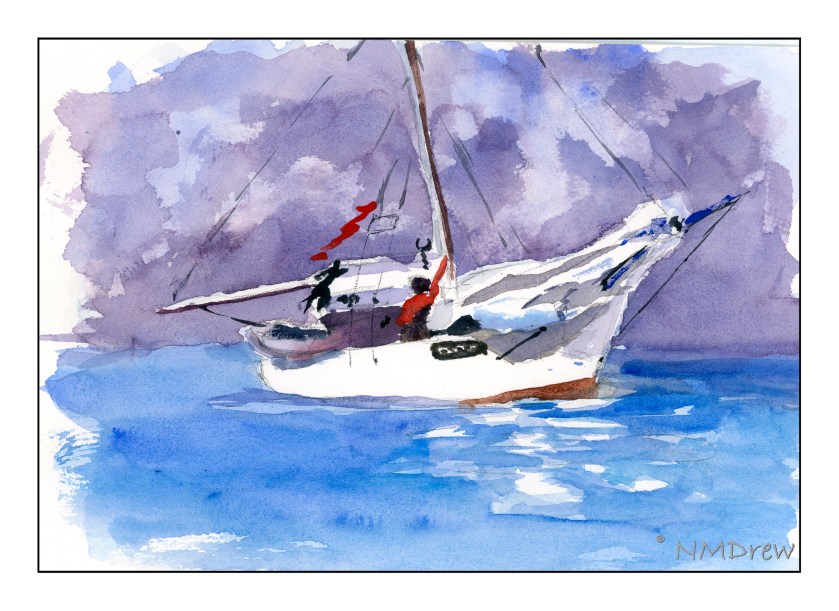
Finally, I decided to see what I could learn from Winslow Homer. He paints boats with abandon! New England boats, sail boats, row boats. Having lived during the 1800s, he saw sails to power boats more than steam or coal. His paintings are filled with detail and, to me, his watercolors are so alive I feel I am in the middle of them.
I don’t think a seaman would approve of my renderings – I am pretty much a landlubber, but I have sailed a bit in my younger days. There is something about the wind and the sea and the speed of it all – but it scares the hell out of me as much as it thrills!
With winds blowing at 40mph, the fear of fires was intense. Electrical lines spark, grasses and brush catch fire, and before you know it, the world is lit, not with electricity, but with flames. As a result of this – PSPS (Public Safety Power Shut-off) – we had no electricity for about 36 hours. What do you do when the sun goes down, there is no phone, no TV, no electricity? You read, you chat, you play games by candle, and paint by flashlight.
Rather than try to be creative, I got out a couple of art instruction books, one by Geoff Kersey, and one by Ted Kautzky. All of these paintings were done with limited palettes and by following some instruction to create a painting from the book.
The one above is from Geoff Kersey’s book, using only red, blue, and yellow. No more. It was the first one I did, and there was still some daylight, but very little, in my darkish studio. It was evening, and the studio window faces east. I used manganese blue, cadmium lemon, and cadmium red.
This one is from a Ted Kautzky study. Less light and more moving my little flashlight from book, to watercolor paper and drawing, to palette. Colors were verditer blue, cadmium red, Hooker’s green, and raw sienna. Verditer blue doesn’t seem to mix well with other colors, but is a lovely blue by itself. Four colors!
Now we are moving into big time! Here, five colors. Payne’s grey, ultramarine blue, aureolin yellow, Hooker’s Green, and burnt umber. Another study from Ted Kautzky.
I enjoy doing studies from books – it helps focus a bit. I also realized that daylight is a better way to paint, or using diffused electrical lighting. Flashlights are good to see with, but their light is not diffuse, but sharp and focused. I think I would have had better lighting with a few candles. Anyway, it was a good way to pass some time when the sun set and the vampires weren’t yet out.
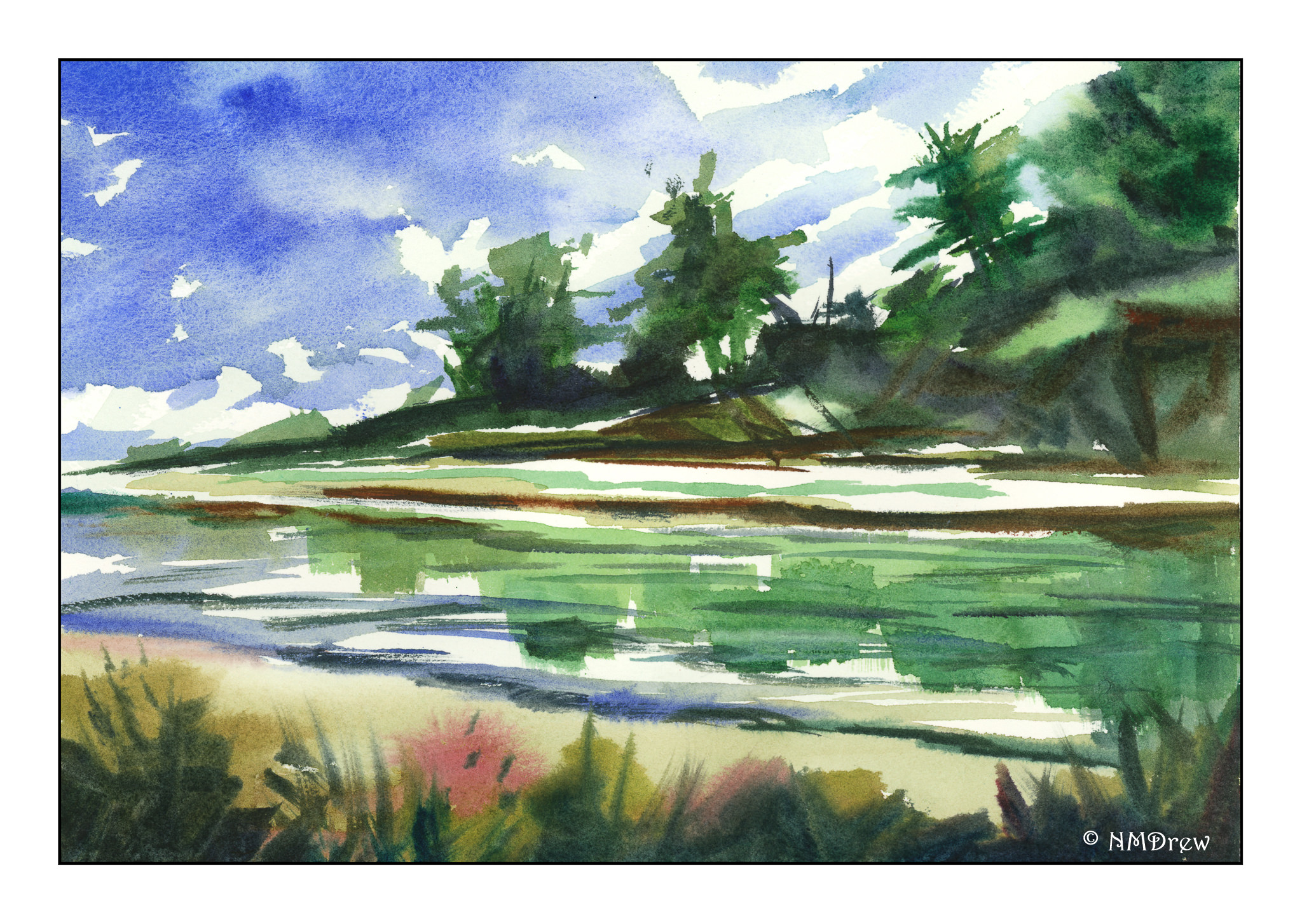
If you follow my all-purpose art blog, Journey By Paper, you know that I have been slithering around with pastels, gouache, and watercolors as a theme for a painting called “The Slough” – sort of an evolutionary adventure. In doing so, I began to move into a kind of abstraction, painting without lines.
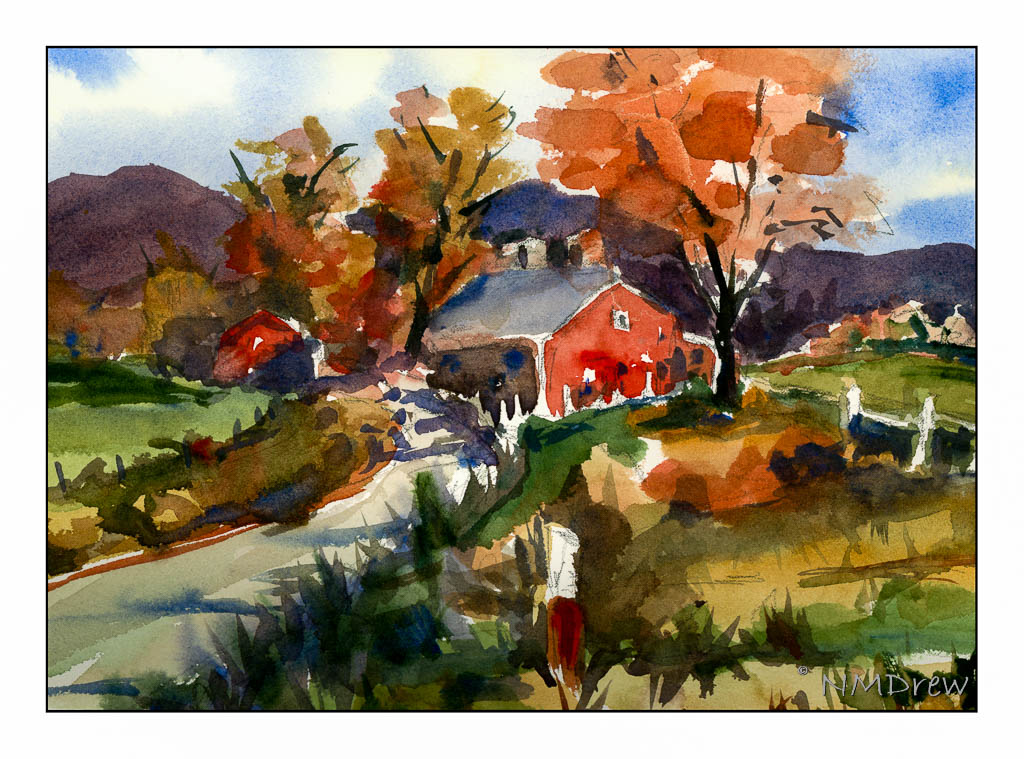
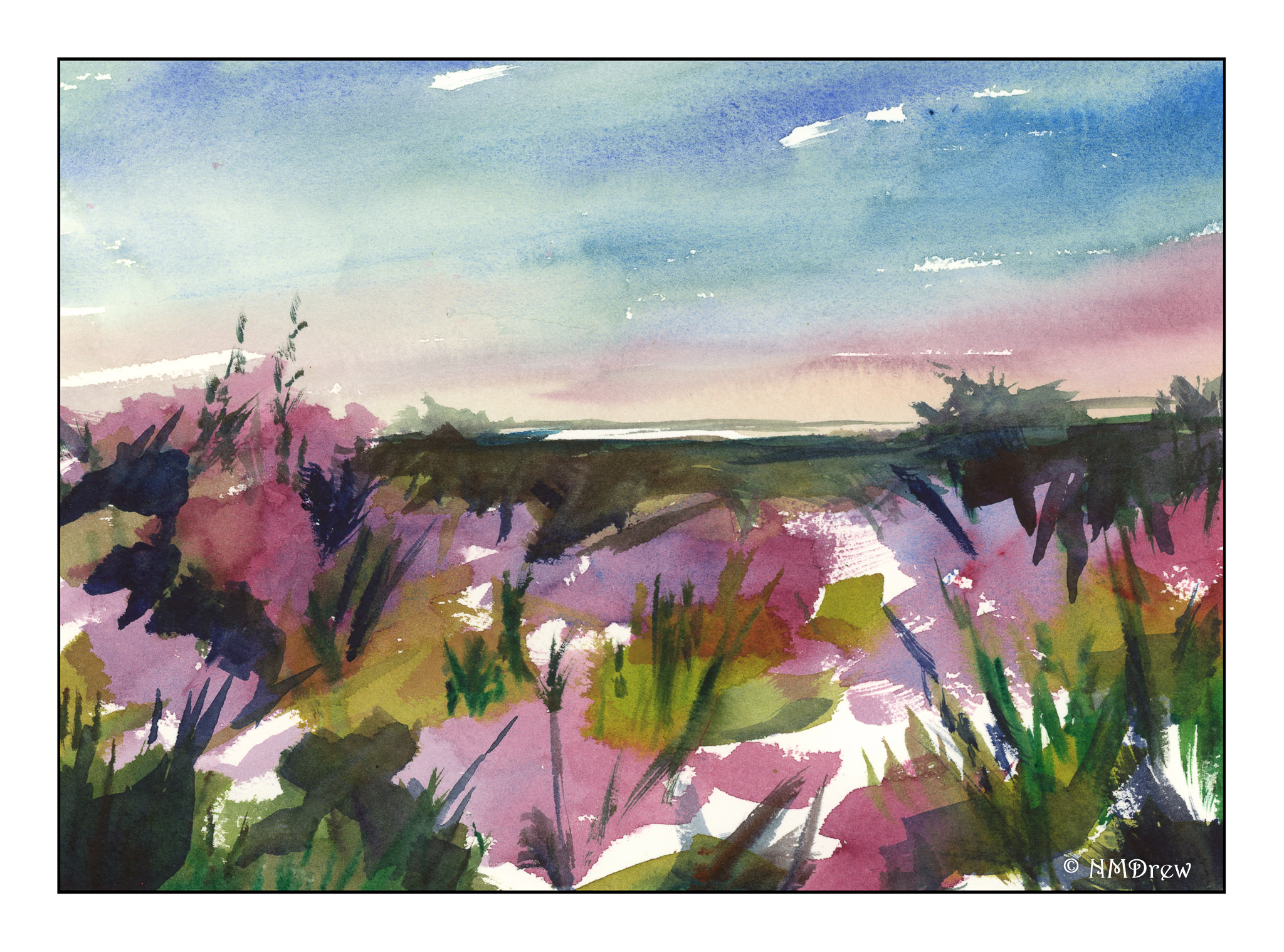
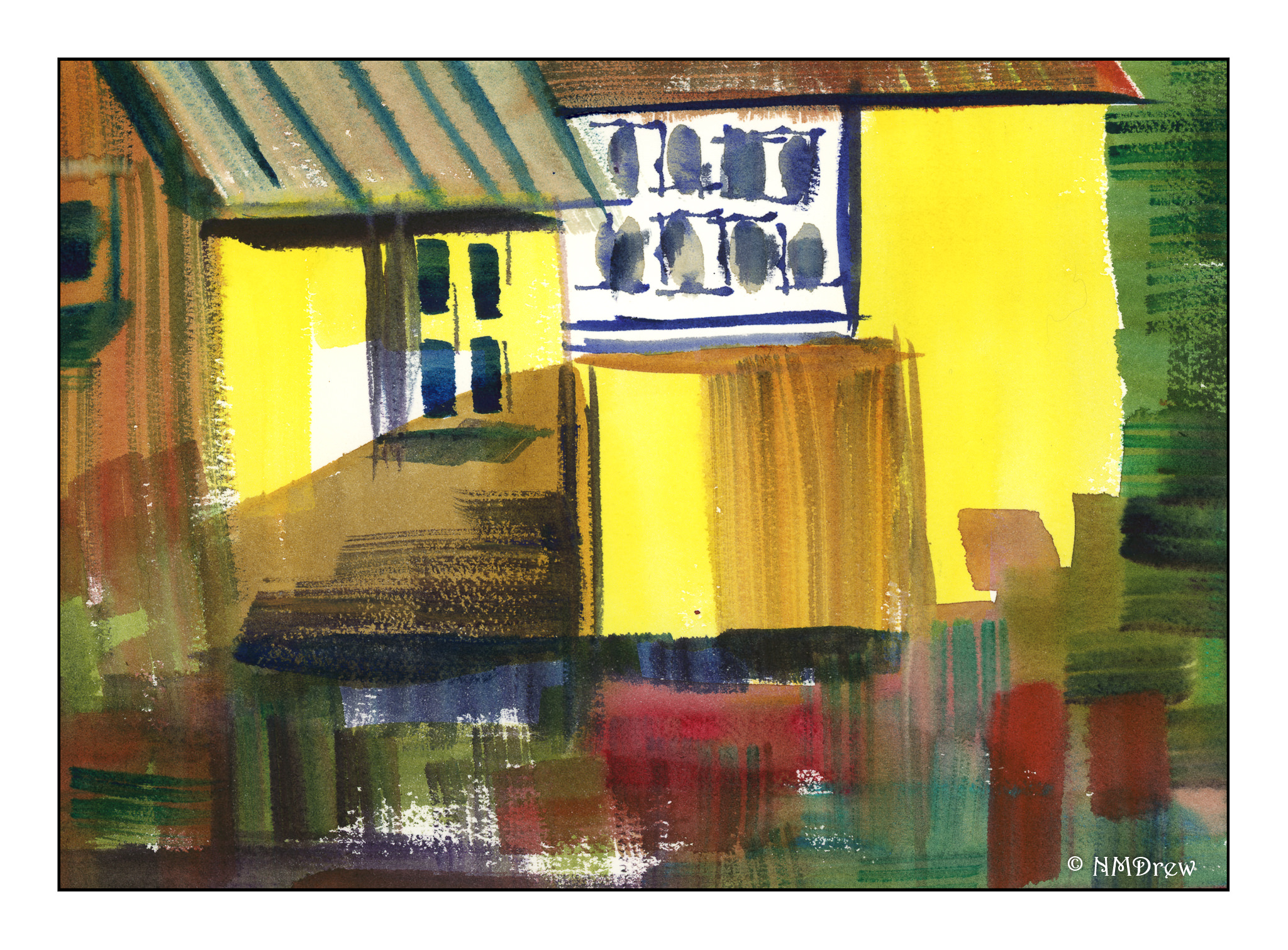
Generally, I tend to paint watercolors without any lines on the paper. I don’t know why, but the lines too often act as a cage, and keep me from just exploring color. I really love the way colors and water react on good paper, and I think the lines make me think I need to produce a “perfect” painting, whatever that is. So, here are some abstractions I did, all in one afternoon, in the order I did them. Comments about each panting are below them. All were painted with a 1/2 inch or 1 inch flat brush.This one I wanted to work on contrast, saving white paper, and creating shapes with the 1/2 inch brush. I was pretty pleased with the results, but the foreground was a bit of a puzzle.The above is an abstraction of heather. The sky doesn’t match the heather. This one I need to re-think.I really like this one – the colors just are so beautiful (to me). I think the abstraction worked to catch trees and snow in the spring, although perhaps I could redo it more simply.Finally, this yellow house has been calling out to me, but a yellow house is not that interesting in and of itself. But, a series of shapes to make a house became the idea after doing all those abstractions before it. Here, a 1 inch brush and a bit of thought. I like this one because it is cheery, has white paper showing through, and is showing me what I can do with pure colors.








 Ink, Yarn & Beer