Iris, iv

Irises – in Color – in Ink

The iris – the butterfly flower – is just too much fun to paint!  And quite a challenge as well.  The videos make it look easy, but I assure you, it is not!  The shape of the flower petals is far more difficult to do in a few squishy movements than it appears.  Loading the brush, with ink and / or pigment, is also a challenge.

Of all the videos, I looked at Virginia Lloyd-Davies’ the most.   The reason for this is that she has multiple irises in different positions.  She also uses similar approaches for each iris, but varies the iris enough so that brush variations also occur.  By watching her video repeatedly, it became possible to actually learn a great deal by imitating.

For these pictures, I used the same paper. The paper is double xuan, which is an absorbent paper which is heavier than student grade, and much nicer as a result.

Iris Scribbles

Unfortunately, I did not take very good pictures, but at least they are clear.  In the picture above, you can see some attempts are better than others.  This picture represents my first attempts at painting irises in color. The ones on the left side were done with the paper turned around – what you see are upside down.  The reddish-purple ones are my first ones, the blue ones later on.  You can see there is some improvement.  As always, my sense of value seems very off to me – not enough contrast between the light and the dark and middle tones. The yellow iris was just awful. The yellow paint has a decidedly greenish cast, and I could not find my white paint (I’m using Marie’s Chinese Paints) – or maybe I’m just out of it.  Anyway, it held no appeal once the color was on the paper.

Colored Irises, i
Colored Irises, ii

These two side-by-side paintings were my tries at creating the irises and attaching them to the stem. Not very good. The colors of the irises are not bad, but the shapes leave a lot to be desired. Leaves as well are unpleasant.

Colored Irises, iii

This painting with the reddish irises is better than the blue ones, as far as some of the shapes of the flowers. Those of you familiar with orchids in Asian painting will realize that these are orchid leaves, not iris leaves! Well, I guess I have some sort of hybrid here.

Sumi Iris, i

Once I got frustrated with color, I got out a Chinese ink stick and ground up some ink. I made three shades – light, medium, dark – and went to work. Again, contrast was an issue, but the flowers, stems, and leaves became a lot nicer. This one was the first attempt which pleased me.

Sumi Iris, ii

The second sumi iris also shows a problem with light / dark, but the composition is pleasing to me.

Sumi Iris, iii

And this one, the third one, pleases me the most. Still some problems with light / dark, but not so badly. The entire flower is looking a lot better, from top to bottom. Certainly some of the irises are rather blobby, and the buds don’t quite make it. Parts of the painting are too busy or crowded, but, over all, I think I am seeing some success. Certainly I plan to continue practicing, and I hope that I will be able to produce a creditable flower.

Leftover Ink

This is what I did to use up the rest of my sumi ink – I hate wasting it!

Corn Stalk
Tiger Lily, i
Tiger Lily, ii

All these paintings were done on Memorial Day. A few others were done as well. As far as the photography, well, let’s just say it sucks and I need to work on it. The paper is a warm cream, and perhaps I should have used a flash. Ah, well, always something new to learn.

Art of Ink, i

Yosa Buson

Now that I’ve pulled out my brush and sumi again, I start rummaging through the drawers of the internet.  I’m not quite sure how I found Yosa Buson, 1716-1784, but I did; I’d forgotten about him.  He was both a poet, and an artist, frequently combining the two.  As a painter in ink, his skills are more than evident in the work below.

Two Black Crows and a Hawk - in Snow and in Rain

Both Crows and Hawk show many techniques that allow expression of the elements in sumi-e.  Snow is painted by going around the flakes – dark ink makes the white flakes fly.  Rain is expressed by using a wide brush, such as a hake, that has been dipped in light / medium ink.  The ink is squeezed out by hand or blotted on towelling, and the bristles squished between the fingertips to create an uneven edge.  Rain is painted in one long sweep; two or three strokes may be all that is needed. These two paintings are very Japanese in approach to working with sumi.

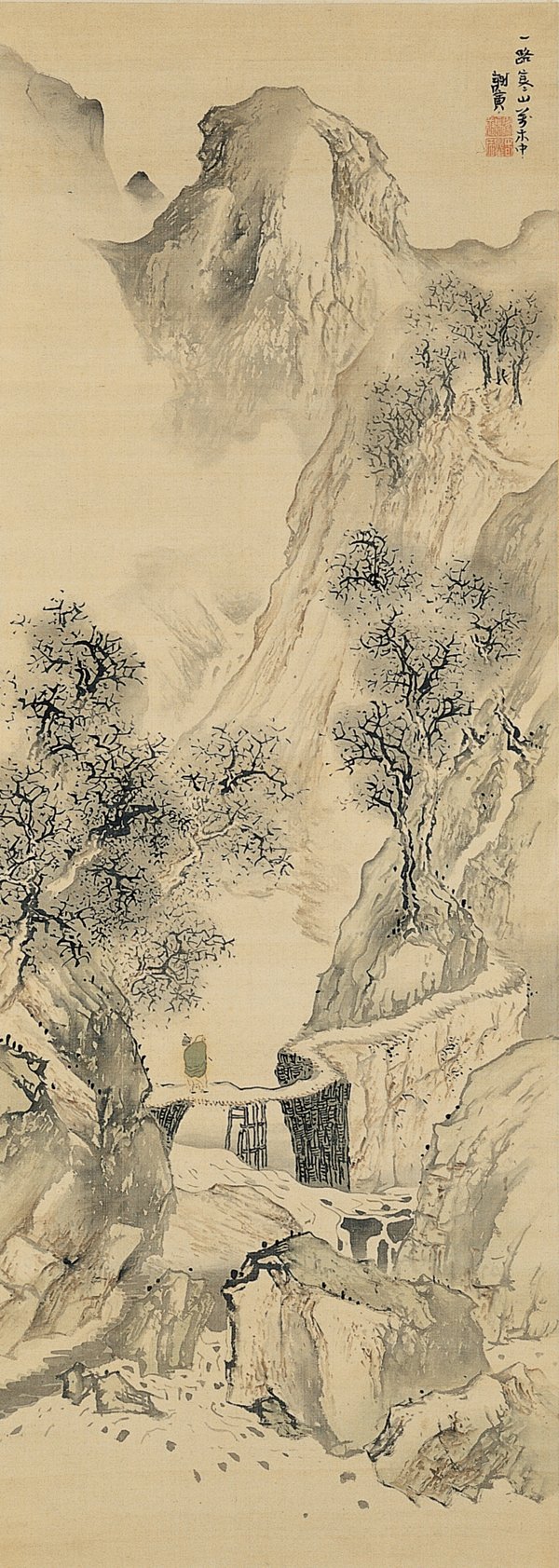
Landscape with Solitary Traveler - 1780

In Landscape with Solitary Traveler, we have a more Chinese approach to ink painting. The theme and constructs are familiar – mountains, water, a path, a bridge, a pedestrian. As in Western painting, Asian painting has its own history and symbolism. The beauty is that these familiar subjects become personal and unique in the hands of the artist. This painting is done in ink, with only a touch of color added to the traveler.

As I mentioned, Buson also wrote traditional Japanese poetry. Here are some translations of his haiku.

coming back—
so many pathways
through the spring grass

in seasonal rain
along a nameless river
fear too has no name

more than last year
I now feel solitude
this autumn twilight

Before the white chrysanthemum
the scissors hesitate

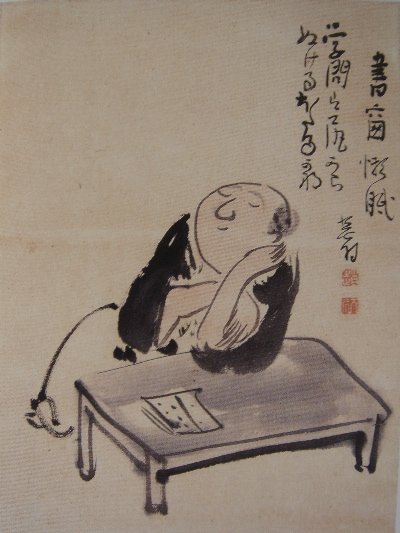
Besides being a master of wash and line (in word and ink), Buson was quite funny. I came across this painting and could not help but laugh. And here, both painting and poetry mingle, albeit not too politely.  Dave Bonta writes about this picture quite well.  Understanding the language – and the humor in the translation – may be read about here.

Bonta translates the writing,

gakumon wa ketsu kara nukeru hotaru kana

as

All this study—
it’s coming out your ass, oh firefly!

Perhaps I should stop while I’m ahead . . .

Iris, iii

I keep thinking about my cochineal dyeing – I still need to write up the rest of it, and post some pictures. Maybe tomorrow when I have more time.

Tonight, though, is painting night. Not a lot of time for it, but in the little time I had, I did some outline drawings of irises. The idea is to get a sense of shape. I drew from some of the photos, and copied some from the Mustard Seed Garden; in fact, I think the best ones were those as the contrast created by the lines was very nice.  My own drawings are quite lacking.  I am so out of practice!

This painting was the first, done early this morning on the same very absorbent paper I used for last night’s wash paintings. You can see just how it sucks up the ink – whoosh! The rest of these are done on tissue thin sulfite paper from Japan, which is much better for line drawings as it is not as quick to wick the ink out of the brush.

All of the above were done from photos. The bottom one was copied from the Mustard Seed Garden – and you can see the refinement compared to my own awkward drawings. Hopefully I’ll get better . . .

Iris, ii

I did my visual research.  I downloaded almost 100 different iris pictures, for color, shape, structure, position.  Too many to post here!  Also copies of famous prints and paintings – Japanese screens, Van Gogh’s fields.  Besides flowers, I also looked at leaves and descriptions.  I pulled out my “how to” books. And, I watched the videos from my last post.

Research

The iris is an impressionistic dream!  It is not a tightly structured flower, but more an explosion of color and shape.  Also, not all irises are bearded, even though there is a similarity of structure amongst the varieties, as far as I can tell.  The color variations are numerous, and vary from subtle to outrageously loud.  The most structured thing about the iris is the leaves, which are a perfect contrast in their simplicity against the frilliness of some of the blooms.

Each video provided some instruction, in shape, in how to move the brush, how to load the color.  Right now I am working in sumi ink alone, so that means grays, whites, blacks, and everything in between.  The paper I am using is a roll, and the paper itself is very absorbent.  This presents a bit of a challenge because the brush has to be very, very dry for control.  And then, waiting for the paper to dry enough to pick up darker lines, but not bleed them away into the already wet paper.

This is what I accomplished this evening.  The main focus of this painting venture was to think about, and to do, the brushwork.  Determining how to manipulate the brush to create given shapes and how to load the ink onto the brush is part of this practice session.  Because the throat of many of the lavender-blue-purple irises have a yellow throat, that pale color has to be represented by white or light grey ink.  Some irises are light on the tips, and darker toward the center.  How the stem attaches to the flower is also important, and deciding how to relay it visually also means deciding what kind of movements need be done with the brush, wrist, and so on.

I’ll stop with that.  Needless to say, the values need to be sorted out at some point!  These are all disasters in that area.

From Sadami Yamada's Book on Flower Painting
Following the Brushwork of Danny Chen's Video
Following Virginia Lloyd-Davies' Brushwork in Her Video

First Attempt Looking at a Photo

Painted from an Upside Down Photo - a la "Drawing from the Right Side of the Brain"

Upside Down Painting Right Side Up!

Painting Day, 03-13-2010

A Bit of Frustration

The other day I pulled out watercolors and paper – you saw the results in my last post.  Yesterday I spent most of the day painting. Suffice it to say that the watercolors were a total disaster – my impatience, as always, got in the way. Or, from another perspective, when it comes to watercolors, the paper is not absorbent like xuan, and as a result, I cannot be as spontaneous and as controlled with the brush at the same time. For me, I think my best results in watercolor come when I am far less impetuous, and thinking more graphically. Happy splattering never occurs for me with sized paper! So, after feeling frustrated (but still in a painting mood) I pulled out my large table of rice paper (12 x 18 inches) and a bottle of Japaneses sumi ink.

Moving from watercolor – wait, patience, think – I messed up a few sheets of the rice paper. My ink was not loaded into the brush, just solid black. My brush choice was poor. My attitude was pretty crappy after a disastrous watercolor experience, and it showed. Still, that energy also started to mellow out – I love the feel of ink and paint on absorbent paper! Finally, a few kinks worked out, I set about to using just the ink itself, and sometimes coupled it with the washes I’d made using my Pelikan pan paints.

Three Out of Four Gentlemen Show Up

To warm up, I used a large, soft brush and a finer, coarse hard brush. I did the plum. The large brush was loaded with a lot of light grey wash, and then the tips were slightly covered in dark black ink.

The next painting was the orchid. For this one I took out a large hard brush and loaded it with ink. This was for the leaves. I then used a medium choryu brush (soft on the outside with hard hair in the center) for the orchid flowers. I used the small hard brush for the orchid centers.

For the bamboo, I took the large, soft brush, again loaded with ink. I used it filled in different ways to get the four stalks. On one of the bamboo, I went in with just a solid wash, and came back later with a darker wash, doing thin strips down the left side. The joints in the bamboo stalks was done with the small, hard brush; I used this same brush for the bamboo leaves.

Palm Trees in Sumi-e

When I looked back over the logs for this blog, I realized with a bit of horror how much time has passed since I received a request for palm trees painted with sumi. I apologize for that, but unfortunately my life got too busy for such endeavors. So, here, at least are some palm trees.

I am not an expert in palm trees, so any mistakes here are my own as far as determining what kind of palm is what. Given that, let’s proceed.

The first thing I always notice about a palm tree is the trunk. Some are smooth, some rough. Coconut palm trees seem to be tall and smooth, with leafier, more graceful fronds. Date palms have thicker trunks with an obvious roughness where palm fronds have fallen off. The fronds tend to be stiffer and less flexible than those of the coconut palm. What they do have in common, though, is the way in which the serrated areas of the frond meet at the center. This gives a clear line in the middle which seems to have a space between it and the serrated areas. If you look at pictures of palm trees, you will see what I mean. To paint them means leaving that gap there, or using a very fine line to connect to it, and then using a steady sweep of the brush, much like you would do with an orchid leave. Pushing down on the brush – smooshing it – creates the wrong impression of the frond. However, you can turn the brush and create bent areas – palm fronds are pretty messy. A hard, dry brush is really good for expressing the ragged edges of some of the serrated “leaves” in the frond.

This is a palm frond, done first to consider how to do the structure of the frond itself. I used some of the colors from my pan paints as well, mixing it with different dilutions of ink.

This next one is from a picture of a coconut palm. The trunk was done with my choryu brush, loaded with a light and medium ink, and tipped in black. I laid the brush sideways, and did a quick stroke for the entire trunk. I then came in with the small, hard brush for the texture found at the base of the trunk and into the trunk itself. I used the choryu brush for the center lines of the fronds and for some of the paler frond leaves. I used my large, hard brush for the darker dry brush fronds. Before dipping it into the ink, I spread out the bristles, and then dipped only the ends into the ink, keeping the brush perpendicular to the ink. I painted the frond leaves the same way, using a quick flick while doing the best to avoid any pause on the paper. As the brush lost its load of ink, this became easier.

The next palm is a date palm. Its trunk is considerably coarser than that of the coconut palm, and its fronds are stiffer and messier. They were all over the ground around the palm tree in the photo I used as a reference. To paint the trunk I used dabs of medium ink, and then began using various loading combinations of light / medium / dark. I ended with the hard brush and undiluted dark ink. For the fronds, I used much the same approach as I did with the coconut palm, but worked to make sure I caught the more upright and clustered qualities of the fronds, as well as the shorter leaves along the frond itself.

Maple Trees with Chinese Paints

With all my washes from the watercolor painting excursion exhausted, but still in a mood to paint, I found a picture of some maple trees in Vermont, brilliant in their autumn foliage. I used the bottled sumi ink for the trunks, and then used yellow, orange, and red from my box of Marie’s Chinese colors. You can see how opaque they are in comparison to the Pelikan paints. I diluted the colors in some areas, mixed them together, smooshed them around. Other areas will show you the individual colors as dabs. Different layers from red-to-yellow can be found, as well as orange or yellow or red on top of everything else.

Altogether, I had a fun day painting. The best paintings are those done in sumi-e. I really like the palm trees and the frond, more so than the orchid, bamboo, or plum. The texture of the plum trunk was enjoyable to do, but the blossoms are too blotchy – you can see where the paint plopped down and spread. I must admit, too, that I find pictures I have done with Marie’s paints never satisfy me – the colors are too garish. I do know, though, that Teacher does lovely stuff with them, and when I work hard at it, I can produce paintings which appeal to me.

My own approach to sumi-e and Chinese painting is certainly influenced by being trained in Western art. I find my best connection is with sumi ink, brush, and paper, and feel it is closest to my own personality. Still, the mastery of watercolor is one of those lifetime goals, and for me, my best results are when I employ patience and thought, which is very different than immediate results of sumi painting.