Copying the Master(s) and Stealing (Their) Secrets

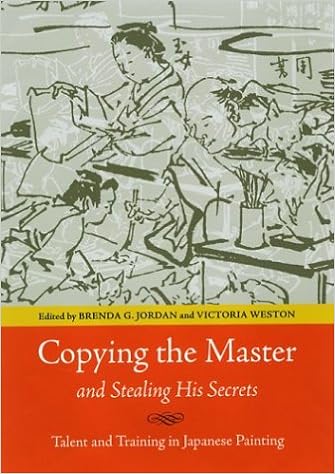
This book remains a favorite of mine, in part because of the history behind art apprenticeships, but also because it serves to remind that in all arts, a period of apprenticeship – with or without a teacher – is needed to gain mastery.  As I struggle with watercolor, I remember how I struggled when I was working with sumi ink.  In sumi-e, the brushes, ink, and paper are enough to make you scream.  Watercolor is perhaps worse!

What makes watercolor difficult?  For me, it is always a matter of less being more.  With colors, I am a magpie – all those colors!  I am hard-pressed to use only a few.  With sumi-e, you have one color:  black.  And shades of grey (50 if you want).  Another struggle is to not create mud.  I seem to be moving away from that.  And finally, lines.  I like lines.  However, I want to paint without lines . . . sort of like giving up training wheels on a bicycle.

At some point, I expect I will be able to master watercolor far more than I am now, but it is a long, hard haul.  And, I admit, one I am not very happy doing.  I wasn’t happy with the struggles with sumi-e, either.

Finding a master is not something easily done in this day and age.  Rather than being apprenticed to learn a skill or craft from a master, many of us go to school.  I am way past spending 4 years or more in college – I am an old workhorse – so I learn by observation.  This means finding an artist I admire and trying to copy his / her work, as well as subscribing to numerous YouTube videos.  I also have to learn by doing, which is the most challenging part.  A part of me expects to be perfect, and my temper flares when I feel frustrated.  That is when it is time for the proverbial deep breath, retreat, regroup, refocus, retry.  Patience is also taught with such apprenticeships!

Thus, in cruising the internet, yes, I do “steal” from the master.  In “stealing,” I learn about color and composition, light and dark, contrast.  I do not ever intend to pass someone’s work off as my own – that is not right.  But, if you go to a museum, you will find people sketching the work of a master.  Why?  To learn.  The best learning is by doing.

Various painters come to mind whose work I enjoy; when I find someone whose work I admire, I like to look at their paintings and try to figure out how they did it, the order it was done, and the colors used.  By copying I learn about color mixing and how to create an image that (might) work.  Every artist is unique, and each has something to offer.  There is a lot to learn from out there, and I am humbled by the talent I see.  And I learn when I copy from the masters.
Brushwork and Value in Watercolor

Watercolor Brush Strokes a la Sumi-e


Having been doing sumi-e with some regularity for several years, I am finding it helpful in watercolor. Because the brush is the vehicle for watercolor, as it is in sumi-e, it is important to understand how the brush works.

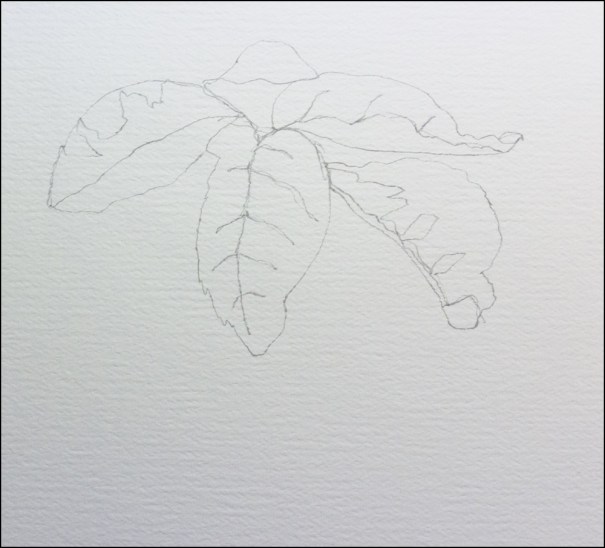
Pencil Outline

Kolinsky sable watercolor brushes can be considerably stiffer than the white-haired sheep brush used in sumi-e, but much more flexible than the wolf and horse brushes, which have darker, more stiff bristles. Basically, a western watercolor brush combines both qualities in one brush, but this does not mean that it is the same at all! A good point is important for a Kolinsky round (I am using DaVinci Maestro Series 10s and Escoda Series 1212) just as it is with sumi-e brushes, as is the ability to carry water and color.

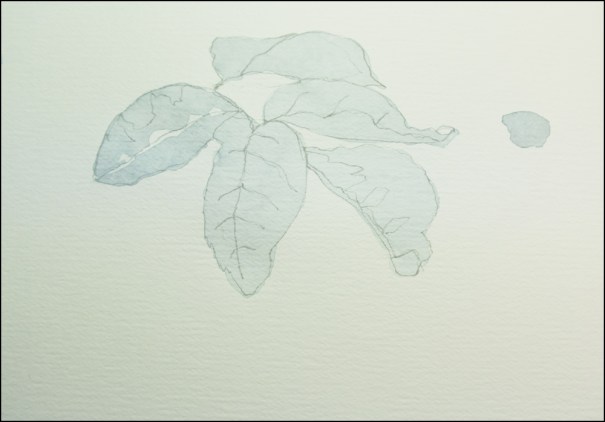
Layer 1

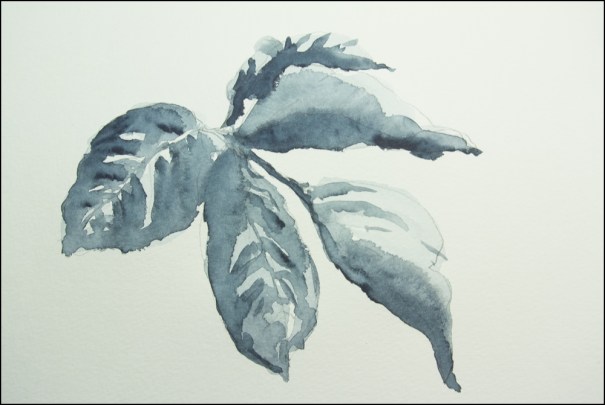
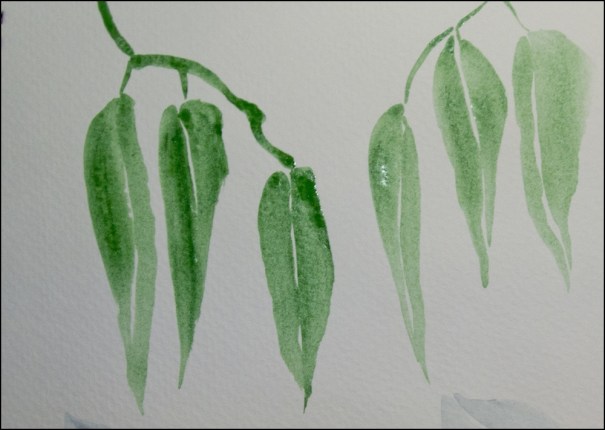
Many of the same techniques used in sumi-e can be applied to watercolor. These include brush strokes, such as increasing and decreasing pressure to change line thickness. Two or more colors may be applied to a brush, as in sumi-e when different ink intensities are applied. In Western watercolor, a brush stroke may be modified, working wet-into-wet, wet-into-dry, dry-into-wet, and glazing or layering colors. This does not work well in sumi-e, unless one is doing fine line Chinese painting.

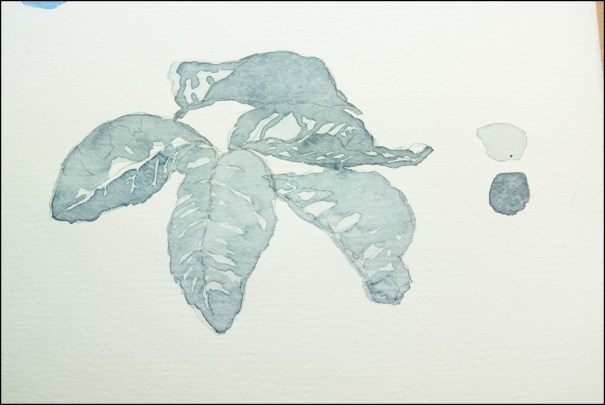
Layer 2

The major differences between sumi-e and western watercolor are responsiveness of paper. Japanese and Chinese painting papers are generally much more porous than traditional Western watercolor papers. Heavily sized Asian papers are used for fine line painting, where color layers are used, and bleeding of ink, so characteristic in sumi-e, does not occur. Western watercolor papers will vary in the amount of sizing used, and this, in turn, affects the absorbent qualities of the paper. Knowing how a paper responds takes time and practice, whether in Asian painting, or Western.

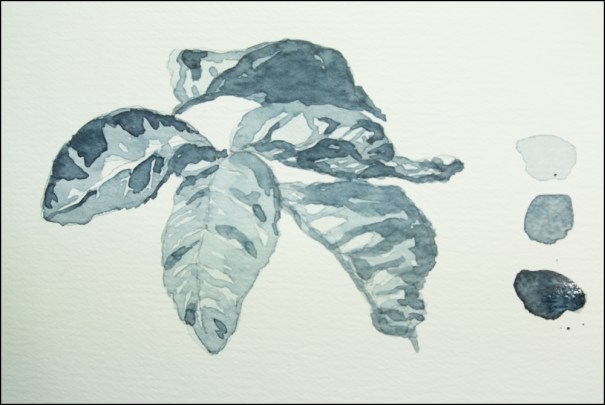
Layer 3

Value in sumi-e is achieved in how the brush is loaded. Ink can be very pale, and while it is still damp, darker ink may be applied to good effect. A sumi brush can also be loaded with pale ink, then a medium ink, and finally a tip or dark, or even one edge of the brush in dark ink. The stroke of the brush creates all the gradations. In watercolor, value is achieved by layering, as well as working wet-into-wet. Layering, also known as glazing, is the application of wet paint on a previously painted layer which has dried. Glazes are also built up light to dark. Wet-into-wet can be sopping wet, or in varying degrees of dampness.  In some ways, wet-into-wet requires more self-discipline than glazing, which requires patience and forethought.

Wet-into-Wet

Each painting technique, sumi-e and watercolor, have similar techniques, as well as some which are exclusive to that medium. The key is to learn from both, and to master each.

All these paintings were based on demonstrations from Linda Stevens Moyer’s book LIght Up Your Watercolors Layer by Layer.

Sumi-e Studies

After the trip to the Descanso Gardens, and the Gardens of the World, I finally got out some ink, paper, and brushes.  The camellias in bloom everywhere in the Descanso Gardens, and the rows of magnolias in the Gardens of the world, pushed it.  Seeing something that I have practiced painting before, in abundance, was an amazing inspiration.  So much beauty!  It is much different to paint something, practice something, and become familiar with it in one form – and then to re-experience it in another form.

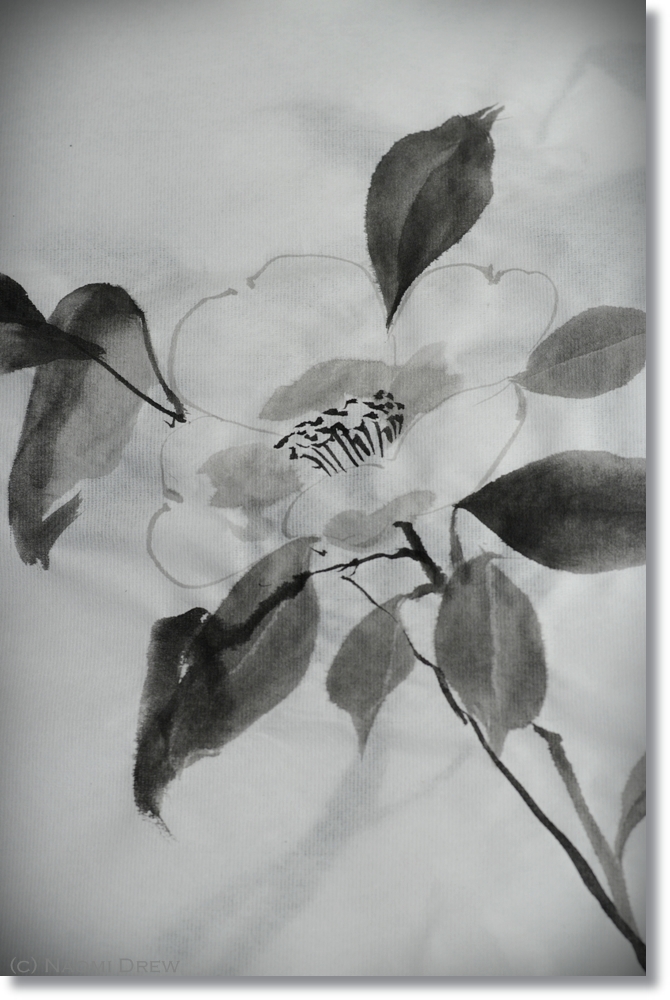
I chose to focus on the camellia, or tsubaki.  There is a lovely painting demonstration by Kazu Shimura, as well as other images in sumi-e throughout the web if you google.  Photographs help, too, ones you might take or you might find.

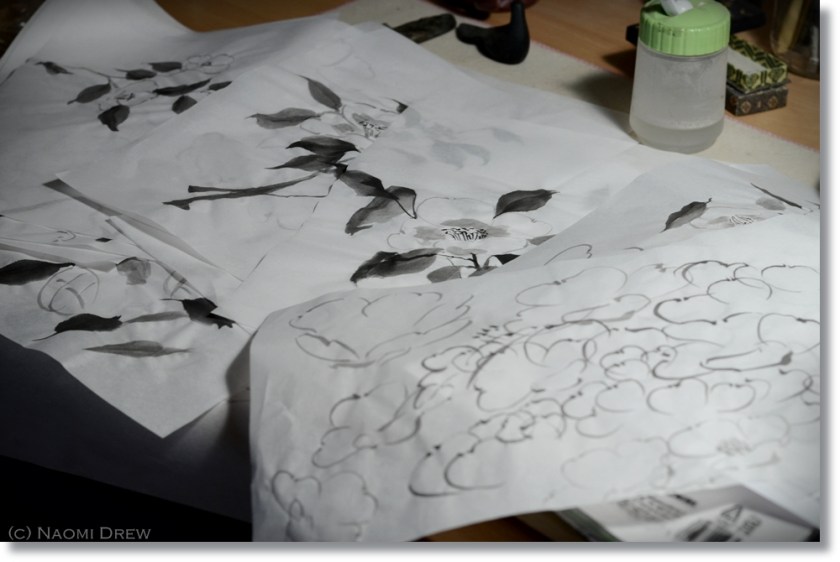
The petals have a light ruffled edge, the center stamens and pistils point outward. Blossoms vary from a few petals – as seen in Shimura’s paintings – to multiple layers.  The leaves vary in shape, but in general are long and round and end in a point.  The edges of the flowers are hard to do gracefully, for me at least.  The leaves are easier.  I spent several hours just practicing the outline of the petals.

Yesterday at a local garden supply store, there were camellia bushes for sale.  I may just buy one for more up close studies as this is the season of bud and flower and leaf.