Film

Lately I am shooting a lot of film.  Hopefully I will be processing some once I master the Lab-Box, first in black and white, and then later in color if I find the frustration level not frustrating!

Anyway, here are a few pictures taken with my N90s and 60mm macro lens, which I dropped, but do not seem to have damaged either.  The film here is Fuji Pro 400H, which is great for color.

If you take a look at the camera in the pictures above, you will see it is a Contax IIIa ca. 1953. It has a rather amazing lens, a Zeiss-Opton Sonnar 50mm f1.5. It’s sharp and lovely when I nail it. Being a rangefinder and a new-to-me camera, I am still learning to “get” the focus. The following images were taken using the camera along with Fuji Super 200. Some pictures I did with the Sunny 16 rule, a light meter, or the suggestions from the camera’s readout.

Editing film certainly beats breathing smoke and listening to sirens!

B&W Film and an Orange 21 Filter

I have shot B&W film with a red filter, and a light yellow filter and have been pleased with the results.  Recently I used an Orange 21 filter and got mixed results.  The equipment was an OM-1n and Ilford FP4+ 125 asa film.  The lens is a 50mm f3.5 Zuiko macro lens.  I shot the film at 100 asa, but my battery was dead, so I did the Sunny 16 rule, and hoped  that doing settings I think would work without a filter would be adequate.  I did well with the yellow and red filters, but not so well with the orange.  Admittedly, I still don’t “get” filters – I really need to study them in greater detail – but you (and I) can read about them here.  And you can, of course, google all about them!

I take my film to a local lab to be processed, whether color, slide, or silver-based black and white.  They do a fairly good job.  I can have film pushed if I want it, too.  I scan the film myself, whether 135 or 120, using either a Pakon scanner or my V600.  The results are decent.  I clean things up in LR or another program, depending on what I want.  Sometimes I do more in post, such as noise reduction, vignetting, etc.

The Ilford FP4+ is considered to be an excellent film.  When I scanned the pictures, they ended up with a rather reddish brown cast – was that the scanner, the processing, or the orange filter?  You can see the totally unretouched photos below.

I am not really pleased with any of the above photos.  The orange filter turned the red rose the same shade as the leaves.  Contrast of light and dark disappeared.  I plan to shoot another roll of FP4+, without a filter, to truly assess my like or dislike of this film.

Post-processing can change an image immensely.  Noise can disappear, dust and threads on the film can be eliminated, and contrast and exposure adjusted.  I do these digitally, just as you could do in a regular film dark room.  Here are some of the images I could clean up – and some needed a heck of a lot of work, let me tell you!

I even managed to one into a color picture using preset in On1 Photo Raw 2019!

Crazy stuff!  It will be interesting to try to reproduce this colored picture sometime in the future.  Meanwhile, back to the film cameras!


Whaler’s Cove with a 1937 Welta Weltur

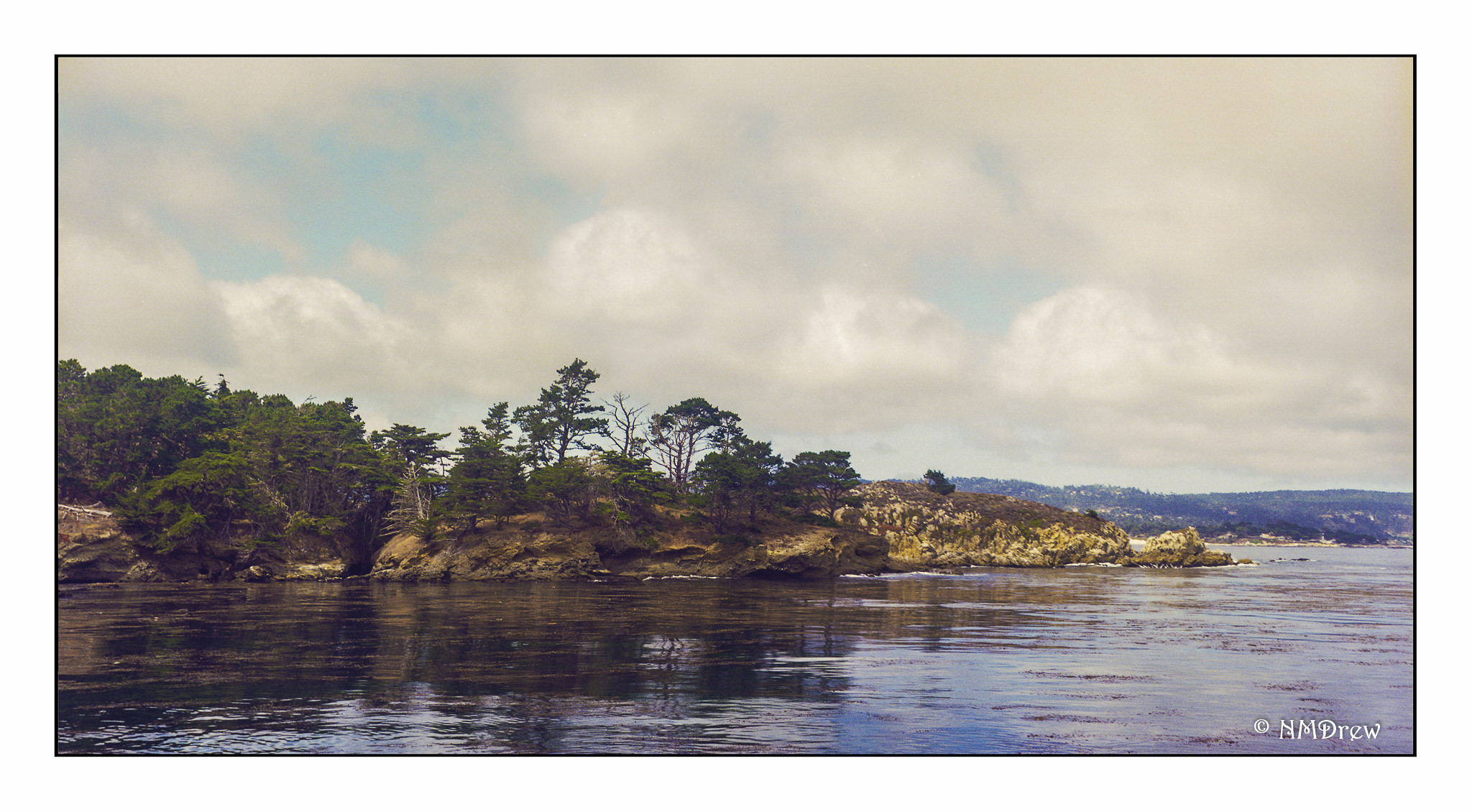
There is something so different in the quality of a photo taken with a film camera, rather than a digital camera.  It is apparent even more so when it is done with an uncoated lens from 1937.  The lens in question is a lovely Schneider Kreuznach Xenar 2.8, 75mm, taken using 1937 Welta Weltur camera.  It is a folding camera that takes the still-available 120mm film.  I used Ektar 100 by Kodak, and applied the Sunny 16 rule for manual exposures.

I have a 6×6 version with a 6×4.5 reduction mask.  I thought I had removed the mask – but hadn’t.  All my supposedly square images came out rectangular!  I stitched two images together in PS6 and then tediously removed threads and dots of dust that were apparent even after scanning with Digital Ice on the Epson V600.

This photo makes me think of landscape paintings of the 1700s and 1800s – especially that turquoise sky.  Mayhap a painting will follow.

A Sunny Day in the Garden

A few miles up the road from me is the local botanical garden.  It’s located on a series of hills that cover several acres.  Trails wander through oak groves and chaparral.  Specific areas are planted for butterflies and birds, sage plants, California natives, rare fruit, cacti.  It’s always a pleasure to meander around in it as it changes with seasons.  Different times of day bring out different animals; as well, the light shifts and changes.  Early morning, sunset, high noon.  Benches  line the paths throughout the garden.  For a wilder walk, there are the trails along the creek.  I’ve seen squirrels, road runners, coyotes and hawks.  Critters like it as much as I do.  It’s even better when you are the only one there except the wildlife!
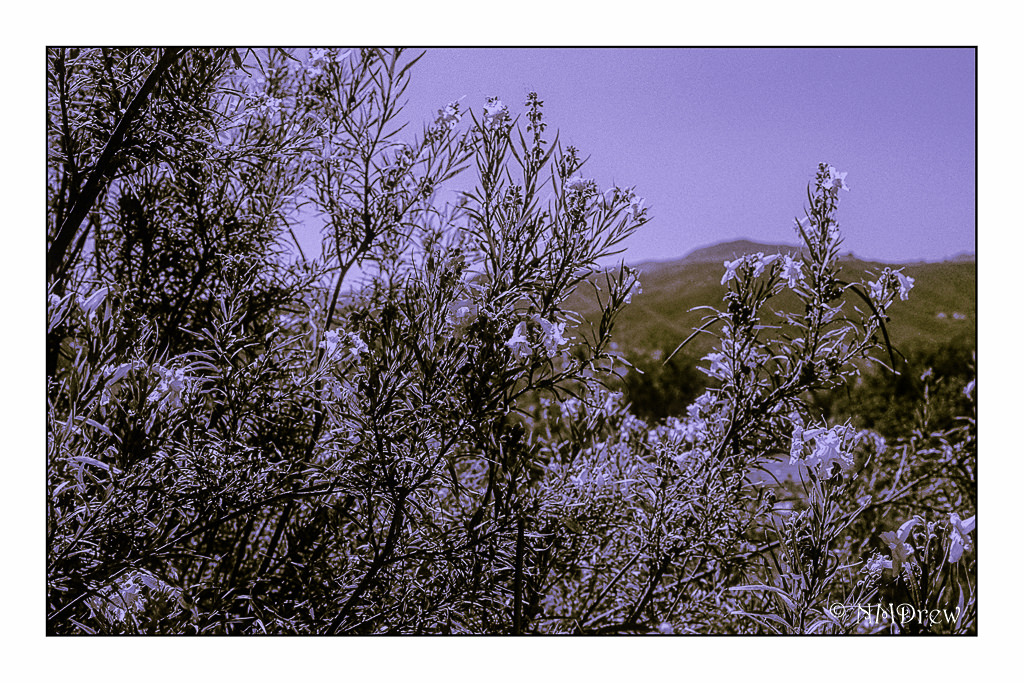
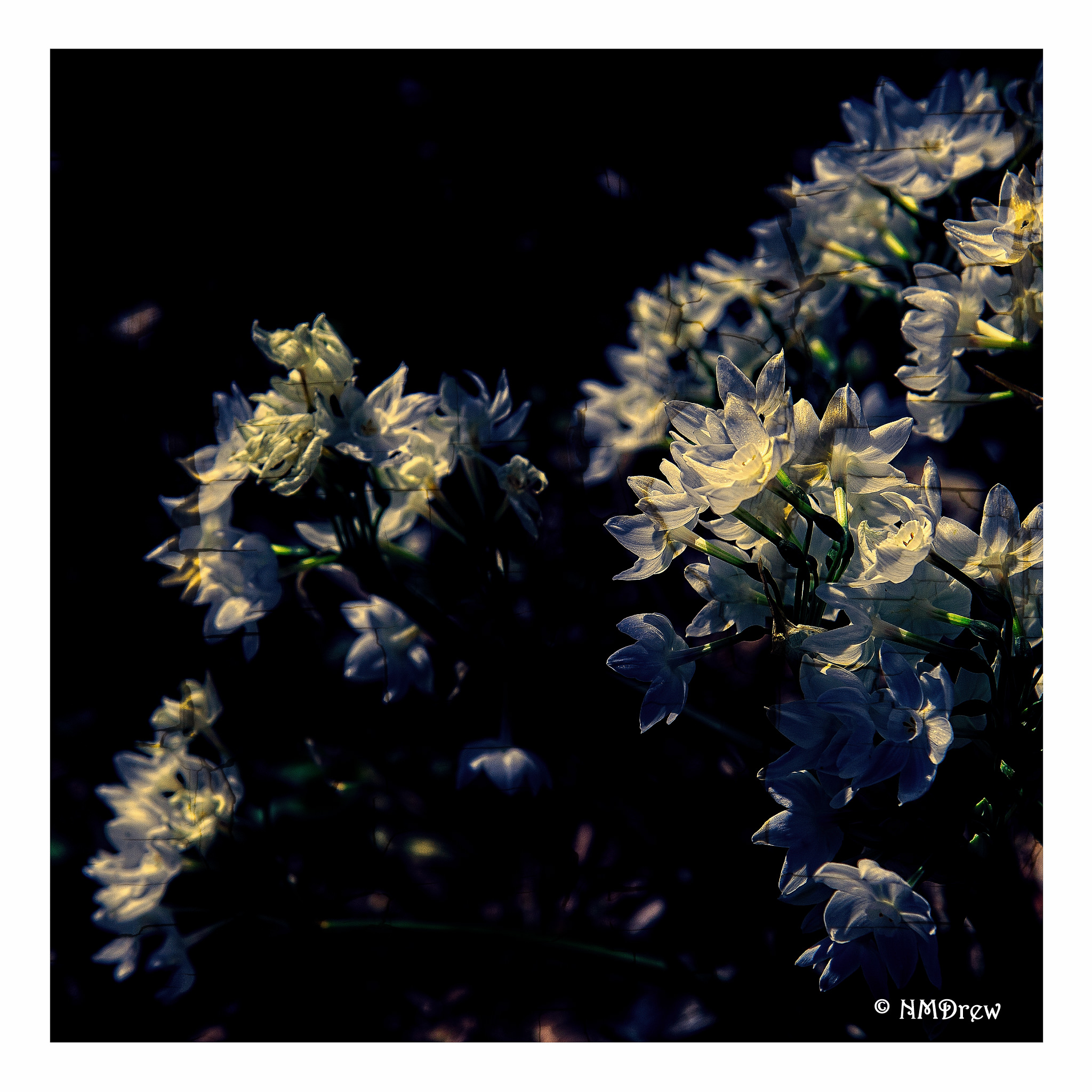
I went out to take pictures and to draw – it’s been several weeks since I was last there.  Rain and cold as well as being ill kept me home for a bit.  With today’s 70 F, it was hard to stay indoors.  I took a couple of cameras – one film, one digital – some paper and a pen.  I wanted to see the flowers in particular, especially the spring bulbs which come up at this time of year.  I wasn’t disappointed.The outing was soul-satisfying on a personal and artistic level. I’ll be back sooner rather than later!  There is little more satisfying than time spent in solitary and quiet appreciation of nature.
The Southwest in Black & White

The last few days of July 2017 and the first few weeks of August 2017 were devoted to a family trip, leaving California and thence traveling through Arizona, Colorado, Wyoming, Utah, Nevada, and home.  In that time period we covered about 4000 miles, spending 2-3 days in each place.  There were four of us – my husband’s parents, my husband, and myself.  It was a family trip, to see places never before seen, as well as to see places where family ancestors lived and worked – specifically, Ft. Laramie, Wyoming.

On this trip, there were two photographers – my FIL and myself.  Tom has a Nikon D810 and D610; he brought the D610 along and shot numerous images, which I hope to see soon!  Myself, I brought along more toys than I should confess to, but enjoyed using all of them.  In particular, I brought along a new-to-me Olympus OM-1n, an OM 50mm f1.8 MC, and the OM 35-70mm f3.5-4.5.  Each has a 49mm diameter, so I also brought along UV, polarizing, orange and red filters, and used the latter two to see how JCH StreetPan 400 would work as landscape film.

It was gorgeous!  Combined with the Oly, I was incredibly pleased.  StreetPan comes in both 35mm and 120mm, so a lot of people will be really happy.

What I like about the StreetPan is that it is contrasty, yet has a good, long grey scale.  The orange and red filters helped to make the skies pop, and the landscape.  I didn’t have to do too much in post, perhaps modifying highlights and blacks to meet my own (artistic?) desires.  Detail was good, too.

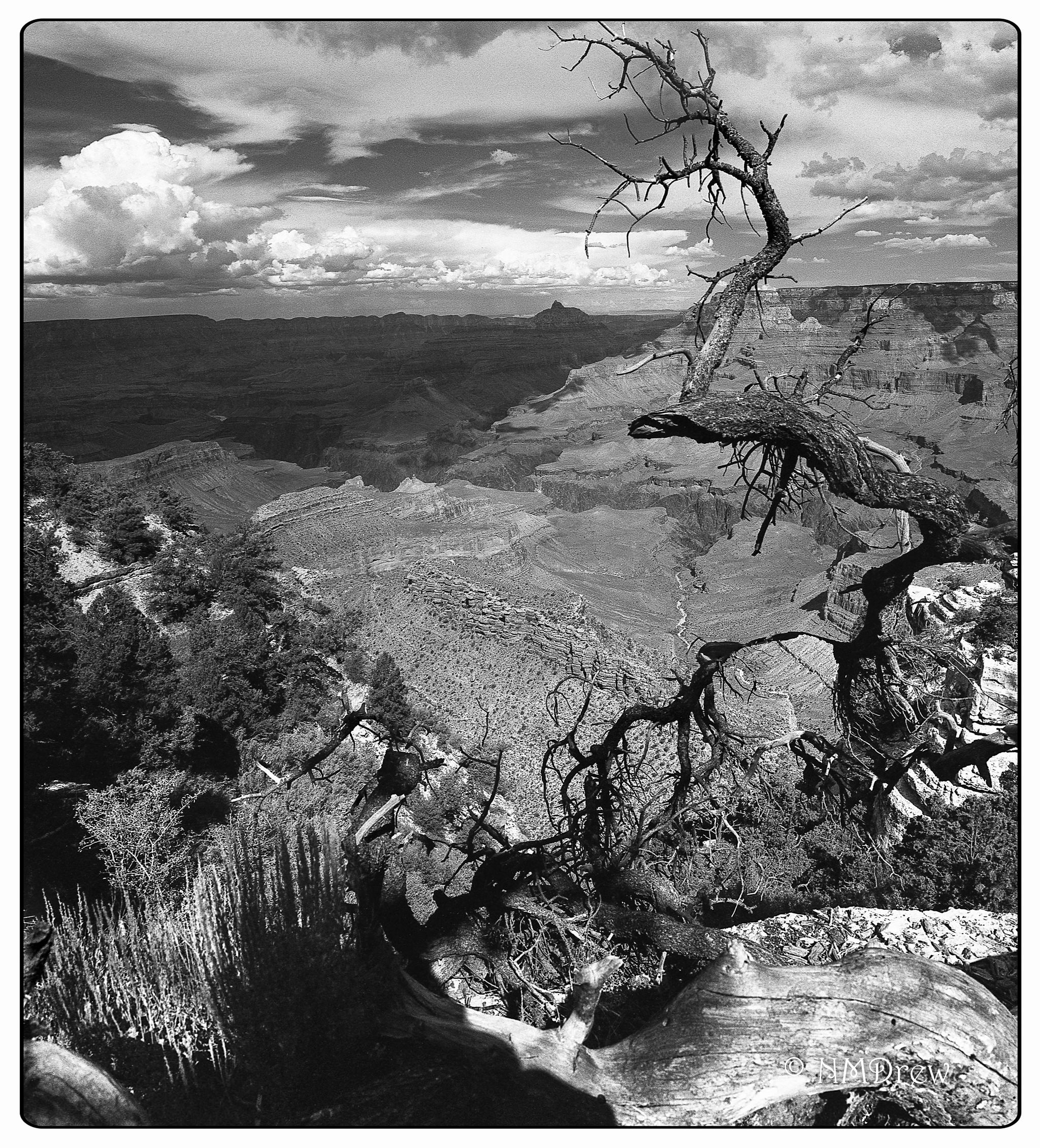
The image at the top is a panorama I stitched together in CS6; below are individual images which can give you a good idea about the beauty of this film for landscape.  These scenes were shot in the Mesa Verde National Park and the Grand Canyon National Park, both in Arizona.


Too often, black and white landscapes don’t interest me, and the reason is the difficulty in differentiating small details.  Dramatic landscapes don’t have to look dramatic, but they need something to make them dramatic.  This can mean contrast, composition, and a number of other elements.  In all honesty, I do not consider myself to be a good black-and-white photographer simply because I find it difficult to think in terms of value.  I see color before I see anything else, and certainly my gaudy photos show this tendency.  Therefore, using the filters and an already contrasty film produced a number of photos that pleased me no end.  This experience is whetting my appetite for more!