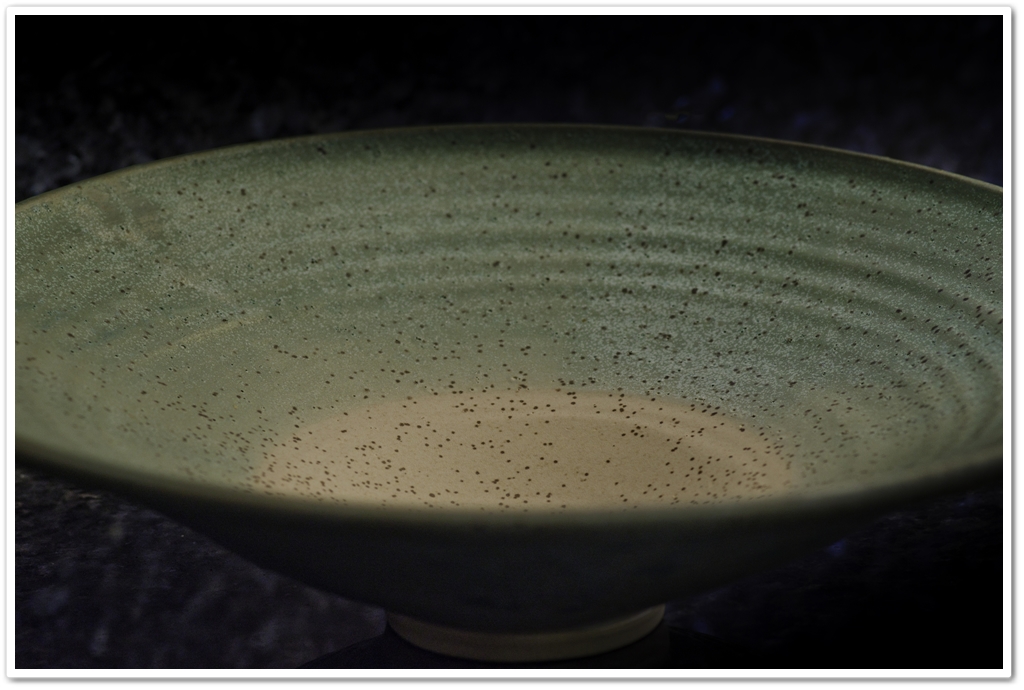
Yesterday a friend who is a potter came over. I’ve only known her a short time, but she is one of those people you like the minute you meet, and like even more as time goes by. She brought some of her work to show me. For some reason the term “organic” is the only way I can describe her pottery – it is earthy and elegant at the same time, and seems to be perfect for the clay. I liked what I saw.
The point of the visit was sort of show-and-tell. You show me yours, I’ll show you mine. She wanted to learn about sumi-e and brush work so she can apply it to her pottery. For me, this was a much-needed diversion from the technology of photography and post-processing software. It also motivated me to dig out a rather large supply of brushes I have from Japan, bought for resale. And it reminded me of just how peaceful it is to ink up a stone, and take the time to do something with my hands other than pushing around a mouse, doing dishes, or whatever.
She is a lefty. The movements I find difficult are easy for her, and vice versa. Together, we went through a bit of paper, tried out different brushes, and have agreed to do some more of this. She left with a stone and ink, a mosen, and a package of sulphite paper. I got a bowl and the reminder to move away from the computer. Maybe I will make some pottery with her at some time.
Some people learn things as they go along, living life on a daily basis and incorporating the new stuff without the disruption of everything else. Not me. When I am curious about something, I jump headlong with both feet. This has its good points and bad points, the worst being it can become obsession – luckily, it never does. The thing is, I am a collector. I collect information. I collect things. And I don’t usually get rid of stuff, either in my mind (though I will as senility approaches), in my closet, under my bed, or in the garage. Granted, when I return to that interest, costs are very insignificant!
Lately, in case you have not noticed, I have been doing a lot of photography, to the point I decided to set up a blog separate from Ink, Yarn & Beer. Here, I really want to get back into more personal things, such as the painting and knitting design, as well as just discussions or whatever I fancy. At that other blog I can focus on photography and what I am doing there, create my little encyclopedia of links, blither on about what I am doing. I’ve gotten a few hits there, mostly spam, but that blog, like this one, is for my own pleasure. And to create balance.
My artistic side finds photography rather frustrating, but I am beginning to see how it is tweaking me at the same time. Thinking about how something is made – effects, colors, process – begin to move into other areas. Looking at the petals of a rose make me wonder how I can capture them with a brush using ink or watercolor. Looking at the light shadows in an image make me consider contrast and detail in a painting and why something in a painting works, or does not. Realism does not need to be done, but the impact created by color, shadow, tone, shape gives an illusion of reality or its impression.
The fact is, any form of art is limited only by the person doing it. This can because of a lack of tools or innovation, or because one is still in the process of becoming or doing. I am limited by my interests in a lot of things – painting, knitting, reading, writing, photography, gardening, hiking, traveling – and it keeps me from doing anything well. On Outlook I have different activities scheduled weekly – creative activities – and that doesn’t help either! Regardless, the plan is to try to do a bit more of all of it, and be focused on it when I can.
I love color. Lots of color. The fact is, it is extremely difficult for me to buy things that, to me, do not have color. That means beige, white, and black. A Japanese kimono full of vibrant colors is far more interesting than the serenity of monochrome; Hawaiian shirts hold endless attraction. Prints intrigue me far more than a brilliant, single color.
Child's Kimono
Because color is so attractive, the absence of color in a painting – such as in sumi-e – and in photography – become endlessly fascinating in the variations of black-grey-white. Color reduction, meaning decolorization, can be done in various photo editing software programs. This pushes the photograph to near monochrome, but with an essence of color. The same may be done in an ink painting. Both become intriguing as the color draws the eye, but because of the lack of color elsewhere, it also becomes a messenger, speaking to the viewer on a symbolic level. Or, it can simply become an attractive element essential to a composition.
Electric Snowflakes
In sumi-e, there is a challenge in gradation and contrast. This is managed by both how the brush is loaded as well as forethought and knowledge as to how dark something will dry – or, more challenging – how light. Understanding the paper being used, the qualities of the ink stick, the subtleties of the brush become an art in themselves, all of which lead to the success or failure of the final painting.
Wheat in Sumi
In photography I am finding much the same challenge. In playing with software, such as Corel Paintshop Photo Pro X3 and Photoscape, I can take a colored photograph and either decolor it, separate it into multiple pre-press layers, or simply change it to a grey-scale image. Red flowers which look awful in color can become quite fascinating when rendered into black and white.
Red Rhododendrons - BW Rhododendrons
Composition also plays into photography, as much as it does in painting. Because one is physically doing a painting, I think that the elements of composition have time to unfold, and the unconscious works toward the final result long before the concept is visible to the artist. It is a slower process altogether.
The very nature of photography lends itself – especially with digital – to taking picture after picture after picture. Only now am I considering more carefully my compositions. Knowing I can crop and edit in software, as well as the fact I don’t have to pay for printing, lets me shoot all over, all and everything. This lets me play. Play is creative, fun, and educational. Happenstance leads to analysis in looking at photographs, which leads to thought about all the elements which come together, as they do in painting, to create the final image: light, subject, color, direction, contrast. As a result, I am developing the skills which permit me to think ahead a bit; these are the same skills, conscious or not, which I apply to a painting.
Fallen
I am finding that my preferences in photography echo those I have for paintings. Simplicity and contrast. Less is more. Whether or not I succeed is up for question.
Now that I’ve pulled out my brush and sumi again, I start rummaging through the drawers of the internet. I’m not quite sure how I found Yosa Buson, 1716-1784, but I did; I’d forgotten about him. He was both a poet, and an artist, frequently combining the two. As a painter in ink, his skills are more than evident in the work below.
Two Black Crows and a Hawk - in Snow and in Rain
Both Crows and Hawk show many techniques that allow expression of the elements in sumi-e. Snow is painted by going around the flakes – dark ink makes the white flakes fly. Rain is expressed by using a wide brush, such as a hake, that has been dipped in light / medium ink. The ink is squeezed out by hand or blotted on towelling, and the bristles squished between the fingertips to create an uneven edge. Rain is painted in one long sweep; two or three strokes may be all that is needed. These two paintings are very Japanese in approach to working with sumi.
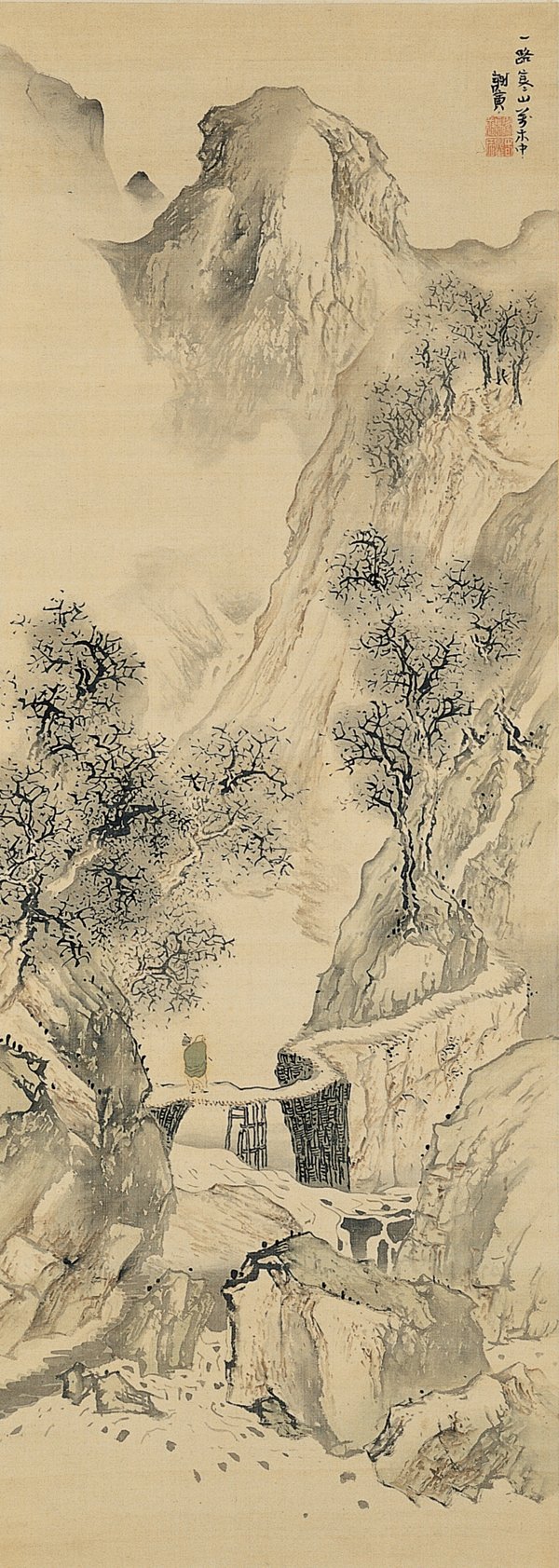
Landscape with Solitary Traveler - 1780
In Landscape with Solitary Traveler, we have a more Chinese approach to ink painting. The theme and constructs are familiar – mountains, water, a path, a bridge, a pedestrian. As in Western painting, Asian painting has its own history and symbolism. The beauty is that these familiar subjects become personal and unique in the hands of the artist. This painting is done in ink, with only a touch of color added to the traveler.
As I mentioned, Buson also wrote traditional Japanese poetry. Here are some translations of his haiku.
coming back—
so many pathways
through the spring grass
in seasonal rain
along a nameless river
fear too has no name
more than last year
I now feel solitude
this autumn twilight
Before the white chrysanthemum
the scissors hesitate
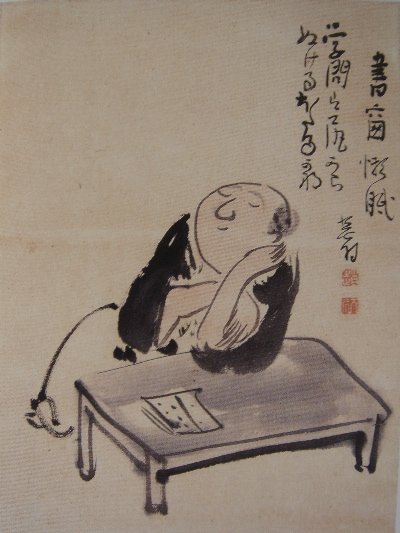
Besides being a master of wash and line (in word and ink), Buson was quite funny. I came across this painting and could not help but laugh. And here, both painting and poetry mingle, albeit not too politely. Dave Bonta writes about this picture quite well. Understanding the language – and the humor in the translation – may be read about here.
Bonta translates the writing,
gakumon wa ketsu kara nukeru hotaru kana
as
All this study—
it’s coming out your ass, oh firefly!




 Ink, Yarn & Beer