Lucious Loquats

I love loquats! They are an odd fruit to most Americans, but they have a mild taste, beautiful seeds, and are borne on bushes or trees with glossy leaves. Over time, I have taken many photos of them and painted or drawn them.

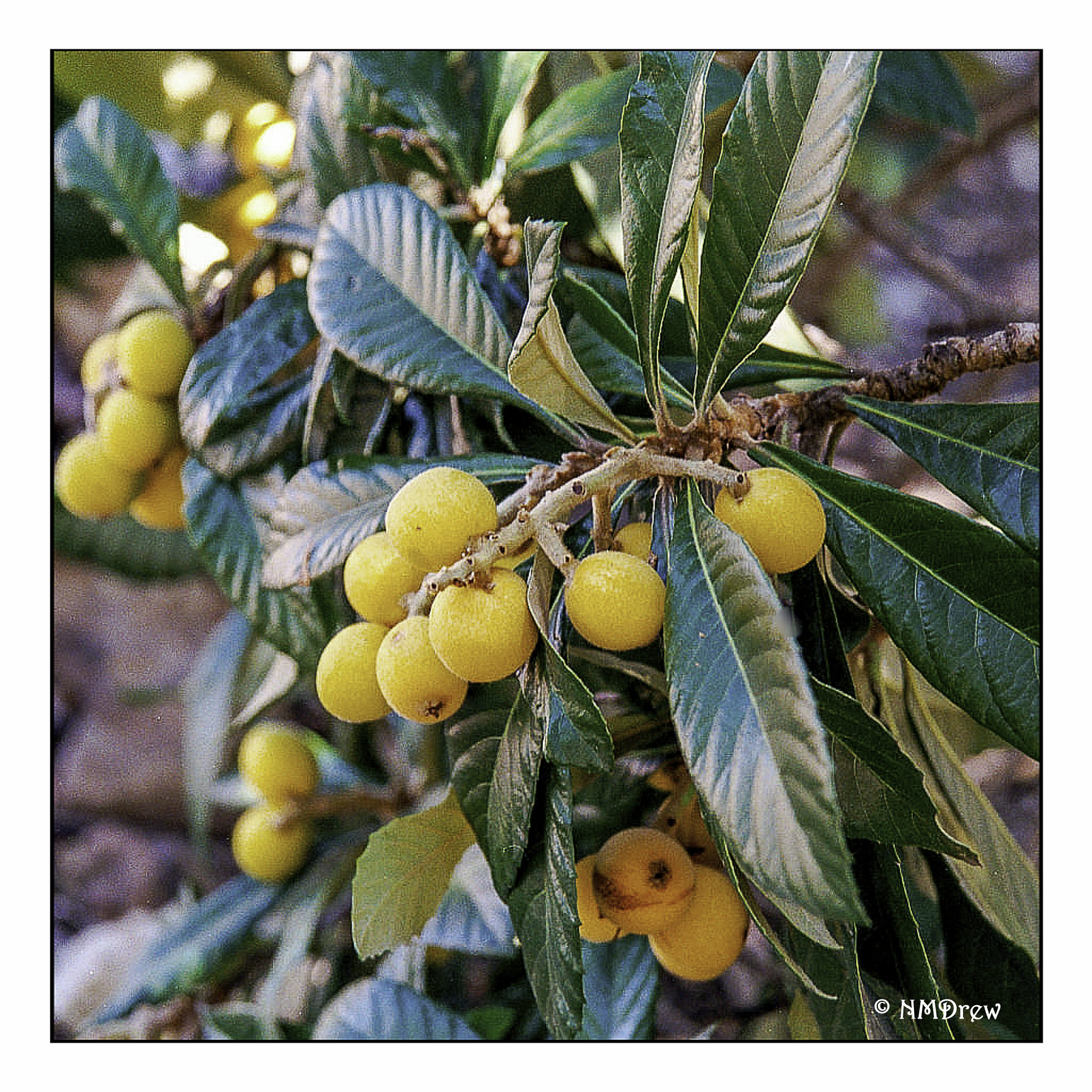
I don’t remember where or when I took this photo, but it really shows the loquat in its full beauty. The fruits are pale yellow to a more deeper orangish color.

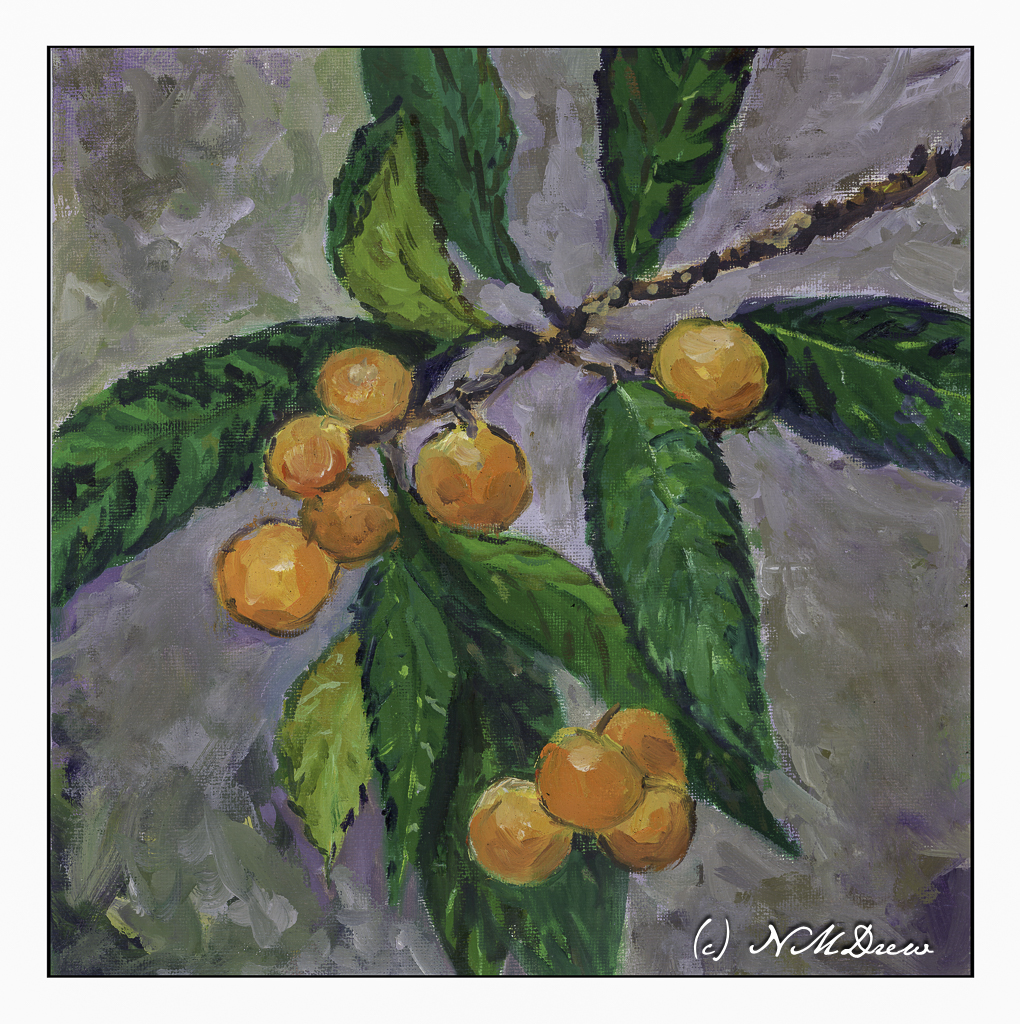
This is my most recent rendition of loquats, done in oil on a 12×12 canvas panel.

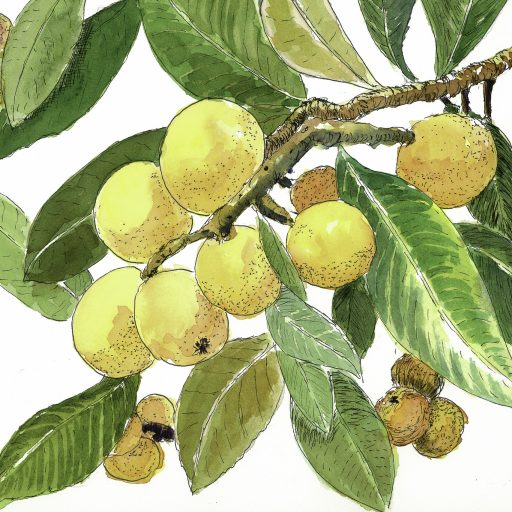
Above is one done in pen, ink, and watercolors.

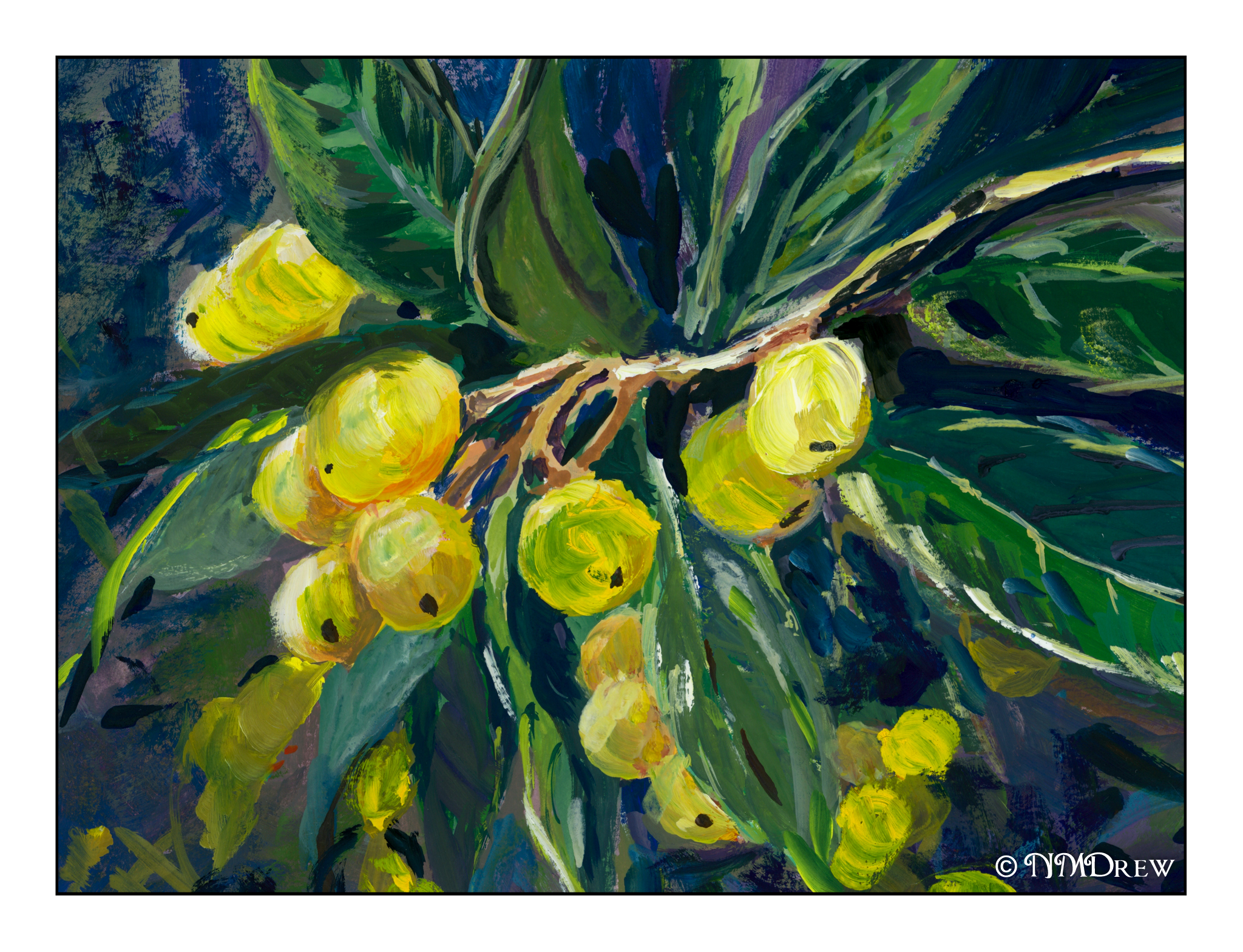
And the above is done in gouache.

The round shapes against pointy, glossy leaves is always a pleasure for the eye.

Gouache, oils, watercolor, pen and ink on various surfaces.

Thoughts on Brushwork

In my last post, I looked at both portraits and brushwork. Doing both is sort of a new adventure for me – portraits, certainly, but brushwork is something I play with periodically. Two artists I admire for both their subject matter and brushwork are Maggie Siner and Hashim Akib. Both have very clear brush marks as well as a strong sense of graphics and color. Siner’s work often displays wide swaths of color and Akib’s often does the same, as well as creates movement and light with brush strokes. Their portraits are striking.

That said, I am a dabber and a rather haphazard (okay, very haphazard) painter in my approach. I paint and putz, sometimes getting it right, sometimes getting it wrong. I will draw in a general idea, but don’t do much more. In particular, I don’t do value studies as I want to look and decide on the scene. I want to train my eye to see them in the picture or landscape or person. It is far more difficult than I think it will be. Slowing down helps, looking and then going into the painting process.

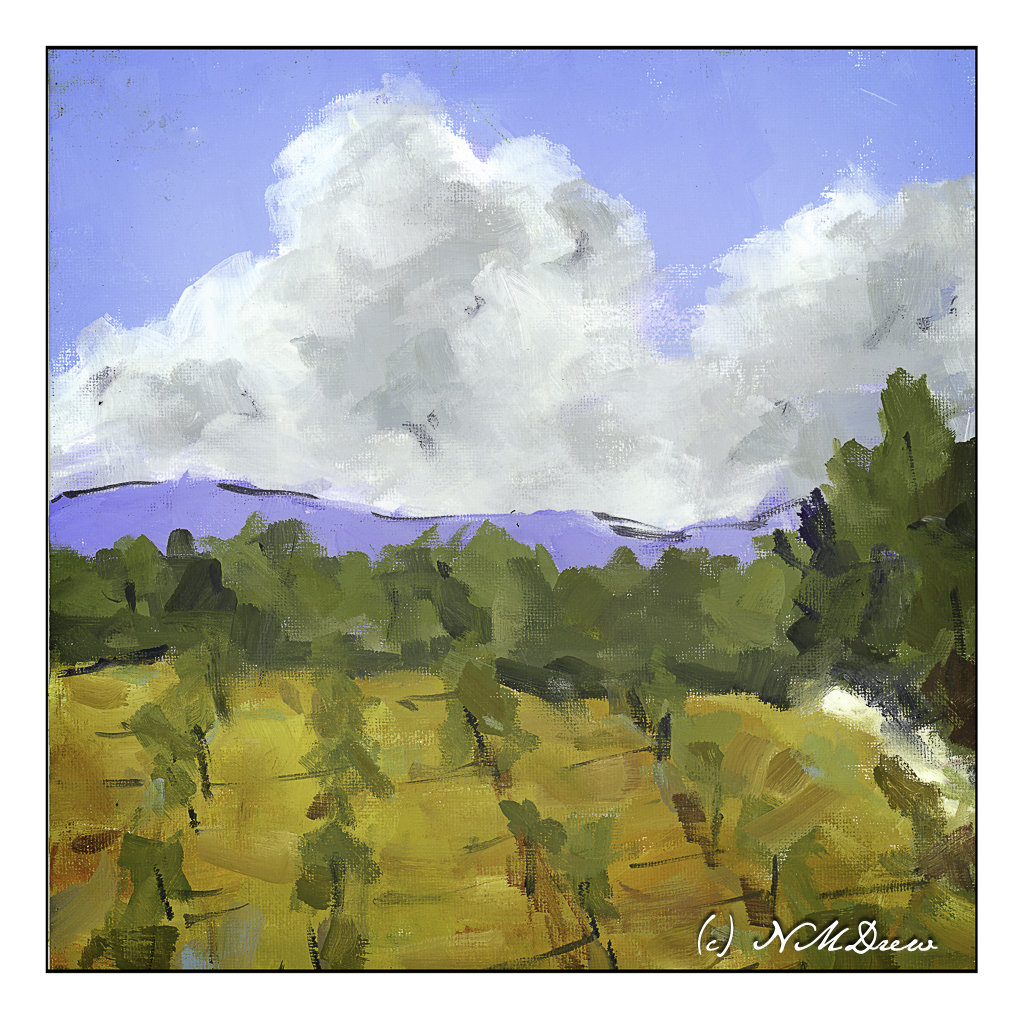
I did the painting below vaguely based off a paining by Siner called “Golden Cumulus”. You can find it on her website. Siner’s brushwork is deliberate, and she says she scrapes her oils off until her brushstroke is as she wants it. She doesn’t paint over things.

What I was looking at in her painting were her brushstrokes. They are directional, sometimes heavy with paint, sometimes not. At times she smudges and edge into another to break things up. For my variant, a wide brush, a square canvas, and either oils or acrylics using the colors found in Siner’s palette, which is very limited.

A lot was learned here: A limited palette makes color choices easy and harder – gotta mix those colors! A big brush – here a flat – allows far more mark making than I thought possible. And a big brush forces me away from my dab-dab-dab with a pointed round.

I don’t remember when I did this painting nor what media I used, or even if I published it here before. I found it the other day and remembered what my goals were. Brushwork then, brushwork now. I’m trying to clean up my oils / acrylic painting skills like I worked on with (and sort of succeeded with ) watercolors.

Oil or acrylic on cotton canvas board, 12 x 12, sort of a master copy of Maggie Siner’s “Golden Cumulus” ca. 2018.

Profile of a Man

One of the painting classes I am taking is one on portraits. The teacher, Barbara, does beautiful work in oils. She is detailed, observant, laissez-faire, and is getting me into enjoying painting portraits of people. For me, I like people I don’t know. Personal portraits are too personal, and while I have done some decent pencil drawings, paint is another story altogether.

If you like free, public domain images of all sorts, check out Pixabay. It’s free and I use it over and over again. For portraits and figures, as well as anything else you might want including “adult” matter (i.e.nudes), you can find it. Many of my art teachers like my photos I use in painting class, and unless I have taken them, most come from this resource.

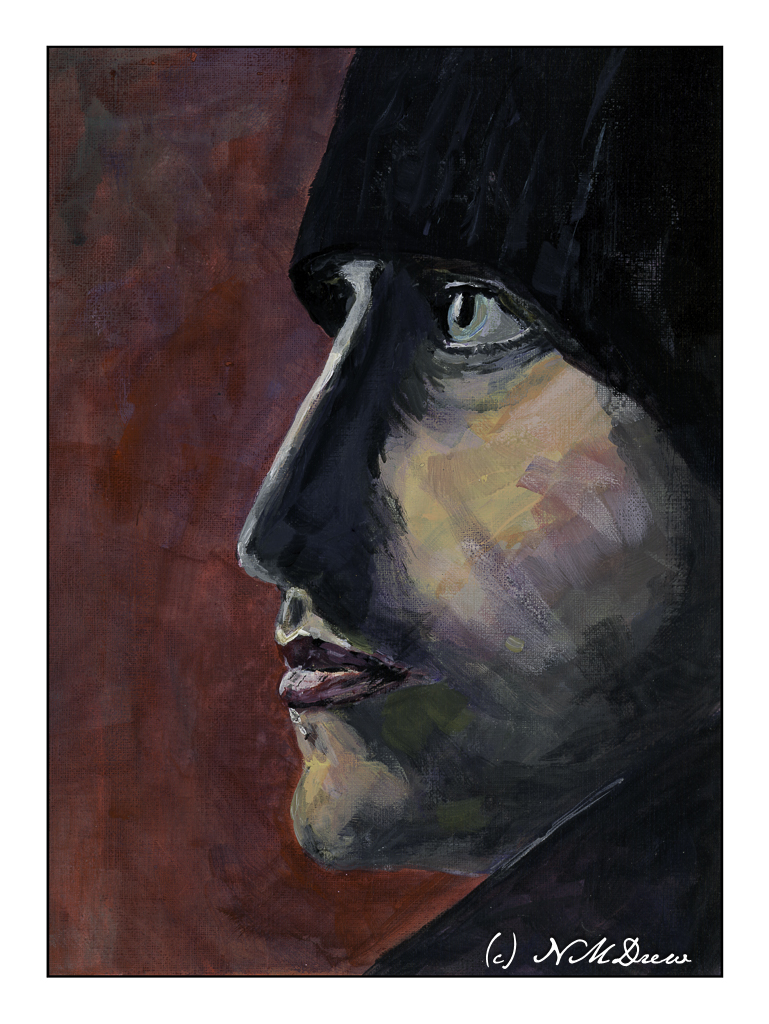
I am giving myself an exercise to paint portraits. How many, no idea. Different positions are certainly ones to study – profile, 3/4, frontal, looking up or down, etc. I also intend to do bodies, working on action and movement, but that is for another time. Today’s post is my painting of the model above.

What drew me to this portrait was its simplicity. Profiles are a good place to begin. The strong light and contrast in this portrait makes things not too subtle, which I think is a good place to begin for a portrait. Below is my painting.

My chosen medium is fluid acrylics, which are about the consistency of heavy cream. In the beginning, I laid in the background with thinned paint, and the same for the general features of the face. As I progressed, I increased the paint’s density by not thinning it, but as time progressed I varied its thickness depending on the opacity I wanted.

Besides rendering good values, I also wanted to focus on brushwork. I have said many times I tend to be a dabber, using a round pointed brush. I set that aside and worked in flats ranging in size from 1/4 inch to about an inch. One of these flats is also an angle brush. For tiny details I did use a fine round.

Altogether, this was painted over 3 days, using time to let the paint dry (or a hair dryer) and take time to step away from the painting. That way I could review what was done and think about changes. In the end, I am pleased with this painting quite a bit.

Fluid acrylic paint, Canson XL oil paint / acrylic paper, 9×12, finished size 8×11.

The House in Back, Albuquerque

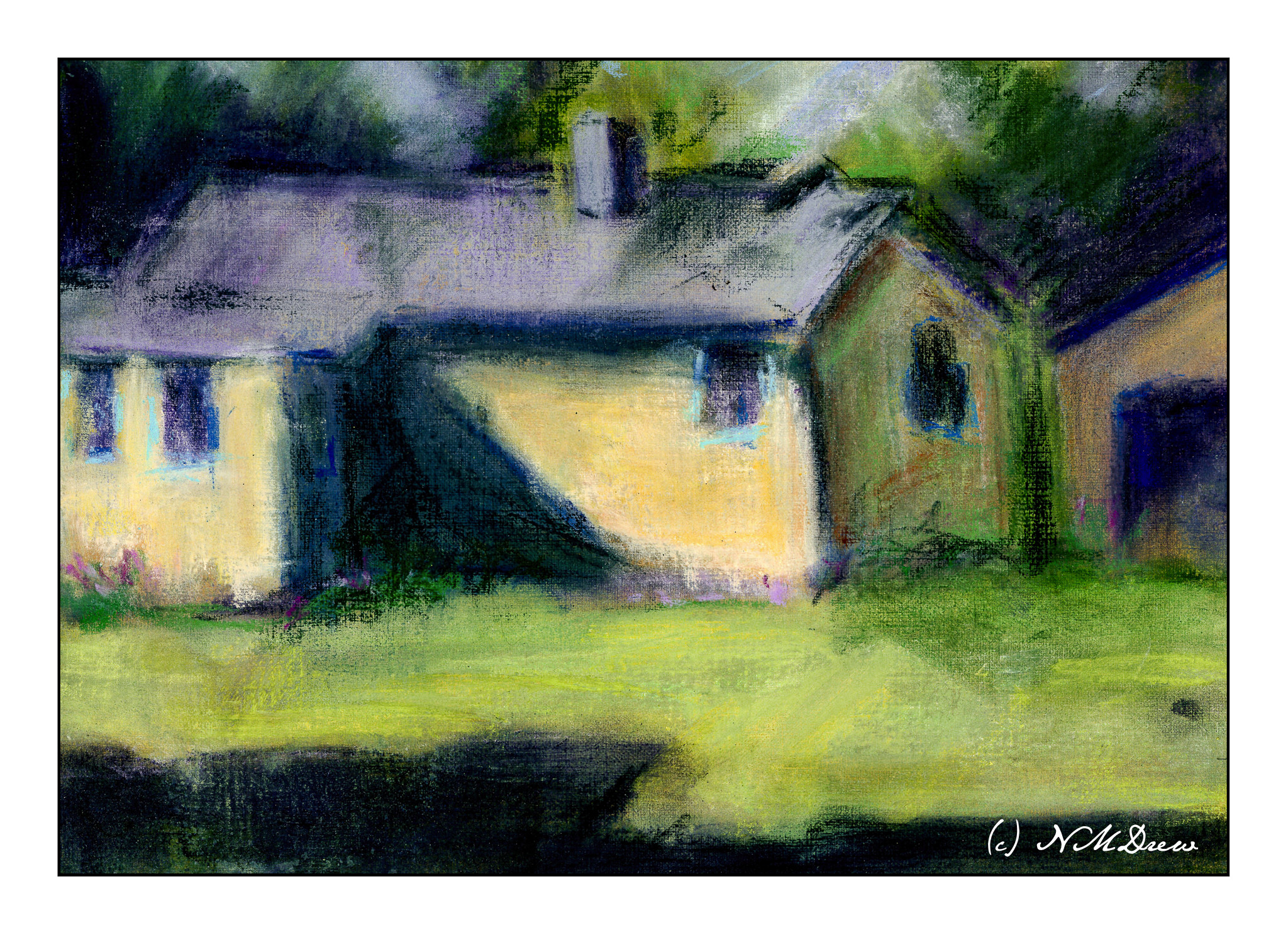
Double lots are interesting as often you find an old, beat up house behind one that looks great from the street. Such is this – an old stucco house with turquoise trim on a back lot in Albuquerque. Not a fancy house, but one which makes for a great study.

This is another pastel done on the paper I created using yellow ochre and Golden pastel medium. It works pretty good so far! I laid in values, working from large to small, adding details at the end. As with oils, the work was done dark to light. In between each layer, after knocking off the pastel dust, I sprayed it with rubbing alcohol, and used alcohol as the final sealant. As with any sealant on pastel, the colors end up becoming darker, so I worked to make this a bit lighter than I thought it should be. Some post-scan twiddling in LR, too.

As an aside, my air purifier arrived, so I have it turned on and used it during the painting process as well as wore a protective mask. I damp wiped all my surfaces the best I could as well.

Nupastels, soft pastels, Rembrandt pastels, Terry Ludwig pastels, Jack Richeson pastels on Canson XL oil / acrylic paper primed with Golden pastel ground and yellow ochre paint. 9×12.

Tomorrow I think I will prime some watercolor paper to see how it does as a painting surface.

Lone Cherry Trees Along Figueroa Mountain Road

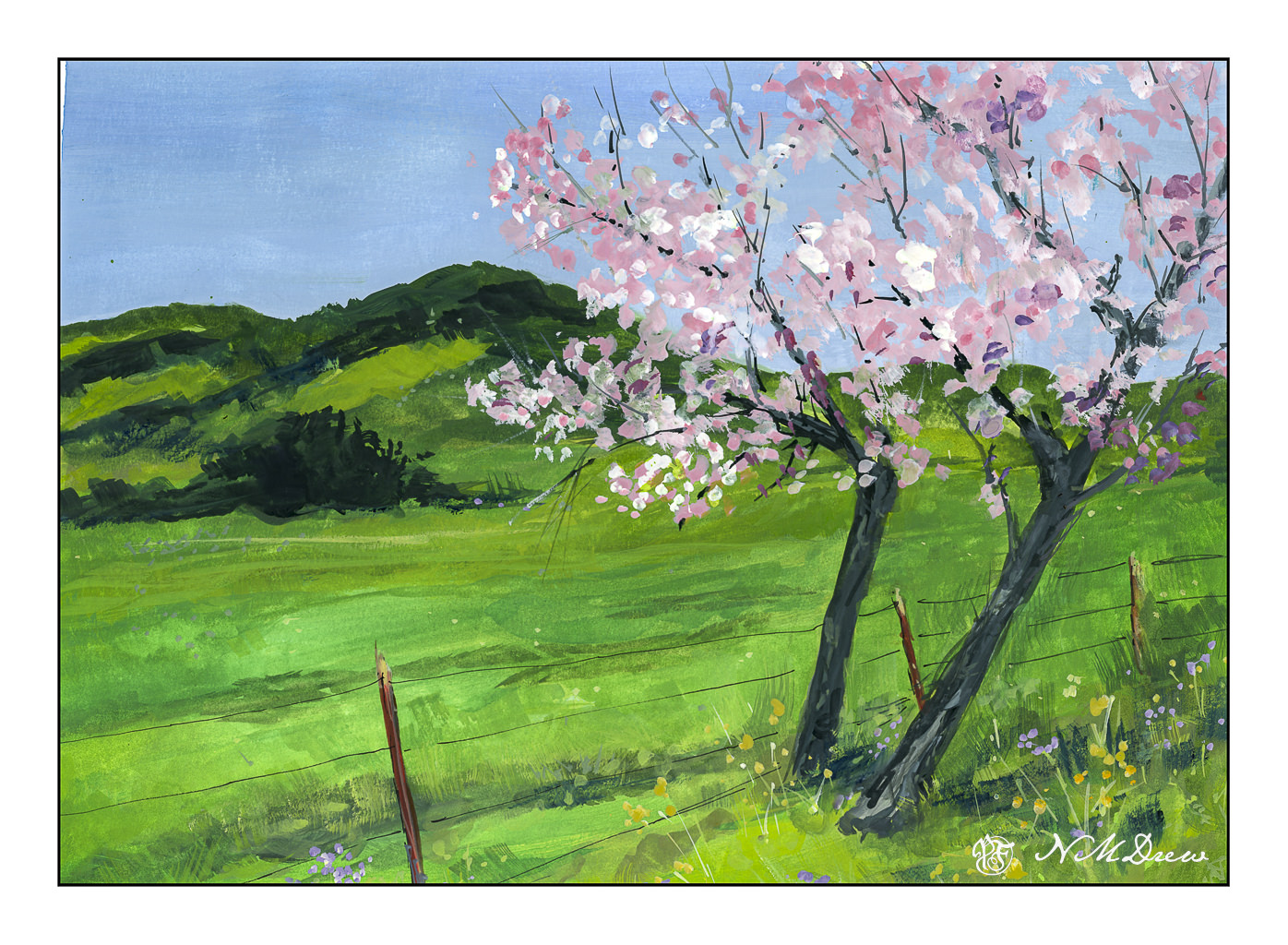
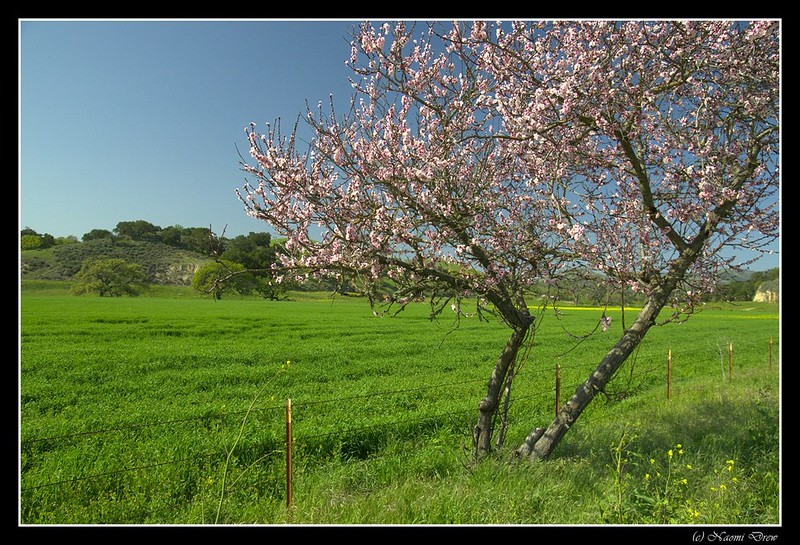
These two trees have long since vanished. I photographed them in 2012 in Santa Barbara County along Figueroa Mountain Road in the early spring. I thought they were a beautiful spot of color against the greens of the California hills, which in themselves, during a superbloom, can be covered in shades of lavender, orange, and gold.

I mixed together gouache paints – whites (zinc and titanium) and some ivory black with my watercolors. This allows for layers to be built and bits painted over, as in gouache, but allows for a bit of transparent and opaque. I’ve done this before and always find it is a lot of fun. Gouache, when thickish, is best with small paintings, but mixing whites with watercolor gets an effect like gouache but at a much lower price point.

The photo – linked from Flickr – is not an especially good photo, but I do feel it catches the beauty of these two trees. When I went back looking for them a few years ago I could not find them, so I am glad I have captured them!

Lone Cherry 3

Watercolor paint mixed with white and / or black artist’s gouache. 11×14 on Canson watercolor paper.