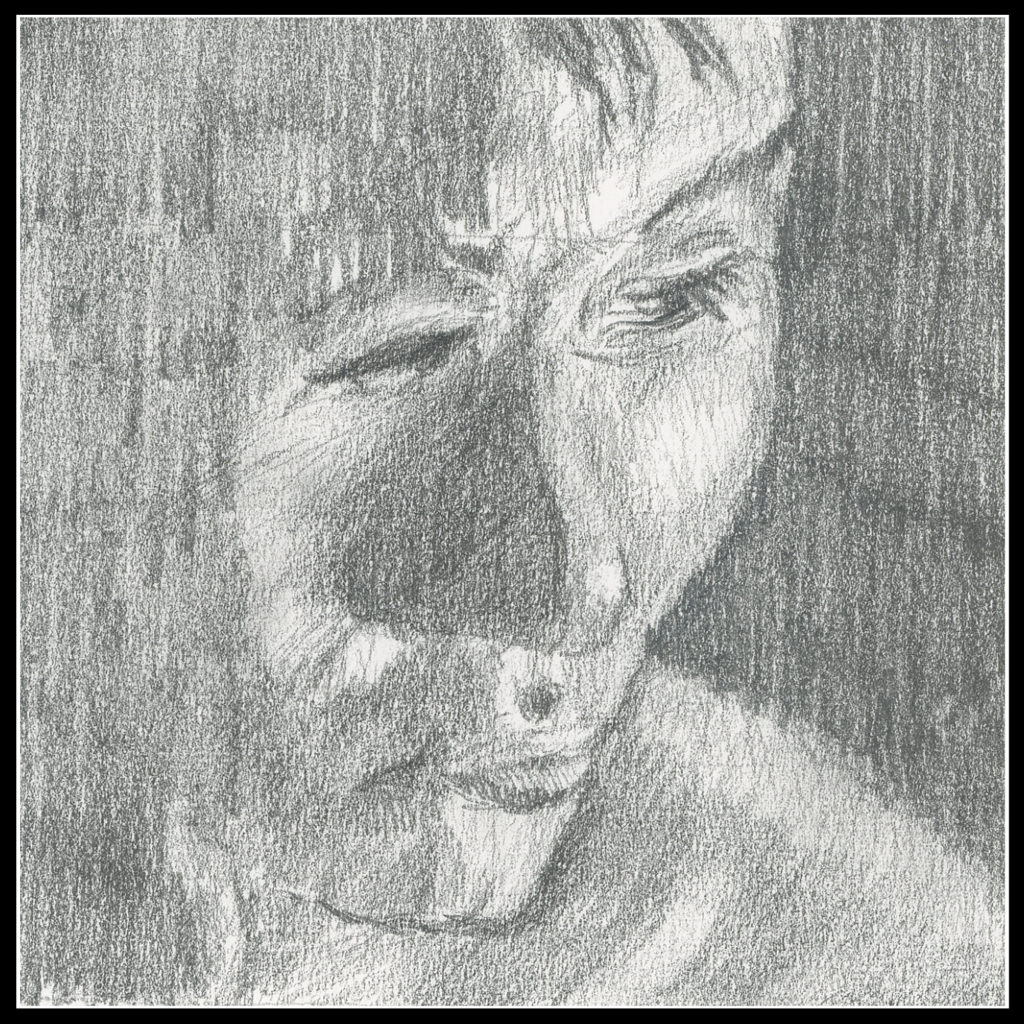
4 x 4 on drawing paper. Not a great sketch, but for values, it was a bit of work!

4 x 4 on drawing paper. Not a great sketch, but for values, it was a bit of work!
I just finished a course on drawing as a preliminary to one on brushwork, and then color theory. Between will be challenges, and the challenge between drawing and brushwork is a 30-day challenge to do small, preliminary sketches in pencil.

One of the things I have enjoyed about the course, taught by Ian Roberts, is the development of drawing as a preliminary to a painting. Initially, as in the first few weeks, shapes were simple and the point was to carve out space on a 2D surface to create a 3D image. We ended with a challenge of doing one such sketch a day for 30 days – or however many sketches we could do. I have time to do 30, so 30 it will be.
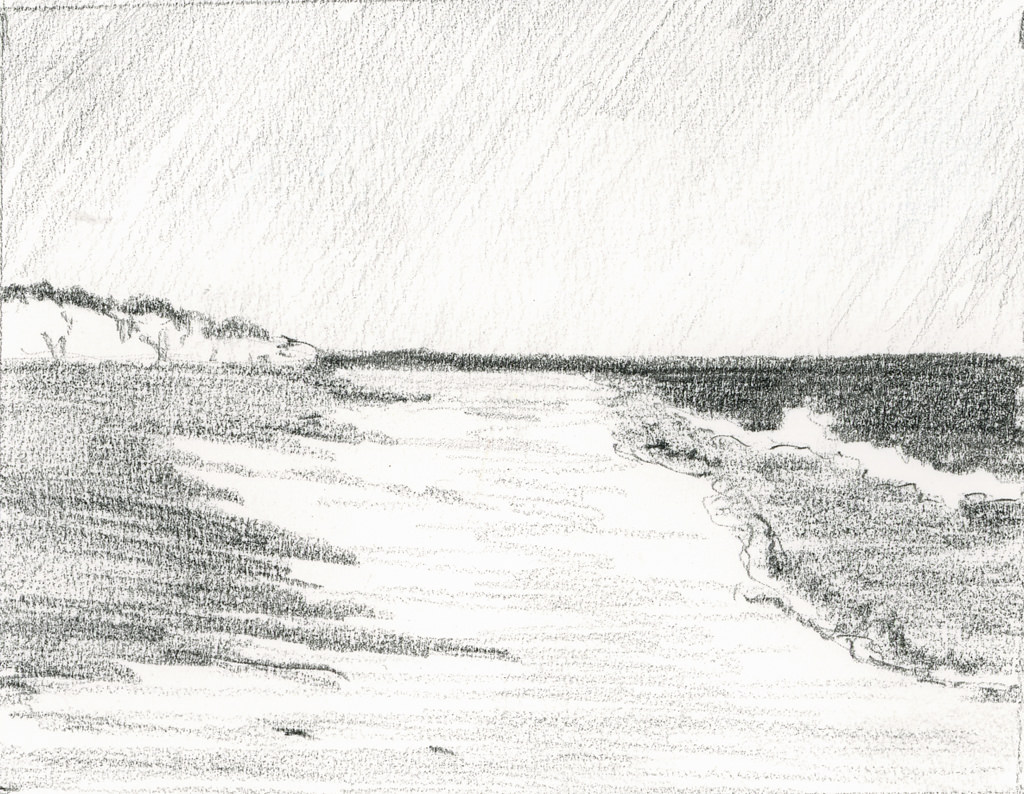
I never do value studies, but I admit to laziness and impatience on my part. So, I decided that I needed to do something which will shake up my approaches to painting. As well, values are always hard for me to see as color always gets me. Roberts says, “Color gets all the attention but value does the hard work.” Or something like that. So true!
What I have enjoyed in particular is how Roberts approaches composition – leading lines, horizontal, verticals, and all leading to the focal point of the picture. I think I am getting that. The direction of the pencil lines indicates, too, the vertical, diagonal, and horizontal. Brush strokes can indicate the same.
Obviously the first picture has some verticals – and things we expect to be vertical, even if tipsy, such as the fence posts on either side of the road. The second one, a picture of low tide at a local beach, doesn’t seem to have any verticals except in the cliffs. But wait! The lines of the ocean and beach are nearly vertical – something I never considered until Roberts pointed them out.
I admit, I am curious how I will get my black and white studies onto a painted surface in color, but I guess that will come with time and practice. All told, I will be in his class through August, and I hope by that time to see some improvement.
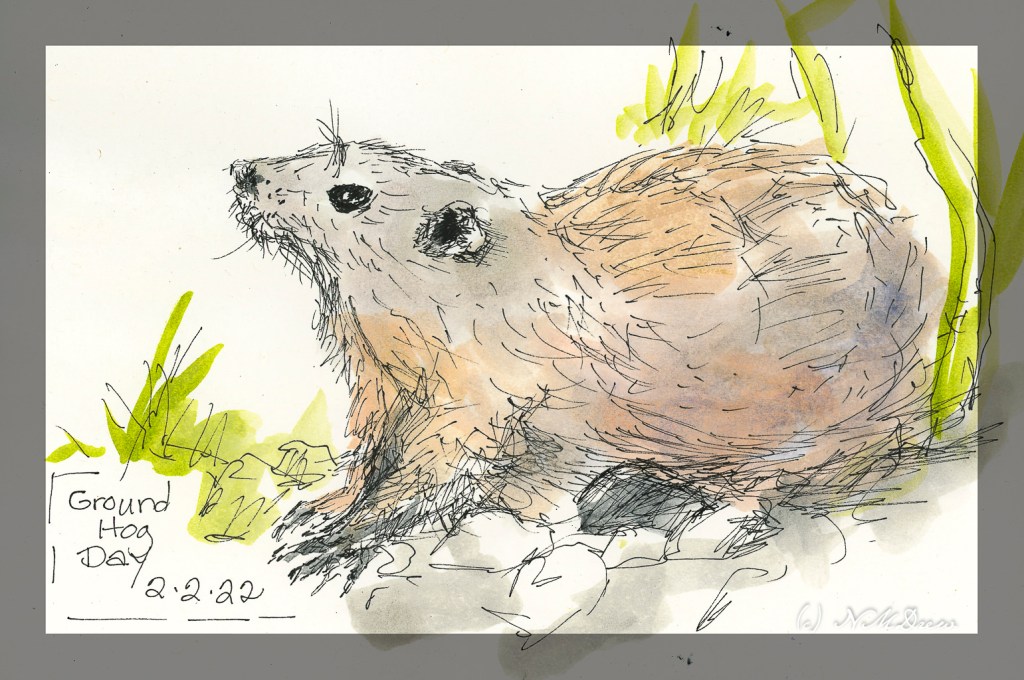
One of the beauties of drawing is you can create anything you want. This is a ground hog, but one I invented. I invented him when I realized his ear is all cockamamy. So, new subspecies: the Lopso-Eared Ground Hog.
Ground Hog Day has always been a favorite of mine. First, I like ground hogs. They are cute. Second, the entire idea of a day devoted to such a cute animal is rather delightful. According to the website history.com:
On February 2, 1887, Groundhog Day, featuring a rodent meteorologist, is celebrated for the first time at Gobbler’s Knob in Punxsutawney, Pennsylvania. According to tradition, if a groundhog comes out of its hole on this day and sees its shadow, it gets scared and runs back into its burrow, predicting six more weeks of winter weather; no shadow means an early spring.
Groundhog Day has its roots in the ancient Christian tradition of Candlemas, when clergy would bless and distribute candles needed for winter. The candles represented how long and cold the winter would be. Germans expanded on this concept by selecting an animal—the hedgehog—as a means of predicting weather. Once they came to America, German settlers in Pennsylvania continued the tradition, although they switched from hedgehogs to groundhogs, which were plentiful in the Keystone State.
Groundhogs, also called woodchucks and whose scientific name is Marmota monax, typically weigh 12 to 15 pounds and live six to eight years. They eat vegetables and fruits, whistle when they’re frightened or looking for a mate (they’re sometimes called whistle pigs) and can climb trees and swim.
They go into hibernation in the late fall; during this time, their body temperatures drop significantly, their heartbeats slow from 80 to five beats per minute and they can lose 30 percent of their body fat. In February, male groundhogs emerge from their burrows to look for a mate (not to predict the weather) before going underground again. They come out of hibernation for good in March.
In 1887, a newspaper editor belonging to a group of groundhog hunters from Punxsutawney called the Punxsutawney Groundhog Club declared that Phil, the Punxsutawney groundhog, was America’s only true weather-forecasting groundhog. The line of groundhogs that have since been known as Phil might be America’s most famous groundhogs, but other towns across North America now have their own weather-predicting rodents, from Birmingham Bill to Staten Island Chuck to Shubenacadie Sam in Canada.
In 1993, the movie Groundhog Day starring Bill Murray popularized the usage of “groundhog day” to mean something that is repeated over and over. Today, tens of thousands of people converge on Gobbler’s Knob in Punxsutawney each February 2 to witness Phil’s prediction. The Punxsutawney Groundhog Club hosts a three-day celebration featuring entertainment and activities.
Let’s hear it for monata monax!

Hummingbirds are amazing little critters! if you have never had the treat of their buzzing past you, I can only say that you are missing out. We have them in our area and enjoy their presence amongst our flowers. Here, an Anna’s Hummingbird in colored pencil.
Below you can see the various stages of my drawing. I have more work on the branch of the final image above, and prefer the third image below. I tried some Gamsol on the one above and wonder if it was a mistake.


I think I will look at this drawing again in a few days, touch it up, and maybe repost. I have a lot to learn about colored pencils and am enjoying it far more than I thought I would. One thing I have learned is to be patient and to take my time.
Nothing like learning a few things! I’ve drawn with colored pencils on a very causal basis, but what I learned today included: use of Saral, a waxy transfer paper; use of burnishing and blending pencils. Never heard of those before today, but used all three.
Where to begin? I got there 30 minutes late – I thought class began at 9:30 but, no, 9:00. Oh, well.
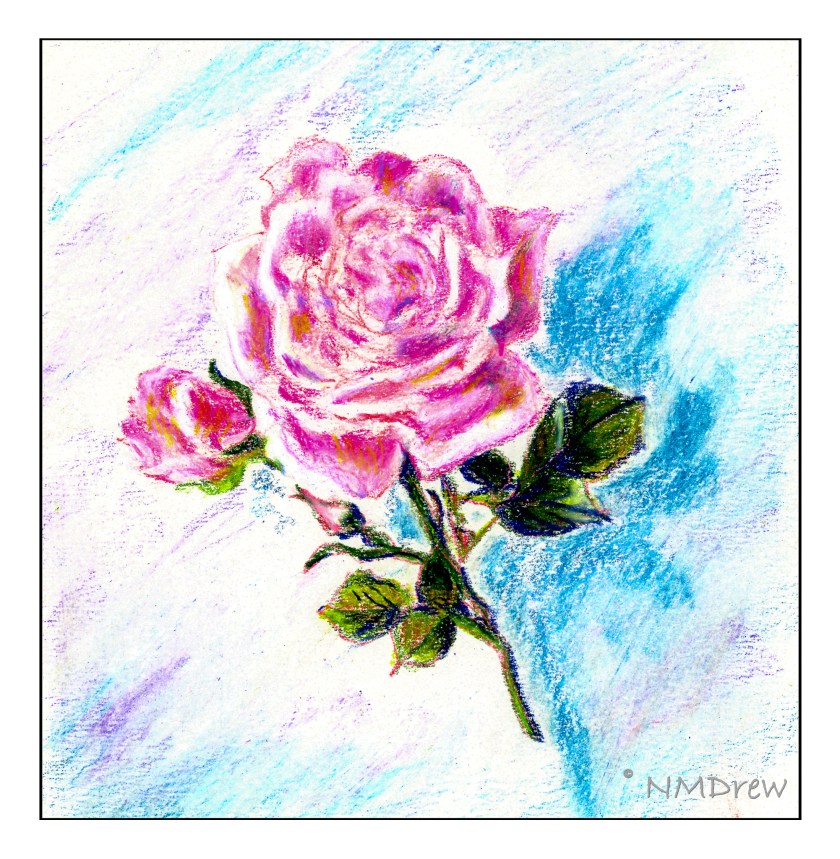
Subject was a rose. Place the Saral between the picture you are going to use as reference and the paper you are going to draw upon – like carbon paper. Press hard to be sure it is on the drawing surface. Then, remove the Saral, and use a rubber eraser to blot the lines. This lightens them so you can still see them, but not so dark they are obvious. The paper we used had a bit of tooth, to catch the colors, and we worked from light to dark, white to reds and pinks and into the greens of the leaves. The suggestion was to moosh up a background to keep the rose from floating in space, so I did.
When I got home, I was interested in trying my hand on different papers. I have some bristol paper, which is a very smooth and very white paper.
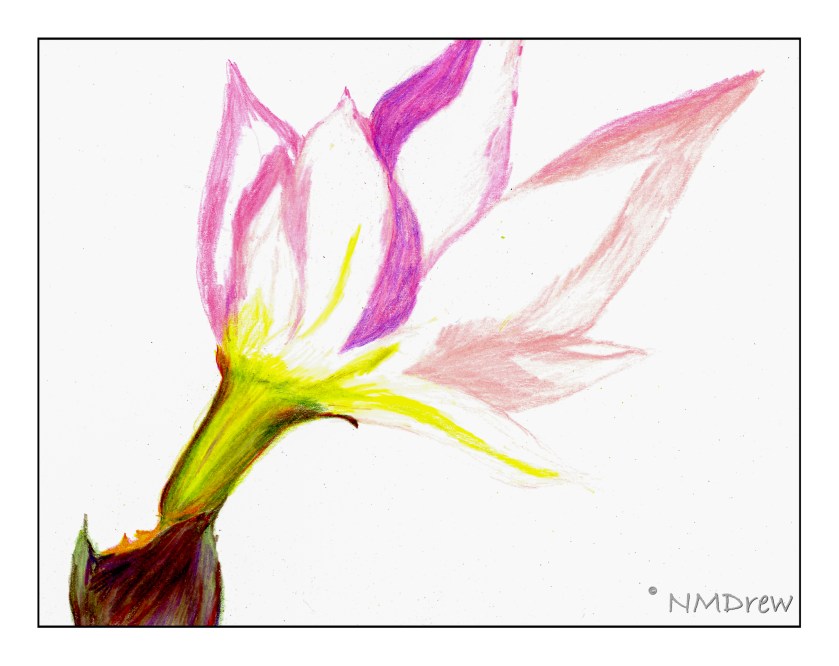
This paper is so, so smooth that it is actually slick. As a result, colors are blended into one another very easily. I think the Prismacolor Premier pencils may be too soft for this paper and a harder, oil-based pencils, such as Polychromos, may be better suited for bristol.
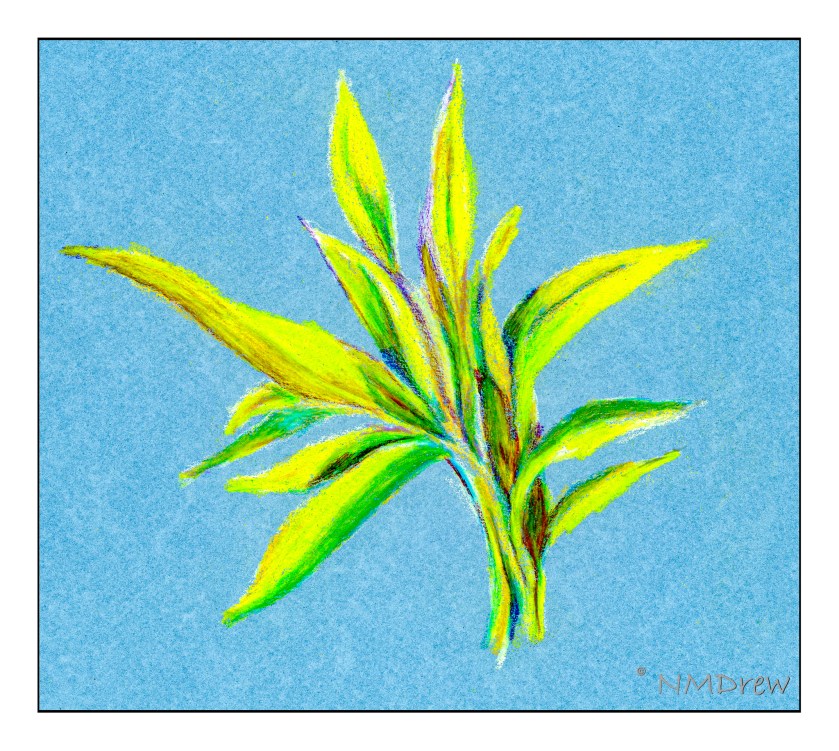
The next experiment was done on some of my MiTeintes pastel paper; here, a mid-blue. I sketched directly onto the paper, using a very pale yellow pencil to create the general shapes as well as limn in the lights and darks. I decided to look at values the best I could, as well as whether they values tended toward warm or cold. The sunlight was dappled on the leaves, with some bright yellow green, and other a deep, blue-green tending toward black.
Out of all of these, I like the galangal the best. I like it because I had gotten a better sense of how to use the colored pencils, learning some of their characteristics and qualities. The blue background adds to the picture. The light and dark colors worked pretty well, and remembering to use complementary colors to dull down shadow areas I think kept the vibrancy. So, for a yellow-green leaf, the shadow colors were a purplish red, or a layer or two of each.
I don’t know if colored pencils will become a big love in my life, but I do enjoy drawing. My Pencil Portrait class was a real joy. I think I learned a lot in it, and moving to colored pencils is interesting. Shades of grey in graphite now are translated (or attempted to be translated) into values in color – something that is very, very challenging for me.
 Ink, Yarn & Beer