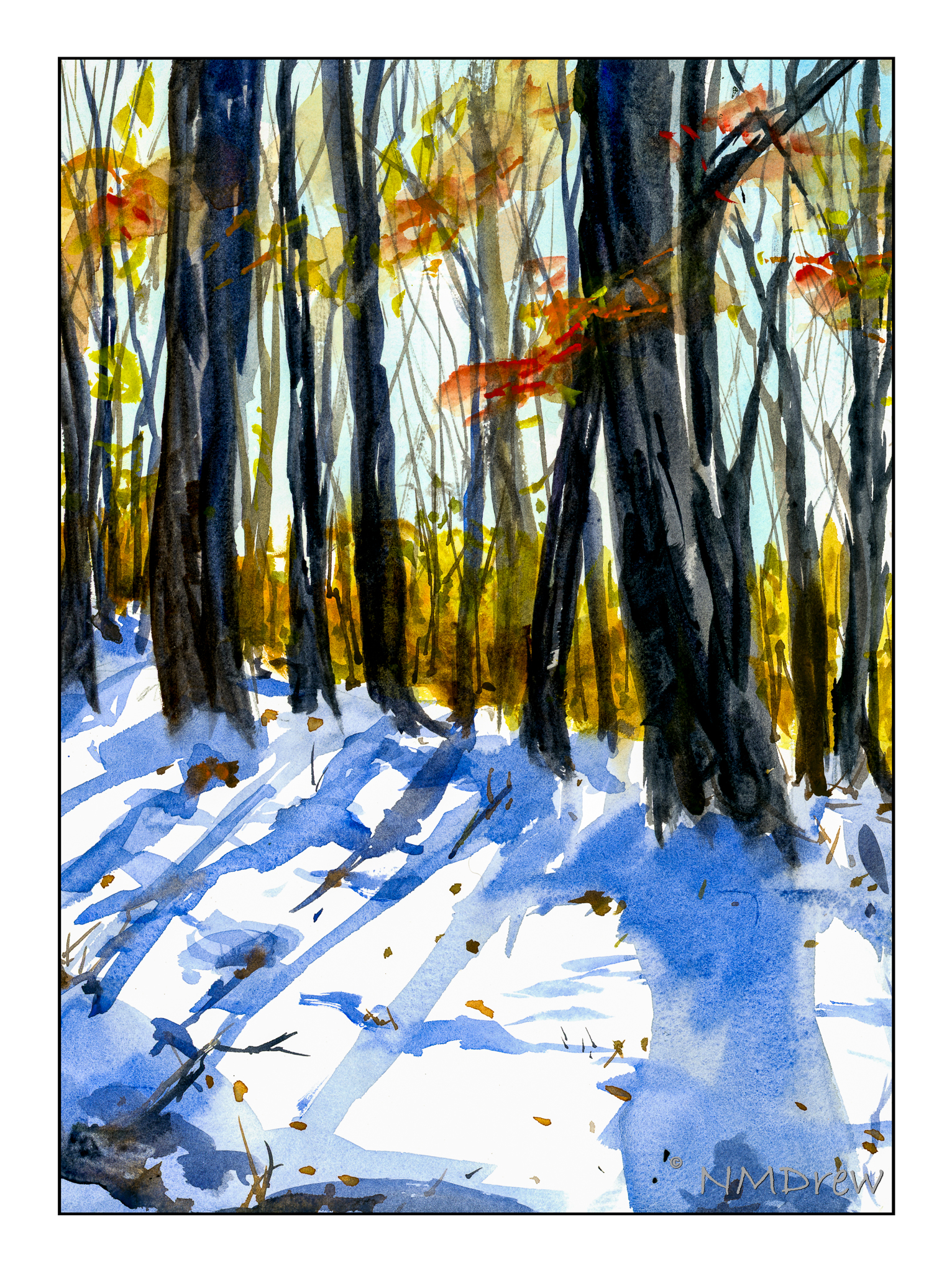
Where I live there isn’t a very big likelihood of snow. At higher elevations, yes, but here in coastal California, 800 feet isn’t gonna get it.
So, I dream.
I’ve lived in some places with stunning countryside, such as rural Illinois, upstate New York, in the Rockies of Colorado. Snow was beautiful and thrilling. As a kid, it’s a wonderland, but I remember my mother would always kvetch about all the little mittens, the snowsuits, the boots, the scarves, the this and that to get a herd of kids dressed to play – and then ten minutes later, they are all back in the house.
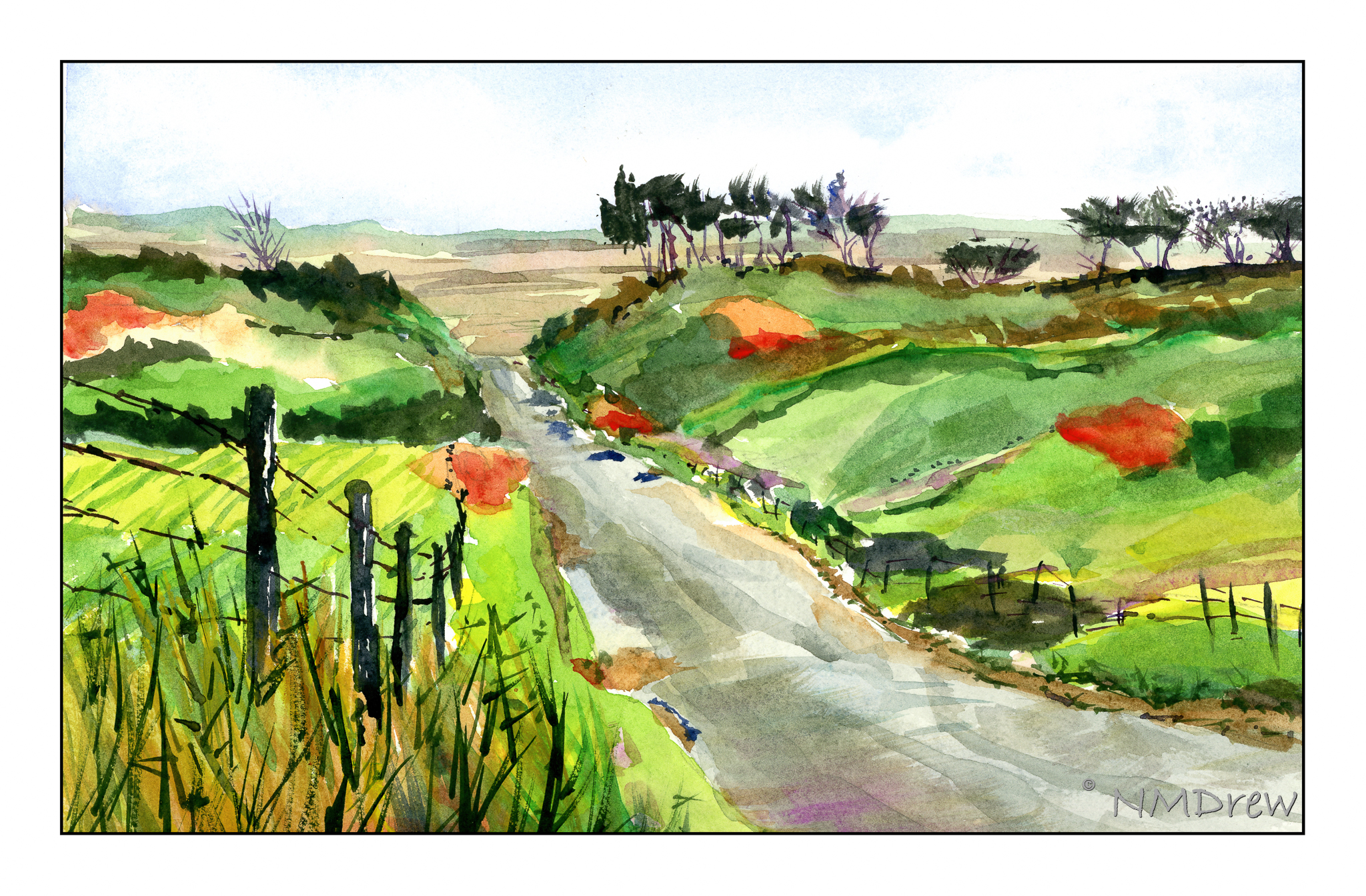
In keeping with yesterday’s quickies, today I present you with another timed study. This time I used only one brush to do everything. It was a 3/4 inch flat brush, rather stiff, and not able to hold a lot of water. It’s always a challenge to do a timed study, but also more challenging when one brush is used for everything.
Oops! I did you a fine line brush for some things, like the trees in the middle left, the windows in the buildings, and some of the grasses in the foreground. However, the flat brush did produce everything else, even the tree trunks. Practice like this is a lot of fun.
I spent the most part of today slogging along in the Dog Free Zone. Emptying out old pots, refilling them, pruning, sweeping, sweeping, sweeping, planting bulbs, cutting back overgrown critters, toiling away in a sweltering 67F for 3 hours. Poor me, eh? But just imagine what I will see in a few months!! And I still have seeds to plant as well.
So, I was honestly too tired to focus on anything requiring logic. I needed to just paint. Flowers seem appropriate given all the gardening. And I also have a couple of dozen of dazzling orangy red tulips. Trust me, the real ones look far better than this painting!
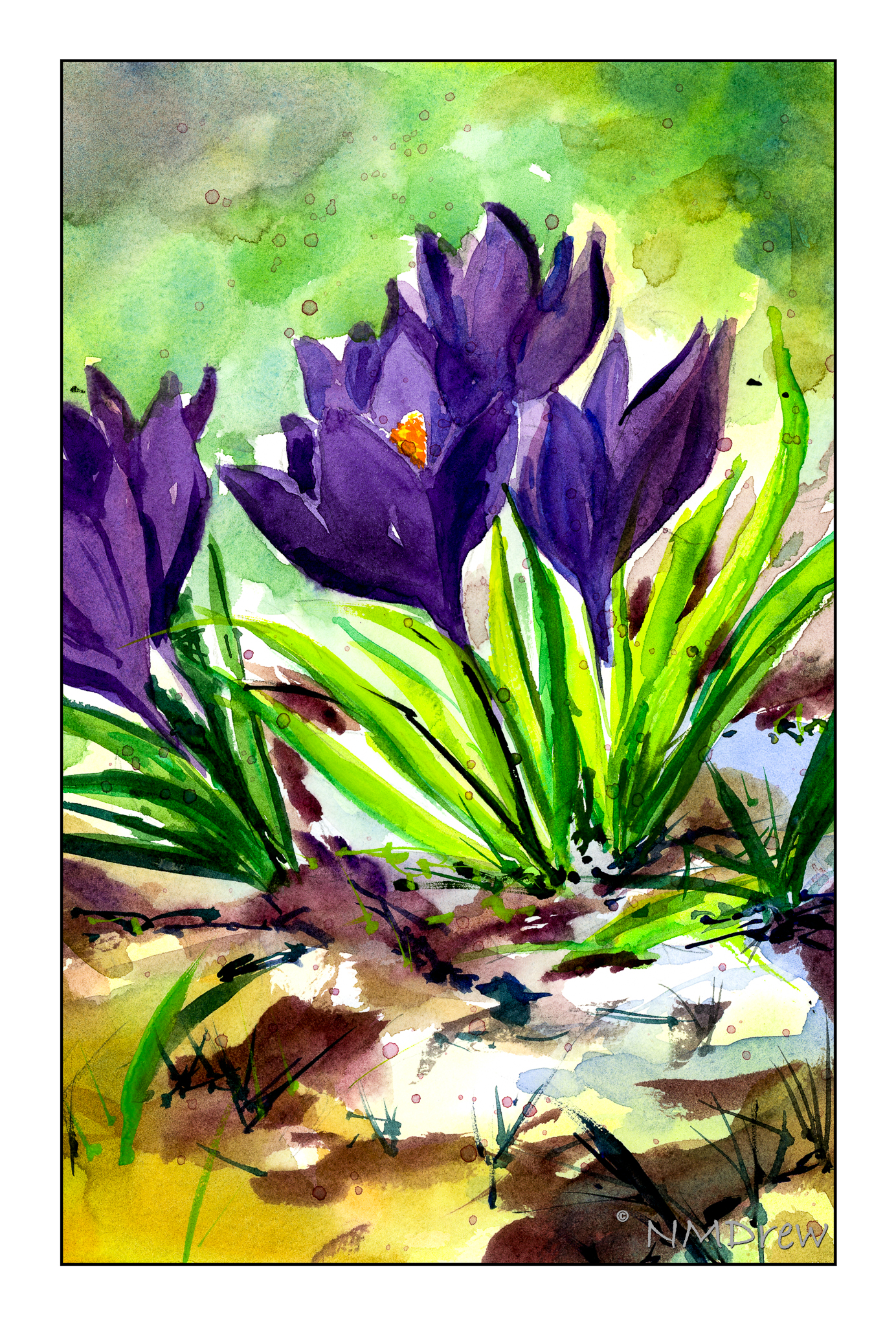
And then there are those wonderful flowers – bulbs – which grow and bloom in winter, when all is drab and drear. Crocus anyone? Here, a bit of snow is all that is left.
Each of these paintings was done with a time limit of 30 minutes. You can make a lot of mistakes in 30 minutes and paint some truly awful stuff – that is why quick studies can be so educational. And you can paint some great stuff, and wonder, how the hell did you do that!?
Today we will hit 77F and it is a joyous combination of spring fever, gardening, and just pleasure the weather is so fine! Colors, too, speak of seasons coming and to come.
As you may recall, my Pencil Portraits class will begin again, on 2/17/21. It’s a lovely class with a great instructor, social distancing, real people! None of this virtual stuff, which has its place, but doesn’t cut it for me. However, that is another story.
For my previous two Pencil Portrait classes, I spent the entire time – 2 hours a day in class for 5 weeks to do one portrait in each session. I learned a lot and got some good results. This time around, though, I am actually “prepping” for the class. I want to be able to render a likeness that is recognizable, but I want to try to do a portrait in each session. That means a portrait in two hours, for a total of 4 portraits (we are meeting for 4 weeks this time, with a possible 5th depending on what the class wants).
Thus, I have decided to refer to various how-to books in my library, as well as work with other resources, such as YouTube. With as many resources at hand, I just need to sit down and work on things. Today’s focus is on proportions and positions of the eye, nose, ears, and mouth in a frontal view and in profile, as well as some practice with shading – as I’ve noted, my ability to render shadows and contrast gets lost when I work with color.
Above are studies from the book Drawing Portraits for the Absolute Beginnerby Mark and Mary Willenbrink.
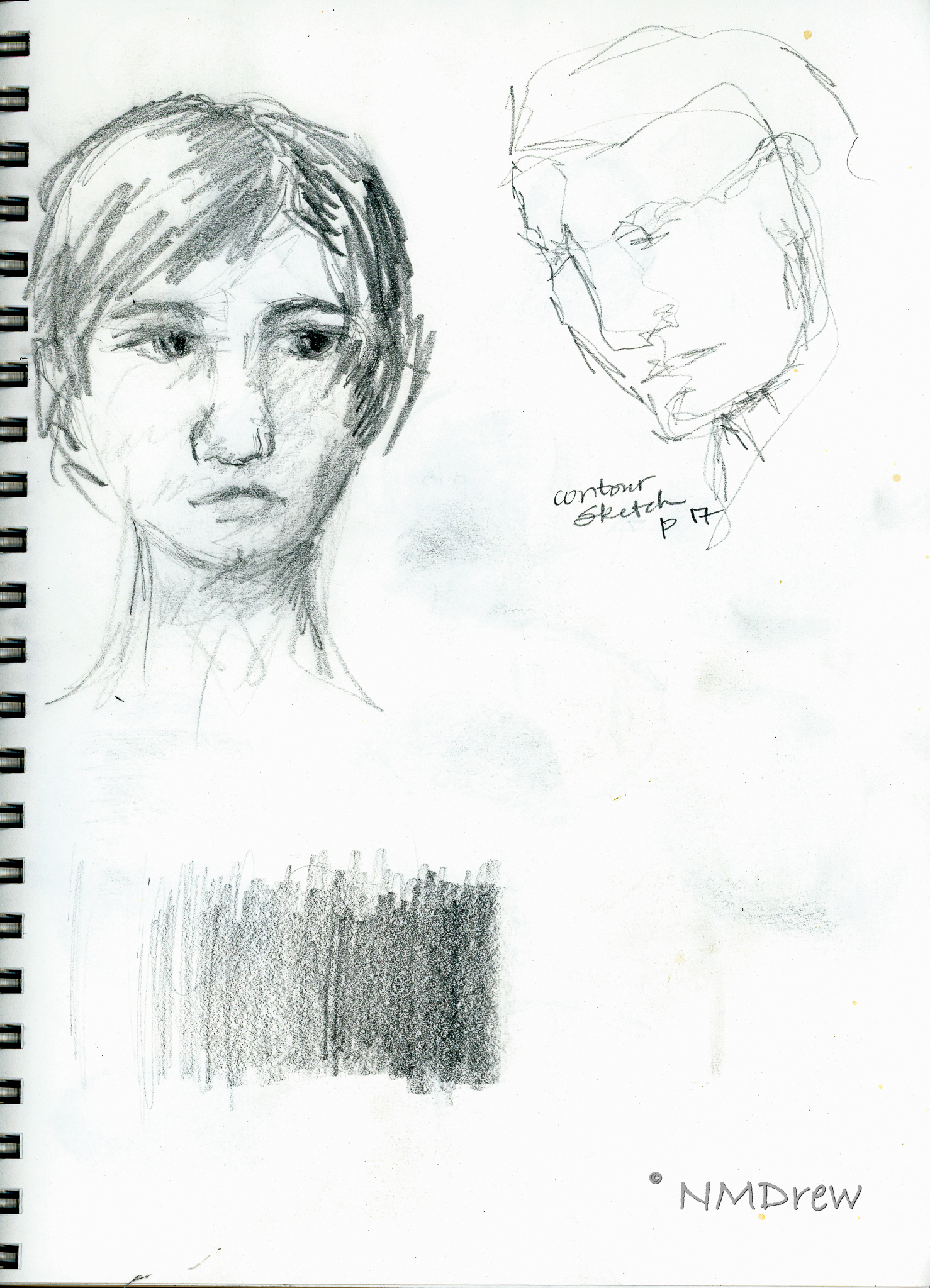
More from the Willenbrink’s book as well as a face I drew the other day.
Shading studies with a look at where light hits a sphere from different directions. Not too sure how realistic my results are, but in a way, just doing it and thinking about it is perhaps more important. Being conscious of shadows is the whole point. I learned a lot from a video by Xabio Arts, which is below:
Solving the problems of drawing means putting tools in your art supplies – mental ones for reference with a pencil (or pen, or brush!).
More shading, and a face. Per the Willenbrinks, the face is about 5 eyes wide – which I know – and 7 eye-widths high – which I never learned. Now that is a good trick. From there – a couple of faces and shadows.
A face on a singe sheet of paper, using guides from the Willenbrink’s book as well as from a video on YouTube from Xabio Arts on drawing the face straight-on.
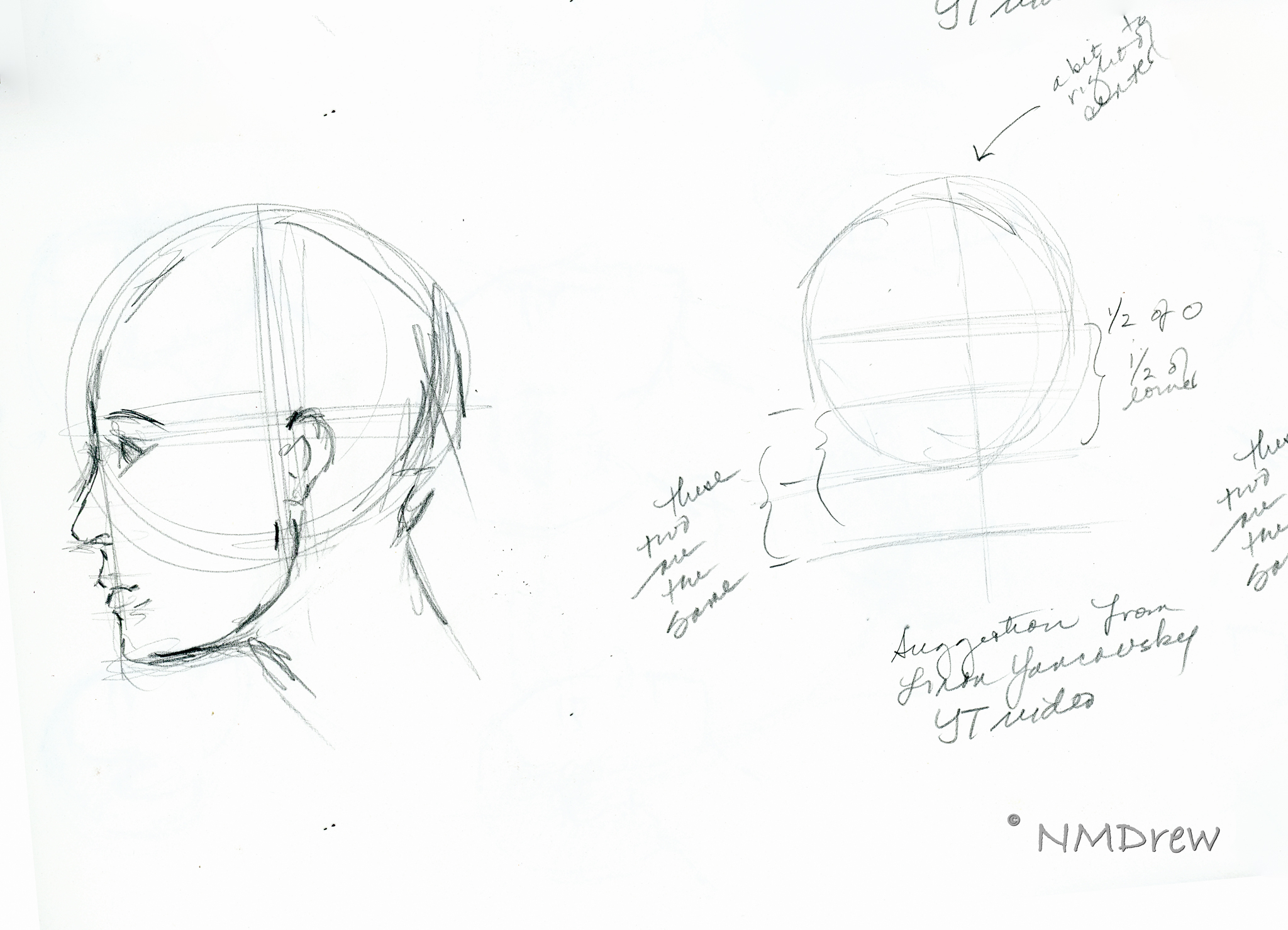
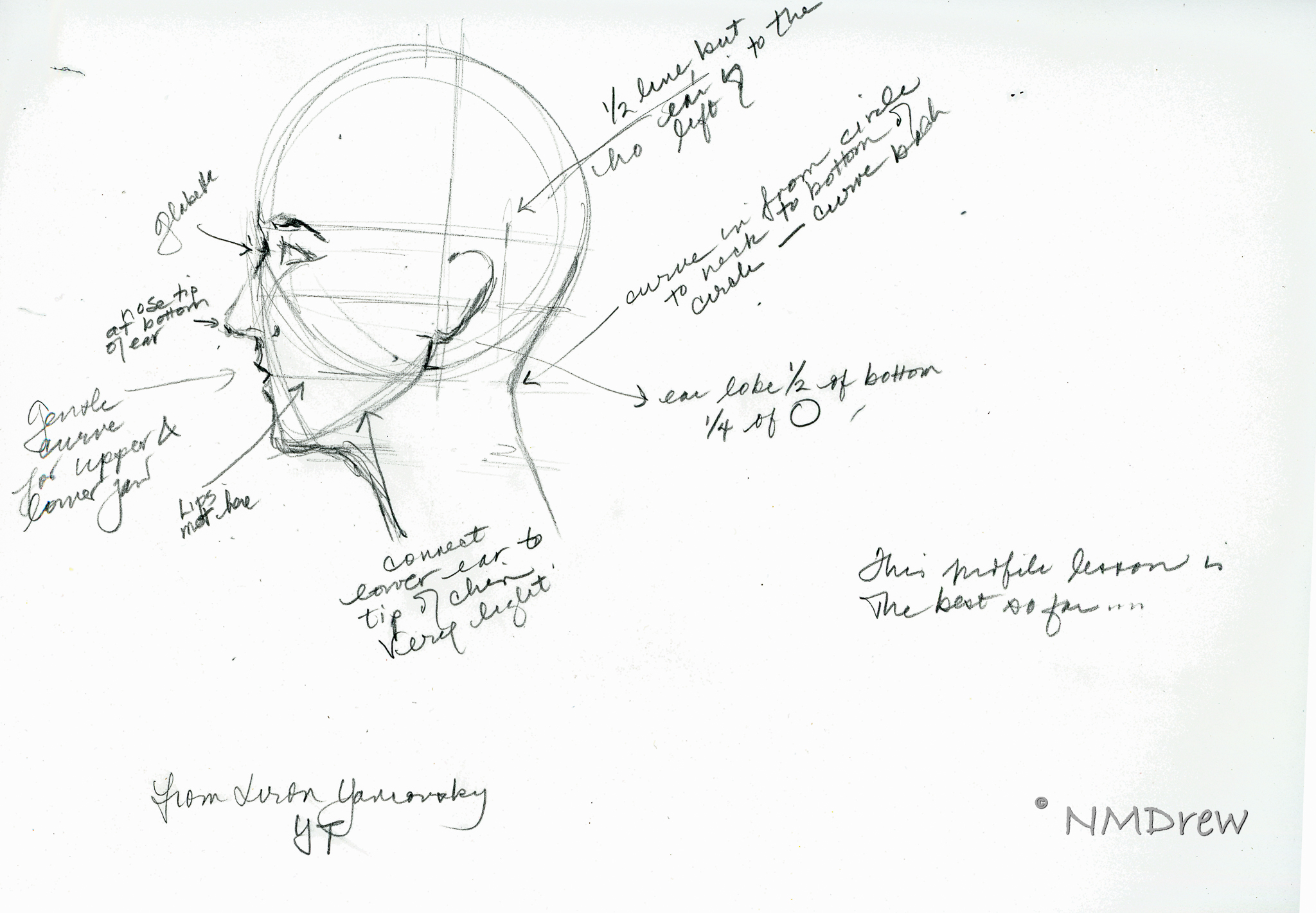
Now, profiles. I really did not get the Willenbrink’s proportions very well. Something eluded me. The heads just don’t seem in proportion. Thus, some YouTube videos on drawing the head in profile. Not much hit me until . . .
. . . I came across a profile video done in 2015 by Liron Yanconsky on YouTube. These are his proportions, and they work a lot better for me and how I want to set up proportions. You can see his video below.
And the final drawing of the day is below.
Art is personal and we all have our own way of doing things. It’s so interesting that, although we are taught the same thing, how our minds and bodies put it out on paper can be so different.
I’ve also realized that I never have had a drawing course, or read a book, that says “Do it this way!” Technical mastery is not just in knowing how your medium works, but also how to render the real world around you. This mastery becomes a jumping-off point to your own adventrues.






 Ink, Yarn & Beer