Winter in the White Mountains

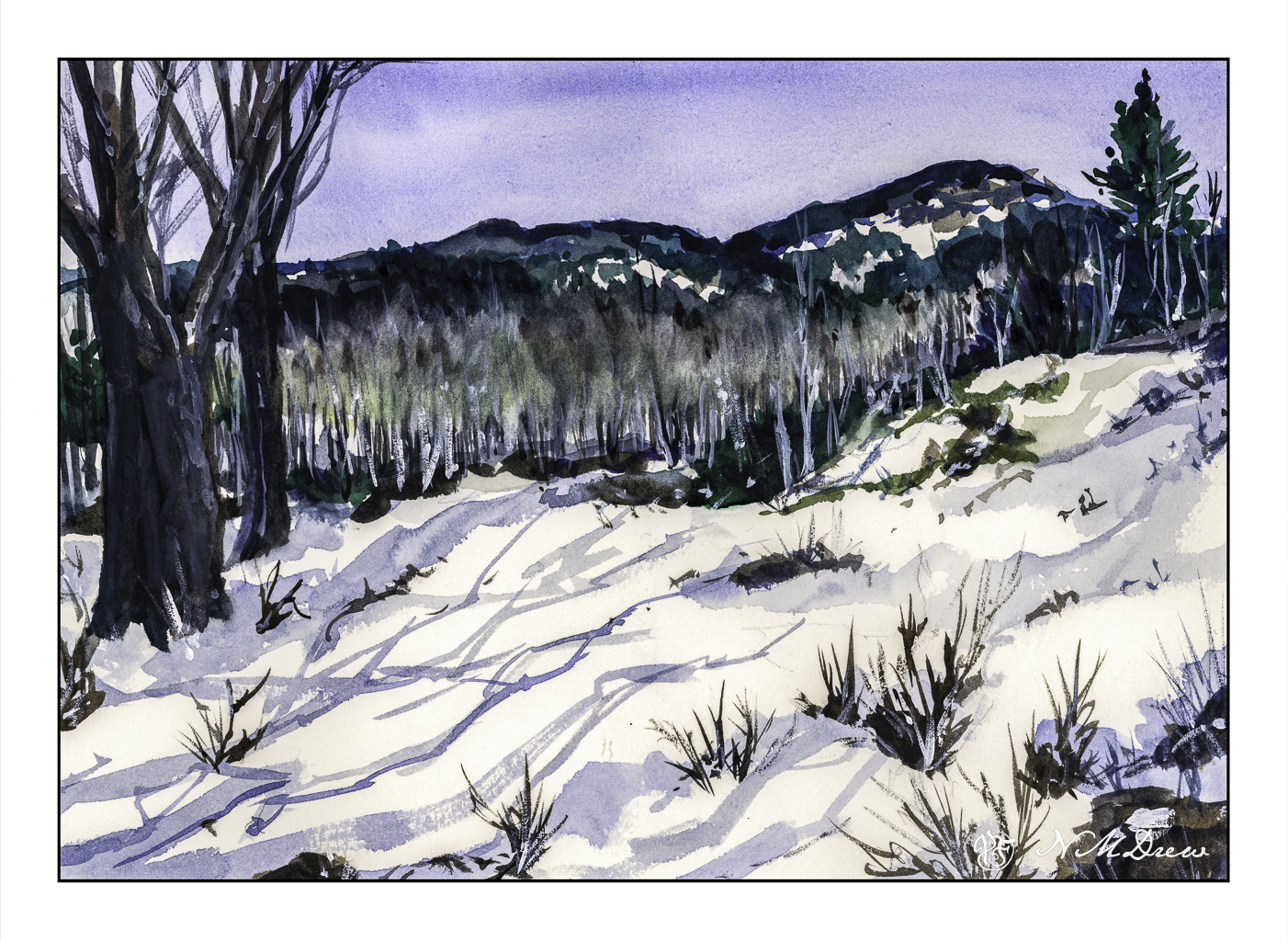
It is exactly a week before Christmas. Today, in SoCal, the wind is blowing, there are fire warnings, and it is about 77F (25C). It is a bit warm. Snow seems to be a good subject to watercolor!

The focal point of painting this picture, besides wanting a bit of snow for the season, is to see if I could catch the softness of the bare birch trees that act as a barrier between the snowy foreground and the mountainous background. Anyone who has seen the leafless birch trees at a distance knows that there is a sort of haziness as all their branches overlap and merge into a softness with some detail and without much detail at all.

I used a relatively limited palette – mostly ultramarine, Hooker’s green, burnt sienna and umber. In some areas I used titanium white gouache, partly to place definite snowy details as well as to blur into the birch branches to create that softness I wanted to express.

Not a bad way to spend an afternoon out of the wind!

Watercolors, Arches 140# CP, 10×14, some gouache.
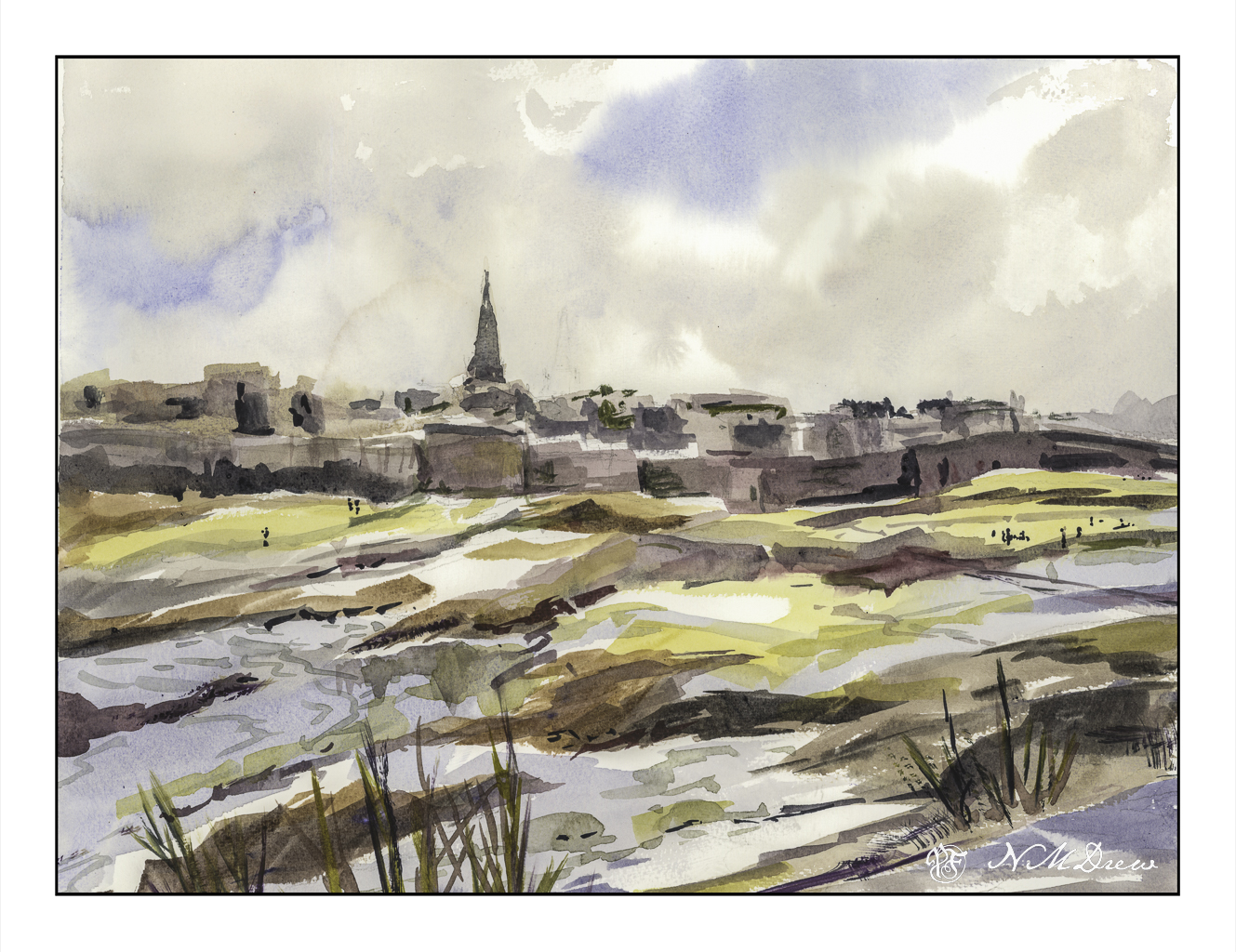
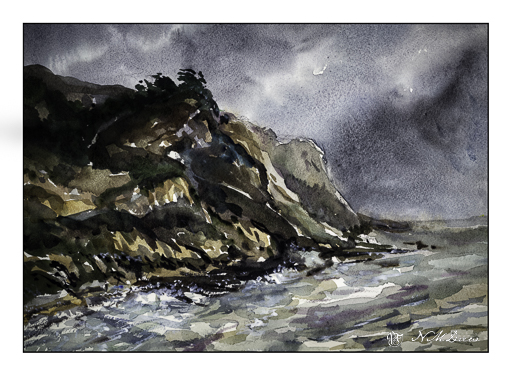
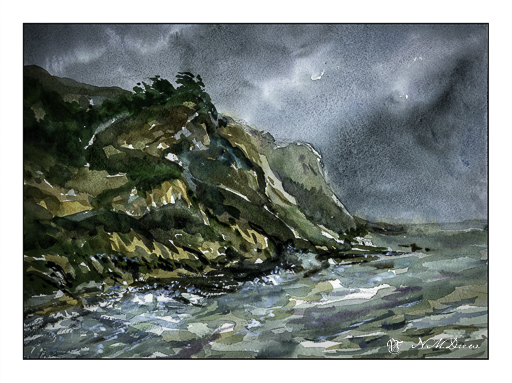
Beach at Saint-Malo

Remember the story All the Light We Cannot See? Ever since, the city has intrigued me. The story is worth reading, and if I remember, the movie was decent as well.

This painting was a quick one, and it turned out pretty good in my opinion. The point was to just paint, as well as to try out a new-to-me watercolor paper. This paper is St. Cuthberts Mill’s Bockingford paper. It seems to be a fairly soft paper as the tape around the edges of the painting pulled up some of the paper even though the tape was on the paper itself for only a short time. Using the heat of a hair dryer solved this problem, like it usually does. I liked this paper, though it does buckle a bit more than I expected when wet, but in the end it has proven to be well behaved.

Initially I scanned this painting on my Epson V600 scanner using the Epson software. Contrast was harsh and the sky barely showed up. I have had issues with watercolors and the software before – not at all pleasant to see – and then I suddenly remembered I have VueScan by Hamrick. I closed out the Epson software and fired up VueScan – and, oh, what a beautiful difference! This software is something I bought years ago, and I never really thought about using it for watercolors – I use it for photos I plan to run through Negative Lab Pro. Well, I guess I will have another use for it as well! Sheesh.

Watercolor, St. Cuthberts Mill Bockingford, 12 x 16, CP 140#.

Under a Rain of Acorns

Yesterday I decided to finally go on a bit of a hike by myself. With a bit of trepidation, I told people where I was going, had my phone, and watched where I put my tootsies. The result was a slow meander, camera in hand, down the Chumash Trail. Housed within the area of this park is the Chumash History Museum, closed weekdays, but worth a visit.

Overhead, the half moon could be seen above the trees and glimpses of the mountainous ridges above. The pathway beneath the trees was dark and shadowy.

Though it is just weeks away from winter, here in SoCal we are experiencing dry weather, sometimes warm, sometimes cold. This morning I woke to the news that Malibu is, once again, in flames. An ironic bit as I thought I should walk down the Chumash before it burns again as I knew the east winds were on their way.

My favorite old, old tree is gone, with only a reminder of its former grandeur and an empty sky overhead.

Grasses, flowers, poison oak, toyon were present, too – some plants I could name, others I could not, but it was just a pleasure to be out, looking for deer and squirrels – listening to the birds – canyon wrens mostly, an occasional crow – and to the patter, patter of the acorns.

And, of course, everywhere are oak trees! Some scorched, some fallen, some cut down and left to return to the earth after the fire. Each tree has its own lovely and crazy shape and form, like dancers bending and arching. The Chumash Trail is a magical place and one which soothes the soul as only a walk under the trees can . . .

Last Night

Last Night

Several weeks ago the fierce, hot east winds (aka Santanas, Santa Anas) came through and the neighborhood over the hill went up in flames with over 320 structures lost. Now we expect the same situation for the next few days – dry, windy, low humidity. I used to love the wind, but now I fear it.

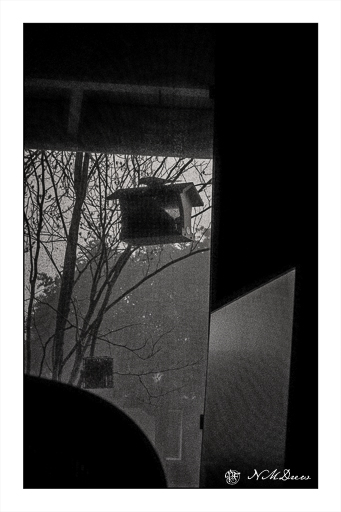
For days we have had sunshine and no rain, few if any clouds in the sky. Day and night are clear with a gentle breeze. Last night, though, the fog came in. Not a pea-souper fog, but enough to leave water droplets on Inky’s fur after her evening walk, and chill enough this morning to feel the damp in my bones. I always like how fog and mist distort and blur the world around me, so last night I decided to take out the little Canon G7X camera to see what I could get.

We have a cinder block wall surrounding our house, and as we sit on a corner, we really have rather nice views up and down the streets in the neighborhood. The top of the wall is flat and stable, so I used it to hold the camera in place, focus in and out for composition, and then pushed down the exposure button and held it there to keep the camera steady. I got a few shots, but this one is my favorite.

How Busy Can It Get?

No, I don’t mean life. I mean trees and piles of leaves and undergrowth – all the stuff that makes up a good fall scene! Some trees have dropped a bazillion tons of leaves and others are hanging on to them. Years of detritus build up on the ground, creating a fertile place for new growth, plant, fungal, insect, which in turn supports other life in the wilder world outside the super market.

Anyone who has taken a walk in the woods or tried to photograph or paint this jumble knows exactly what I mean – it is really a busy-ness of color and texture and shape.

This is my sketch, done with a fountain pen and some Carbon Ink by Platinum. The paper is a bit rough so it could be what caused some difficulties with the pen nib – or the pen itself is not the best – or both. I tried to convey light and dark and texture with different pen marks. Straight lines to show trees and texture and the shadows of the trees across the pathway. Contrast is suggested rather than emphasized as I wanted to use paint to give the sense of shadows and so on. With that in mind, I pulled a palette of my out-of-the-tube paints rather than pan paints, cleaned them up and went to work.

As you can see, light and dark are more emphasized with the use of color, as are the colors of the leaves and the complex shapes of trees on the left and undergrowth on the right. The leaves that have fallen have some variegation, depending on when they fell and how long they have been there. Green grasses and weeds peek through. There are a few rocks, too, and leaves on the pathway. Tree shadows fall across the trail and up onto the tree on the right. There is a brightness to the day despite the murk of the undergrowth.

After adding color, I waited for the picture to dry. I made some color adjustments. And then, back to the waterproof ink pens. This time I used Micron pens and my Uniball waterproof pens. Micron pens come in different nib widths (here 0.1, 0.2 and 0.5) and the Uniball is labelled as “fine” but in reality makes a darker, thicker mark than the Micron pens.

Overall, I am more pleased with today’s ink and wash sketch than the one I did yesterday of the plumeria. As usual, I did not do a preliminary pencil drawing but just worked from the end of the path and then moved back and forth to establish areas. I really like my tangled tree in the lower left and the shadows on the big tree on the right. The brightness of an autumn day is expressed. Now all I have to do is get to scuffling through those leaves and it will make my day.

Pen, ink, watercolor wash, on Strathmore Vision 140# CP paper, 9 x 12.