An Afternoon in Thought

With sensing a bit of accomplishment in the field of photography, it is beginning to take a place for me in the world of creativity.  I am beginning to see what I could not see before.  This ability to relate to photography pools it into other arts, specifically, painting.  Consequently, I am re-reading about and re-evaluating the works of Georgia O’Keeffe, and as an extrapolation, the life and works of Ansel Adams, both whom I admire as artists.

Georgia O’Keeffe – Blue & Green Music – 1921

Their creative viewpoints resonate with my own.  While I doubt I shall ever meet their productivity, or creativity, I can appreciate their work as individuals.  What interests them interests me – looking at landscapes, parts of things, plants.  The natural world in color and in black and white, both lush and sensuous, and stark and contrasting.
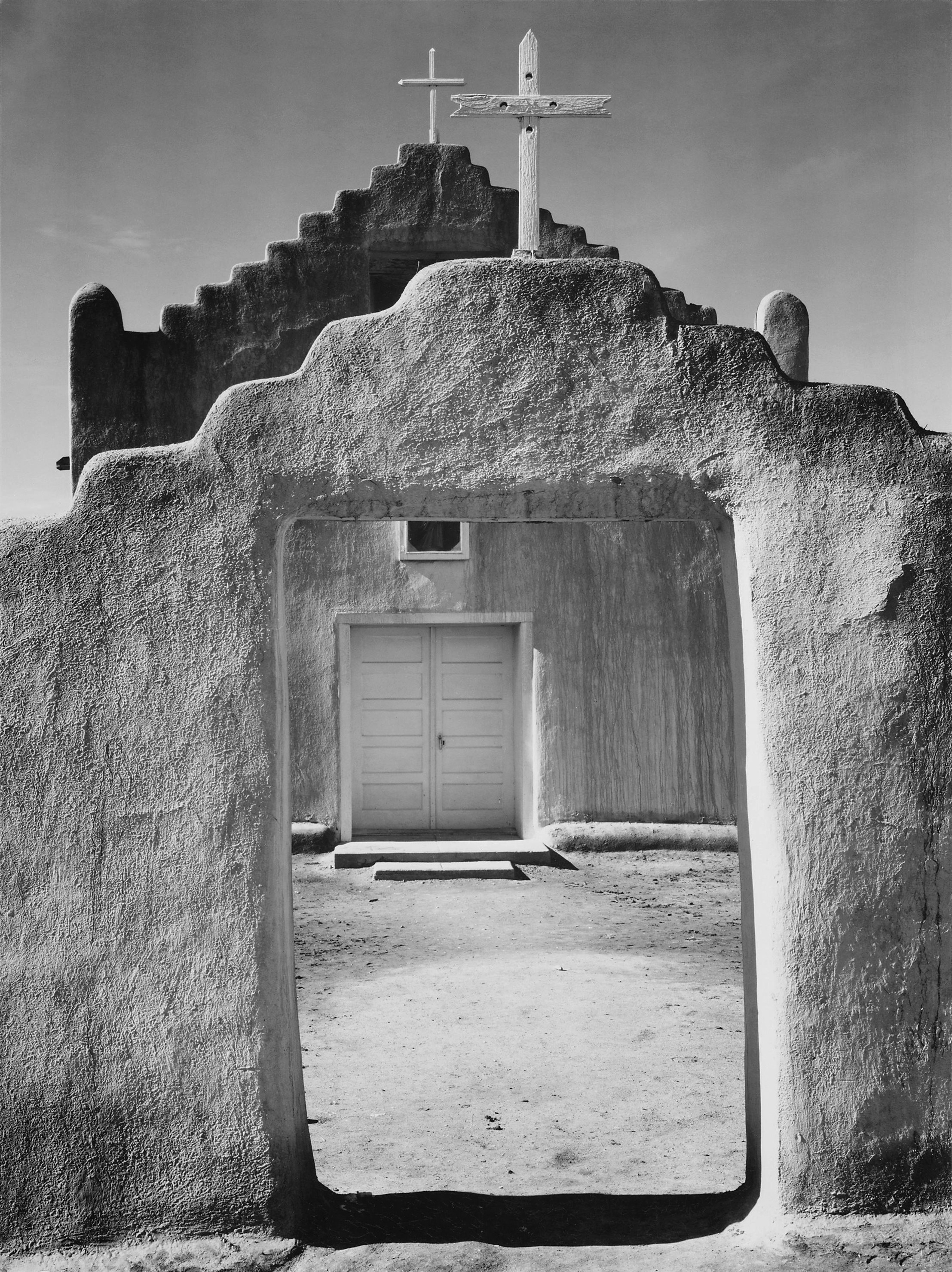
Ansel Adams – Church, Taos Pueblo – 1942

In particular, I like the fact they do not put people in their works.  I cannot think of a single painting by O’Keeffe in which there is a person; few photographs by Adams include individuals.  And that is not to say I do not enjoy images of people, but it is more likely I am not going to go out of my way to pursue then.  People like Kirk Tuck and Vivian Maier are wonderful photographers, both of whom photograph people.  Kirk works often in his studio, but also does street portraiture; Maier, on the other hand, was a street photographer at its finest.

I may at some point venture out to take pictures of the random person, but for now, the textures and colors of the world around me intrigue me enough to focus on them.  And perhaps I shall begin painting again – my period of apprenticeship in photography may be ending.

Vision

I have been pondering just removing this blog from the blogosphere, but haven’t done that.  I have been ignoring it because I am not so sure that it is going in any direction right now.  I am going in some directions, but not necessarily the ones that created the impetus for its existence.  The result is something of a conflict, because I have been “doing” photography for a bit, and ignoring other things I really love.  The fact is, though, photography gets me outdoors more and more, and I have forgotten how much I like that.  Not outdoors at the mall, but outdoors in the wilder parts of town (i.e. places with trees and plants, not crazy drunks!).  Suburbia is sadly lacking in open space at times, and that means actually taking time out to travel and drive somewhere to be outdoors.

On the other hand, photography also means packing things to lug along.  I have always been a minimalist in hobbies.  I don’t like to need a ton of stuff to do anything, but often photography seems to require a few things more than I really want to haul around.  The trade off, though, is producing things that are better than just okay.  I also think I have reached a point where I have a fairly good handle on some of the technical aspects of photography, along with more thought about composition and light, and not just running around pointing and shooting everything I see.

In a nutshell, I have reached a point of dissatisfaction with photography.  That is interesting, don’t you think?  For me it is.  What this means that I am now at a point where it is necessary to push past the do-able to the less do-able.  This may mean making advances in technique.  It also means advances in creativity.  At this point, photography is rather boring.  Sitting at a computer to post process a picture is horribly boring – but useful.  Even that, though,I prefer to keep to a minimum.

For me, the most frustrating part of photography is that it is not as manual as I would like it to be.  Simply put, I like working with my hands.  Cameras are not especially complex when it comes to pushing a button . . . there is not a lot of finesse, as there is in painting.  It is different.  On the other hand, I do get outdoors and crawl around in the bushes.  That is kind of fun.  And I don’t do that when I paint or knit.

The question, here, is what is my vision as a photographer – person – artist – human?  Perhaps by defining my artistic vision I can open the elusive.

So, let me make a start . . .

I want to find the essential and the beautiful in the world around me, whether in nature, in a person, or in an object, whether simple or complex.

Bull?  Let’s see where it goes.

Too Much!

Some people learn things as they go along, living life on a daily basis and incorporating the new stuff without the disruption of everything else.  Not me.  When I am curious about something, I jump headlong with both feet.  This has its good points and bad points, the worst being it can become obsession – luckily, it never does.  The thing is, I am a collector.  I collect information.  I collect things.  And I don’t usually get rid of stuff, either in my mind (though I will as senility approaches), in my closet, under my bed, or in the garage.  Granted, when I return to that interest, costs are very insignificant!

Lately, in case you have not noticed, I have been doing a lot of photography, to the point I decided to set up a blog separate from Ink, Yarn & Beer.  Here, I really want to get back into more personal things, such as the painting and knitting design, as well as just discussions or whatever I fancy.  At that other blog I can focus on photography and what I am doing there, create my little encyclopedia of links, blither on about what I am doing.  I’ve gotten a few hits there, mostly spam, but that blog, like this one, is for my own pleasure.  And to create balance.

My artistic side finds photography rather frustrating, but I am beginning to see how it is tweaking me at the same time.  Thinking about how something is made – effects, colors, process – begin to move into other areas.  Looking at the petals of a rose make me wonder how I can capture them with a brush using ink or watercolor.  Looking at the light shadows in an image make me consider contrast and detail in a painting and why something in a painting works, or does not.  Realism does not need to be done, but the impact created by color, shadow, tone, shape gives an illusion of reality or its impression.

The fact is, any form of art is limited only by the person doing it.  This can because of a lack of tools or innovation, or because one is still in the process of becoming or doing.  I am limited by my interests in a lot of things – painting, knitting, reading, writing, photography, gardening, hiking, traveling – and it keeps me from doing anything well.  On Outlook I have different activities scheduled weekly – creative activities – and that doesn’t help either!  Regardless, the plan is to try to do a bit more of all of it, and be focused on it when I can.

Perspective

I’ve seen a lot of “impressionist” photos of late – rather like some of them.  Certainly a different skew on photography itself, and how to use a DSLR.  Tonight, rather bored, decided give it a bit of a shot.  These were done with long exposures – 8 seconds to a minute I think – with jerks and jitters during exposure.


Art of Ink, i

Yosa Buson

Now that I’ve pulled out my brush and sumi again, I start rummaging through the drawers of the internet.  I’m not quite sure how I found Yosa Buson, 1716-1784, but I did; I’d forgotten about him.  He was both a poet, and an artist, frequently combining the two.  As a painter in ink, his skills are more than evident in the work below.

Two Black Crows and a Hawk - in Snow and in Rain

Both Crows and Hawk show many techniques that allow expression of the elements in sumi-e.  Snow is painted by going around the flakes – dark ink makes the white flakes fly.  Rain is expressed by using a wide brush, such as a hake, that has been dipped in light / medium ink.  The ink is squeezed out by hand or blotted on towelling, and the bristles squished between the fingertips to create an uneven edge.  Rain is painted in one long sweep; two or three strokes may be all that is needed. These two paintings are very Japanese in approach to working with sumi.

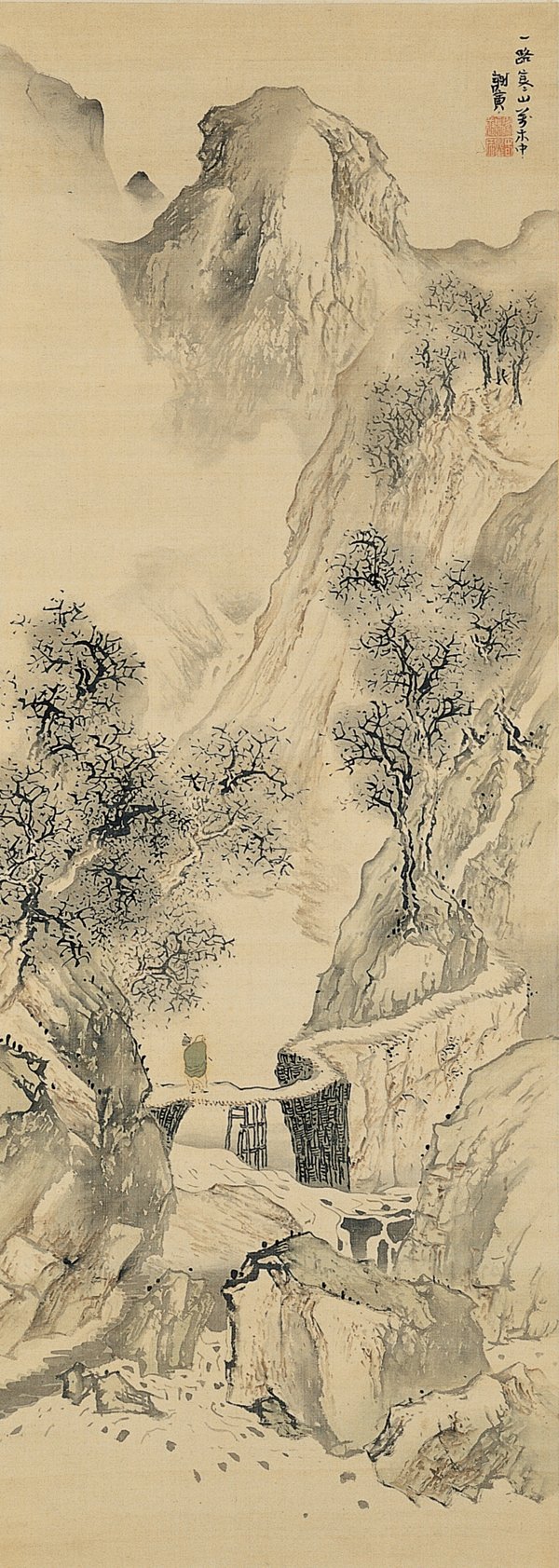
Landscape with Solitary Traveler - 1780

In Landscape with Solitary Traveler, we have a more Chinese approach to ink painting. The theme and constructs are familiar – mountains, water, a path, a bridge, a pedestrian. As in Western painting, Asian painting has its own history and symbolism. The beauty is that these familiar subjects become personal and unique in the hands of the artist. This painting is done in ink, with only a touch of color added to the traveler.

As I mentioned, Buson also wrote traditional Japanese poetry. Here are some translations of his haiku.

coming back—
so many pathways
through the spring grass

in seasonal rain
along a nameless river
fear too has no name

more than last year
I now feel solitude
this autumn twilight

Before the white chrysanthemum
the scissors hesitate

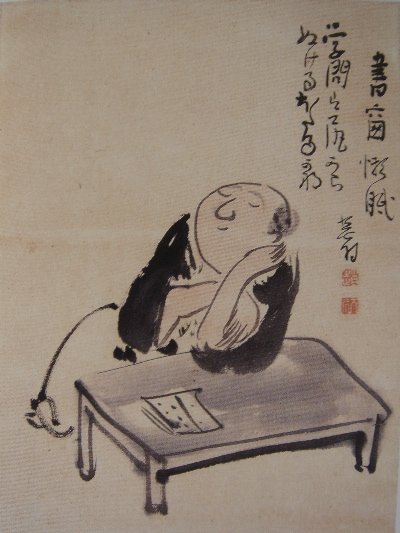
Besides being a master of wash and line (in word and ink), Buson was quite funny. I came across this painting and could not help but laugh. And here, both painting and poetry mingle, albeit not too politely.  Dave Bonta writes about this picture quite well.  Understanding the language – and the humor in the translation – may be read about here.

Bonta translates the writing,

gakumon wa ketsu kara nukeru hotaru kana

as

All this study—
it’s coming out your ass, oh firefly!

Perhaps I should stop while I’m ahead . . .