



Irises – in Color – in Ink
The iris – the butterfly flower – is just too much fun to paint! And quite a challenge as well. The videos make it look easy, but I assure you, it is not! The shape of the flower petals is far more difficult to do in a few squishy movements than it appears. Loading the brush, with ink and / or pigment, is also a challenge.
Of all the videos, I looked at Virginia Lloyd-Davies’ the most. The reason for this is that she has multiple irises in different positions. She also uses similar approaches for each iris, but varies the iris enough so that brush variations also occur. By watching her video repeatedly, it became possible to actually learn a great deal by imitating.
For these pictures, I used the same paper. The paper is double xuan, which is an absorbent paper which is heavier than student grade, and much nicer as a result.

Unfortunately, I did not take very good pictures, but at least they are clear. In the picture above, you can see some attempts are better than others. This picture represents my first attempts at painting irises in color. The ones on the left side were done with the paper turned around – what you see are upside down. The reddish-purple ones are my first ones, the blue ones later on. You can see there is some improvement. As always, my sense of value seems very off to me – not enough contrast between the light and the dark and middle tones. The yellow iris was just awful. The yellow paint has a decidedly greenish cast, and I could not find my white paint (I’m using Marie’s Chinese Paints) – or maybe I’m just out of it. Anyway, it held no appeal once the color was on the paper.


These two side-by-side paintings were my tries at creating the irises and attaching them to the stem. Not very good. The colors of the irises are not bad, but the shapes leave a lot to be desired. Leaves as well are unpleasant.

This painting with the reddish irises is better than the blue ones, as far as some of the shapes of the flowers. Those of you familiar with orchids in Asian painting will realize that these are orchid leaves, not iris leaves! Well, I guess I have some sort of hybrid here.

Once I got frustrated with color, I got out a Chinese ink stick and ground up some ink. I made three shades – light, medium, dark – and went to work. Again, contrast was an issue, but the flowers, stems, and leaves became a lot nicer. This one was the first attempt which pleased me.

The second sumi iris also shows a problem with light / dark, but the composition is pleasing to me.

And this one, the third one, pleases me the most. Still some problems with light / dark, but not so badly. The entire flower is looking a lot better, from top to bottom. Certainly some of the irises are rather blobby, and the buds don’t quite make it. Parts of the painting are too busy or crowded, but, over all, I think I am seeing some success. Certainly I plan to continue practicing, and I hope that I will be able to produce a creditable flower.
Leftover Ink
This is what I did to use up the rest of my sumi ink – I hate wasting it!


All these paintings were done on Memorial Day. A few others were done as well. As far as the photography, well, let’s just say it sucks and I need to work on it. The paper is a warm cream, and perhaps I should have used a flash. Ah, well, always something new to learn.
The Final Post
Two different batches of cochineal dyeing resulted in a number of skeins – about 7 – in different shades, from pale to dark. All are gorgeous, and work together harmoniously. Thing is, what to knit up?? That is a lot of pink and rose!
What really amazes me is the amount of color I got out of a few grams of bugs. Van Stralen’s recipe was really simple, and the percentage method in metric was a piece of pie. Pushing the colors in different directions came from the final rinse in either ammonia or vinegar, with ammonia pushing more toward the blues and the vinegar more toward the yellows – or colder and warmer, to make it simple.
I let the skeins air-dry for a few days, and then pulled apart the outer yarn from that of the inner. Initially, there was some difference, but in the intervening weeks, the color seems to have evened out throughout the skeins. I expect, though, that any irregularities in the dyeing will show up when the yarn is knitted up.


Here are all the skeins in a row. The one on the very far left is a skein of this in a commercially dyed color. The remaining seven are the ones pictured above.


Yosa Buson
Now that I’ve pulled out my brush and sumi again, I start rummaging through the drawers of the internet. I’m not quite sure how I found Yosa Buson, 1716-1784, but I did; I’d forgotten about him. He was both a poet, and an artist, frequently combining the two. As a painter in ink, his skills are more than evident in the work below.

Both Crows and Hawk show many techniques that allow expression of the elements in sumi-e. Snow is painted by going around the flakes – dark ink makes the white flakes fly. Rain is expressed by using a wide brush, such as a hake, that has been dipped in light / medium ink. The ink is squeezed out by hand or blotted on towelling, and the bristles squished between the fingertips to create an uneven edge. Rain is painted in one long sweep; two or three strokes may be all that is needed. These two paintings are very Japanese in approach to working with sumi.
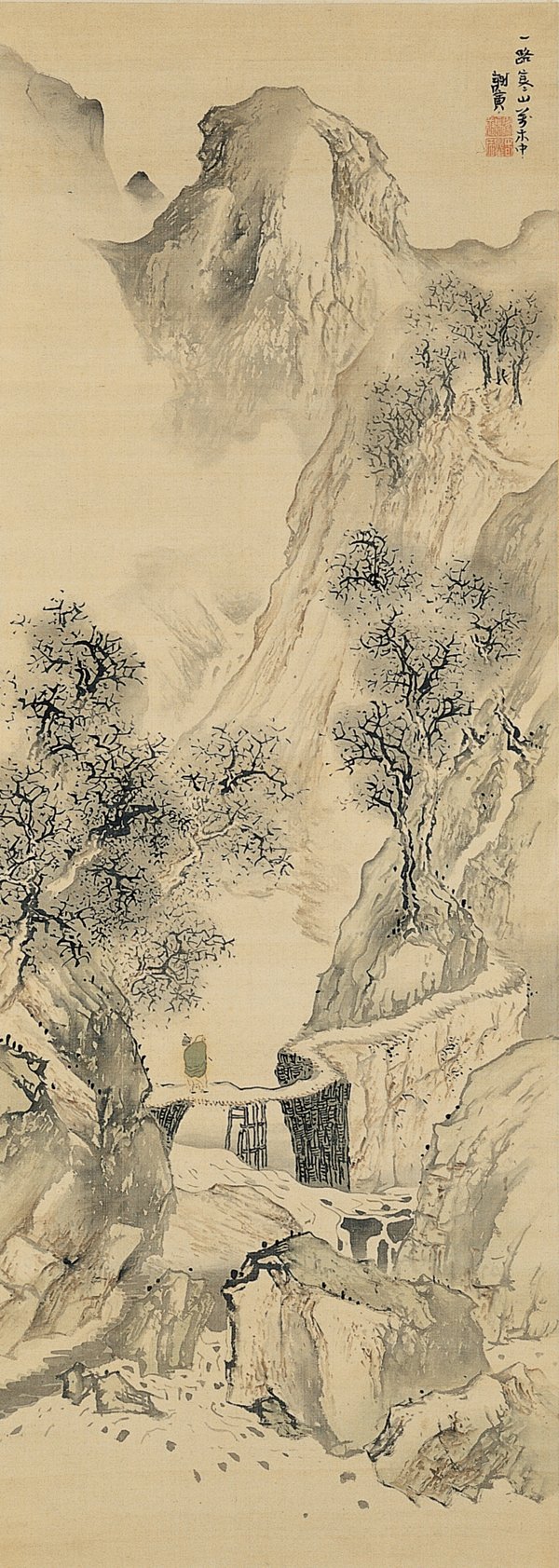
In Landscape with Solitary Traveler, we have a more Chinese approach to ink painting. The theme and constructs are familiar – mountains, water, a path, a bridge, a pedestrian. As in Western painting, Asian painting has its own history and symbolism. The beauty is that these familiar subjects become personal and unique in the hands of the artist. This painting is done in ink, with only a touch of color added to the traveler.
As I mentioned, Buson also wrote traditional Japanese poetry. Here are some translations of his haiku.
coming back—
so many pathways
through the spring grass
in seasonal rain
along a nameless river
fear too has no name
more than last year
I now feel solitude
this autumn twilight
Before the white chrysanthemum
the scissors hesitate
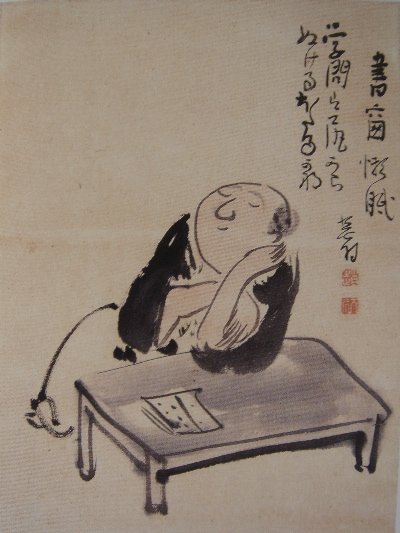
Besides being a master of wash and line (in word and ink), Buson was quite funny. I came across this painting and could not help but laugh. And here, both painting and poetry mingle, albeit not too politely. Dave Bonta writes about this picture quite well. Understanding the language – and the humor in the translation – may be read about here.
Bonta translates the writing,
gakumon wa ketsu kara nukeru hotaru kana
as
All this study—
it’s coming out your ass, oh firefly!
Perhaps I should stop while I’m ahead . . .
 Ink, Yarn & Beer