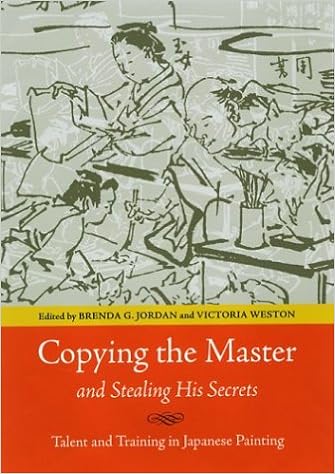
Copying the Master(s) and Stealing (Their) Secrets

This book remains a favorite of mine, in part because of the history behind art apprenticeships, but also because it serves to remind that in all arts, a period of apprenticeship – with or without a teacher – is needed to gain mastery.  As I struggle with watercolor, I remember how I struggled when I was working with sumi ink.  In sumi-e, the brushes, ink, and paper are enough to make you scream.  Watercolor is perhaps worse!

What makes watercolor difficult?  For me, it is always a matter of less being more.  With colors, I am a magpie – all those colors!  I am hard-pressed to use only a few.  With sumi-e, you have one color:  black.  And shades of grey (50 if you want).  Another struggle is to not create mud.  I seem to be moving away from that.  And finally, lines.  I like lines.  However, I want to paint without lines . . . sort of like giving up training wheels on a bicycle.

At some point, I expect I will be able to master watercolor far more than I am now, but it is a long, hard haul.  And, I admit, one I am not very happy doing.  I wasn’t happy with the struggles with sumi-e, either.

Finding a master is not something easily done in this day and age.  Rather than being apprenticed to learn a skill or craft from a master, many of us go to school.  I am way past spending 4 years or more in college – I am an old workhorse – so I learn by observation.  This means finding an artist I admire and trying to copy his / her work, as well as subscribing to numerous YouTube videos.  I also have to learn by doing, which is the most challenging part.  A part of me expects to be perfect, and my temper flares when I feel frustrated.  That is when it is time for the proverbial deep breath, retreat, regroup, refocus, retry.  Patience is also taught with such apprenticeships!

Thus, in cruising the internet, yes, I do “steal” from the master.  In “stealing,” I learn about color and composition, light and dark, contrast.  I do not ever intend to pass someone’s work off as my own – that is not right.  But, if you go to a museum, you will find people sketching the work of a master.  Why?  To learn.  The best learning is by doing.

Various painters come to mind whose work I enjoy; when I find someone whose work I admire, I like to look at their paintings and try to figure out how they did it, the order it was done, and the colors used.  By copying I learn about color mixing and how to create an image that (might) work.  Every artist is unique, and each has something to offer.  There is a lot to learn from out there, and I am humbled by the talent I see.  And I learn when I copy from the masters.

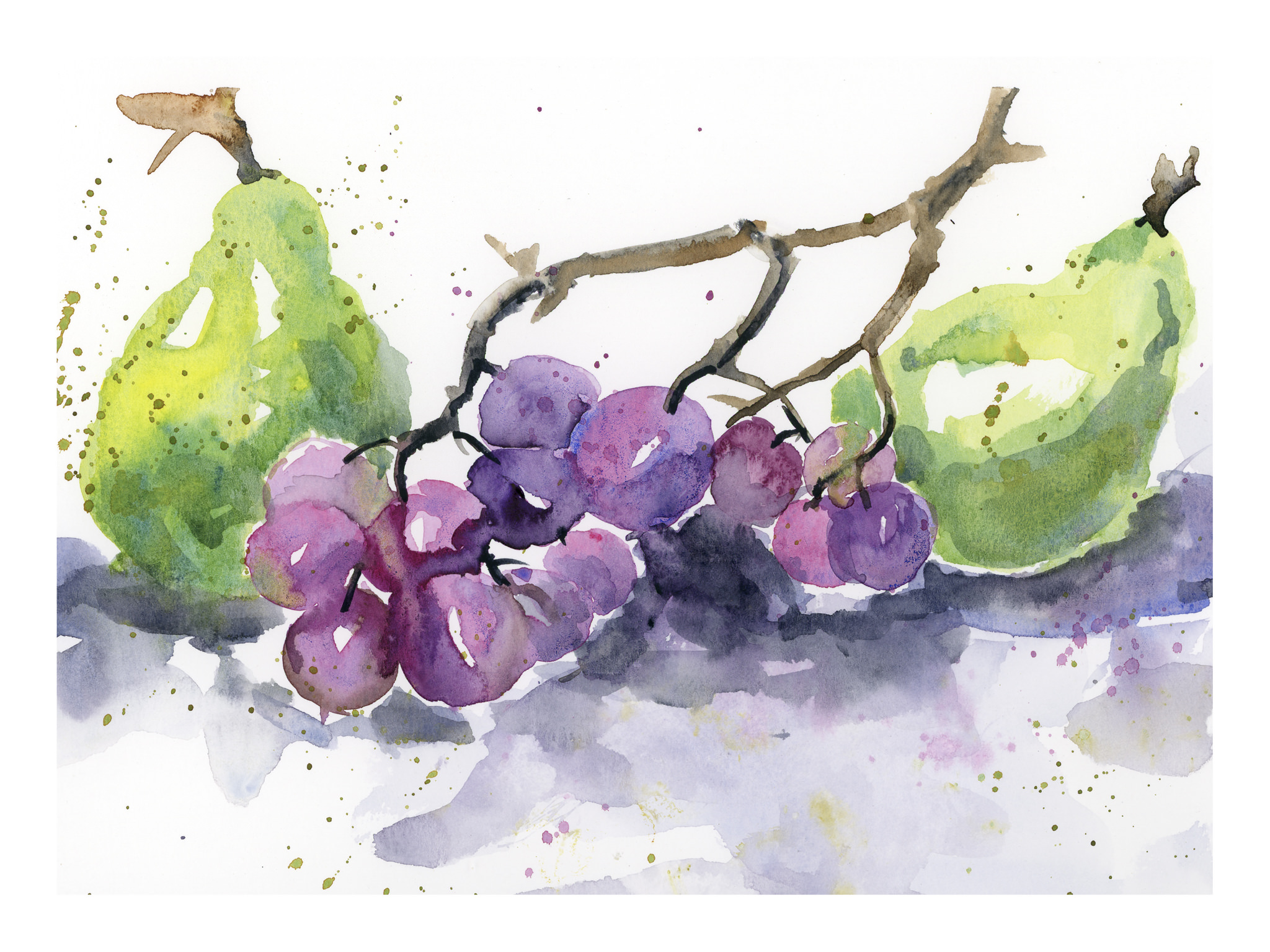
The Grapes of Wrath

Today was a day of wrath!  I was soooo frustrated!

And a day of learning.  I did four watercolors without lines.  The first two were sketched in with pencil; the last two were done freehand, relying on imagination and the precepts of sumi-e, where lines are not drawn.

In each painting, something works, and in each painting there are places of failure.  What I failed at was separating various areas from the neighboring shape or shadow.  Some areas appear rather painterly. I still have a long way to go – but at least, at last, there are no lines.

Paper is Canson’s watercolor paper, and colors include quinacridone yellow, cobalt teal, carbazole violet, ultramarine blue, burnt sienna, Hooker’s green, alizarin crimson, Payne’s grey, and a few others.

Grapes of Wrath (1)
Grapes of Wrath (2)
Grapes of Wrath (3)
Grapes of Wrath (4)

Yosemite: Reflections at Mirror Lake

This is a view of Mirror Lake in Yosemite National Park and some artistic license with color thrown in.  Here, I used a sumi-e brush and watercolors.  Yes, lines.  No mud.  This is the first picture, other than my pencil cup, that I really like since I started this project.

I began with a photo, then drew in some lines, used the ink brush to create the bones.  Then it sat overnight and in my sleep I imagined how I would paint it.  Parts worked out, parts didn’t.  After the colors were applied, I went back with my sumi-e brush and redid some original strokes and then added others to create contrast and so on.  Colors include phthalo blue, indanthrene blue, organic vermillion, hansa yellow, quinacridone gold, Hooker’s green, carbazole violet, cerulean blue, and ultramarine blue.

Logitech Mouse in Red

This is perhaps one of the first paintings – sketches? – that I have done since re-visiting watercolors a few weeks ago that does not depend on ink lines to make sense of what it is.  It’s still floating in space, as the shadows are not especially strong.  There are a few things I like here.  One is how there is a highlight in the read of the mouse.  Another is the central brownish panel on the side of the mouse, which is a mixture of carbazole violet and Naples yellow.  The black outline of the mouse is in Daniel Smith’s Genuine Sodalite, which I picked up some time ago.  It’s a rather nice blackish color.  The blues in the background / foreground are from Daniel Smith’s Lapis Lazuli Genuine, which, like the sodalite, I picked up on a whim.  It will be interesting to see how these two paints work.

I also set up my studio palette the other day, choosing a variety of colors to fill my Quiller palette.  I did a color study and labeled all my colors, except one, which I think might be yellow ochre – or not!

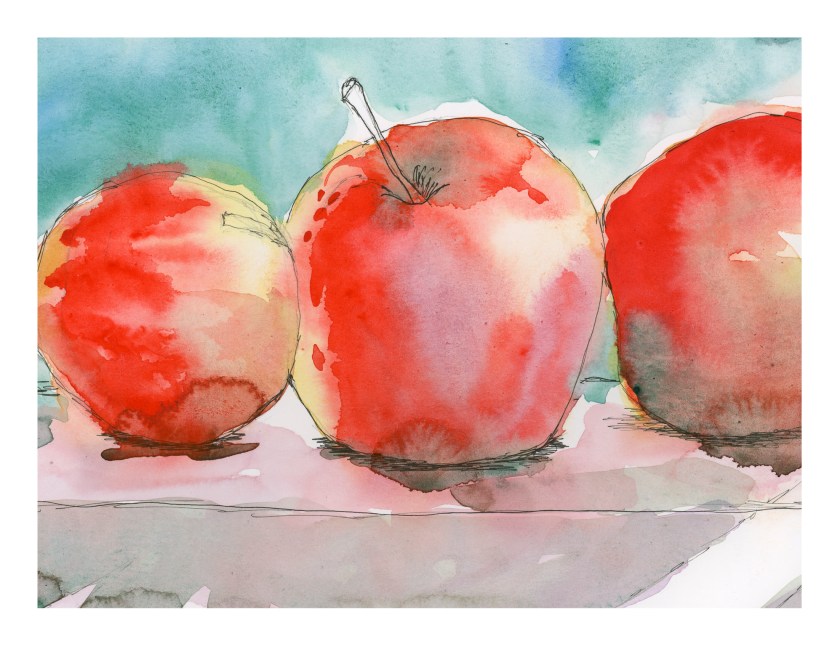
Apple Apocalypse

Up front, not too thrilled with these apples.  I was working on trying to get an apple to look like an apple in a painterly manner, hoping against feeble hope that I could make them look like apples without the lines.  Didn’t work.  On the other hand, mud is not present, and there are some nice bleeds of color.  I worked too wet, which is also why a lot of the problems exist.  I wonder what apples will look like in a year . . .