Wood & Wetland

I have been spending the better part of the day watching the videos in a class in which I have enrolled before starting any of the projects. There are a lot of short videos in it pointing out this and that, but sitting still to watch the longer ones makes me restless. I need something to do with my hands rather than just sit on my butt! Knitting is out as I have a few projects at a point which need some focus, but oil pastels did the trick. I can draw / paint and watch at the same time. I may not get all of the video, but I do get a lot of it – just as I am now as I write this post.

I picked up a few brands of oil pastels and a 6-pack each of soft white and greys. These include Sennelier, Mungyo, and Caran d’Ache. The white and grey pack are labeled “Anders” I think. I also have been playing on various papers, but decided to check out the Sennelier oil pastel paper. It seems to do a pretty good job despite all the rubbing in of layers of pastels.

Oil pastels, at this point, are more like playing with crayons for me. I blur the colors using my fingers and tortillons. Harder oil pastels make up the underlayers with the softer, oilier ones going on top. This adheres to the adage of “fat over lean” in oil painting, so it makes sense that it would apply to the oil pastels as well.

Oil pastel on Sennelier paper; about 5×7 finished. Scanned on Epson V600.
13 / 30

Day 13

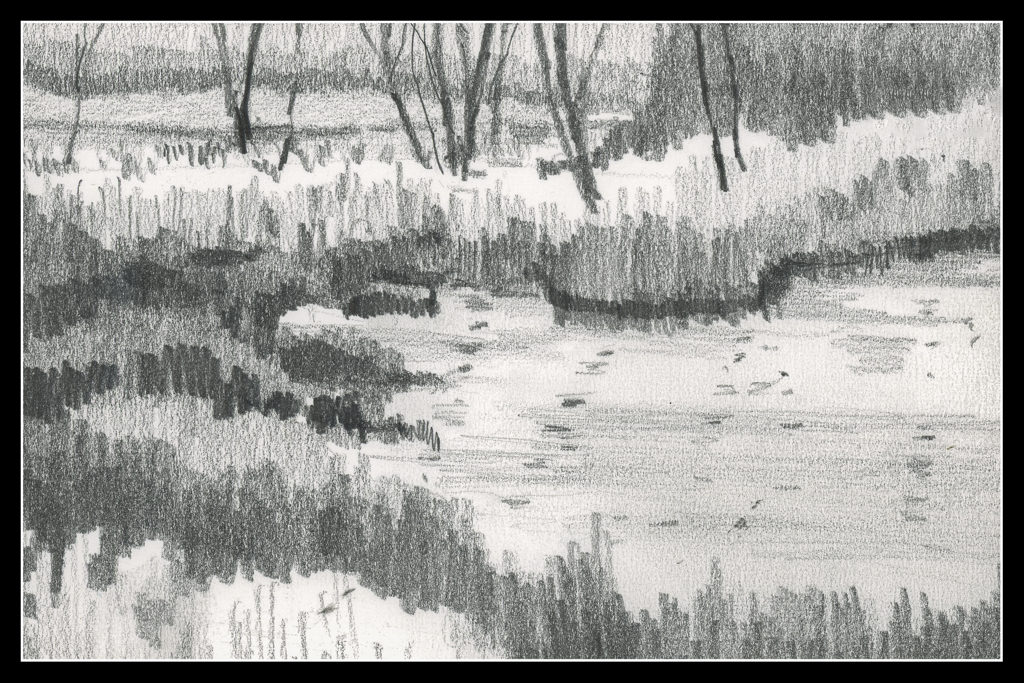
A couple of takeaways from last Saturday’s Zoom meeting for this class. First, a suggestion to make marks simpler – horizontal and vertical. Done. It creates less noisy masses.

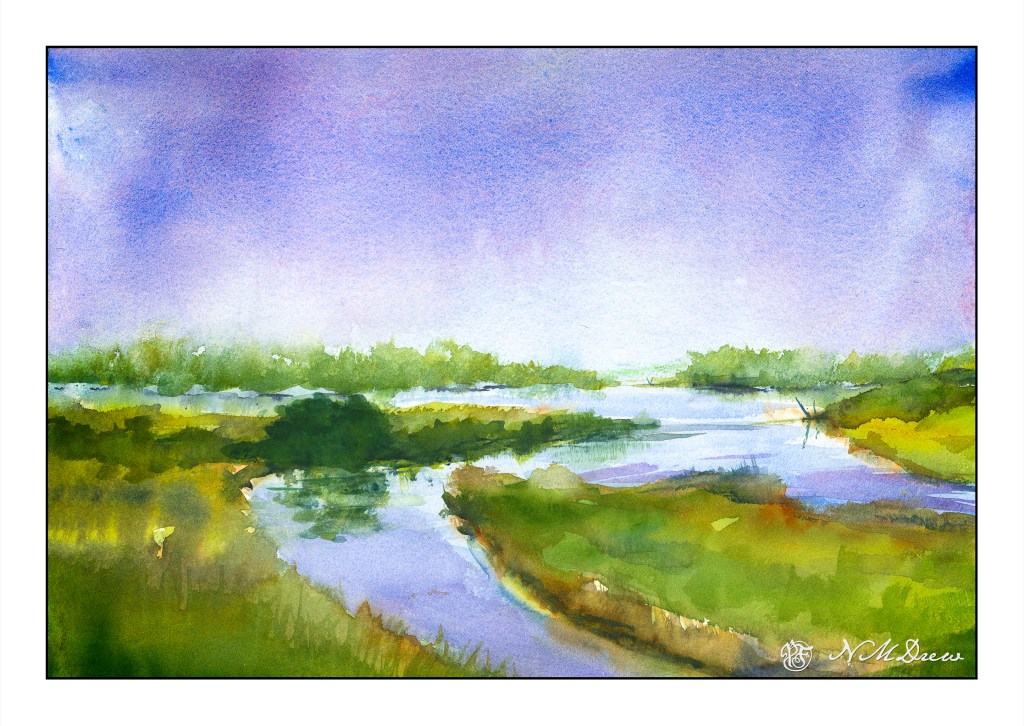
Obviously this is some kind of wetland. I sort of made it up. It’s missing a focal point. I should have done that, but this is sort of dashed off as we are soon to leave for a birthday party and I would like to put on my frippery!

Tribute

This wet-in-wet is drawn from imagination and inspiration by the Dutch watercolorist Edo Hannema. I just love his mastery of water and color and wet paper! There is a peaceful quality to his paintings of the Dutch landscape.

Painting like this demands thought and deliberation and patience. Timing is also critical. Painting wet-in-wet requires risks and experience. Too wet, everything just blurs. Paint wet paint which is wetter than the still damp colors result in blooms which can destroy a painting in now time. The rule is drier paint into wet paint – that on your brush must be drier than the stuff on the paper. Blot your brush if in doubt.

Oops! Just noticed that the horizon is dead center . . . compositional error! And that big green blob is also a mistake – tried to fix it – but since this is time for true confessions, I may as well own up. 😉

This is one of my more successful wet-in-wet paintings. Usually there is a big cauliflower bloom somewhere – sometimes I can hide it, but it feels really good not to have one this time! Remembering the trick of drier onto wetter was a good thing.

For the first time, I am painting on 300# paper. This is Kilimanjaro CP from Cheap Joe’s. With such a heavy paper, lots of water can be used. 140# warps but this stayed virtually flat. I like this paper a lot – certainly will be getting more of it.

Under the Summer Sky

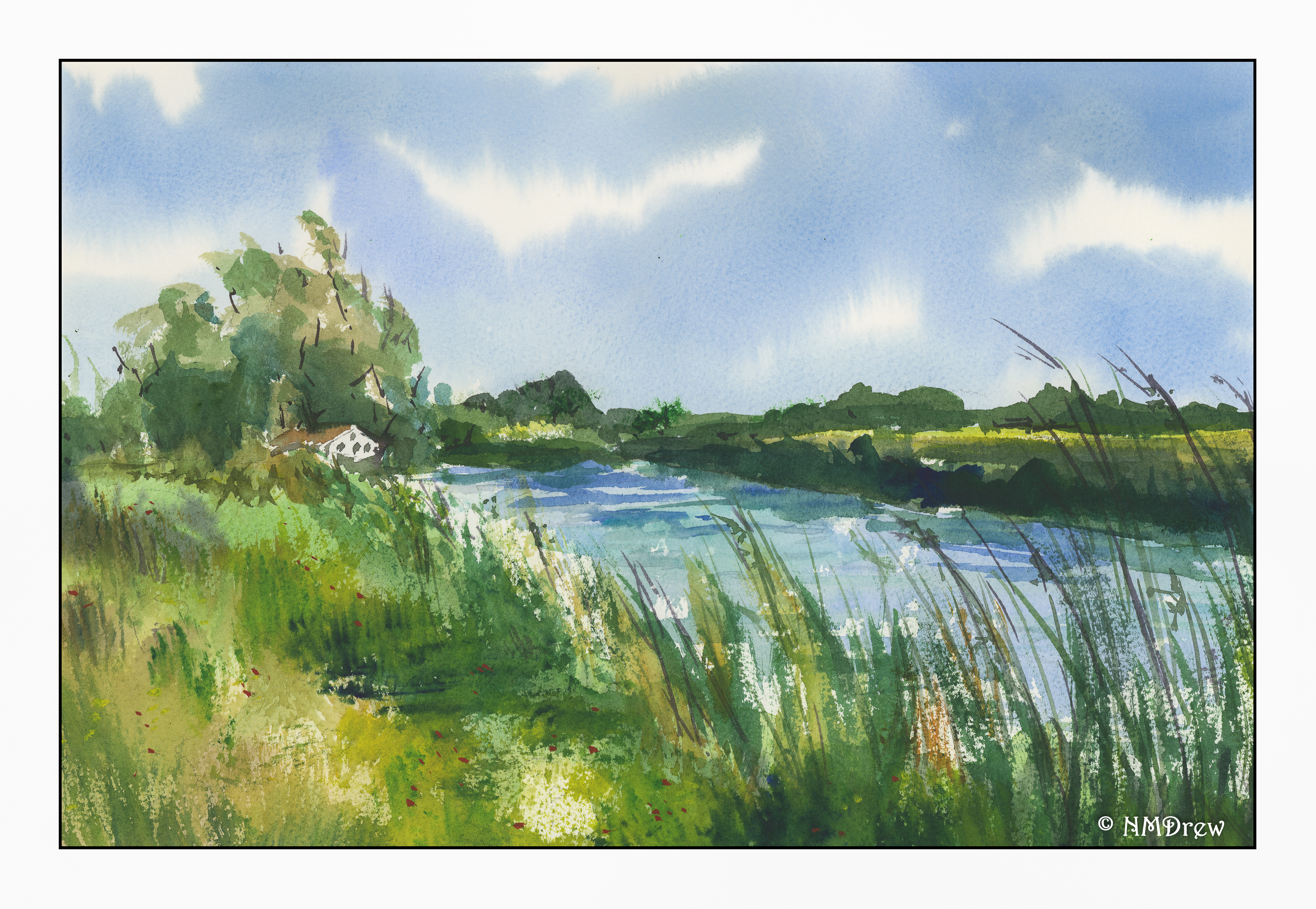
As summer fades away, the fires are burning along the west coast, and the clarity of the air has gone murky. This is when I dream of being somewhere along a river, with sun, blue skies, flowers and birds. I’m a country girl at heart, stuck in suburbia! (But there are advantages of the ‘burbs, too.)

I used Arches Rough 12×16 140# paper. The texture is not as smooth as what CP or HP provide. There is a lot more “tooth” which is great for dry brush and texture, such as in the foreground grasses and middle ground trees. I used one of my hake brushes for the general grass shapes, and a larger, harder brush for the sky. Before I painted any large area, I used the hake brush with clear water, letting it soak in a bit to help the paint to spread more easily on this rough paper.

In general, I am pleased with this painting. DOF works fairly well. I put in a building, too! For me, the most flawed area is the squared-off top of a tree to the left of the building – maybe I will go in later to correct it, but for now, I’ll let it be, cuz it’s time for a nap!