Iceland Moss is really not a moss, but a symbiotic association between algae and fungus. It grows to be about 10 centimeters tall or about four inches , and is found in alpine and cold climates such as Iceland from which its name is derived. It can be used as an herbal remedy for a variety of complaints, such as pulmonary problems or digestive upsets and so on, although there is not a popular need for it apparently. The terrain and latitude of Iceland makes tall trees not very common, but Alpine plants and low-growing seasonal flowers, lichens, moss, and other such things make for a lovely landscape.
By no means am I trying to be a scientific illustrator, but looking at these plants, such as this lichen, just really fill me with delight because they’re so beautiful and so tiny.
Tomorrow I’m going to look at some of the photos I took before my tumble in Reykjavik, and hope to put in some drawings of buildings and historical landmarks before we move on to Ireland and Dublin where our next stop was supposed to be.
The Mountain Avens, also known as dryas octopetala, is an Arctic alpine plant that’s in the family rosacea. It is a small flower which grows at higher elevations. It is found in the Arctic tundra of northern Eurasia, North America, and, of course, in Iceland where it is the national flower. Areas with high altitudes, such as the Rocky Mountains or the Alps and other high mountain regions, also are home to this lovely little flower.
For our next adventure into Iceland I thought it would be really interesting to explore what life was like historically. In a country where there is obviously a lot of rock and turf, and a seeming dearth of trees, what better thing to think about than how people lived for 1000 years before modern architectural technology?
I googled “traditional Icelandic houses”as Reykjavik is full of modern buildings and not a lot of older ones that I could see. This made me curious. Native resources created perfectly warm houses. People need shelter, and creatively use what is at hand. Early on around 950 CE, native birch trees were for building, and later wood from shipwrecks or detritus found on the beach was used.
There’s a really great website called The Ultimate Guide to Turf Houses in Iceland and it is filled with the history of preserved buildings, including houses, barns, churches, and schools. Turf buildings deteriorate quickly if not maintained.
Below is a really good video on that web page, which I’m linking below. It has some great information in addition to the aforementioned web page.
I took some time to rummage around the studio and found my pad of paper I had set aside – an inexpensive, 100% cotton paper. This paper does not work well with really wet washes, but does well with lighter ones.
I always enjoy the combination of ink and watercolor. Drawing in ink without a pencil drawing beneath seems to me to be far easier to do, and more logical (if that makes sense) than working with a pencil for a value study and then inking over it, erasing the pencil, and then painting. I guess the amount of lines makes more sense to me than the pressure of the pencil? Anyway, I decided to see what I could do with ink and watercolor.
Nothing fantastic, but it does have a nice composition and sense of value to a point. I think the details – or lack – makes an ink drawing express itself. From there, I began to lay in some light washes, referring to the color sheet from my new set of 48 Schmincke Horadam half pan set I mentioned a couple of posts ago. Already I can see my heading toward specific colors, but looking at the painted color sampler, I tried different ones, like English Venetian Red. That color has never made it into my palette, so this was fun!
It took awhile to get comfortable using the pans as I usually paint with tubes. I am experimenting with things to decide what I want for plein air painting and drawing. Thus, pan paints make sense as does pen and ink. I like to travel light, and don’t like lugging this and that around. Having a lot of colors also allows for less need for water, I think, when sketching and painting, as mixing colors can be a bit of a job. At the same time, I do mix, such as blues and yellows to make greens, and having a lot of choices makes for some new and interesting result.
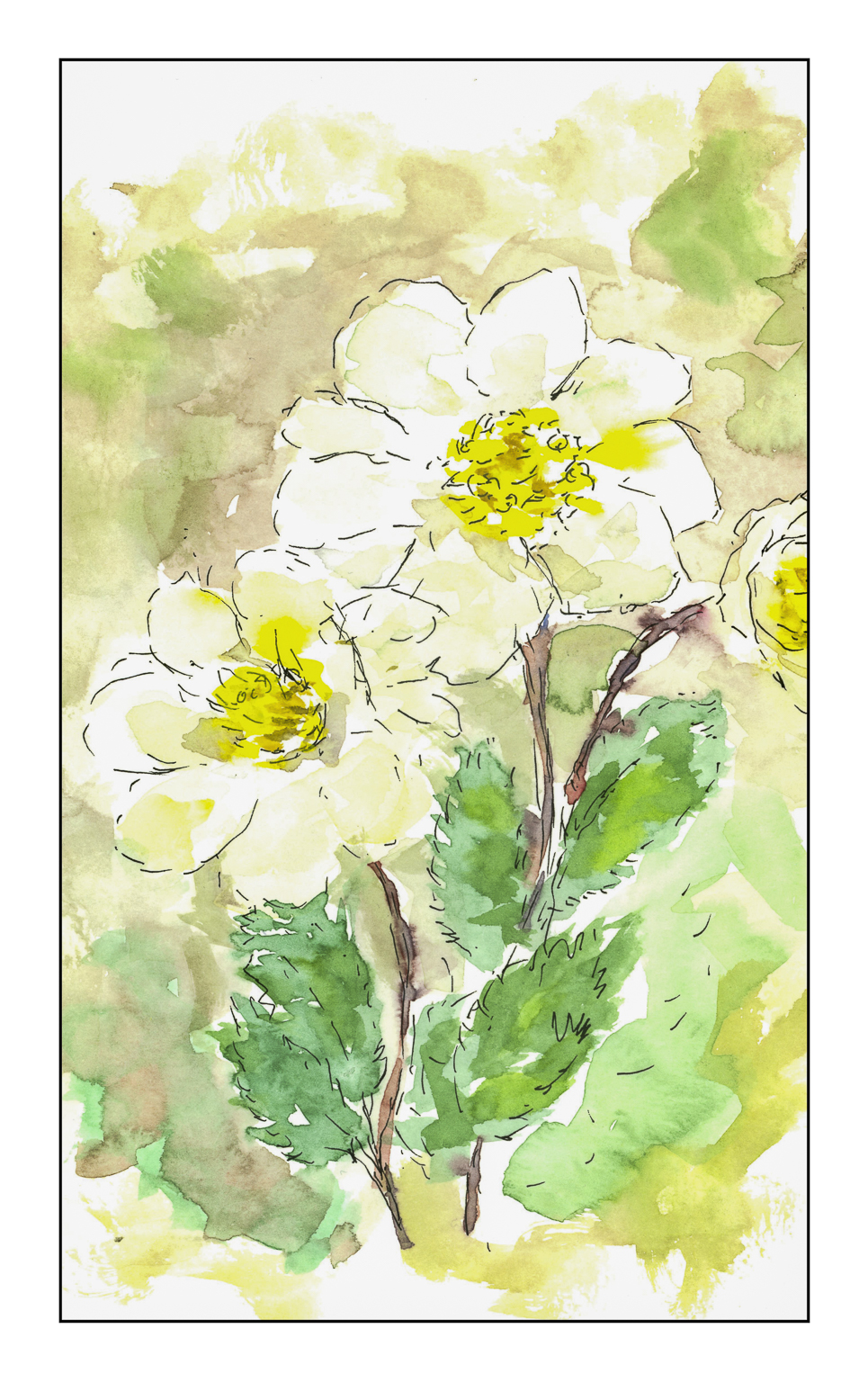
So, here is the finished ink and watercolor sketch. 9×12 on 100% cotton student grade watercolor paper. Light washes were used for most places, including the darker areas. For the darks, though, I did need to work on making my paint thicker and heavier. And I got to mix a lot of greens in addition to using the 4 or 5 available in the pans themselves. Altogether, I was pleased with the results and the experience.
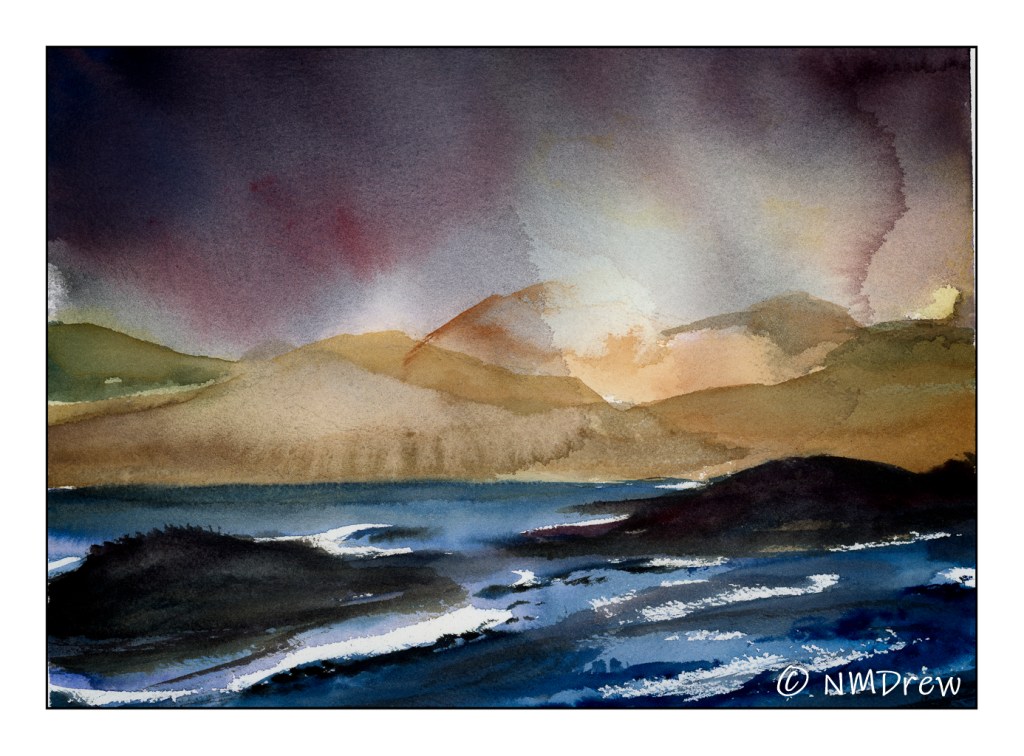
I painted this shortly after doing the “Quiet River” watercolor yesterday. Still in a patient mood, which was good, as this painting, though small, needed a bit of thought and a bit of patience to complete. The effect of rain meant laying in heavy washes on damp paper and letting them run. In other areas, damp color had to dry only so far before a dryer brush could apply color. As you can see, I rather messed up with a second round of wet paint because of the bloom (aka cauliflower) in the middle right. Still, it works, catching the breakthrough of the sun and the scudding quality of a storm on a windy day.




 Ink, Yarn & Beer