Actually, this is just one part of a creek which runs throughout my neighborhood and into the open space a few miles away. Rain water washes into the creek from gutters, and you can find breeding ducks and frogs in its water. I have even seen an egret there. After our rains, we have a fair bit of water in it, and I enjoy walking a few blocks to the park, just to hear its trickle and see kids and dogs having a bit of a riot.
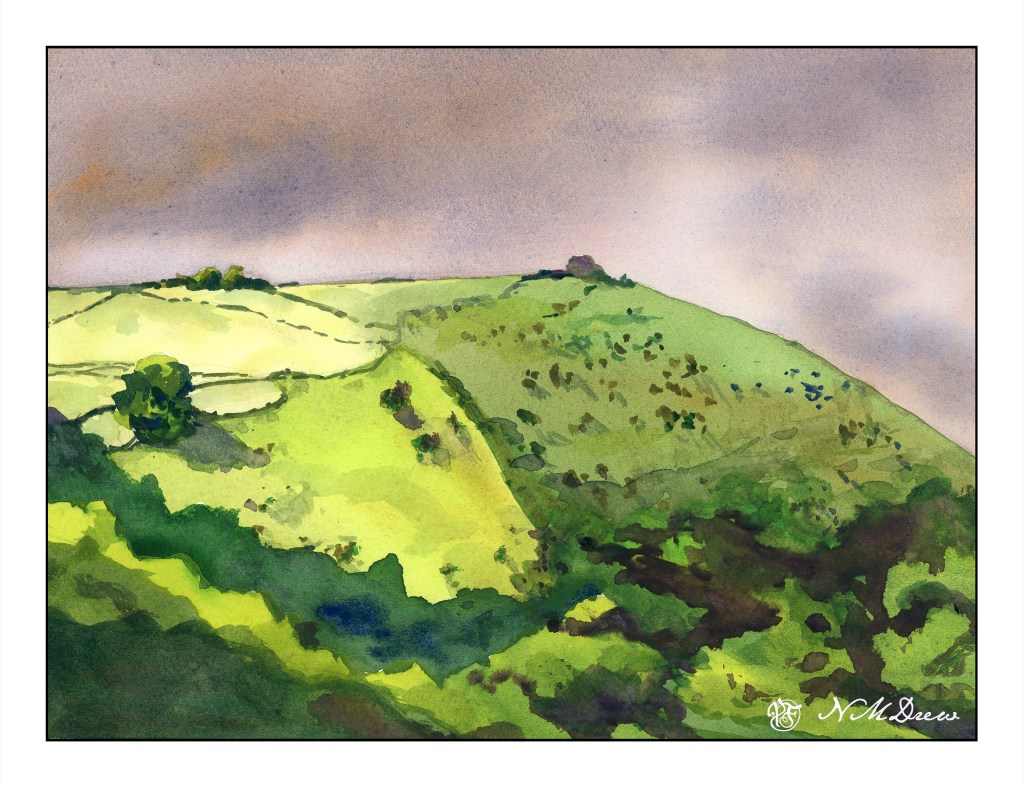
I am having a lot of fun, despite frustrations, with this repeated subject for a watercolor. Today was bit more thought out, and the focus was just planes of washes to create depth, dimension, or at least some attempt at it. I think I am seeing this more and more as an abstract as I work on it – planes of color to suggest the trees along the base of the headland. I dropped a blob of color on the hill that wasn’t in the previous two, and tried to do a bit of a save, but not really successfully. Ah, the joy of watercolor!
I was playing around yesterday – rocks, water, reflections of rocks in water. Glazes and lines became trees on the rocks and then some. I was rather pleased with it since I wasn’t aiming for anything . . . .
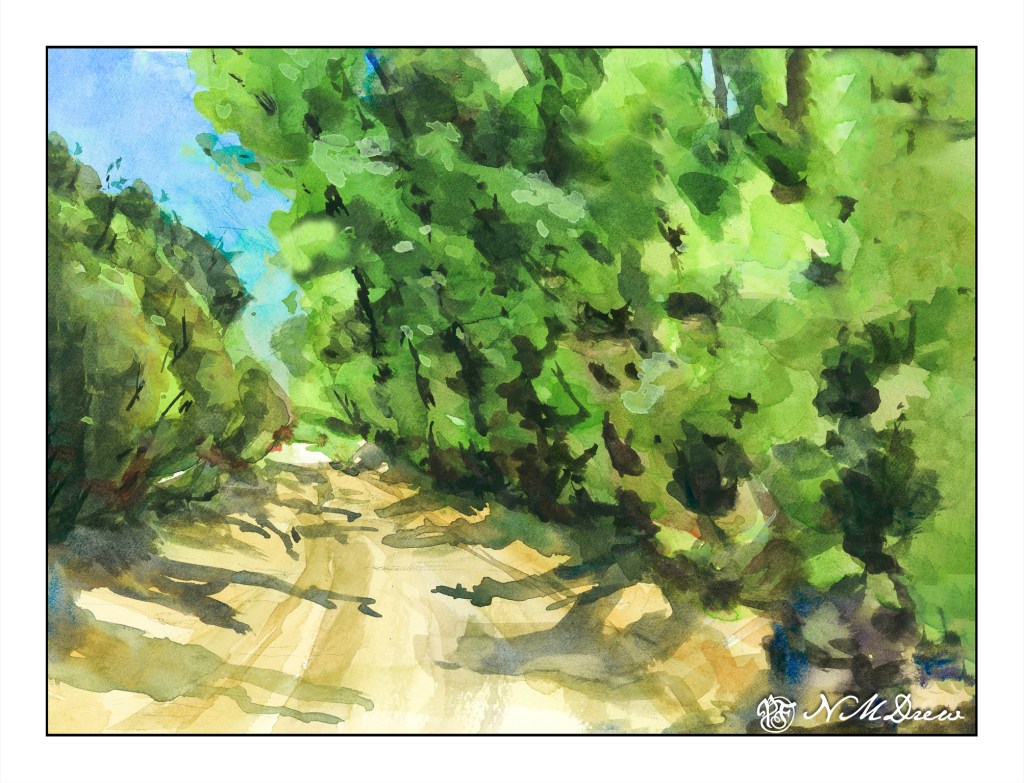
Yesterday I posted a hill that was a color study. Today I am posting trees and a road as large planes of colors. Green is green, but there are variations. The trees on the left are different greens than on the right, and so is the brushwork. The center is a rather yellowish grey road. The shadows, too, are a bit different, with the ones on the left are more blue than on the right, which have more green.
The painting started out with my using my the Schmincke half-pans on a large painting for the pans. I struggled to get enough color to begin a wash and resulted in blooms and cauliflowers everywhere. The whole beginning was a major disaster and I was not happy. Then I pulled out my usual large palette with tube paints. Start the painting over on a new sheet, or try to rescue it? I decided to apply some life saving . . . .
The sky was a big cauliflower. The trees on both sides of the road were big cauliflowers. I began with using clear water to wash away as much of the cauliflower lines, blending the paint into the surrounding color. This ended up with some lifting of color and some stripey areas, but that was not a bad start.
The next step was repainting the sky. It started out a nice light color but with another layer of color it got darker. Then the trees. Each layer became darker although I did manage to save some lighter areas. This was annoying, but then I decided to re-watch Shari Blaukopf’s “Trees Across the Seasons” to see her tree painting technique. It really helped.
My crime in watercolor is a lack of patience. That is what happened with this painting – my frustration using the pan paints made me impatient. I just want to get in and paint – I don’t want to pre-plan, do value studies, etc. There is a place for spontaneity and a place for patience. Outdoors is for spontaneous painting with drawing and thought; in the studio I want to be more deliberate. I made the choice to use tube paints, and be more patient.
The end result is not too bad. The original is darker than this one, but that is the beauty of digitalization – I can fix things. I use it in my photos, and I use it when I post my paintings online. Is this wrong? I don’t really know, but as far as I am concerned there is nothing unethical about such manipulation. If I were selling prints, I would be working to make sure the prints were good – just as in a photo – removing spots, augmenting colors, etc. Having worked awhile in the printing industry, this is the norm to produce modified images. Digitalizing a painting lets me crop and frame and sign it, too.
Besides helping me make a painting look better, it also allows me to see it differently. A monitor makes everything more clear, and that includes mistakes like weird shapes and splatters that I don’t notice in the original. Seeing such things is a learning experience in and of itself.
So, color planes and shapes, getting rid of cauliflowers, learning that half-pans are not best for my way of painting large, and fixing a painting that could have just gone into the scrap paper pile. Altogether, a good experience.
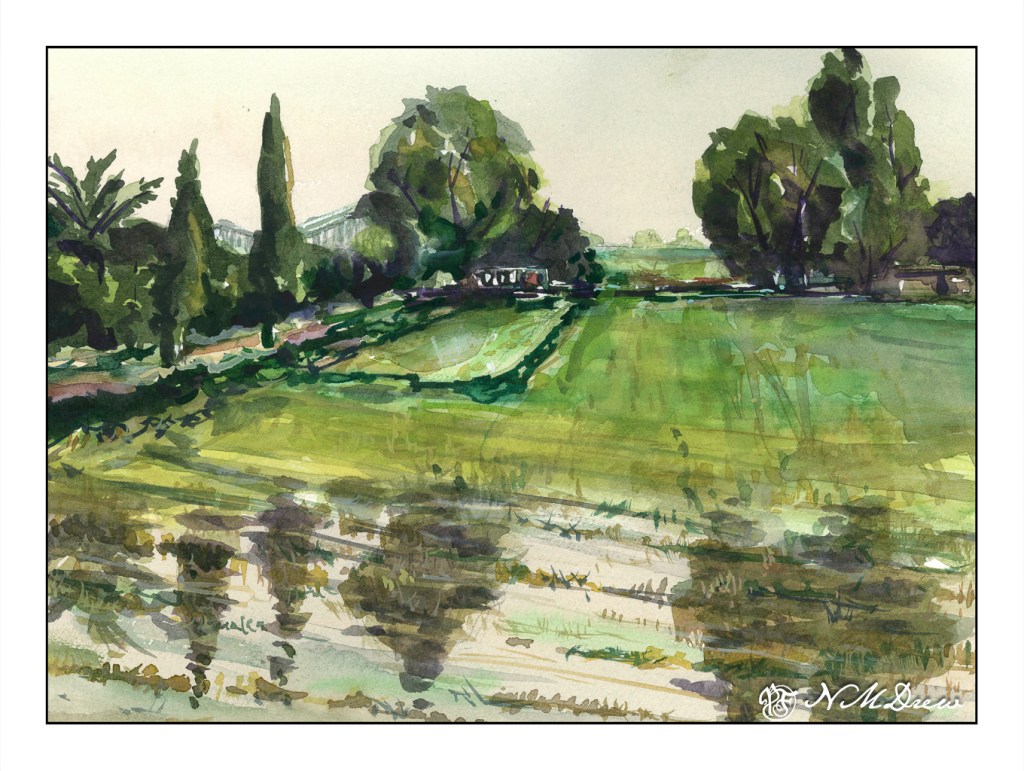
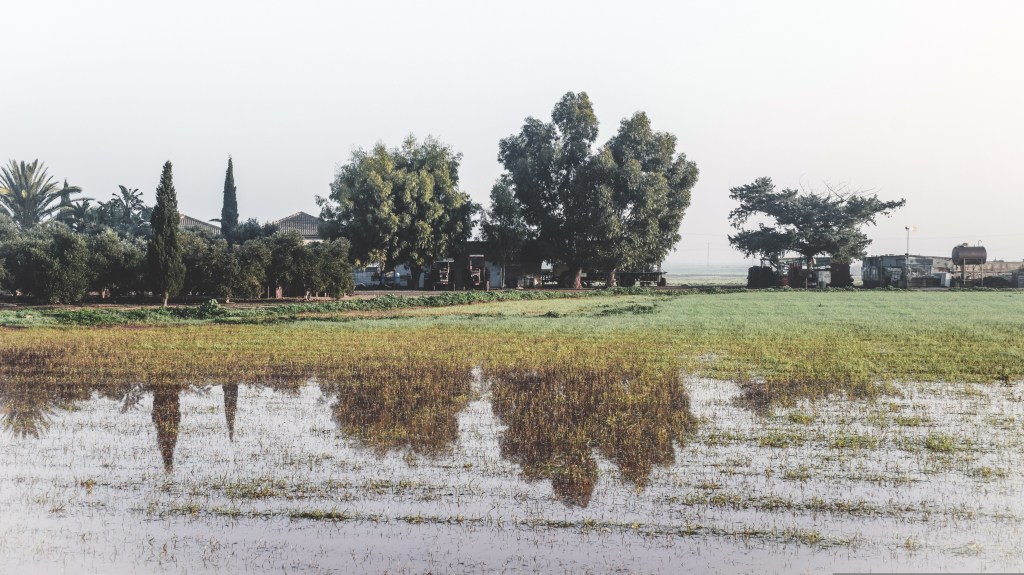
It’s been raining buckets out here, and water is just sitting on top of the ground and slowly sinking in. We have a small lake in our back yard, and it weren’t for a pump, we would really be in trouble. California has seen record-breaking rain, rain, rain, snow, and more rain; now mudslides and other disasters are happening.
While this painting is not of my area – despite the palm tree – I thought it was representative of what we are seeing here. To the west of us is the Oxnard Plain, a major growing area in my county. It is very flat, and water run-off is diverted to culverts and ditches alongside the fields, but areas still stay soggy a bit.
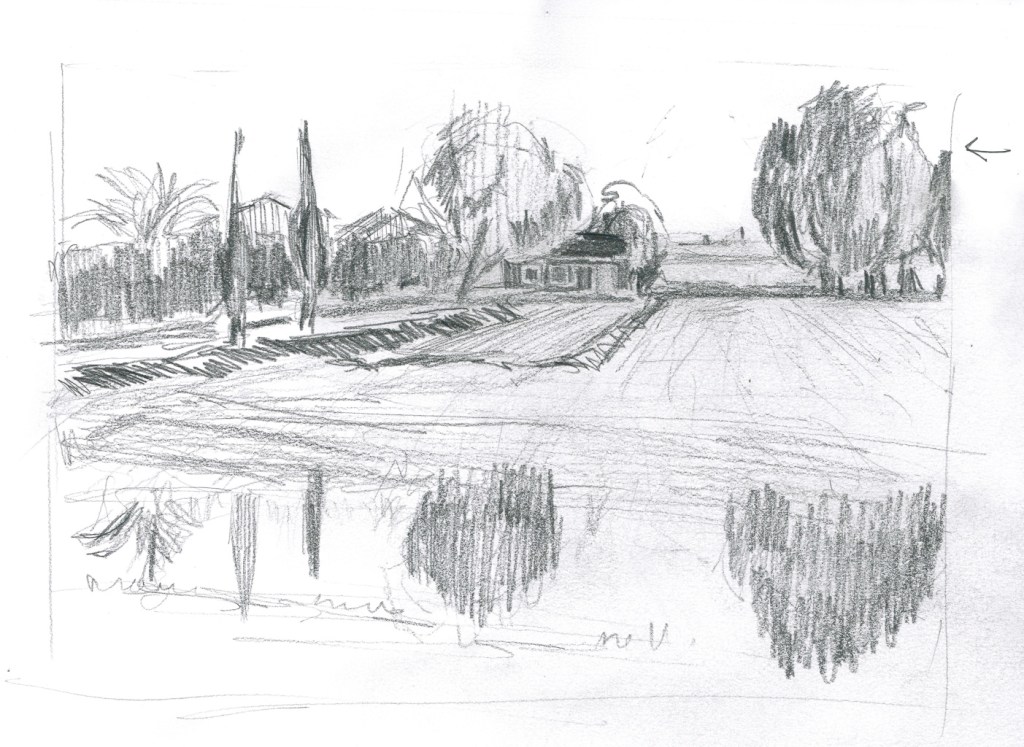
I have also been really disgusted by my last few landscapes, so I decided to make myself do value studies prior to painting. When I do, results are always better, and I am happier. Below is the reference photo from Pixabay.



 Ink, Yarn & Beer