Up the Hill

Up the Hill – Acrylic, 12×16

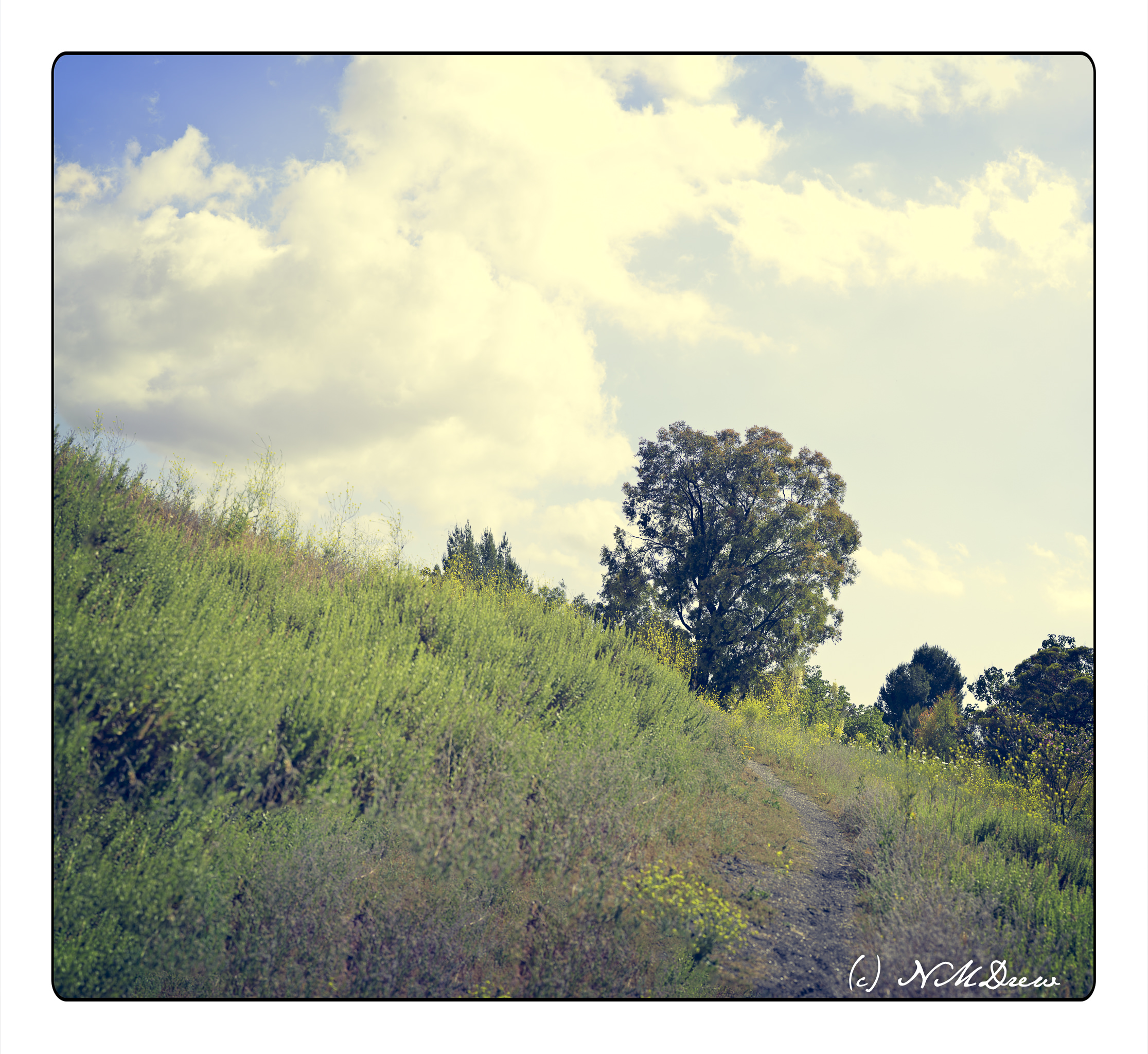
I started this painting a few weeks ago, at the first class at the local adult school with a new teacher. This is from a photo I took some time ago. I was at the bottom of a hill, looking up.

This painting has taken a lot of time – several hours – but the work has been worthwhile. I have been applying the various principles I am slowly garnering from hours at the proverbial grindstone, memorizing techniques, concepts, whatever. For instance, I think this painting actually has a nice sense of depth and perspective – something I have struggled with for a long time. The light on the trees also pleases me, as do other bits and pieces of it.

I have also learned just through doing how to get the heavy body acrylic paint into a more viscous and enjoyable mess to paint with, and that is a big help! It’s a combination of matte medium, water, and the paint itself. I dislike the plasticky quality so often that accompanies acrylic paints, so even thought my colors are bright, I think they moosh together fairly well.

I’ll ask my teacher’s opinion when I see her next week. Meanwhile, here is (to my eye at present) finished work. Below is the photo which is the basis for this painting.

14-16 / 30

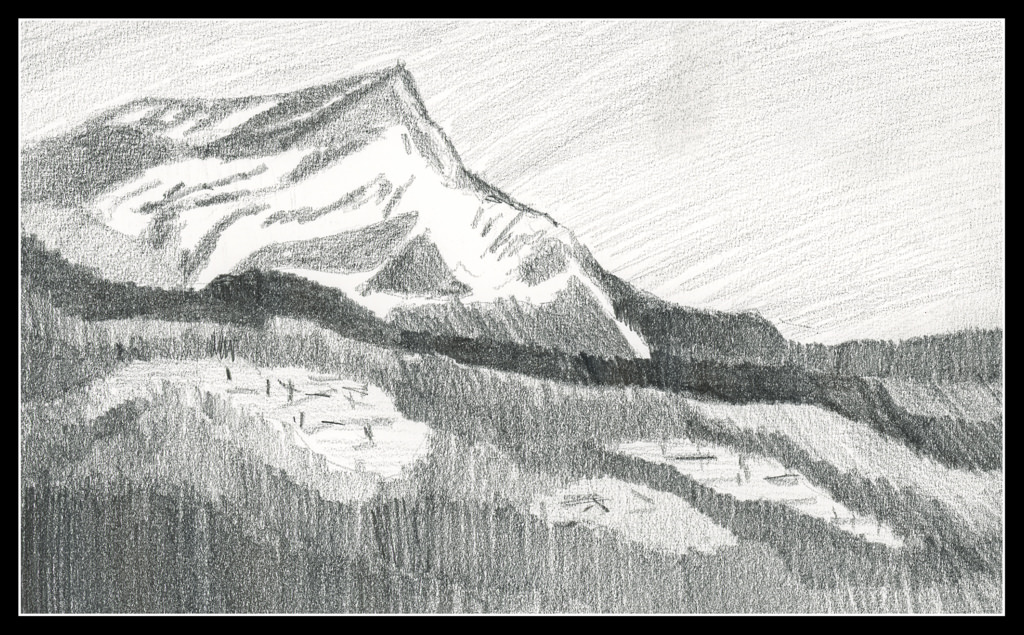
Day 14

I am beginning to lose track of the days since I began this project since some days I do nothing, and other days I do a few.

Above is Day 14. Continuing to simplify shapes and masses into values, the above should represent a mountain in the distance. From there, mid-ground is a dark ridge before the mountain, and another to the right of the mountain, behind the mountain itself. The white blobs in the foreground area with sticks is supposed to represent structures. To me, they look like felled timber. Ideally, I think the mountain itself should be lighter to represent atmospheric perspective.

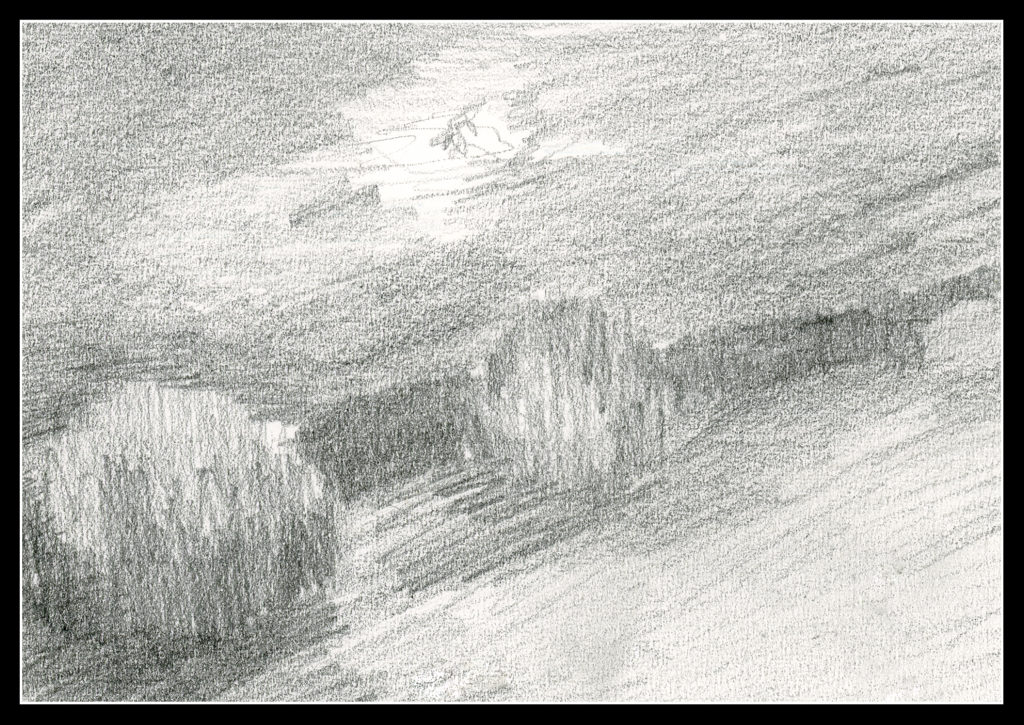
Day 15

This is an attempt at a nocturne – a night time value study to see if I could catch the light of the full moon. The bush-like thing in the middle needs some lightening at the top. Overall, I like this as a start to something even though it is so vague – but that is how night is!

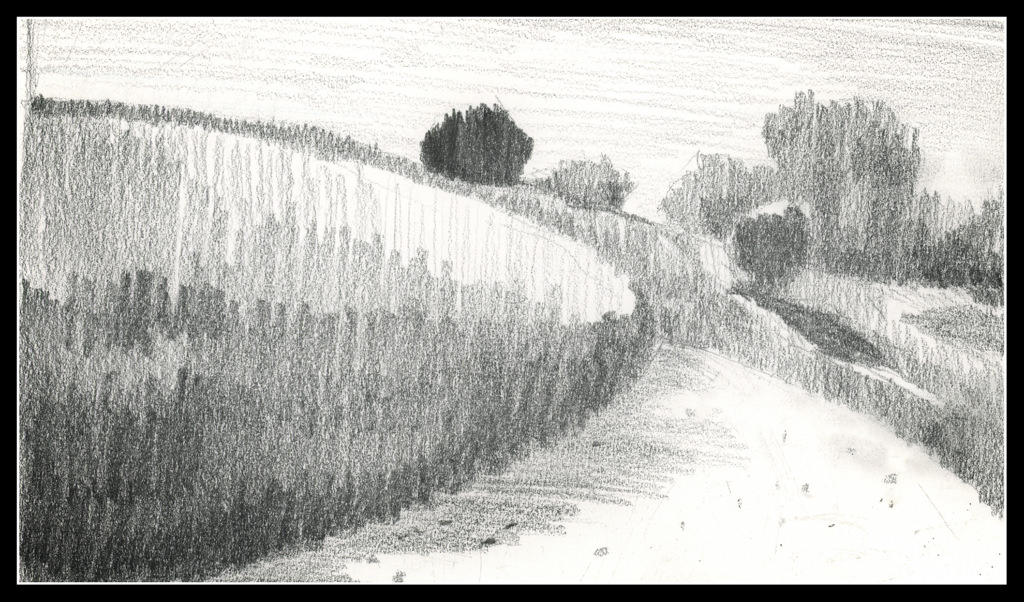
Day 16

This is a view upward to the hill at the center of the local botanical garden. The white swath in the right foreground is the sand trail which winds around downward (behind the viewer) into the riparian woodland below.

I am not quite sure if I like the values as I have them set up here – nor am I really sure about the focal point of the drawing. It seems the dark tree at the top is too dark, but it could be a leading line down the hill to the tree with the cast shadow. The trail leads the eye. In a painting, this could work out with warm and cool tones in addition to values. Maybe I’ll give it a shot!

Commentary

With Day 13 I tried to make my masses more simple and graphic. I am continuing this, and will for the rest of the 30 day challenge.

Some studies lend themselves to it more readily than others. Despite that, I tried to simplify in all three. Doing this makes Roberts’ admonition to “draw shapes, not things” easier to do. Distilling the more important – most important – into value masses seems to be happening (at long last!).

Again, it will be interesting to see where it works with painting.

The Hill

More browsing through history! Today, a trip back to the spring of 2017, a hike on a pathway behind the local botanical garden. Obviously there was some rain that year as there are green plants!

One thing I really enjoy doing is making panoramas out of a whole series of images. Sometimes I fail to get enough to create a good study, and that is where Photoshop comes in. I did a lot of filling in of empty spaces, and if you look closely you will see repetition of the cloud in the upper right corner, and plants in the lower left corner. That is what happens when I hand hold my Nikon Df camera and a long lens – this was the Tokina 100 macro lens. I think I took about 50+ photos here. I like to use a macro lens for panos because of the sharpness that is inherent in such lenses.

Altogether, I like what I did in post here. The coloration and composition are pleasant and summery. I also think it is a photo worth using as the basis for a landscape.

Royal Poinciana Tree

Another tribute to The Highwaymen of Florida.

The Royal Poinciana Tree is native to Madagascar, but because of its vibrant red flowers, it has been transplanted throughout the world. It prefers temperate to semi-tropical climates, so the heat and cold of where I live make it an unlikely candidate. However, we do enjoy the vibrant purple jacaranda tree!

That said, I gessoed Arches 140# CP paper and used acrylic paint this time. I spent hours on this painting, and attempted to do a rather more primitive approach, working for a type of simplicity I seldom employ. Not having painted for some time in acrylics, I needed to work at it. One thing I did do was not the default dabbing I seem to gravitate toward with acrylic. I saved that for the flowers and leaves, in the tree and on the ground.

I am so tired I have no idea if this is a “good” or “bad” or “mediocre” painting – but does it matter? This painting took a lot out of me. The scan, too, is poor – the colors are too extreme – the reds and oranges and greens dominating. Adjustments are not really successful in LR. So, here I think we are limited by the software and its interpretation of such colors in the scan. Still, it’s here for your perusal . . .

Wetlands

Another wet-into-wet painting, but this time with more challenges and a longer painting period. As before, 140# Arches CP paper.

The goal of this painting was to get away from trees and aim for seeing how using a very wet piece of paper could be worked for skies and water along with plant life, from rushes and grasses to distant trees. The style itself lends itself more to softness in general, but with judicious brushwork and glazes, more defined areas were achieved. I also used white gouache to represent a tasseled top to the tall reeds (or whatever) in the middle right of the painting; I realized I might have achieved an airier effect by splattering some frisket in the areas I wanted white.

I painted the majority of the picture last night, working glazes over areas more defined to blend them in more harmoniously. Dry brush was used for the the foreground and in areas where a rough edge was needed to show plants.

I don’t think this painting is as good as the one I did previously. The contrast is not good enough to convey distance – too strong of colors were used to paint the reeds and trees in the horizon. I do like the colors and softness, though. Another point of focus was to create a point of focus! I tried to use birds, warm colors in the center of the painting, a bit of a vignette around the edges, and other visual tricks to lead the eye somewhere. Again, I don’t think I had much success. As well, the sky and land do not seem to match.

I did accomplish a few things I set out to do – wet-into-wet with some control for sky and plants and water. Doing it is a lesson in itself, and each painting teaches something. I worked on the painting last night and then refined it this morning. I had more patience than I usually demonstrate when painting in watercolor. Why is that? Is it because watercolor is wet and watery and seems to demand a bit of speed?

Anyway, more to come, more to learn.