Spring Comes to the High Plains

I have to admit, I am on a winter kick.  Cold, chill.  And loneliness.  I don’t tend to paint or photograph people or civilization, but as far as painting goes, I need to get into painting them.  I’m doing okay with moving inland water.  But buildings, people, and oceans leave me baffled for now.

So, the open spaces of the flatlands between mountain ranges.  Harsh weather, blasted heaths, winter and wild weather. The hint of spring.

Dappled Light

More work with water and light.  Here I thought about some of the exercises I have followed from Rick Surowicz’s YouTube channel – lines, curves, and dots to capture branches, light, and leaves.  I think this painting worked out quite nicely.

Besides considering what I wanted in advance (a way of thinking that has taken a very long time to get to) by applying frisket, I also was determined to paint from light to dark and use glazing and blending.  Areas of color were also considered, and rather than trying to paint each leaf, I painted blobs of color to represent the foliage.  As a result, I built up layers of color throughout the painting as I moved along, and can say this is possibly the first painting in which I have done this.

I also had to be very patient!  Frisket is not happy when you blow dry it – it gets all sticky and you have let it set up again. As a result, this 6×9 painting probably took a couple of hours to do.  However, the results, for me, were definitely worth the time it took.  Perhaps my impatience is lessening . . .

Winter Sunset

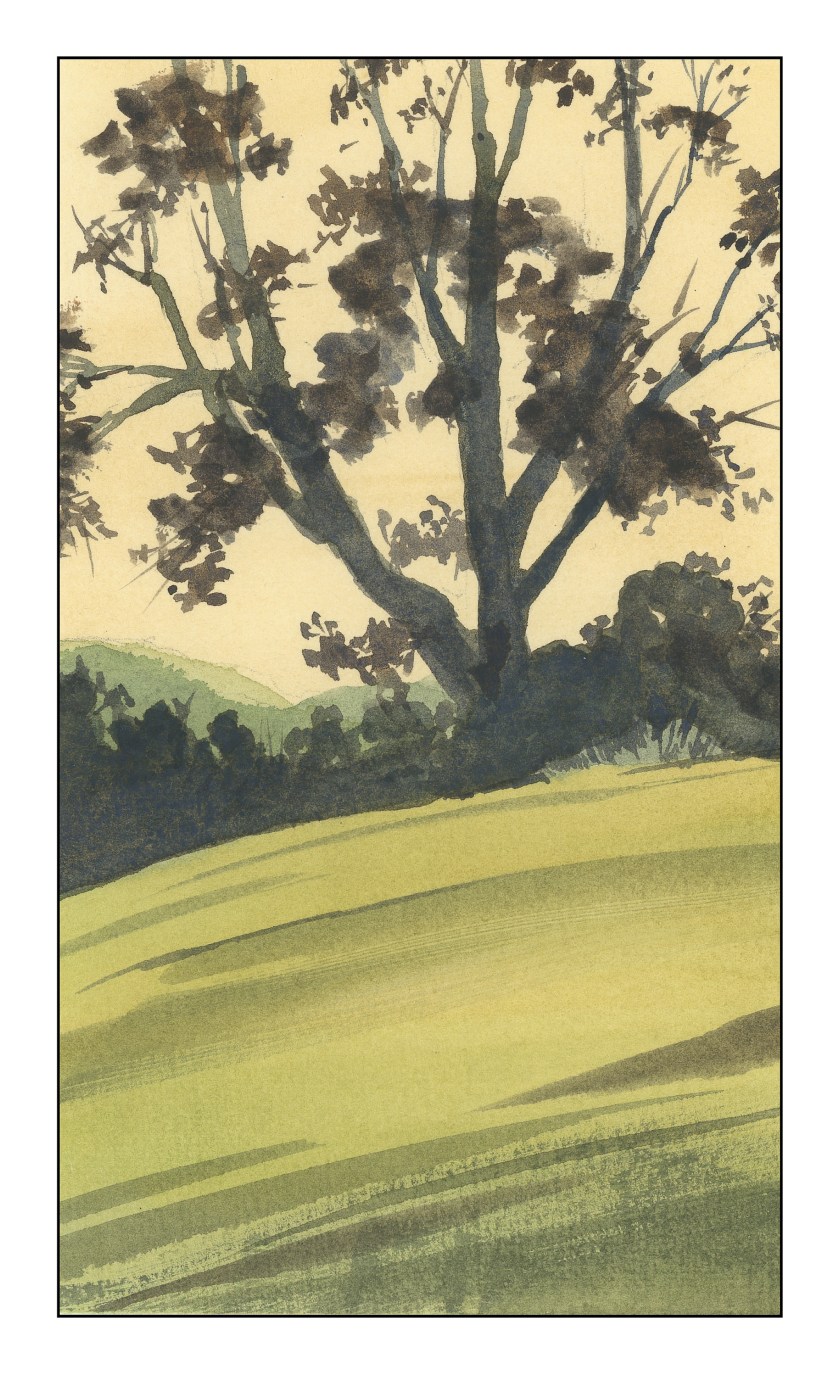
I took this picture awhile back in the local botanical garden.  It is an oak against the sky, with the Santa Monica range in the distance.  In the photo, the tree is silhouetted against a yellow sky, and the foreground is mottled with dried grasses.  The California oak is not deciduous, but shows leaves year round.

The process here is along the lines of yesterday’s post, and is more successful I think.  It is very simple.  The steps I took began with a wash on the entire paper (8×10) in raw sienna.  The mountains on the left were done next using a bit of sap green with the raw sienna, followed by some cobalt blue for the darker range.  After that, the lower half of the painting had a wash of a greenish color, later followed with a darker green of sap green and cobalt blue.  The tree and brush in the center were of burnt sienna and cobalt, with perhaps a bit of ultramarine as well.

That’s it.  Fairly successful in moving from light to dark, general to specific.  The simplicity of the subject matter makes it an easy painting to do – yesterday’s fig tree through the window was more complex, and accordingly more difficult.  I really wonder if I will ever successfully paint complex scenes, such as a forest and creek or a city street filled with cars, people, buildings, and whatever – rather daunting, actually.