California Coastal Cypress

Stuck at home for the most part because of my ankle, I need to find things to do. It turns out that my ankle, while a mess of historical injuries, has no tears in the soft tissues. That is good. However, my heel bone has “microfractures” from the hard landing dodging the car last month. This is a bone bruise, and it is painful! I finally got into see the orthopedist, got a walking boot, and return in a month. The boot makes a big difference though it does take some getting used to wearing and using. I have to be careful not to pitch forward or backward. And you can hear me coming a mile away – squish, squeak, squish, squeak.

Of course, painting is the first choice! I am still tired intermittently from Covid, but I don’t have brain fog (at least I don’t think so), and look for things to enjoy but not be a source of frustration. Thus, ink and watercolor.
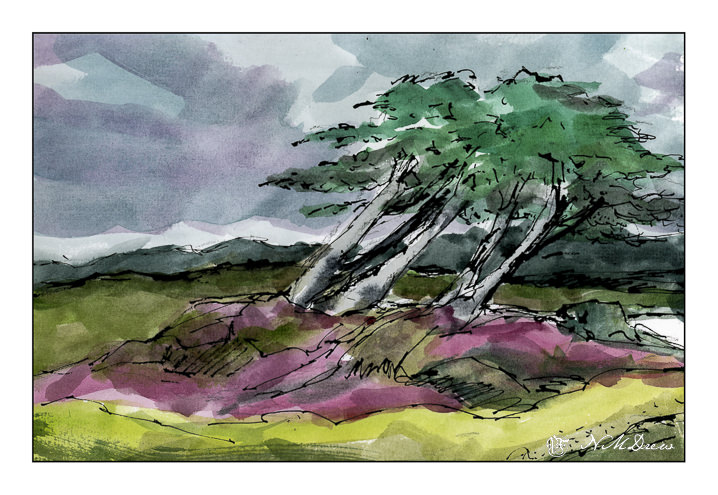
The Monterey Cypress is a tree that is common along the northern central coast of California. It is shaped by the environment as it moves with the wind and seems to grow away from the prevailing winds. To me, this quality is what makes it so beautiful and eye-catching. The coast is also subject to foggy days, damp and dreary, even in the height of summer.

Carbon ink, watercolor, Koi pan paints, about 8×10.
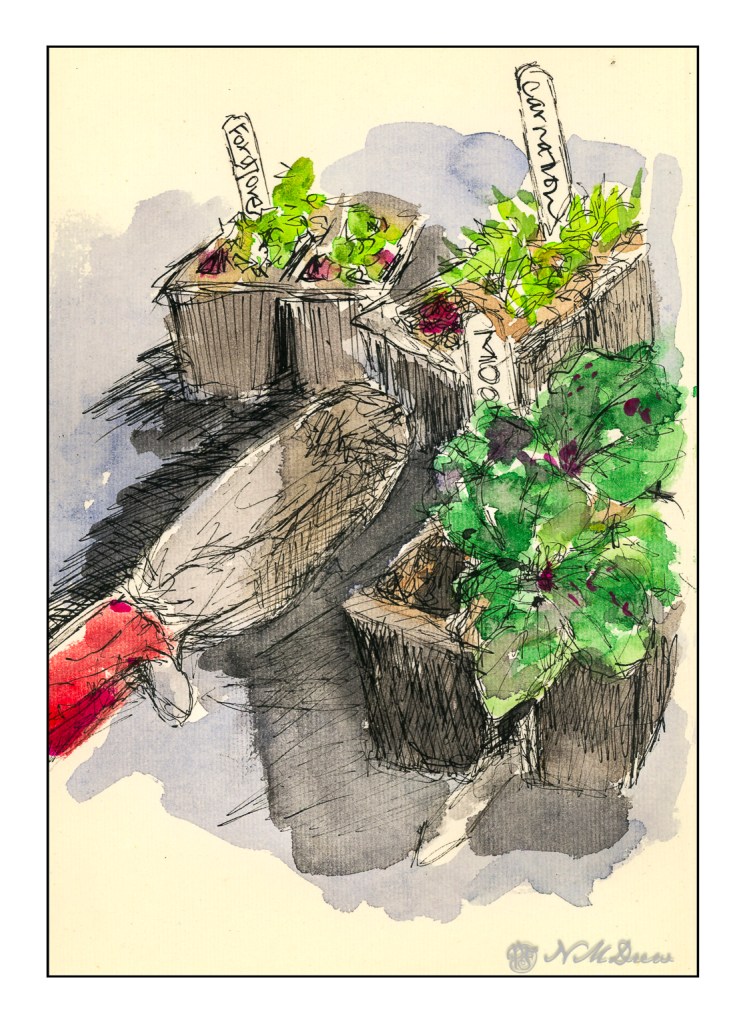
Waiting to be Planted

For the past several days I have had a lot of little gardening projects going on. I transplanted a number of seedlings into pots. I also started seeds. I have some seedlings I have sent on to a new home. This season I have vegetables already setting fruit, even it won’t mature for weeks, and seeds which are sprouting, and seeds I am waiting to sprout. Vegetables this year include winter (hard, yellow) squash, bush beans, radishes, lettuce, pepper of the hot variety, tomatoes, parsley and cilantro.

I also have a lot of flowers. These include hummingbird and butterfly mixes all thrown together in the front flower bed as well as foxglove, larkspur, polka dots (which I think are scabiosa or pincushion plants), carnations, nigella, Mexican sunflowers, Titan sunflowers (they can grow 12 feet tall with seed heads 24″ across!), and moonflowers. Herbs include the usual rosemary, sage, parsley, thyme, basil, but I have also added summer savory and a few Asian ones for variety. Mint and lemon balm and lemon verbena.

With all this work, there has been little time for sketching or painting. Thus I decided, much like my “Not Taken Vacation” that a sketchbook dedicated to this year’s gardening efforts would be fun to do. I have a fanfold Chinese calligraphy book I am using. It is a fanfold, so I can spread it out if I want to create a panorama, or use individual pages.

Above, just an individual page to get a sense of the paper. It is very soft and very absorbent, as well as a creamy color that is far from white, but not yellow. I figured my first foray into this documentation would be best served with a simple ink and watercolor drawing to see how the paper handled. Overall, I like it. The soft paper requires a bit more caution with the water, yet it does seem to handle it very well.

So, a few pony packs with seedling waiting for a home on my gardening table. My hand trowel is not well represented, but such is life! Meanwhile, I can enjoy the sweet smell of a freshly turned bit of earth and dream of flowers and garden produce.

Last Day of April – Morning Sketches

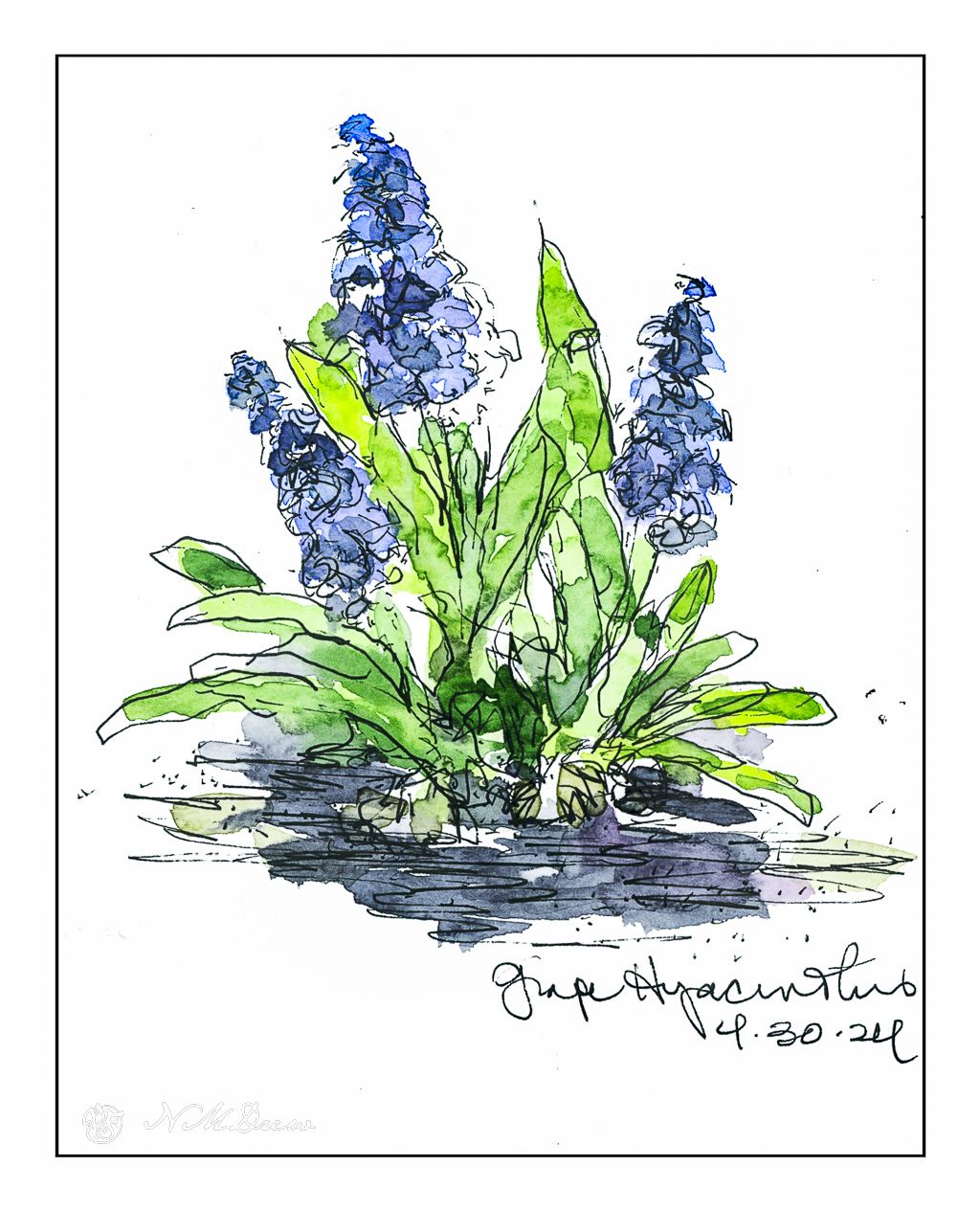
The last few days have been the quintessential spring days in Southern California – and I have been outside, but never enough. I planted some tomatoes and cleaned up some plants in the patio garden, basked in the sun, and have done very little. Today, though, pen and watercolor beckoned with the morning coffee, and the colors of spring and the outdoors called.

Grape hyacinths are so odd to me! I am used to the big ones, in pinks and blues and flower petals which curl outward. Grape hyacinths make me think of little bells. This is the first year I have ever grown them, and short-lived as they were, they were so much fun to see. Bulbs always make me happy, and I have a variety of them, such as iris, ixia, daffodils. Bulbs need to be hybridized for our warm California winters, so they are not so rare as they used to be, but never seem as exciting as they do when they flower in a patch of snow.

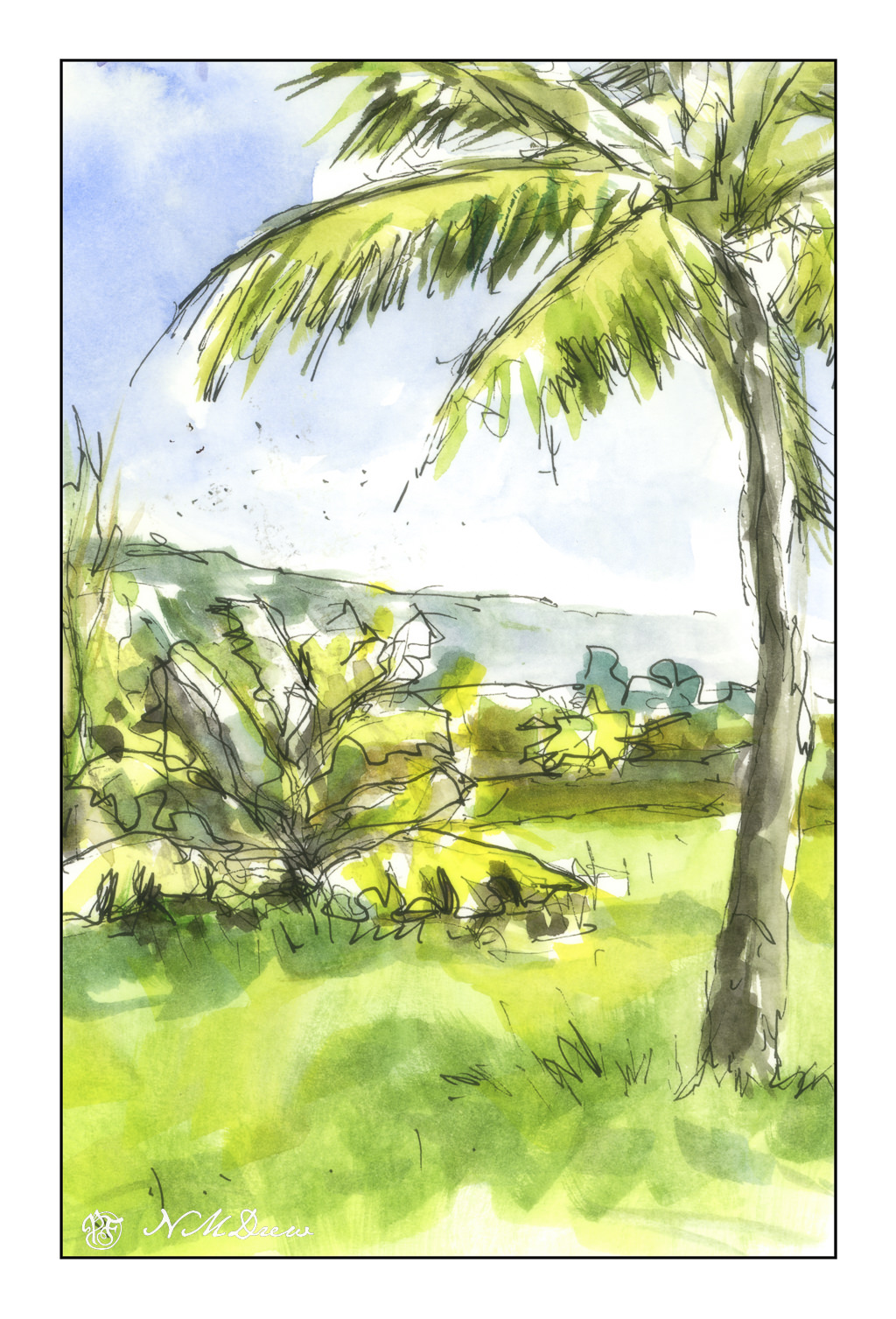
I was poring over some photos I have, taken by me or collected through Pixabay and other free online royalty sources. Palm trees and banana plants. I did this to practice dry brush on a wedge brush – nothing great but it accomplished what I wanted – a soft bit of blending, such as in the foreground.

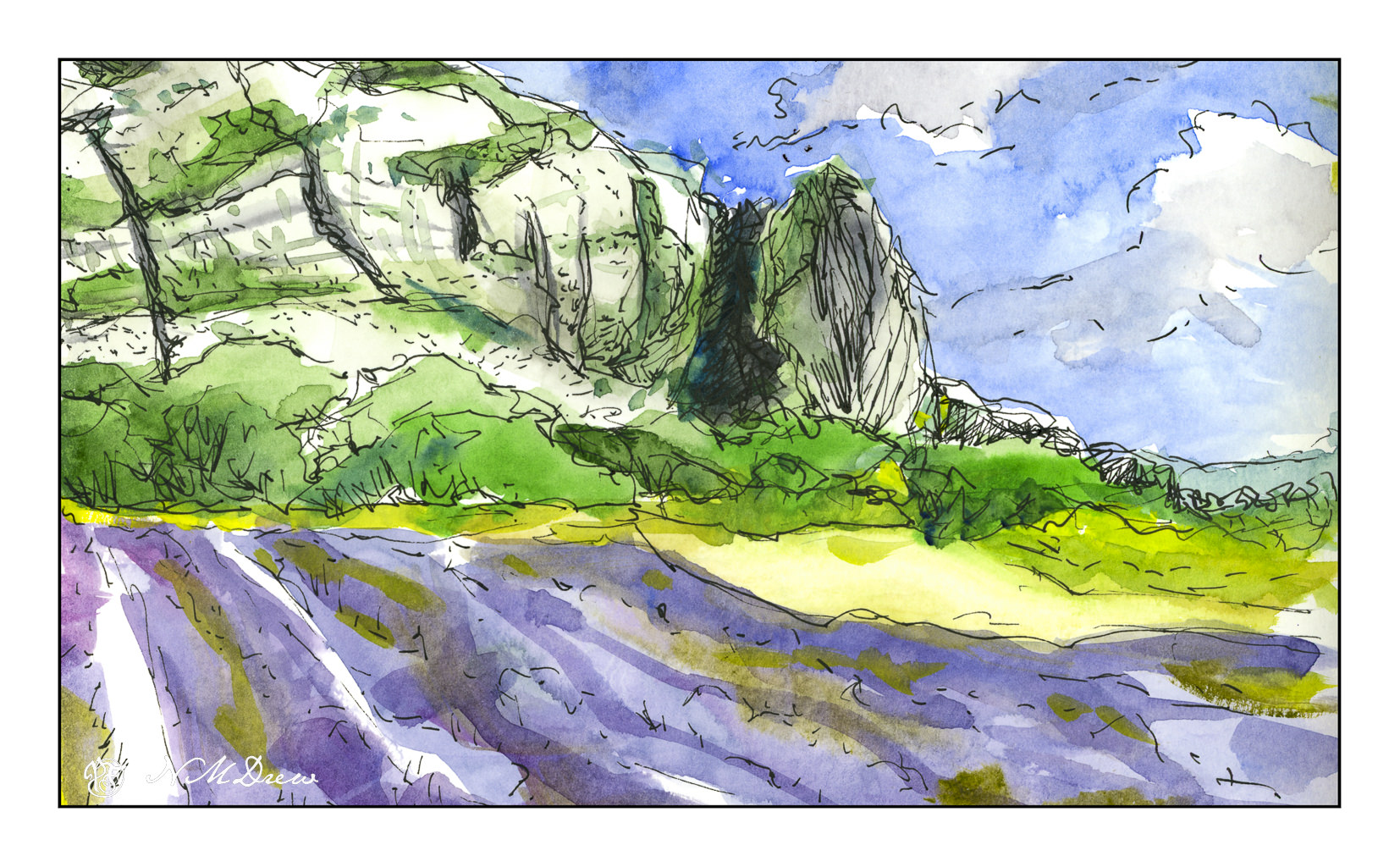
Once more lavender fields in Provence and other areas of southern France. In particular, mixing lavender that is bluish is a challenge; here, in watercolor, I diluted my purples with some blue and rose, as well as some greenish colors to suggest the lavender’s foliage. The scan didn’t do a great job. Additionally, I wanted to capture the texture in the rocky faces of the mountain, cracks vertically and horizontally in the bare stone.

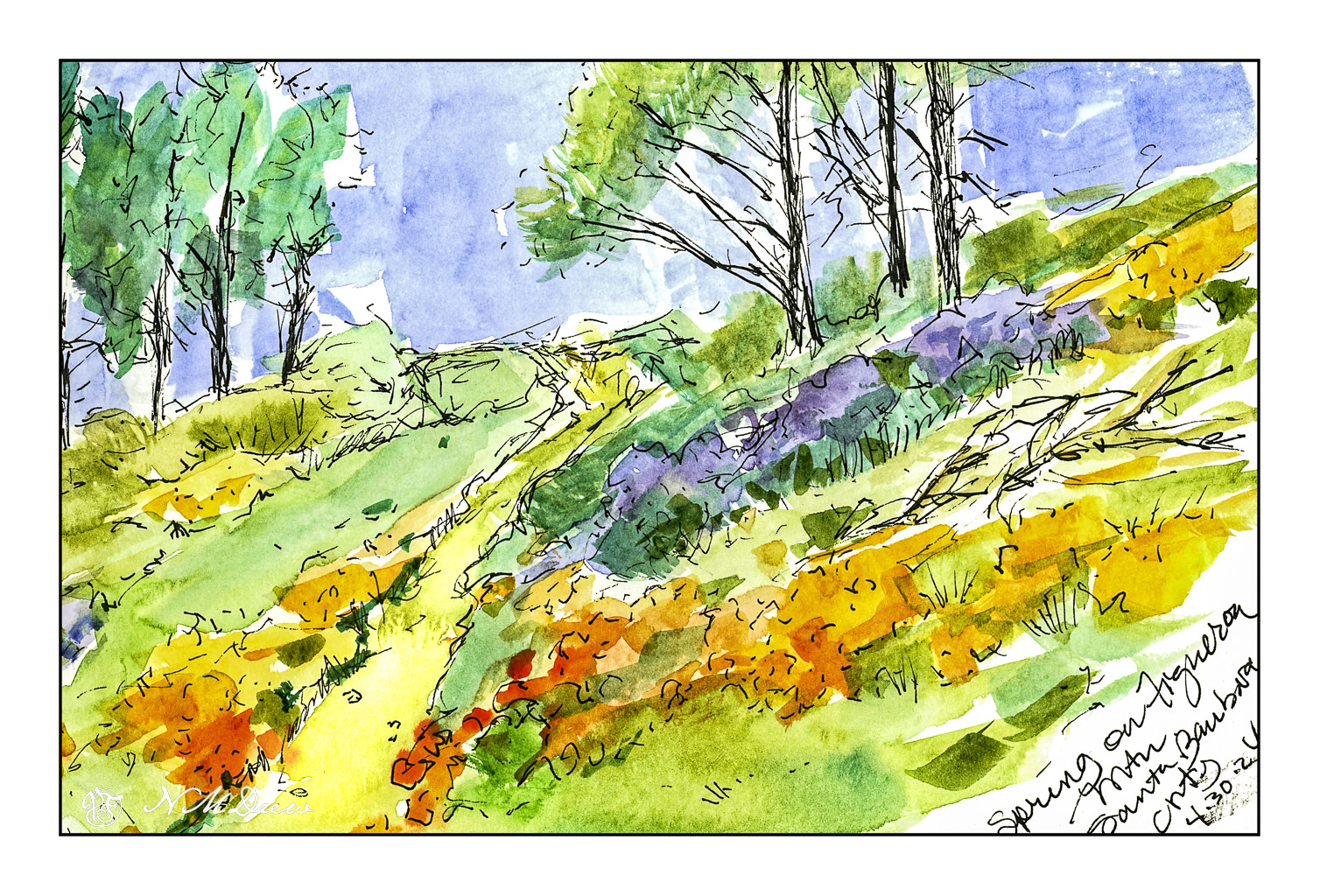
Finally, a favorite place of mine – Figueroa Mountain in Santa Barbara County. In the spring, lupines and poppies bloom, and the view across the Santa Ynez Valley extends for miles. To me, this is the epitome of a wonderful time of year in California. It is when the rains turn the hills from brown and dull to an intense display of yellow, gold, and purple.

Drawing with ink and watercolor is pleasant and relaxing, and doing it in a sketchbook takes away the desire to create a masterpiece. Here, exploration, play, practice.

Carbon ink on watercolor paper; Rosa pan watercolors.

The Not Taken Vacation: Frigiliana

Andalucia, a region in southern Spain, is well know for its beauty. “White villages” abound, and Frigiliana was voted by the Spanish Tourist Board as the “prettiest village in Andalucia” – so of course, in my imaginary road trip along the winding back roads, seated in my fab 1948 Alfa Romeo 6C 2500 Sport Cabriolet, we drove with reckless abandon to Frigiliana.

Winding roads, winding streets, winding walkways – all a far cry from the freeways of Southern California!

The Not Taken Vacation: Ronda, Spain

Located in the province of Malaga in southern Spain, Ronda is about 65 miles northwest of Malaga, Spain. It is a “white village” located in Andalusia – a vast region along the Mediterranean and inland – but it is more than just a “white village” as it is home to what I think is one of the most fascinating bits of architecture, the Puente Nuevo. We will explore that famous bridge later on, but for now, let us just enjoy the magnificent scenery of this lovely place.

Ronda has been settled since neolithic times, but the 6th century seems to be when itself became a more settled area. It is marked by cliffs and canyons, as you can see below, but it is also built up on either side of the Guadalevin river. As the countryside is steep, getting from one side of the river to the other is a bit problematic.

These buildings are on one side of the Puente Nuevo. They stand on steep cliffs. As someone without a head for heights, I am not so sure I would want to stand on a balcony and look down – but I think looking across would show some marvelous scenery. Also, coming from earthquake country with unstable soil, my thoughts are, oops! – why did they build there? However, I expect things are far more stable than they are in my neck of the woods as this is an area where a bridge spanning a canyon 400 feet deep and completed in 1793 still stands.

So much to see in the south of Spain! To be continued!